Expert Opinion Letter vs. Recommendation Letter
If you are preparing an EB-2 NIW, EB-1, H-1B, or O-1 petition, two types of supporting letters will shape how USCIS evaluates your case: expert opinion letters and recommendation letters. Most applicants — and even some attorneys — treat them as interchangeable. They are not. Submitting the wrong type, or using either type incorrectly, is one of the most common and avoidable causes of RFEs and denials.
This guide explains exactly what each letter is, how USCIS weighs them differently, what goes inside a case-winning letter, how many you need, and who should write them. Whether you are filing a first petition or responding to an RFE, what follows gives you a clear framework.
The Core Distinction: What Each Letter Actually Does
The fastest way to understand the difference is this:
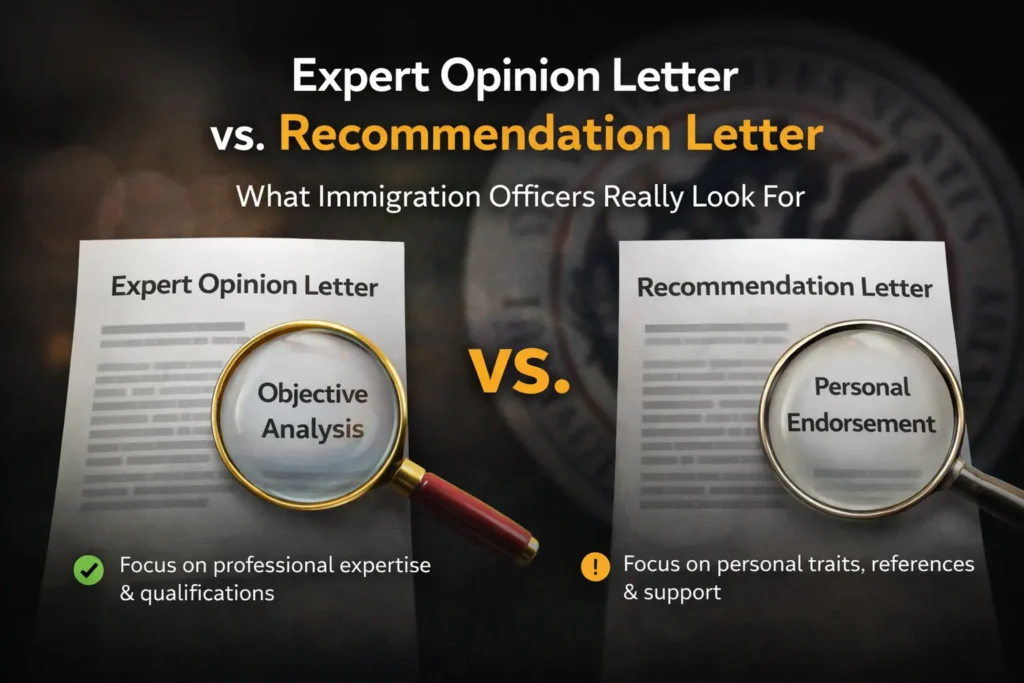
- A recommendation letter answers the question: “Who is this person and what have they accomplished in your direct experience?”
- An expert opinion letter answers the question: “Why does this person’s work matter — objectively, and at a national or field-wide level?”
Both are valuable. But they carry different evidentiary weight with USCIS, serve different prongs of the legal standard, and must be written by different kinds of people.
Recommendation letters come from people who have worked directly with the applicant — supervisors, collaborators, colleagues, or academic advisors. They are rooted in personal knowledge. They speak to character, professional conduct, and firsthand observations of the applicant’s contributions.
Expert opinion letters come from recognized authorities who may have never met the applicant at all. They review the applicant’s body of work — publications, patents, project outcomes, citations, industry impact — and provide an independent, scholarly assessment of whether those achievements qualify the applicant under the specific legal standard being petitioned.
✅ Key point: The most common petition mistake is submitting five letters from close collaborators and calling them “expert opinions.” USCIS adjudicators are trained to identify this. When letters that are framed as independent expert assessments are actually written by co-workers, supervisors, or lab partners, the entire letter package can be discredited — including the letters that were genuinely independent.
The Matter of Dhanasar Test and Why It Determines Which Letter You Need
For EB-2 NIW petitions, USCIS applies the three-prong framework established in Matter of Dhanasar (AAO 2016). Understanding which letter type addresses which prong is critical for building a coherent evidentiary strategy.
Prong 1 — Substantial Merit and National Importance The applicant’s proposed endeavor must have substantial merit and be of national importance. This prong is best addressed by an expert opinion letter from an independent authority who can explain — in plain terms that a non-specialist USCIS officer can evaluate — why the work matters beyond the applicant’s immediate field or institution.
Prong 2 — Well Positioned to Advance the Endeavor The applicant must demonstrate they are specifically qualified to carry out their proposed work. This prong can be supported by both types: recommendation letters from those with firsthand knowledge of the applicant’s capabilities, combined with expert opinion letters that objectively validate the applicant’s track record. A January 2025 USCIS policy clarification explicitly noted that prong 2 benefits from letters showing “first-hand knowledge of the person’s achievements” — making genuine recommendation letters more relevant here than many attorneys previously assumed.
Prong 3 — National Interest Waiver Justification The United States must benefit more from waiving the job offer requirement than from enforcing it. Expert opinion letters are particularly powerful here, since an independent authority can explain why the applicant’s work is not easily replicated by U.S. workers and why a labor market test would underserve the national interest.
???? Practical implication: If your petition only has recommendation letters from direct colleagues, you may be well-covered on Prong 2 but weak on Prongs 1 and 3. That is precisely why USCIS issues RFEs requesting independent expert-level analysis — and why a balanced letter strategy requires both types.
Which Visa Categories Require Each Letter Type
EB-2 NIW (National Interest Waiver)
Both letter types are used, but serve different purposes as described above. A minimum of 5–7 letters is recommended, with the majority from independent outer-circle experts. See AAE’s EB-2 NIW Expert Opinion Letters and EB-2 NIW Recommendation Letters.
EB-1A (Extraordinary Ability)
EB-1A petitions require evidence across multiple criteria — awards, memberships, published material, judging, original contributions, critical roles, and high salary. Expert opinion letters here explain the field-level significance of the applicant’s achievements to USCIS officers who are not specialists. Recommendation letters provide firsthand testimony of extraordinary contributions. See EB-1 Expert Opinion Letters and EB-1A Recommendation Letters.
H-1B (Specialty Occupation)
For H-1B petitions — particularly when responding to an RFE — expert opinion letters serve two distinct functions: (1) a position evaluation letter that confirms the job qualifies as a specialty occupation, and (2) a beneficiary qualification letter that confirms the worker’s background meets the specialty occupation requirements. These can be delivered as a combined letter. See H-1B Expert Opinion Letters.
O-1A (Extraordinary Ability in Sciences, Business, Education, Athletics)
O-1 petitions require letters from peers, colleagues, or professional associations that speak to sustained national or international acclaim. For O-1A, a well-structured expert advisory letter from an independent authority — explaining why the applicant belongs in the top tier of their field — significantly strengthens the case. See O-1 Expert and Advisory Letters and O-1 Recommendation Letters.
L-1A / L-1B (Intracompany Transferee)
Expert opinion letters for L-1 petitions establish that the transferee holds managerial or executive capacity (L-1A) or specialized knowledge (L-1B). These letters explain the organizational structure and the employee’s role within it in terms USCIS can evaluate. See L-1A and L-1B Expert Opinion Letters.
How USCIS Evaluates These Letters — and What Triggers RFEs
USCIS adjudicators reviewing employment-based petitions are generalists, not specialists. An officer evaluating a software engineer’s EB-2 NIW petition may have no background in computer science. An officer reviewing an oncologist’s O-1A petition may have no medical training. Their job is to evaluate the evidence presented, not draw on their own expertise.
This is exactly why expert opinion letters matter so much: a well-written letter translates complex, technical achievements into plain-language arguments that directly address the legal criteria. When letters are vague, generic, or written purely in technical jargon without connecting the work to visa requirements, adjudicators cannot do their job — and they issue RFEs.
RFEs are most commonly triggered when:
- All supporting letters are from close collaborators, creating an appearance of coordinated bias
- Letters praise the applicant personally but do not address the significance of their work to the field
- Expert letters lack the author’s CV or credentials, making it impossible for USCIS to assess the writer’s authority
- Letters read identically or share similar phrasing — a signal that they were written from a template
- No letter directly addresses the specific Dhanasar prongs (for NIW) or extraordinary ability criteria (for EB-1A/O-1)
- The author’s field of expertise does not clearly align with the applicant’s area of work
⚠️ If you have already received an RFE: Never reuse letters submitted in your original petition for the RFE response. USCIS has already seen those letters and found them insufficient. A targeted, new expert opinion letter written specifically to address the concerns identified in the RFE is the single most effective document in an RFE response package.
Inner Circle vs. Outer Circle: Why It Matters More Than You Think
One of the most practical frameworks for building your letter strategy is the inner circle / outer circle distinction, and it directly affects how much weight USCIS assigns to each letter.
Inner circle letters come from people who have worked with you directly — your supervisor, PhD advisor, research collaborators, co-authors, or colleagues at your current employer. These people have firsthand knowledge of your work and can speak to specific contributions, day-to-day capabilities, and professional conduct. They are valuable for establishing the factual record of your achievements.
The limitation: USCIS treats them as potentially biased. An adjudicator reading a glowing letter from your direct supervisor will discount it — not because the content is false, but because the author has a relationship with you that could motivate flattery over accuracy.
Outer circle letters come from recognized experts who know your work, but not you personally. They may know you through your published research, a patent your team filed, a project that became industry standard, or a citation in their own work. Because they have no personal or professional stake in your immigration outcome, their assessment carries substantially more evidentiary weight.
The ideal outer circle writer:
- Holds an advanced degree or executive position in your field
- Is affiliated with a research university, government body, or recognized professional institution
- Has no co-authorship, employment relationship, or personal connection with the applicant
- Can speak specifically to the national importance or field-level impact of the applicant’s work — not just describe it
✅ Recommended balance for EB-2 NIW: 3–4 outer circle independent expert letters (60–70% of total) + 1–3 inner circle recommendation letters (30–40% of total). Quality always outweighs quantity — three detailed, specific, independently written letters beat seven generic ones.
What a Case-Winning Expert Opinion Letter Contains
A strong expert opinion letter is typically 3 to 5 pages long and follows this structure:
Opening: Scope and Purpose A clear statement of what the letter will assess and the expert’s basis for rendering an opinion. Not: “I am writing to support this application.” Instead: “This letter provides an independent evaluation of [applicant]’s contributions to [field], specifically as they relate to [visa criteria].”
Expert Credentials The author’s current position, institutional affiliation, academic degrees, publications, awards, and professional recognitions — establishing why this person is qualified to render an expert opinion. A CV or resume is typically attached.
How the Expert Knows the Applicant’s Work A clear explanation of the basis for the expert’s knowledge — citing specific publications, projects, or field-wide impact the expert has independently observed. This section establishes the writer as an outer-circle evaluator, not an inner-circle colleague.
Substantive Analysis of Qualifications The core of the letter. This section addresses the specific visa criteria — for EB-2 NIW, all three Dhanasar prongs; for EB-1A, the specific extraordinary ability criteria the applicant claims. The analysis should:
- Reference specific, named accomplishments (not generalities)
- Include quantifiable metrics where available (citations, h-index, project scale, revenue impact, lives affected)
- Connect the work to U.S. national interest or international acclaim in concrete terms
- Use clear, non-technical language that a non-specialist can follow
Conclusion and Opinion
A direct, confident statement of the expert’s conclusion — that the applicant meets the relevant visa standard — and why. This should not be hedged or conditional.
What a Strong Recommendation Letter Contains
While expert opinion letters focus on objective field-level analysis, recommendation letters fill a different evidentiary role: establishing the person behind the accomplishments.
A strong recommendation letter for immigration purposes is not the same as a graduate school recommendation. It is not primarily about personal qualities or academic promise. It is evidence of specific, named contributions that the writer has personally witnessed.
The key elements:
- Specific examples — Two or three concrete instances of the applicant’s work, described in detail. Not “she was an excellent researcher” — but “she led the redesign of our data pipeline that reduced processing time by 40% and was subsequently adopted by three other teams.”
- The writer’s own perspective — What did the writer observe that others would not have seen? What did the applicant contribute that the writer can uniquely attest to?
- Influence on the field — Even a close colleague can speak to wider impact, if they do so with specificity: “His approach to X was published in [journal] and has since been cited 47 times.”
- A clear endorsement — The letter should close with an unambiguous statement of support and the writer’s confidence in the applicant’s ability to contribute to the United States.
???? 2025 USCIS policy update: A January 2025 USCIS policy clarification reinforced that letters supporting Prong 2 (well-positioned to advance the endeavor) benefit from first-hand knowledge of the applicant’s achievements. This makes well-structured inner circle letters more strategically valuable than some practitioners had previously assumed — when written with specificity and focused on demonstrated accomplishments rather than personal praise.
How Many Letters Do You Need — and Who Should Write Them?
| Visa Type | Recommended Total | Outer Circle | Inner Circle |
|---|---|---|---|
| EB-2 NIW | 5–7 | 3–4 (60–70%) | 1–3 (30–40%) |
| EB-1A | 5–7 | 3–4 | 1–3 |
| O-1A / O-1B | 3–4 | 2–3 | 1 |
| EB-1B | 3–4 | 2–3 | 1–2 |
| H-1B (RFE) | 1–2 expert opinion letters | N/A (position + beneficiary analysis) | N/A |
Who qualifies as an outer circle expert?
- University professors, associate professors, or research scientists with recognized expertise in your field
- Senior executives or technical leaders at companies not affiliated with your employer
- Government researchers, policy experts, or agency professionals with relevant subject matter authority
- Independent professionals recognized through publications, patents, or awards in your discipline
Who does NOT qualify as an outer circle expert (regardless of title)?
- Your current employer or any affiliated organization
- Co-authors, research collaborators, or anyone named in your own publications
- Former academic advisors who supervised your degree
- Anyone who was involved in projects or work you are using as evidence
Common Mistakes That Get Letters Dismissed by USCIS
Template letters. USCIS officers review hundreds of petitions. When three letters submitted by the same applicant use the same sentence structure, opening lines, or paragraph organization, adjudicators flag all of them as non-credible — including the ones that were genuinely written by independent experts.
Generic praise without specifics. “Dr. X is one of the most brilliant researchers I have encountered” is not evidence. “Dr. X’s work on [specific project] directly contributed to [specific measurable outcome]” is evidence.
Unverifiable expert credentials. If an expert opinion letter does not include the author’s CV, full institutional affiliation, and contact details, USCIS cannot verify that the writer is who they say they are. The letter will be discounted.
Letters that address the wrong criteria. An EB-2 NIW expert letter that focuses on academic credentials but does not address national importance does not help. An O-1 letter that describes day-to-day job performance but does not reference international acclaim does not help. Every letter must be tailored to the specific legal standard.
Reusing original petition letters for RFE responses. USCIS has already reviewed those letters and found them insufficient. New letters, specifically addressing the concerns raised in the RFE, are required.
Expert whose field doesn’t match. A professor of mechanical engineering writing an expert opinion letter for a biotech applicant’s EB-2 NIW will raise credibility questions. The expert’s stated specialty must align with the applicant’s field.
Side-by-Side Comparison Table
| Expert Opinion Letter | Recommendation Letter | |
|---|---|---|
| Primary Purpose | Independent, objective evaluation of qualifications against visa criteria | Personal testimony of achievements from direct professional experience |
| Author Profile | Recognized authority with no personal connection to applicant | Supervisor, colleague, collaborator, or academic advisor |
| USCIS Weight | Higher — objective, independent, no conflict of interest | Moderate — valuable but viewed as potentially biased |
| Dhanasar Prongs (NIW) | Primarily Prongs 1 and 3; supports Prong 2 | Primarily Prong 2 |
| Content Focus | Field-level impact, national importance, criteria analysis, quantified achievements | Direct observations, specific contributions, professional relationship context |
| Length | 3–5 pages with attached CV | 1–3 pages |
| Key Risk | Discounted if author has undisclosed connection to applicant | Discounted if too generic, too praiseworthy, or template-based |
| Recommended Quantity (EB-2 NIW) | 3–4 (majority of 5–7 total) | 1–3 (minority of 5–7 total) |
| Applicable Visas | EB-2 NIW, EB-1A, H-1B, O-1A, L-1 | EB-2 NIW, EB-1A, O-1 |
How AAE Evaluations Can Help
At AAE Evaluations, we specialize in preparing both expert opinion letters and recommendation letters that are written to USCIS adjudication standards — not generic templates, not repurposed academic endorsements, but case-specific documents built around the precise legal criteria your petition must satisfy.
Our letters are prepared by subject matter experts and academic professionals with relevant credentials in your field. Every letter is individually researched and written for your specific case — because USCIS can tell the difference.
We support immigration attorneys and individual applicants across all major employment-based visa categories:
- EB-2 NIW Expert Opinion Letters — $675 | 6 business days
- EB-2 NIW Recommendation Letters — $550 | 6 business days
- EB-1 Expert Opinion Letters — $675 | 6 business days
- EB-1A Recommendation Letters — $550 | 6 business days
- H-1B Expert Opinion Letters — $495 | 5 business days
- O-1 Expert and Advisory Letters — $675 | 6 business days
- O-1 Recommendation Letters — $550 | 6 business days
- L-1A and L-1B Expert Opinion Letters — $675 | 6 business days
See our full Pricing Page for a complete list of services and fees.
Working with an attorney? We coordinate directly with immigration law firms. Our reports are formatted and structured to integrate into attorney-prepared petition packages. Contact us to discuss your firm’s needs or get started on a case.
Frequently Asked Questions
Can I apply for EB-2 NIW without recommendation letters?
Technically yes, but very few petitions succeed without them. Even applicants with strong publication records, patents, or professional recognitions need letters to contextualize those achievements for a non-specialist adjudicator. The practical answer for most applicants is no — you need letters, and you need the right mix of both types.
How is an expert opinion letter different from a credential evaluation?
A credential evaluation compares your foreign academic degree to a U.S. degree equivalent. An expert opinion letter goes further: it evaluates the significance of your professional work and qualifications against specific visa criteria. They serve different purposes and are often both required in the same petition.
Should I get one letter that covers everything, or multiple focused letters?
Multiple focused letters are almost always stronger. A single letter trying to cover all three Dhanasar prongs, the applicant’s credentials, and the national interest argument will either be too long and unfocused, or too shallow. Better practice: assign each letter a primary purpose and author it accordingly.
What if I can’t find outer circle experts willing to write for me?
This is a common challenge, particularly for early-career professionals. Working with a service like AAE Evaluations provides access to a network of qualified academic experts across disciplines who can evaluate your work objectively — without requiring a pre-existing personal relationship.
Does the 2025 USCIS policy update change the strategy?
The January 2025 clarification reinforces the importance of first-hand knowledge for Prong 2 letters — which means well-structured inner circle recommendation letters now carry more weight for that specific prong than previously assumed. It does not diminish the value of independent expert opinion letters for Prongs 1 and 3. The practical takeaway: don’t choose one type over the other. Use both, for the right prongs.
How long should an expert opinion letter be for USCIS?
A well-prepared expert opinion letter is typically 3 to 5 pages in length, not including the expert’s attached CV. Letters shorter than 2 pages rarely provide enough analysis to be persuasive. Letters over 6 pages can dilute the key arguments. Focused, well-organized letters outperform exhaustive but unfocused ones.
Can the same expert write both an opinion letter and a recommendation letter?
No. The entire evidentiary value of an expert opinion letter rests on the author’s independence from the applicant. If the same person writes both types of letters for your case, it undermines the credibility of both. Each letter type must come from the appropriate category of writer.
The Bottom Line
The difference between approval and an RFE — or between an RFE response that works and one that doesn’t — often comes down to how well the supporting letters are built. Not how many. Not how enthusiastic. How well they are matched to the right legal standard, written by the right person, and structured to give a non-specialist USCIS adjudicator everything they need to rule in your favor.
Expert opinion letters and recommendation letters do different jobs. Use both. Use them correctly. And if you want to make sure they are written to the standard that gives your petition the best possible outcome, AAE Evaluations is ready to help.
Related reading: