Hiring skilled international professionals has become an essential strategy for many companies in the United States. Through the H‑1B visa program, employers can recruit talented workers in fields such as technology, engineering, finance, healthcare, and research. However, obtaining an H1B visa involves meeting strict eligibility requirements, particularly regarding education.
One critical step that many applicants overlook is credential evaluation. When an applicant has completed their education outside the United States, immigration authorities must verify whether that education is equivalent to a U.S. degree. This verification is performed through a professional education evaluation h1b report.
Credential evaluation helps bridge the gap between global education systems and U.S. academic standards. Without it, even highly qualified professionals may face delays, requests for evidence, or rejection of their visa petition. Understanding how this process works—and why it matters—can significantly improve your chances of a successful H1B application.
Introduction to Credential Evaluation for H1B
International professionals often come from education systems that differ significantly from those in the United States. While many foreign degrees provide excellent training, immigration officers must determine how those credentials align with U.S. academic requirements.
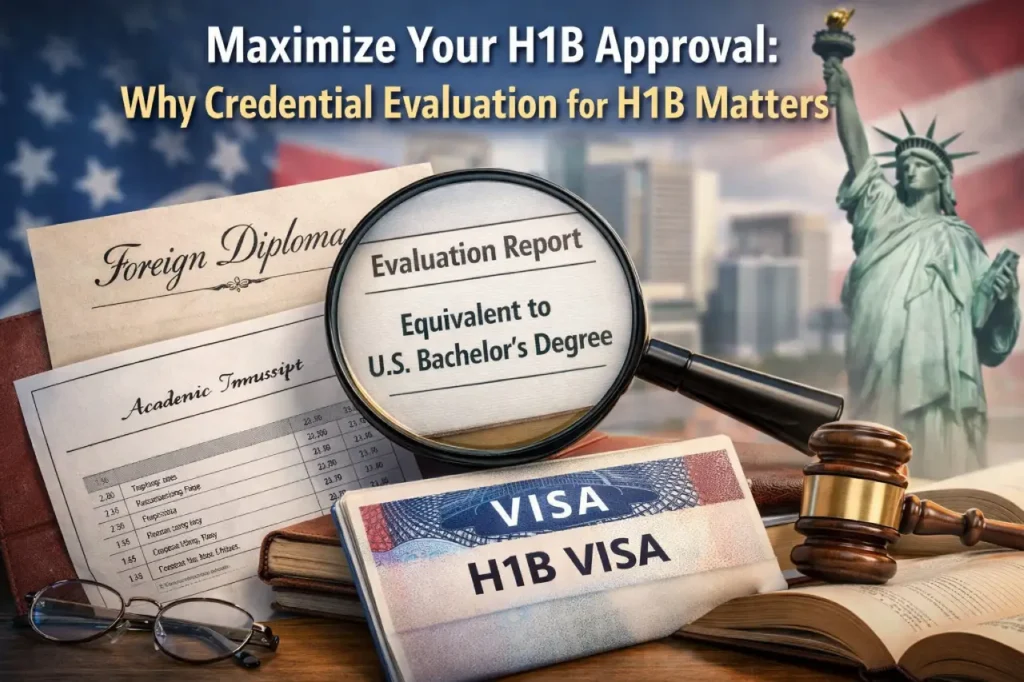
A professional education evaluation h1b report is used to compare foreign academic qualifications with U.S. educational standards. The evaluation analyzes transcripts, degree certificates, course duration, and institutional recognition. Based on this analysis, the evaluator determines whether the applicant’s education is equivalent to a U.S. bachelor’s degree or higher.
For most H1B applicants, the minimum educational requirement is a U.S. bachelor’s degree in a field related to the offered job. If the applicant studied abroad, immigration authorities rely on credential evaluation to verify this requirement.
In other words, the evaluation acts as a translation between international academic systems and U.S. education standards.
Understanding the Role of Education Evaluation in H1B Applications
The education evaluation h1b process plays a vital role in helping immigration authorities assess whether an applicant meets the academic qualifications required for a specialty occupation.
The H1B visa is designed for professionals whose roles require specialized knowledge and higher education. Examples include software developers, engineers, data analysts, architects, and financial specialists. To qualify for these roles, applicants must typically possess at least a bachelor’s degree or its equivalent.
Because academic structures vary worldwide, the evaluation process ensures that immigration officers can fairly interpret foreign credentials. For example, some countries offer three-year bachelor’s degrees, while others have integrated programs that combine undergraduate and graduate studies.
A credential evaluation carefully examines these differences and determines the closest U.S. equivalent. This allows immigration authorities to make consistent decisions regardless of where an applicant studied.
By providing a clear and structured academic comparison, the evaluation report becomes an important supporting document in an H1B petition.
When You Need an Education Evaluation for H1B
Not every applicant needs credential evaluation, but it is required in most cases involving international education.
If an applicant completed their degree outside the United States, immigration authorities typically request a professional education evaluation h1b report. This report confirms that the foreign degree meets the educational requirements for a specialty occupation under the H1B visa category.
Applicants who completed three-year bachelor’s programs often require evaluation to determine whether their education is equivalent to a four-year U.S. degree. Similarly, individuals with diplomas, professional certifications, or partial degrees may need evaluations that combine education with work experience.
Work experience can sometimes be used to supplement academic qualifications. Experienced evaluators analyze the applicant’s professional background to determine whether their combined education and experience meet the equivalent of a U.S. bachelor’s degree.
Obtaining an evaluation early in the visa process is recommended. Doing so ensures that employers and immigration attorneys have the documentation needed to prepare a strong H1B petition.
How Foreign Degrees Are Compared to U.S. Education
Credential evaluation agencies use a structured methodology to analyze international education systems. The goal is to determine how a foreign academic credential compares with U.S. standards.
The process usually begins with reviewing official transcripts and degree certificates. Evaluators analyze course content, program length, credit hours, grading systems, and institutional accreditation. They also review the recognition status of the issuing university within its home country.
Using established educational equivalency guidelines, the evaluator determines whether the applicant’s degree corresponds to a U.S. bachelor’s, master’s, or other academic qualification.
For example, a Bachelor of Technology degree from certain countries may be determined equivalent to a U.S. Bachelor of Science in Engineering. Similarly, a postgraduate diploma combined with relevant work experience may be considered equivalent to a bachelor’s degree.
This detailed comparison allows immigration officers to understand exactly how the applicant’s education fits within the U.S. academic framework.
Documents Required for H1B Credential Evaluation
To prepare an accurate education evaluation h1b report, applicants must provide clear and complete documentation of their academic background.
The most commonly required documents include degree certificates, official transcripts, and mark sheets issued by the educational institution. These documents provide details about course content, grades, and program duration.
Some evaluations may also require additional information, such as the applicant’s resume or employment verification letters. This is particularly important when work experience is used to supplement academic qualifications.
In certain cases, evaluators may verify institutional accreditation or request additional clarification about the program structure. Providing complete documentation at the beginning of the process helps ensure that the evaluation is completed efficiently and accurately.
Well-prepared documentation also reduces the likelihood of delays during the visa application process.
How Credential Evaluation Strengthens Your H1B Petition
A well-prepared evaluation report can significantly strengthen an H1B visa petition. Immigration officers rely on these reports to verify that applicants meet the educational requirements of the job being offered.
The education evaluation h1b report helps establish that the applicant’s academic background aligns with the specialty occupation requirement of the visa category. It also provides professional analysis explaining how foreign degrees correspond to U.S. educational standards.
In many cases, a detailed evaluation report can help prevent Requests for Evidence, commonly issued when immigration authorities require additional clarification about an applicant’s qualifications.
By presenting a clear and credible academic comparison, the evaluation supports the employer’s claim that the applicant is qualified for the position. This documentation becomes an important part of the overall visa petition.
Ultimately, the evaluation helps ensure that international professionals receive fair recognition for their educational achievements.
Common Mistakes Applicants Should Avoid
While credential evaluation is a straightforward process, applicants sometimes make mistakes that can slow down their H1B applications.
One of the most common issues is submitting incomplete or unclear academic documents. Missing transcripts or illegible scans can delay the evaluation process and create unnecessary complications.
Another mistake is choosing an evaluation service that lacks experience with immigration cases. Since H1B petitions require specific formatting and explanations, it is important to work with professionals who understand immigration documentation requirements.
Applicants also sometimes wait until the last moment to request an evaluation. Because visa filings follow strict deadlines, starting the evaluation process early can help avoid last-minute stress.
Taking the time to prepare accurate documentation and selecting a reputable evaluation provider can significantly improve the efficiency of the process.
Why Choose AAE Evaluations
Selecting a trusted evaluation service is essential when preparing documentation for an H1B petition. AAE Evaluations provides specialized credential evaluation services designed specifically for immigration and professional recognition purposes.
AAE Evaluations focuses on producing detailed reports that clearly explain how international academic credentials compare with U.S. educational standards. These reports are structured in a way that immigration attorneys and petitioning employers can easily include in visa applications.
The organization also understands the importance of deadlines within immigration processes. Because H1B filings often involve strict submission timelines, efficient processing and clear communication are essential.
Another advantage of working with AAE Evaluations is their expertise in analyzing diverse education systems from around the world. Their team studies global academic structures to ensure that foreign degrees are evaluated accurately and fairly.
By providing professional documentation and reliable service, AAE Evaluations helps applicants present their qualifications with confidence during the H1B application process.
Who Is AAE Evaluations
AAE Evaluations is a credential evaluation service that assists international professionals, students, and employers in translating foreign academic achievements into U.S. educational equivalency.
The organization provides evaluation reports for a variety of purposes, including immigration petitions, employment verification, university admissions, and professional licensing. Their services are designed to help individuals demonstrate that their education meets the academic expectations within the United States.
Through detailed academic analysis, AAE Evaluations reviews international transcripts, degree programs, and institutional recognition. The resulting reports provide clear explanations that help immigration authorities and academic institutions understand the value of foreign credentials.
Over time, AAE Evaluations has become a resource for individuals navigating complex immigration and education systems. Their work supports professionals from many countries who wish to pursue career opportunities in the United States.
Conclusion
Credential evaluation is a critical step for international professionals applying for the H1B visa. Because education systems vary around the world, immigration authorities must confirm that foreign degrees meet the academic requirements for specialty occupations in the United States.
A professional education evaluation h1b report provides this verification by carefully comparing international qualifications with U.S. academic standards. The report not only supports the visa petition but also helps immigration officers understand the applicant’s educational background.
By preparing documentation early and choosing an experienced evaluation provider, applicants can strengthen their H1B applications and avoid unnecessary delays. Credential evaluation ultimately ensures that global talent receives proper recognition for their academic achievements while pursuing career opportunities in the United States.