Table of Contents
- Introduction to EB-2 NIW
- Why Supporting Letters Matter
- Understanding Expert Opinion Letters
- Understanding Recommendation Letters
- Professional Comparison Table
- When Expert Opinion Letters Become Essential
- When Recommendation Letters Are Most Effective
- Common Mistakes Applicants Make
- How Immigration Officers Review Letters
- Tips for Strong Supporting Letters
- Combining Letters for Stronger Cases
- Additional Service of AAE Evaluations
- Final Thoughts
Applying for an EB-2 NIW recommendation letters visa requires more than simply meeting educational or professional qualifications. Applicants must demonstrate that their work benefits the United States at a national level, which often involves explaining complex achievements to immigration officers who may not specialize in the applicant’s technical field.
This is where supporting letters become one of the most powerful components of a petition. However, many applicants struggle to understand the difference between Expert Opinion Letters and Recommendation Letters, often assuming they serve the same purpose. In reality, each type of letter plays a unique role in strengthening an immigration case.
This guide explains both letter types in clear, professional language so researchers, engineers, entrepreneurs, and other skilled professionals can confidently prepare their petitions.
Introduction to EB-2 NIW
The EB-2 visa category is designed for professionals with advanced degrees or exceptional ability. Under the National Interest Waiver, applicants can bypass the standard job offer and labor certification requirement if they prove their work serves the broader interests of the United States.
Applicants must show their work has substantial merit and national importance, that they are positioned to continue advancing their field, and that waiving the job offer requirement benefits the country.
Because immigration officers cannot personally evaluate every technical profession, professional evaluations through letters become essential. These letters explain achievements and validate their importance in practical terms.
Why Supporting Letters Matter
Immigration petitions rely heavily on third-party validation. Supporting letters confirm that an applicant’s professional contributions are meaningful and recognized.
Complex technical or research achievements are often difficult for non-specialists to evaluate. Letters help clarify how projects or innovations benefit industries or society at large.
Strong letters usually demonstrate professional credibility, impact, and future contribution. However, different letters serve different purposes. Some describe personal experience working with the applicant, while others provide technical evaluations. Understanding this distinction helps strengthen petitions significantly.
Understanding Expert Opinion Letters
Expert Opinion Letters are professional evaluations written by recognized authorities in the applicant’s field. These experts may not personally know the applicant but review documented achievements such as research publications, patents, technical projects, or industry contributions.
In immigration petitions, including EB-2 NIW expert opinion letters, the focus is analytical rather than personal. Experts explain how the applicant’s work impacts the industry or contributes to national interests.
These letters maintain an objective and professional tone. Instead of personal praise, experts discuss broader significance and may compare contributions with industry standards.
Such letters are especially useful when achievements require technical explanation. Scientific discoveries, engineering developments, or medical innovations often need expert interpretation to demonstrate their true value.
Understanding Recommendation Letters
Recommendation Letters serve a different purpose. They are written by people who have worked directly with the applicant, including supervisors, collaborators, professors, or clients.
These letters focus on personal experiences and describe professional skills, leadership qualities, and workplace performance. Writers often share real examples showing how the applicant contributed to successful outcomes.
Such letters help officers understand how applicants perform in real professional environments. They highlight teamwork, leadership, and reliability, providing a human perspective on accomplishments.
However, recommendation letters alone may not sufficiently demonstrate technical or national impact without support from expert evaluations.
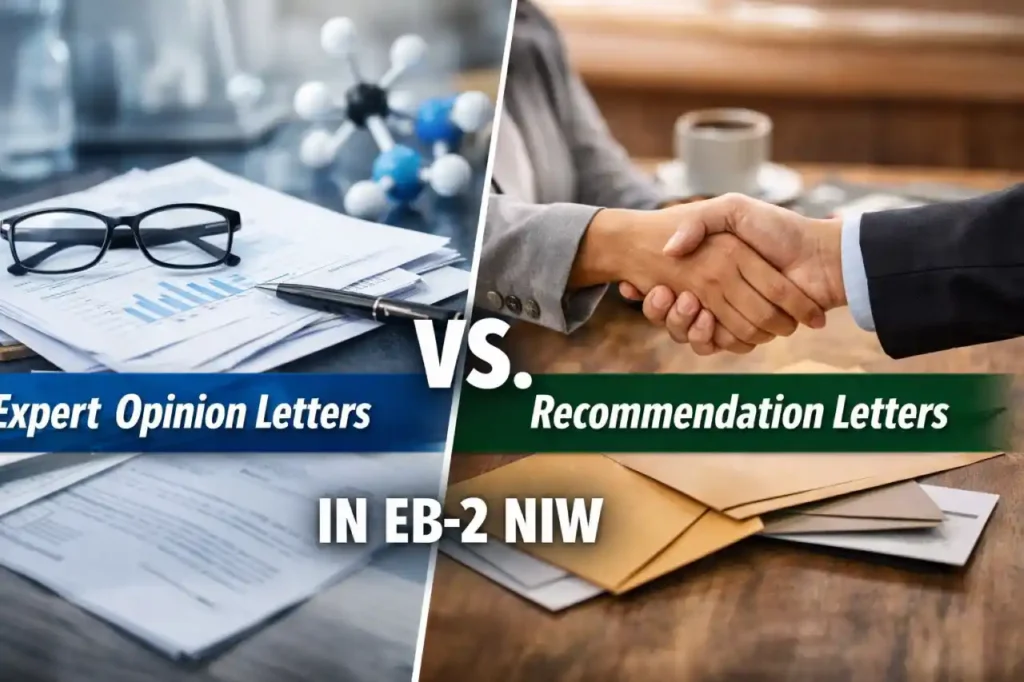
Professional Comparison: Expert Opinion Letters vs. Recommendation Letters
| Evaluation Factor | Expert Opinion Letters | Recommendation Letters |
| Primary Purpose | Independent technical evaluation of impact | Personal professional endorsement |
| Written By | Field experts or authorities | Supervisors, professors, colleagues, clients |
| Relationship | Often independent assessment | Direct professional relationship |
| Tone | Analytical and objective | Personal and supportive |
| Focus Area | Technical impact and national importance | Professional performance and skills |
| Evidence Used | Publications, patents, innovations | Workplace examples and achievements |
| Role in EB-2 NIW | Explains broader industry value | Shows professional credibility |
| Petition Benefit | Adds objective credibility | Adds personal validation |
| Typical Usage | Technical or complex cases | Demonstrating leadership and teamwork |
| Strategic Value | Validates national impact | Validates professional excellence |
This comparison helps applicants understand how both letters support petitions differently.
When Expert Opinion Letters Become Essential
Expert Opinion Letters become particularly important when applicants work in specialized or technical industries. Immigration officers may not possess expertise in fields such as artificial intelligence, biotechnology, healthcare innovation, or advanced engineering.
Expert letters clarify why contributions matter and how they benefit national interests. They also help explain future impact and continued contribution potential.
Whenever achievements require technical context, expert letters provide clarity and credibility.
When Recommendation Letters Are Most Effective
Recommendation Letters are powerful when they show practical workplace success. Managers or collaborators can describe leadership skills, teamwork, and project contributions.
Supervisors may explain operational improvements or successful leadership roles. Clients can confirm business impact, while professors may highlight academic excellence.
These letters show professional reliability and competence, helping officers evaluate real-world performance.
Common Mistakes Applicants Make
Many immigration petitions face delays because letters are poorly prepared. Generic or repetitive letters weaken credibility.
Another mistake involves choosing writers without recognized expertise, reducing letter impact. Some letters also focus only on routine job duties instead of broader contributions.
A frequent oversight is failing to demonstrate national importance, leaving officers unclear about broader benefits.
Avoiding these mistakes strengthens petitions.
How Immigration Officers Review Letters
Officers evaluate both the writer’s credibility and letter content. They consider whether claims are supported by evidence and whether writers possess authority to provide opinions.
Clear explanations of professional impact and national importance help officers assess qualifications effectively.
Detailed and structured letters carry more weight than vague praise.
Tips for Strong Supporting Letters
Strong letters are specific and evidence-based. Writers should include measurable examples demonstrating impact rather than general compliments.
Each letter should provide a distinct perspective. Authenticity is important, and exaggerated claims should be avoided.
Letters should also emphasize future contributions, showing how continued work benefits the United States.
Professional drafting assistance can help present information clearly while preserving authenticity.
Combining Letters for Stronger Cases
Strong EB-2 NIW petitions strategically combine Recommendation Letters and Expert Opinion Letters. Recommendation letters show competence and leadership, while expert letters validate technical and national impact.
Together, they provide a complete professional picture, improving petition credibility and approval chances.
Additional Service of AAE Evaluations
Many applicants also require professional evaluation services beyond NIW petitions.
Common services include O-1 expert opinion letters, supporting extraordinary ability visa petitions by confirming professional recognition and exceptional contributions.
Another important service involves EB-1 recommendation letters, used in petitions requiring evidence of sustained international acclaim and leadership.
Credential and professional evaluations also help translate academic and professional achievements into formats recognized by immigration authorities.
These services ensure achievements are presented clearly across immigration pathways.
Final Thoughts
Understanding the difference between Expert Opinion Letters and Recommendation Letters is essential for building a strong EB-2 NIW petition. Recommendation letters showcase professional strengths, while expert letters validate technical contributions and national impact.
Applicants who prepare documentation strategically make it easier for immigration officers to evaluate qualifications accurately. Strong supporting letters significantly improve approval chances and ensure professional contributions receive proper recognition.