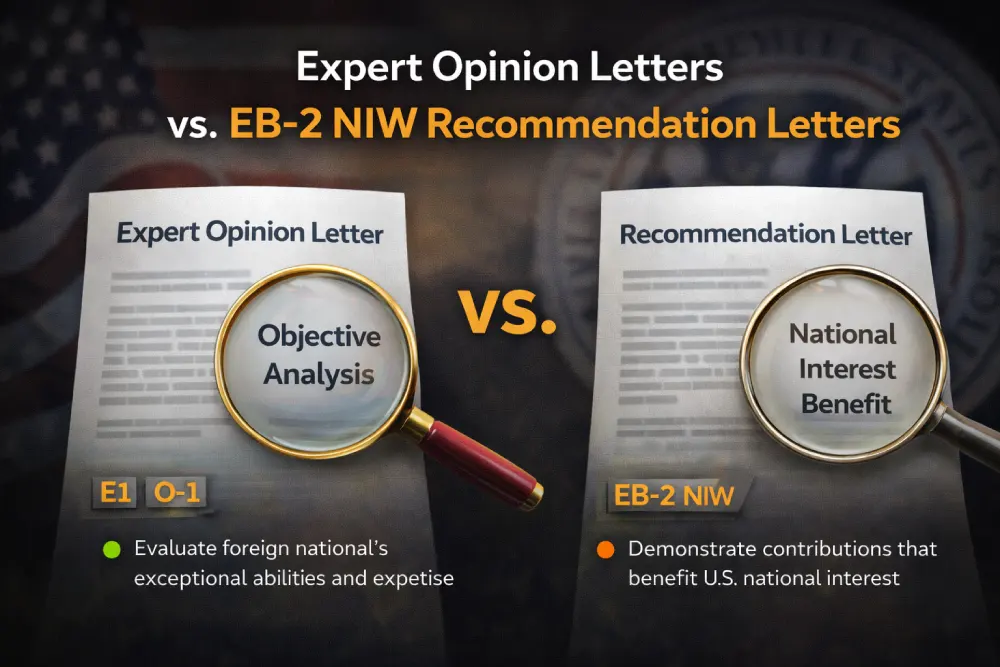
Expert Opinion Letters vs. EB-2 NIW Recommendation Letters
If you are preparing an EB-2 NIW petition — the National Interest Waiver that allows skilled professionals to self-petition for a U.S. green card without a job offer or PERM labor certification — two types of supporting letters will define how USCIS evaluates your case: Expert Opinion Letters and Recommendation Letters.
Most applicants either conflate the two or underestimate how differently USCIS adjudicators weigh them. Submitting the wrong combination — or using either type without understanding its strategic purpose — is one of the most preventable causes of EB-2 NIW RFEs and denials.
This guide explains what each letter does, how each maps to the Matter of Dhanasar three-prong test, who should write them, how many you need, and what USCIS actually looks for when reviewing your NIW petition supporting letters. Whether you are filing your first petition or responding to a Request for Evidence (RFE), this is the framework you need.
What Is an EB-2 NIW and Why Do Supporting Letters Matter?
The EB-2 National Interest Waiver (NIW) is an employment-based second-preference immigration category that allows foreign nationals with an advanced degree or exceptional ability to self-petition for a U.S. green card — without needing a U.S. employer sponsor, a job offer, or PERM labor certification approval.
To qualify, applicants must satisfy the Matter of Dhanasar standard (AAO 2016), which requires demonstrating three things:
- Their proposed endeavor has substantial merit and national importance
- They are well-positioned to advance that endeavor
- Waiving the job offer requirement benefits the United States on balance
Because USCIS adjudicators are generalists — not specialists in biotechnology, artificial intelligence, civil engineering, or any other technical field — they cannot independently assess whether an applicant’s work is nationally important. They rely entirely on the objective evidence submitted, which is precisely why expert opinion letters and NIW recommendation letters are not optional accessories to a petition. They are the mechanism through which USCIS understands and evaluates your qualifications.
Supporting letters in an EB-2 NIW petition serve three core functions:
- They translate complex achievements into plain-language arguments that non-specialist adjudicators can follow
- They provide third-party validation that the work is recognized and valued beyond the applicant’s immediate professional circle
- They directly address the legal standard — the Dhanasar three prongs — in a structured, evidence-backed way
A petition with strong letters is far easier for an officer to adjudicate in your favor. A petition with weak, generic, or unbalanced letters almost always generates an RFE.
Understanding EB-2 NIW Expert Opinion Letters
An EB-2 NIW expert opinion letter is a formal, analytical document written by a recognized authority in the applicant’s field — typically a university professor, senior research scientist, or industry executive — who reviews the applicant’s documented body of work and provides an independent, objective assessment of its significance.
The defining feature of an expert opinion letter is independence: the author may have never met the applicant. They evaluate the work — publications, patents, project outcomes, citations, industry impact — not the person.
What an Expert Opinion Letter Covers
- Field-level context: How the applicant’s work fits within the broader landscape of the specialty
- National importance argument: Why the work matters beyond the applicant’s institution or organization — and specifically how it serves U.S. interests
- Substantial merit analysis: The technical or scientific value of the contributions, explained in accessible language
- Dhanasar alignment: Explicit connection of the applicant’s background to Prong 1 (substantial merit and national importance) and Prong 3 (balance of national interest)
- Comparative standing: Where the applicant ranks within their field, based on evidence such as citation impact, publication record, or project scale
Who Writes an Expert Opinion Letter
An effective EB-2 NIW expert opinion letter author is:
- A tenured or senior professor at a recognized U.S. or international university
- A senior research scientist at a government agency, national laboratory, or recognized institution
- An executive, director, or recognized expert in an industry the applicant’s work directly affects
- Someone with no co-authorship, employment, or personal relationship with the applicant
Why independence matters: USCIS explicitly discounts letters that appear to come from the applicant’s professional network. An independent expert — someone whose only knowledge of the applicant is through their published work, patents, or public contributions — carries far more evidentiary weight precisely because they have no stake in the outcome.
See AAE’s EB-2 NIW Expert Opinion Letter service →
Understanding EB-2 NIW Recommendation Letters
An EB-2 NIW recommendation letter is a personal professional endorsement written by someone who has worked directly with the applicant — a supervisor, research collaborator, academic advisor, colleague, or client. Unlike expert opinion letters, recommendation letters are relational in nature: they are grounded in firsthand knowledge of the applicant’s capabilities and contributions.
The strategic value of a recommendation letter is not objectivity — it is specificity. A direct supervisor can describe exactly what the applicant did on a specific project, with concrete outcomes, in a way that an independent expert who never worked alongside them cannot.
What a Recommendation Letter Covers
- Direct observations of the applicant’s professional conduct, problem-solving ability, and leadership
- Specific named contributions — not generic praise, but particular projects, innovations, or decisions the writer personally witnessed
- Professional credibility and reliability — how the applicant performs in real working environments under realistic conditions
- Career progression — how the applicant’s skills and responsibilities have grown over time
- Prong 2 support: Evidence that the applicant is specifically qualified and positioned to advance their proposed endeavor, based on demonstrated past performance
Who Writes a Recommendation Letter
- Direct supervisors or managers who oversaw the applicant’s work
- Research collaborators who co-contributed to the same projects
- Academic advisors or department heads with firsthand knowledge of the applicant’s academic and research work
- Clients or industry partners who can speak to the real-world impact of the applicant’s contributions
Important distinction: Recommendation letters for EB-2 NIW immigration purposes are not the same as graduate school recommendation letters. The focus must be on the applicant’s professional impact and field-level contributions, not personal character or academic promise.
See AAE’s EB-2 NIW Recommendation Letter service →
The Matter of Dhanasar Three-Prong Test: Which Letter Covers Which Prong
Understanding which letter type addresses which Dhanasar prong is the single most important strategic insight for building a strong NIW petition. Most applicants and even some attorneys submit letters without explicitly mapping them to the legal standard — and adjudicators notice.
Prong 1 — Substantial Merit and National Importance
Primary letter type: Expert Opinion Letter
This prong asks whether the applicant’s work — not just their credentials — has genuine importance to the United States at a broad level. Independent expert opinion letters are ideal here because they provide an authoritative, objective explanation of why the work matters beyond the applicant’s institution or industry.
An expert who can state, based on their own professional standing, that the applicant’s contributions address a nationally significant challenge — in healthcare, infrastructure, national security, technology, or another priority area — provides the kind of third-party validation that USCIS cannot obtain from the applicant’s own materials.
Prong 2 — Well Positioned to Advance the Endeavor
Primary letter type: Recommendation Letter (with expert support)
This prong asks whether this specific applicant has the skills, track record, and resources to actually execute their proposed work. A January 2025 USCIS policy clarification explicitly reinforced that letters supporting Prong 2 benefit from “first-hand knowledge of the person’s achievements” — making well-structured inner circle recommendation letters directly relevant here.
Direct supervisors and collaborators who have witnessed the applicant’s capabilities in action are the most credible voices for this prong. Expert letters can supplement by independently confirming the applicant’s standing within the field.
Prong 3 — On Balance, Beneficial to Waive the Job Offer Requirement
Primary letter type: Expert Opinion Letter
This prong requires demonstrating that it serves U.S. interests more to let this applicant work freely in their field — without being tied to a single employer — than to require them to go through the standard PERM labor certification process. Expert opinion letters address this prong by explaining the uniqueness of the applicant’s expertise, the difficulty of finding equivalent U.S. workers, and the national benefit of the applicant’s continued contributions.
???? Practical takeaway: A petition that submits only recommendation letters from direct colleagues may be strong on Prong 2 but weak on Prongs 1 and 3. A petition that submits only independent expert letters may miss the firsthand validation that Prong 2 specifically calls for. You need both — and they must be mapped to the right prongs.
Inner Circle vs. Outer Circle: Why Author Independence Determines USCIS Weight
One of the most consequential concepts in EB-2 NIW letter strategy is the inner circle / outer circle framework, which directly determines how much weight USCIS assigns to each letter.
Inner circle letters come from people who have worked with the applicant directly — supervisors, PhD advisors, research partners, co-authors, or current colleagues. They have deep firsthand knowledge of the applicant’s work, which makes them ideal for Prong 2 recommendation letters. Their limitation: USCIS treats them as potentially biased, since they have a professional relationship with the applicant that could motivate flattery over accuracy.
Outer circle letters come from recognized independent experts who know the applicant’s work — through publications, patents, industry presentations, or field-wide reputation — but have no personal or professional connection to the applicant. Because they have no stake in the outcome, their assessments carry substantially more evidentiary weight with USCIS adjudicators.
The Ideal Outer Circle Expert for EB-2 NIW
- Holds an advanced degree and senior position at a recognized institution
- Has no co-authorship, employment, or personal relationship with the applicant
- Can speak specifically to the national importance or field-wide significance of the applicant’s work
- Has their own established reputation — publications, awards, institutional affiliations — that USCIS can independently verify
✅ Recommended balance for EB-2 NIW: 3–4 outer circle independent expert letters (60–70% of total) + 1–3 inner circle recommendation letters (30–40%). Quality always outweighs quantity. Three focused, specific, independently written letters beat seven generic ones.
Head-to-Head Comparison Table
| Evaluation Factor | Expert Opinion Letter | Recommendation Letter |
|---|---|---|
| Primary Purpose | Independent technical evaluation of national impact | Personal professional endorsement based on direct experience |
| Written By | Independent field experts or academic authorities | Supervisors, collaborators, advisors, clients |
| Author’s Relationship | No personal connection — outer circle | Direct professional relationship — inner circle |
| Tone | Analytical, objective, scholarly | Personal, supportive, observational |
| Focus Area | Technical significance, national importance, Dhanasar Prongs 1 & 3 | Professional performance, skills, leadership, Dhanasar Prong 2 |
| Evidence Used | Publications, patents, citation data, project outcomes, industry impact | Workplace examples, leadership situations, project contributions |
| Role in EB-2 NIW | Explains broader industry value and national interest | Demonstrates professional credibility and execution capability |
| USCIS Weight | Higher — objective, independent, no bias concern | Moderate — valuable but viewed through the lens of potential bias |
| Typical Length | 3–5 pages + expert CV attached | 1–3 pages |
| Recommended Quantity (EB-2 NIW) | 3–4 (majority of 5–7 total) | 1–3 (minority of total) |
| Key Visa Applications | EB-2 NIW, EB-1A, H-1B, O-1, L-1 | EB-2 NIW, EB-1A, O-1 |
When Expert Opinion Letters Are Essential
Expert opinion letters for EB-2 NIW become especially critical in the following scenarios:
Highly technical fields where USCIS cannot self-evaluate. Artificial intelligence, biotechnology, advanced materials, medical device innovation, quantum computing, structural engineering — these are fields where USCIS adjudicators have no independent basis to assess national importance. An expert who can explain, in plain language, why the applicant’s work matters to the United States fills a gap that no other document can.
When the national importance argument is non-obvious. Some work has a clear connection to national interest — healthcare, defense, energy. Other work requires the connection to be drawn explicitly. An independent expert opinion letter builds that argument in credible, evidence-backed terms that the applicant cannot make about their own work.
RFE responses targeting Prongs 1 or 3. If USCIS issues an RFE questioning national importance or the value of waiving the job offer requirement, a new expert opinion letter — written specifically to address the RFE concerns — is typically the most effective single document in the response. Never reuse letters from the original petition for an RFE.
When the applicant’s achievements need technical translation. Patents, research contributions, and engineering innovations often require an expert to explain their significance. An adjudicator reading a patent abstract cannot independently determine whether it advances the national interest. An expert letter closes that gap.
When Recommendation Letters Are Most Effective
EB-2 NIW recommendation letters are most powerful when they:
Demonstrate execution capability with specificity. A direct supervisor who can describe exactly how the applicant led a team that solved a specific problem — with measurable outcomes — provides concrete evidence that the applicant is well-positioned to advance their proposed endeavor. Vague praise does not serve this purpose. Named projects with specific results do.
Show progressive career growth. Letters from supervisors or advisors at different stages of the applicant’s career can demonstrate that responsibilities, impact, and recognition have consistently grown — which supports both the “well-positioned” argument of Prong 2 and the broader credibility of the petition.
Provide firsthand validation of extraordinary contributions. For EB-1A and O-1 petitions that run in parallel with or follow an EB-2 NIW, recommendation letters that describe original contributions and their recognition within the field are particularly important.
Establish reputation beyond the immediate employer. Letters from clients, industry partners, or external collaborators are more persuasive than letters from direct colleagues because they represent validation from outside the applicant’s primary organization.
How Many Letters Do You Need for EB-2 NIW?
| Visa Type | Total Recommended | Outer Circle | Inner Circle |
|---|---|---|---|
| EB-2 NIW | 5–7 | 3–4 (60–70%) | 1–3 (30–40%) |
| EB-1A | 5–7 | 3–4 | 1–3 |
| O-1A / O-1B | 3–4 | 2–3 | 1 |
| EB-1B | 3–4 | 2–3 | 1–2 |
Quality always beats quantity. Three letters that are specific, evidence-based, and independently written will outperform seven generic letters every time. USCIS officers are experienced enough to recognize when letters are formulaic, template-based, or coordinated — and will discount all of them when the pattern is obvious.
For EB-2 NIW specifically: The ideal package is 3–4 independent expert opinion letters from outer circle authorities (addressing Prongs 1 and 3), plus 1–3 recommendation letters from direct professional contacts (addressing Prong 2). Each letter should have a clear and distinct purpose in the petition strategy.
What USCIS Officers Actually Look For When Reviewing Letters
USCIS adjudicators reviewing NIW supporting letters evaluate the following, in rough order of priority:
1. Author credibility. Can USCIS verify that this person is who they say they are, and that their stated expertise is genuine? Letters must include the author’s full name, title, institutional affiliation, and CV. Letters without a CV attached are routinely discounted.
2. Independence from the applicant. Is the author part of the applicant’s professional circle? Even if the letter is formally structured as an “expert opinion,” if the author is a direct colleague, USCIS will apply a bias discount. The more independent the author, the more the letter is trusted.
3. Specificity of claims. Does the letter make specific, verifiable claims — or does it offer general praise? “Dr. X is an exceptional researcher” carries no evidentiary weight. “Dr. X’s work on [named project] has been cited 84 times and directly informed the [named policy/standard/application]” is evidence.
4. Direct alignment with the Dhanasar prongs. Does the letter address the specific legal questions USCIS must answer? Letters that are technically impressive but never connect the applicant’s work to national importance, or never address why the applicant specifically is positioned to advance their endeavor, leave adjudicators without the evidence they need to rule favorably.
5. Letter-to-letter consistency without template similarity. All letters should be consistent in their factual assertions. But if multiple letters share the same sentence structures, opening paragraphs, or organizational patterns, USCIS will flag the entire set as non-credible — including letters that were genuinely independent.
What Goes Inside a Case-Winning Letter
Structure of a Strong Expert Opinion Letter (3–5 pages)
Opening statement — The letter’s scope and the expert’s basis for rendering an opinion. Not “I am writing to support this application” but “This letter provides an independent assessment of [applicant]’s contributions to [field], specifically as they relate to [visa criteria].”
- Expert credentials — Full title, institutional affiliation, publication record, awards, and professional recognitions. Attached CV required.
- Basis of knowledge — How the expert knows the applicant’s work (through publications, patents, industry reputation) — establishing outer-circle independence.
- Substantive analysis — The core of the letter. Named achievements, quantified metrics, direct connection to national importance, explicit alignment with all three Dhanasar prongs.
- Conclusion — A direct, unhedged statement that the applicant meets the relevant standard and why.
Structure of a Strong Recommendation Letter (1–3 pages)
- Author’s relationship — How long and in what capacity they have worked with the applicant.
- Two or three specific examples — Named projects, roles, or contributions the author directly observed. Specific outcomes, not general impressions.
- Field-level impact — Even an inner-circle author can speak to external recognition of the applicant’s work — citations, industry adoption, awards.
- Clear endorsement — An unambiguous statement of support, specifying the applicant’s ability to continue advancing their proposed work in the United States.
Common Mistakes That Get Letters Dismissed
Submitting only inner circle letters. All five letters from direct colleagues, no matter how well-written, will be assessed through a bias lens. USCIS will question whether the national importance argument is genuine if the only people making it are the applicant’s own professional network.
Generic praise without specifics. “She is one of the most talented professionals I have encountered” is not evidence. Evidence is a named contribution with a measurable outcome.
Letters that don’t address the Dhanasar prongs. An expert letter that describes the applicant’s impressive CV but never connects it to substantial merit and national importance does not help Prong 1. Petition strategies must ensure every letter has a clear purpose.
Reusing original petition letters in an RFE response. USCIS has already reviewed those letters and found them insufficient. An RFE response requires new letters, written specifically to address the concerns the adjudicator identified.
Template letters. When three letters share the same phrasing, paragraph structure, or opening lines, USCIS flags the entire package. Every letter must be individually drafted.
Missing author CV. Without a CV, USCIS cannot verify the author’s credentials. The letter will be discounted regardless of its content.
Expert’s field doesn’t match applicant’s specialty. A molecular biologist writing an expert opinion for a civil engineering EB-2 NIW creates credibility questions. The author’s stated expertise must clearly align with the applicant’s field of work.
How to Combine Both Letter Types for Maximum Impact
The strongest EB-2 NIW petitions use both letter types strategically — not interchangeably — with each letter assigned a clear role in the Dhanasar framework.
Think of it as a two-layer evidential structure:
Layer 1 — The national case (Expert Opinion Letters): Independent authorities from your field explain, in analytical terms, why your work has substantial merit, why it serves national interests, and why the United States benefits from letting you continue that work without a job offer constraint. These letters answer the “why does this matter to America?” question that USCIS must be satisfied on.
Layer 2 — The personal case (Recommendation Letters): People who have worked directly with you confirm, through specific examples, that you are not just doing important work — you are specifically capable of advancing it. These letters answer the “why is this person the right one to do it?” question that Prong 2 requires.
Together, the two layers give USCIS adjudicators everything they need: the national importance argument made credibly and objectively, and the personal qualification argument made specifically and with firsthand authority.
One letter package that covers both layers well is worth more than ten generic letters that cover neither with conviction.
AAE Evaluations: EB-2 NIW Letter Services and Pricing
At AAE Evaluations, we prepare both EB-2 NIW expert opinion letters and EB-2 NIW recommendation letters to USCIS adjudication standards. Every letter is individually researched and written for your specific case by a subject matter expert with relevant credentials in your field. We do not use templates, and we do not reuse letter frameworks across clients.
Our letters are built to map explicitly to the Matter of Dhanasar three prongs, are structured for direct integration into attorney-prepared petition packages, and are written at the 3–5 page depth that USCIS expects from high-quality supporting letters.
EB-2 NIW Services and Pricing
| Service | Price | Turnaround |
|---|---|---|
| EB-2 NIW Expert Opinion Letter | $675 | 6 business days |
| EB-2 NIW Recommendation Letter | $550 | 6 business days |
| EB-1 Expert Opinion Letter | $675 | 6 business days |
| EB-1A Recommendation Letter | $550 | 6 business days |
| H-1B Expert Opinion Letter | $495 | 5 business days |
| O-1 Expert and Advisory Letter | $675 | 6 business days |
| O-1 Recommendation Letter | $550 | 6 business days |
| L-1A / L-1B Expert Opinion Letter | $675 | 6 business days |
See all services and fees at aaeevaluations.com/pricing.
Also need to establish degree equivalency or work experience equivalency for your petition? See our Work Experience Evaluations — designed specifically for applicants combining professional experience with academic credentials to meet EB-2 or H-1B degree requirements.
Working with an immigration attorney? We coordinate directly with law firms. Our letters are formatted to integrate into attorney-prepared petition packages. Contact us to discuss your case.
???? (+1) 813-816-3969 | ???? Contact@aaeevaluations.com
Frequently Asked Questions
Can I apply for EB-2 NIW without recommendation letters or expert opinion letters?
Technically there is no statutory requirement. In practice, very few NIW petitions succeed without supporting letters because USCIS adjudicators have no independent mechanism to assess the national importance of the applicant’s work. Petitions without letters must rely on other objective evidence — citation records, awards, media coverage, patents — that independently establishes all three Dhanasar prongs. This is feasible for a small number of applicants with exceptional public recognition but is not a viable strategy for most.
Is an expert opinion letter the same as a recommendation letter for EB-2 NIW?
No. A recommendation letter documents personal professional experience with the applicant and serves primarily as Prong 2 evidence. An expert opinion letter is an independent, analytical assessment of the national importance of the applicant’s work and serves primarily as Prong 1 and Prong 3 evidence. They serve different legal purposes and should be written by different types of authors.
What is the difference between inner circle and outer circle letters?
Inner circle letters come from people who have worked directly with the applicant — supervisors, collaborators, advisors. They have firsthand knowledge but are viewed by USCIS as potentially biased. Outer circle letters come from independent experts who know the applicant’s work through publications, patents, or industry reputation but have no personal professional relationship. Outer circle letters carry more evidentiary weight for the national importance and waiver justification arguments.
How long should an expert opinion letter be for EB-2 NIW?
A high-quality EB-2 NIW expert opinion letter is typically 3 to 5 pages, not including the expert’s attached CV. Letters shorter than 2 pages rarely provide sufficient analytical depth. Letters longer than 6 pages can dilute the core arguments. Every paragraph should serve a specific purpose in the Dhanasar framework.
Can I use the same letters for an EB-2 NIW RFE response that I submitted in my original petition?
No. USCIS has already reviewed those letters and determined they were insufficient. An RFE response requires new letters written specifically to address the concerns the adjudicator identified. Reusing original letters is one of the most common and costly mistakes in RFE responses.
Does the 2025 USCIS policy update change the letter strategy?
The January 2025 USCIS policy clarification reinforced that Prong 2 letters benefit from first-hand knowledge of the applicant’s achievements. This makes well-structured inner circle recommendation letters more strategically important for Prong 2 than some practitioners had previously assumed. It does not reduce the importance of independent expert opinion letters for Prongs 1 and 3. The overall strategy remains: use both, for the right prongs.
Can the same person write both an expert opinion letter and a recommendation letter?
No. The evidentiary value of an expert opinion letter depends entirely on the author’s independence from the applicant. If the same person writes both types of letters, it undermines the credibility of both. Each letter type must come from the appropriate category of author.
The Bottom Line
Expert opinion letters and EB-2 NIW recommendation letters do different jobs. Expert letters establish national importance and validate that the applicant’s work deserves a labor certification waiver. Recommendation letters establish that this specific person is uniquely qualified to advance that work. Both are essential. Neither substitutes for the other.
A strategic petition uses both types, assigns them to the right Dhanasar prongs, sources them from the right authors, and writes them to the standard USCIS adjudicators expect — specific, evidence-backed, and aligned to the legal framework.
If you want to make sure your EB-2 NIW supporting letters give your petition the strongest possible foundation, AAE Evaluations is ready to help.
Related reading: