USCIS Expert Opinion Letter Requirements: What Officers Actually Look For in 2026
Expert opinion letter requirements have grown more critical to immigration application success heading into 2026. AAE Evaluations understands that these specialised documents strengthen qualifications across visa categories — including EB-1, EB-2 NIW, O-1, H-1B, and L-1 petitions. Our network of 200+ independent experts spanning Computer Science, Mechanical Engineering, Medicine, Law, and dozens of other disciplines helps build stronger, USCIS-ready cases.
These immigration support letters prove especially valuable when responding to Requests for Evidence (RFEs). Specialty Occupation and Beneficiary Qualifications remain among the most frequently challenged issues. The EB-2 NIW (National Interest Waiver) petition requires a comprehensive immigration evaluation aligned with specific USCIS requirements. H-1B applicants must demonstrate an advanced degree or its equivalent — many rely on the 3-in-1 rule, which treats three years of relevant work experience as equivalent to one year of undergraduate coursework.
This guide covers what USCIS officers actually look for in 2026, the different types of expert opinion letters, the key components that meet current adjudication standards, common red flags to avoid, and how our credential evaluation service at AAE Evaluations makes applications stand out. Letter costs typically start around $500. A quality qualifications assessment from an established evaluation agency often determines whether your immigration case succeeds or fails.
What USCIS Looks for in an Expert Opinion Letter in 2026
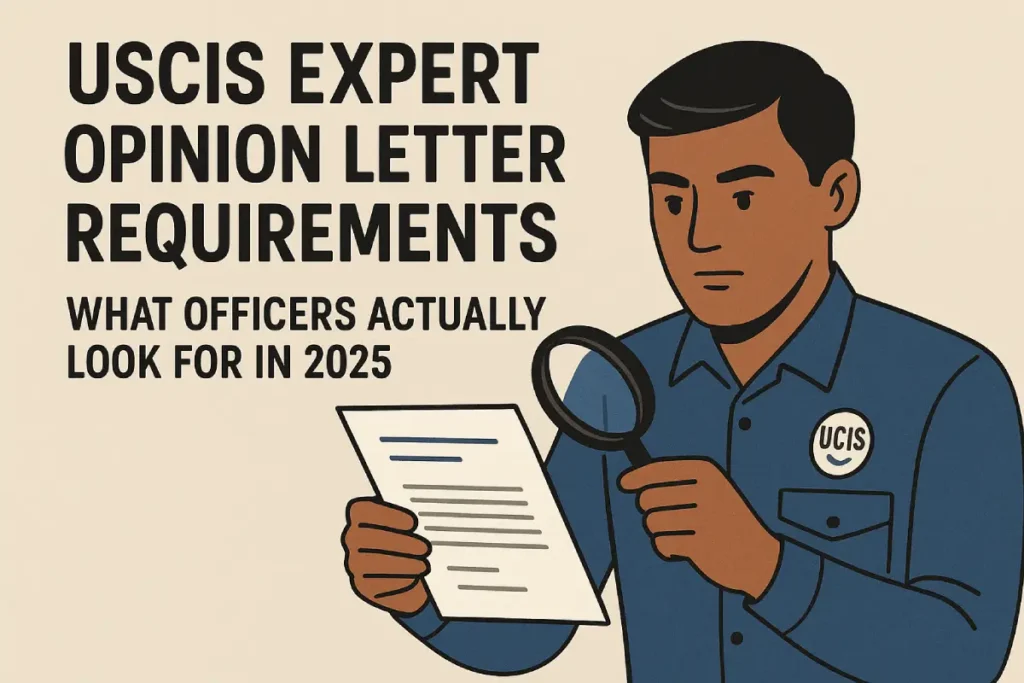
USCIS officers scrutinise expert opinion letters with increasing care in 2026. They look well beyond basic endorsements to verify visa eligibility claims with objective, field-specific evidence. Understanding what officers value most directly improves your approval prospects.
Independent Assessment From a Subject Matter Expert
USCIS seeks advisory opinions from qualified individuals who have no personal stake in the outcome. These letters should come from a U.S. peer group in the applicant’s field, a relevant labour organisation, or recognised independent experts in the applicant’s discipline. Immigration officers treat third-party verification as the cornerstone of credibility.
Researchers affiliated with prestigious institutions carry additional weight during the review process due to their established professional reputations. The expert’s credentials are subject to close scrutiny — their educational background, publication record, professional accomplishments, and standing within the industry all influence how USCIS weighs their opinion.
Matching USCIS Visa-Specific Criteria
Each visa category carries its own distinct requirements, and immigration evaluations must address those criteria directly and explicitly. H-1B petitions require proof that the position qualifies as a specialty occupation. O-1 applications must demonstrate extraordinary ability through documented national or international acclaim. The expert opinion letter must connect the applicant’s qualifications to these specific visa requirements — general endorsements are insufficient.
EB-2 NIW petition letters must address all three prongs of the Matter of Dhanasar test with evidence-based assertions. H-1B support letters should describe the position’s required duties, explain why a bachelor’s degree in a specific field is necessary, and include relevant industry data substantiating those requirements.
Objective Evidence Over General Praise
USCIS officers want hard evidence, not vague praise. Generic compliments and template language trigger red flags immediately. Officers specifically look for:
- Clear examples of the applicant’s measurable, quantifiable achievements
- Precise explanations of the applicant’s influence within their field
- Technical details about the applicant’s contributions, written in accessible language
- Documented proof of national or international professional recognition
Peer-reviewed publications provide particularly strong independent verification, as they represent unbiased evaluations of the applicant’s work by field experts. USCIS also cross-checks submitted letters against one another — if letters appear template-based rather than individually researched and written, officers may reject the entire supporting documentation package.
AAE Evaluations experts understand these requirements in depth. We create custom immigration support letters that address visa-specific criteria and back every assertion with real data points and concrete examples that meet current USCIS adjudication standards.
Types of Expert Opinion Letters and When to Use Them
Different visa categories require specialised expert opinion letters that satisfy distinct regulatory standards. AAE Evaluations produces custom letters for a wide range of immigration scenarios — each built to meet specific USCIS requirements. Selecting the right letter type has a significant impact on your application’s outcome.
Specialty Occupation Analysis for H-1B
H-1B visas require proof that the position qualifies as a specialty occupation demanding specialised knowledge and at least a bachelor’s degree in a specific field. A Specialty Occupation Analysis letter provides a detailed examination of:
- The complexity of job duties requiring specialised knowledge
- Industry-wide educational standards for comparable positions
- How the role aligns with USCIS specialty occupation criteria
These letters are particularly critical when USCIS questions whether a position genuinely requires specialised knowledge, or when the job title does not map neatly to traditional specialty occupation classifications. See also our guide on credential evaluation for H-1B visas for related requirements.
Work Experience Evaluation for Degree Equivalency
Work Experience Evaluations help candidates without formal U.S. degrees establish academic equivalency through the “three-for-one rule” — three years of specialised professional experience treated as equivalent to one year of college-level education. This is essential for H-1B applicants with extensive career histories but incomplete or foreign educational credentials.
The evaluation analyses how the candidate’s professional responsibilities evolved over time and maps that experience to academic credit equivalency. These professional experience equivalency letters become decisive for applicants whose career depth outpaces their formal qualifications on paper.
Combination Letters for RFEs
Combination letters address Requests for Evidence (RFEs) by tackling multiple USCIS objections within a single, cohesive document. Rather than handling each concern in isolation, these letters blend specialty occupation analysis with beneficiary qualifications assessments, connecting all eligibility factors into a unified, persuasive response. This integrated approach builds a stronger petition and confronts RFE concerns directly and comprehensively.
National Interest Waiver Letters for EB-2 NIW
The EB-2 NIW (National Interest Waiver) requires evidence that waiving the standard job offer and PERM labor certification requirements serves the national interest of the United States. These specialised letters must fully address all three prongs of the Matter of Dhanasar test:
- Substantial merit and national importance of the proposed endeavour
- Well-positioned to advance — proof the applicant can effectively carry the work forward
- National benefit of the waiver — demonstrating what the U.S. gains by granting the exception
NIW letters emphasise the applicant’s impact on their field and their potential future contributions to the United States, rather than focusing solely on credentials. For more detail, see our dedicated guide on EB-2 NIW expert opinion letters and NIW recommendation letters.
Extraordinary Ability Letters for O-1 Visa
The O-1 visa requires proof that the applicant has achieved extraordinary ability through sustained national or international acclaim, placing them among the top performers in their field. O-1 support letters must incorporate input from a peer group or recognised professional association in the applicant’s discipline. Per USCIS guidelines, these letters should analyse the applicant’s achievements, professional recognition, and distinguished reputation relative to peers in the field. See also our O-1 Visa Recommendation Letters service.
AAE Evaluations maintains a network of 200+ credentialed independent experts across a wide range of disciplines. We produce fully customised letters for each visa category that meet current 2026 USCIS standards and position your case as compellingly as possible.
Key Components USCIS Expects in an Expert Opinion Letter
Expert opinion letters must contain several essential components to pass USCIS review in 2026. These elements provide the third-party validation from qualified, independent professionals that immigration officers require to make objective eligibility determinations.
Expert’s Credentials and Authority in the Field
The persuasive power of an expert opinion letter begins with the writer’s qualifications. USCIS officers carefully assess whether the expert has genuine authority to offer a meaningful evaluation. An effective letter must establish:
- The expert’s specific credentials and qualifications within their discipline
- A professional background that includes advanced degrees and relevant certifications
- Demonstrated capacity to assess academic or professional equivalency
- A complete curriculum vitae evidencing relevant career experience
AAE Evaluations works with over 200 qualified experts across more than 20 fields — including Computer Science, Mechanical Engineering, Chemistry, Medicine, Finance, and Law. This breadth of expertise ensures we can match every applicant with an evaluator whose specialisation aligns precisely with the position or endeavour at issue.
Detailed Qualifications Assessment of the Applicant
Beyond the expert’s introduction, USCIS expects a rigorous, evidence-based review of the applicant’s background. This qualifications assessment must:
- Provide specific details about the applicant’s academic credentials and professional history
- Demonstrate how the applicant’s training and career development align with USCIS academic credit standards
- Describe the applicant’s technical skills, accomplishments, and professional contributions with specificity
- Trace the evolution of specialised knowledge and expertise over the applicant’s career
These assessments require substantive documentation — academic transcripts, employment verification letters, detailed position descriptions — and experts must analyse this material analytically rather than simply cataloguing it.
Connection to Visa Category Requirements
The letter must draw an explicit, evidence-supported link between the applicant’s qualifications and the specific requirements of the visa category being sought. This critical component:
- Addresses the precise USCIS legal criteria for the applicable visa type
- Explains how the position’s required knowledge and skills connect to the visa’s specialty occupation or extraordinary ability standards
- Demonstrates how the applicant’s background satisfies H-1B specialty occupation requirements or extraordinary ability criteria for O-1 or EB-1 petitions
An O-1 visa letter is structurally and substantively different from an H-1B evaluation, even when written about the same individual. Cookie-cutter approaches that ignore visa-specific criteria are consistently unsuccessful with USCIS.
Use of Verifiable Data and Supporting Documents
Concrete, verifiable evidence must be woven throughout the assessment. USCIS specifically looks for:
- Supporting documentation that substantiates every material claim
- Measurable outcomes and achievements, not generic praise
- Publicly available materials such as publications, presentations, patents, or awards
- Employment verification and detailed role descriptions that corroborate the letter’s analysis
AAE Evaluations adheres strictly to these documentation standards across all immigration evaluation services. Our expert opinion letters incorporate comprehensive reference materials, with pricing from $500–$800 depending on turnaround time. Review our full pricing for details.
Together, these four components produce immigration support letters that withstand USCIS scrutiny and provide the objective, verifiable proof needed for successful visa adjudication.
Common USCIS Red Flags and How to Avoid Them
USCIS officers are trained to identify deficiencies in expert opinion letters — deficiencies that frequently result in application denials or costly RFEs. Recognising these warning signs in advance can save you significant time, money, and stress.
Generic Language Without Field-Specific Context
USCIS consistently rejects expert opinion letters that lack specialised terminology and industry-specific analytical depth. Officers have denied evaluations that offer only broad, unsubstantiated statements without technical context — a pattern particularly common in template-based documents. To avoid this:
- Use industry-standard technical terminology when describing the position’s requirements
- Reference specific projects, technologies, methodologies, or standards relevant to the role
- Avoid vague character assessments such as “she is one of the best professionals I have encountered”
- Ensure every letter is researched and drafted uniquely for the individual case
Letters From Biased or Unqualified Sources
Letters from colleagues and direct supervisors carry inherently limited weight with USCIS due to the potential for professional bias. Officers also scrutinise the credentials of letter writers closely and will discount opinions from individuals who lack demonstrable authority in the relevant field.
AAE Evaluations addresses this by sourcing letters exclusively from fully independent experts with verifiable credentials. The most effective letters come from qualified professionals who have no personal interest in the application’s outcome and whose authority to render an expert assessment is beyond question. Learn more about this distinction in our post on expert opinion letters vs. recommendation letters.
Lack of Alignment With Job Description or SOC Code
Immigration evaluation letters raise an immediate red flag when they fail to engage directly with the position’s Standard Occupational Classification (SOC) code and the detailed job description provided by the petitioner. Officers quickly identify evaluations that draw only on the petitioner’s characterisation of the role without independent analytical depth.
Your expert opinion letter should explicitly reference the applicable SOC code’s requirements and provide a comprehensive analysis of how the specific position meets specialty occupation or other applicable visa standards.
Failure to Address RFE-Specific Concerns
Applicants responding to RFEs frequently submit generic supporting materials instead of targeted evidence that speaks directly to the officer’s articulated concerns. The most effective RFE responses engage with the exact language of the RFE notice and provide evidence that directly rebuts each identified deficiency.
AAE Evaluations produces RFE-specific letters that address USCIS concerns with precision and solid documentary support. Our experts study each RFE carefully and structure the response letter around the specific objections raised, demonstrating a clear understanding of the issues identified.
Remaining alert to these common red flags will substantially improve your visa approval prospects and help you avoid unnecessary delays or complications.
Why AAE Evaluations Letters Meet USCIS Standards
AAE Evaluations has built its reputation by producing expert opinion letters that not only satisfy USCIS requirements but anticipate the specific analytical questions officers raise during adjudication.
200+ Credentialed Experts Across 20+ Disciplines
Our network includes more than 200 independently verified subject matter experts spanning Computer Science, Mechanical Engineering, Chemistry, Business Administration, Medicine, Finance, Law, and many other fields. This depth allows us to match every applicant with an evaluator who has direct, demonstrable expertise in the relevant industry and understands its specific professional standards. Every expert in our network undergoes rigorous credential verification and ongoing performance review.
Custom Letters Tailored to Visa Category and Applicant Profile
Generic documentation is inadequate for modern USCIS adjudication. Our immigration evaluation process begins with a careful match between your case and the right expert based on your field and the specific visa category. A dedicated specialist then reviews your full credentials, researches applicable industry standards, and drafts a detailed evaluation that addresses every criterion relevant to your visa type. These credential evaluation services serve both initial applications and RFE responses with equal effectiveness.
Strict Adherence to USCIS Documentation Standards
Our evaluators actively monitor evolving USCIS requirements, service centre approval patterns, and adjudication policy updates throughout 2026. This vigilance ensures every letter we produce includes the verifiable data, objective analysis, and explicit qualification-to-requirement connections that officers expect to see. Our letters consistently withstand scrutiny through the full adjudication process.
Transparent Pricing: $500–$800 Depending on Turnaround Time
AAE Evaluations maintains straightforward, all-inclusive pricing from $500 to $800 based on your required turnaround time. Final cost may vary slightly with visa category complexity, but we never cut corners on quality regardless of the processing speed chosen. Every immigration support letter includes a full qualifications assessment, verified expert credentials, and analysis customised to your specific case. View our complete pricing page for a full breakdown, or contact us to discuss your timeline.
Conclusion: Securing Your Immigration Success With Expert Opinion Letters in 2026
Expert opinion letters have become indispensable components of successful immigration petitions in 2026. This guide has examined what USCIS officers scrutinise in these documents across H-1B, EB-2 NIW, O-1, EB-1, and L-1 petitions.
Your immigration support letter must go well beyond a basic endorsement. Quality documentation requires an independent assessment from a qualified expert, explicit alignment with visa-specific requirements, objective evidence in place of general praise, and verifiable data substantiating every claim.
Each visa type demands its own specialised approach. H-1B petitions require a focused specialty occupation analysis. EB-2 NIW applications must comprehensively address all three prongs of the Matter of Dhanasar test. O-1 visas require proof of extraordinary ability demonstrated through sustained national or international recognition.
Common red flags — generic language, biased sources, poor alignment with job descriptions, and inadequate RFE responses — can cause even otherwise strong applications to fail.
AAE Evaluations is your trusted partner through these complex requirements. Our network of 200+ credentialed experts across 20+ disciplines ensures your application receives the right evaluation for your specific case. Professional credential evaluation services are priced at $500–$800 depending on turnaround, making expert-level support accessible regardless of your timeline.
Explore our immigration evaluation services to see how we can build a stronger case and maximise your approval chances — or contact our team directly to get started. Understanding exactly what USCIS officers look for in 2026 and partnering with professionals who build to those standards gives your application the decisive edge it needs.
Frequently Asked Questions
Q1. What is a USCIS expert opinion letter and why is it important?
An expert opinion letter is a document produced by a qualified, independent professional that evaluates an applicant’s credentials and qualifications for a specific visa category. It is essential to immigration applications because it provides the objective, third-party assessment that USCIS officers rely on when assessing eligibility — particularly in cases where the officer lacks specialised knowledge of the applicant’s field. Learn more about the types of expert opinion letters AAE Evaluations provides.
Q2. How much does an expert opinion letter typically cost?
Expert opinion letters from AAE Evaluations range from $500 to $800, depending on the complexity of the case and the turnaround time required. This investment directly improves your approval prospects. See our full pricing page for a complete breakdown.
Q3. What are the key components USCIS looks for in an expert opinion letter?
USCIS expects every expert opinion letter to include: (1) the expert’s verifiable credentials and authority in the relevant field; (2) a detailed, evidence-based assessment of the applicant’s qualifications; (3) an explicit connection between those qualifications and the specific visa category requirements; and (4) verifiable supporting data — statistics, publications, awards, employment records — substantiating all claims.
Q4. Can an expert opinion letter help when responding to a Request for Evidence (RFE)?
Yes — a well-crafted expert opinion letter is one of the most effective tools available when responding to an RFE. It can directly address the specific concerns USCIS raised, provide targeted evidence to rebut each objection, and reframe the petition in terms of the officer’s stated requirements. AAE Evaluations produces RFE-specific letters built around the exact language of the RFE notice. Understand the difference between expert opinion and recommendation letters when assembling your RFE response.
Q5. How do I ensure my expert opinion letter meets USCIS standards in 2026?
Ensure the letter comes from a qualified, fully independent expert with no personal connection to the applicant; contains field-specific technical context rather than generic praise; aligns explicitly with the position’s SOC code and the visa category’s legal requirements; and backs all assertions with objective, verifiable evidence. Using a specialist evaluation agency with a demonstrated track record — such as AAE Evaluations — is the most reliable way to meet all current standards.
Q6. Do I need a credential evaluation as well as an expert opinion letter?
In many cases, yes. If your academic degrees were earned outside the United States, a formal academic credential evaluation confirming U.S. degree equivalency strengthens your petition. If you are relying on professional experience in place of a formal degree, a work experience evaluation documents that equivalency through the three-for-one rule. AAE Evaluations provides both services, and combining them with your expert opinion letter creates the most comprehensive possible evidentiary foundation. Read our full guide on credential evaluation services for more detail.