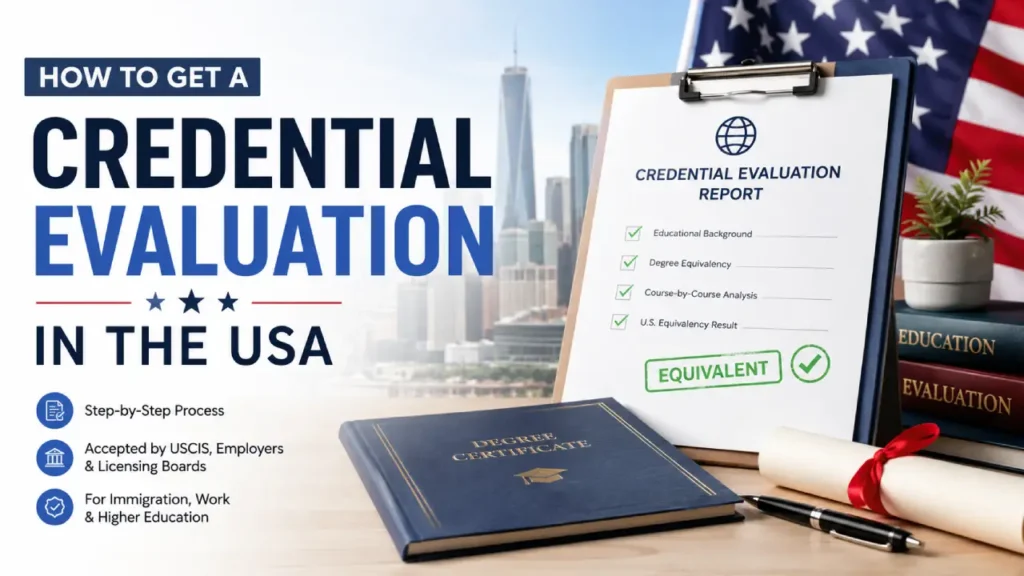
Getting a credential evaluation in the USA involves four steps: choose an accredited agency such as AAE Evaluations, EEE of America, or EBS of America, gather your official academic documents (transcripts, degree certificates, and certified translations if needed), submit your application online and pay the fee, then receive your formal equivalency report. The process typically takes 7–21 business days. Agencies like AAE Evaluations and EEE of America are accepted by USCIS, U.S. employers, universities, and state licensing boards — making them trusted choices for immigration petitions, graduate admissions, and professional licensing alike. The type of evaluation you need — general, course-by-course, or work experience — depends on what the receiving institution requires.
What Is a Credential Evaluation?
A credential evaluation (also called a foreign credential evaluation or education evaluation) is a formal assessment prepared by an accredited evaluation agency that compares your foreign academic degrees, diplomas, or professional experience to the equivalent U.S. standard.
The report typically states:
- The U.S. degree equivalent of your foreign credential
- The name and location of the institution you attended
- The year your credential was awarded
- Your major field of study
- A professional opinion from an evaluator regarding the equivalency
Quick answer: A credential evaluation tells U.S. employers, universities, and USCIS what your foreign degree is worth in American terms — and it carries legal evidentiary weight in immigration proceedings.
Credential evaluations are used for:
- Immigration — H-1B, EB-1, EB-2 NIW, EB-3, O-1, L-1, TN, and green card petitions
- University admissions — graduate and undergraduate programs requiring foreign transcript assessment
- Employment — HR verification, background checks, and job applications requiring U.S. degree equivalency
- Professional licensing — nursing, teaching, engineering, accounting, and other regulated professions
Who Needs a Credential Evaluation?
You need a credential evaluation if you fall into any of these categories:
International professionals applying for U.S. work visas.
Most employment-based visa categories require proof that your foreign degree meets U.S. specialty occupation standards. For H-1B applications, USCIS requires either a U.S. bachelor’s degree or its foreign equivalent. An education evaluation provides that equivalency in writing.
Immigrants applying for green cards.
EB-2, EB-3, and PERM labor certification cases require USCIS and the Department of Labor to confirm your educational qualifications meet the job requirements listed in your petition.
International students applying to U.S. colleges and universities.
Graduate programs require credential evaluations to verify that your undergraduate degree meets U.S. admission standards. Course-by-course evaluations are often required for programs that need GPA conversion.
Professionals seeking U.S. licensure.
State boards for nursing, medicine, engineering, teaching, and accounting typically require a credential evaluation before granting a license to a foreign-trained professional.
EB-2 NIW and EB-1 self-petitioners.
If you are filing without an employer sponsor, establishing that your credentials meet the exceptional ability or advanced degree standard requires a formal evaluation letter.
Types of Credential Evaluations
Choosing the right evaluation type before you apply prevents delays, rejections, and unnecessary costs. The type you need depends entirely on what the receiving institution or agency requires.
1. Document-by-Document Evaluation (General Evaluation)
This is the most common type. It provides a summary-level assessment of your degree, diploma, or certificate and states the U.S. equivalent. It does not include course-level detail.
Best for: H-1B petitions, employment verification, university admission where only degree equivalency is needed, EB-2 NIW filings.
2. Course-by-Course Evaluation
This evaluation goes deeper. It analyzes every course listed on your transcript, converts your grades to a U.S. GPA scale (typically 4.0), calculates U.S. credit hours, and maps each course to its American equivalent.
Best for: Graduate school admissions, nursing and medical licensing boards, situations where the receiving institution needs full academic history and GPA.
EEE of America’s course-by-course evaluation provides this detailed breakdown for international students and professionals, mapping each subject’s credit equivalency for U.S. academic recognition.
3. Work Experience Evaluation
When you don’t have a formal degree — or your degree is below U.S. bachelor’s level — a work experience evaluation can establish equivalency through professional experience. USCIS allows certain visa categories to substitute three years of relevant work experience for each year of missing education.
Best for: H-1B petitions where the applicant holds a three-year degree or no degree, non-degree pathways for EB-3.
AAE Evaluations’ work experience evaluation is built specifically for immigration petitions, converting professional experience into documented academic equivalency that USCIS and attorneys can use in filings.
4. Position Evaluation (Position-by-Position)
A position evaluation assesses whether a specific job role qualifies as a specialty occupation under USCIS standards. This is separate from — and complementary to — an education evaluation.
Best for: H-1B specialty occupation arguments, L-1B specialized knowledge letters, RFE responses challenging the nature of the role.
5. Expert Opinion Letter (EOL)
Not a traditional credential evaluation, but closely related. An expert opinion letter is written by a qualified academic or industry authority and provides an independent professional opinion on whether a candidate’s qualifications meet USCIS requirements for a specific visa category.
Best for: EB-1A extraordinary ability, EB-2 NIW national interest waivers, H-1B RFE responses, O-1 petitions.
AAE Evaluations’ expert opinion letters are prepared by credentialed field experts and address the specific evidentiary standards each visa category requires — including the three Dhanasar prongs for NIW cases.
How to Get a Credential Evaluation: Step-by-Step
Step 1: Confirm What the Recipient Requires
Before contacting any evaluation agency, find out exactly what the receiving institution or agency needs.
Ask your immigration attorney, university admissions office, licensing board, or HR department:
- Which type of evaluation is required (document-by-document or course-by-course)?
- Do they accept any NACES-member agency, or do they specify a particular provider?
- Is an expert opinion letter required alongside the academic evaluation?
- What turnaround time do you need?
Skipping this step is one of the most common — and most costly — mistakes applicants make. Ordering the wrong evaluation type, or ordering from an agency the recipient does not accept, means starting the process over.
Step 2: Choose an Accredited Evaluation Agency
The agency you choose must be recognized by the institution or agency receiving your report. For U.S. immigration purposes, agencies that work directly with USCIS filings are your strongest option.
What to look for in an evaluation agency:
- Evaluators with PhD-level credentials in relevant fields
- Specific experience with USCIS and immigration-based evaluations (not just academic assessments)
- Proven track record with the visa category you are filing under
- Fast turnaround options if you are on a deadline
- Bundled services if you need both an evaluation and an expert opinion letter
Three agencies worth considering for immigration-focused evaluations:
AAE Evaluations — A full-service provider handling education evaluations, work experience evaluations, position evaluations, expert opinion letters, and business plans under one roof. This matters when your attorney is filing a complex EB-1, NIW, or H-1B petition and needs all documents to be consistent. AAE evaluators are specialists in immigration, not general academic assessment. Their education evaluation for USCIS is structured to meet the specific format immigration attorneys and adjudicators expect. They also offer course-by-course evaluation with GPA and credit conversion for cases where detailed academic history is required.
EEE of America — An established credential evaluation firm with over eight years of experience and a team of PhD-level evaluators. EEE of America handles education evaluations, work experience evaluations, course-by-course evaluations, expert opinion letters, position evaluations, and certified translations. Their reports are accepted by USCIS, U.S. colleges, universities, employers, and state licensing boards. For green card applicants, their education evaluation for green card guide is a practical resource that covers the key differences between H-1B and EB-2/EB-3 evaluation standards.
EBS of America — Focused on the self-petition categories: EB-1A extraordinary ability, EB-2 NIW, and O-1 visa strategies. EBS of America specializes in building the evidence narratives that USCIS needs to see for exceptional professionals — with a reported 97% approval rate on their cases. They offer free profile evaluations, which is a practical starting point if you are unsure which visa category fits your profile.
Step 3: Gather Your Documents
Once you know which agency you are using and what evaluation type you need, collect your academic documents. Incomplete submissions are the most common cause of evaluation delays.
Standard documents required for most credential evaluations:
- Official transcripts — Must be issued directly by your academic institution, either in a sealed envelope or sent electronically through a secure platform. Some agencies accept scanned copies uploaded through a secure portal.
- Degree certificate or diploma — A legible copy of your degree showing your name, the institution, and the date of award.
- Certified translations — Any document not in English must be accompanied by a certified, word-for-word translation. Some agencies provide this service directly; others require you to use an approved third-party translator.
- Government-issued ID — A passport or national ID may be required to confirm that your name matches the documents submitted.
- For work experience evaluations: Employment verification letters, a detailed resume, and job duty descriptions from each employer.
Important: Some countries use central government issuing authorities rather than individual institutions to distribute official academic records. If your country requires this, contact the appropriate ministry or national authority before applying — not your university.
Step 4: Submit Your Application
Most evaluation agencies operate through an online portal. The general process is:
- Create an account on the agency’s website
- Select the evaluation type that matches your needs
- Enter your personal and educational details accurately
- Upload or arrange delivery of your required documents
- Pay the evaluation fee
- Submit your application
Pay close attention to how documents must be received. Many agencies allow electronic uploads of scanned copies. Others require official documents to be mailed directly from your institution. Some accept both. Confirm this before you order.
AAE Evaluations’ pricing page and EEE of America’s pricing page both list current fees by service type. For immigration cases, always confirm fees directly with the agency since pricing can vary by visa category and turnaround speed.
Step 5: Track Your Evaluation and Respond to Requests
After you submit, the agency reviews your documents and prepares your report. During this time:
- Watch for email requests for additional information. Evaluators sometimes need to verify specific credentials or request supplemental documents from your institution.
- Respond quickly. Delays in responding to evaluator requests are the most controllable factor in your turnaround time.
- Add the agency’s email address to your contacts so correspondence does not land in spam.
If your evaluation goes on hold — meaning the evaluator cannot proceed without additional documentation — the agency will contact you with specific instructions.
Step 6: Receive and Review Your Evaluation Report
Once complete, most agencies deliver your report digitally first, with an option to receive a printed hard copy by mail.
When your report arrives, review it carefully:
- Confirm that your name matches exactly as it appears on your immigration documents and other filings.
- Verify that every degree or credential you submitted is listed.
- Check that the U.S. equivalency stated matches what your attorney or institution expects.
If anything is incorrect, contact the agency immediately. Errors in evaluation reports — especially name discrepancies — can cause delays at USCIS.
Step 7: Submit the Report to the Recipient
Your credential evaluation report is now ready to submit. Depending on your purpose:
- For immigration petitions: Your attorney will include the evaluation in your petition package submitted to USCIS.
- For university applications: Submit directly to the admissions office as part of your application materials.
- For employer or licensing board use: Provide the report as part of your credential verification package.
Keep digital and physical copies of your evaluation report. You may need it for future visa renewals, green card applications, or employment changes.
How Long Does a Credential Evaluation Take?
Turnaround times vary by agency and service level. Standard processing typically takes 7 to 21 business days. Most agencies offer rush or expedited options with faster turnaround.
For immigration purposes, always order well in advance. Attorney preparation, USCIS processing, and any RFE responses all require time beyond the evaluation itself.
How Much Does a Credential Evaluation Cost?
Fees vary by evaluation type and agency. General ranges in 2026:
| Evaluation Type | Typical Fee Range |
|---|---|
| Document-by-document (general) | $100 – $180 |
| Course-by-course | $150 – $250 |
| Work experience evaluation | $150 – $300 |
| Position evaluation | $200 – $350 |
| Expert opinion letter | $300 – $800+ |
Rush processing typically adds 50–100% to the base fee. Always verify current pricing directly with your chosen agency.
Common Mistakes to Avoid
Ordering the wrong evaluation type. Confirm with your attorney, admissions office, or licensing board before placing your order. A course-by-course evaluation and a document-by-document evaluation serve different purposes.
Submitting incomplete documents. Missing transcripts, missing translations, or documents with incorrect names will put your evaluation on hold. Prepare everything before you apply.
Choosing an agency the recipient does not accept. For Canadian immigration, WES is the designated evaluator. For specific U.S. nursing boards or medical licensing authorities, check whether the board specifies approved agencies before ordering.
Waiting until the last minute. Even standard evaluations take time. For visa petitions with filing deadlines, factor evaluation time into your overall timeline from the start.
Assuming an H-1B evaluation works for a green card. The H-1B 3-for-1 work experience substitution rule does not apply to green card adjudication. If you are transitioning from an H-1B to an EB-2 or EB-3 filing, you may need a new evaluation that meets the stricter green card standard.
Credential Evaluation for Specific Immigration Categories
H-1B Visa
For H-1B petitions, USCIS requires proof that the beneficiary holds at least a U.S. bachelor’s degree equivalent in the specialty occupation field. A document-by-document education evaluation — or a work experience evaluation if the applicant lacks a formal four-year degree — satisfies this requirement.
EEE of America’s education evaluation for H-1B is designed specifically around the H-1B specialty occupation standard and is widely accepted in USCIS filings.
AAE Evaluations’ H-1B education evaluation is also structured for H-1B requirements, with evaluators who understand how USCIS adjudicates specialty occupation and education equivalency arguments.
EB-2 NIW (National Interest Waiver)
EB-2 NIW applicants must establish that they hold an advanced degree or exceptional ability. A credential evaluation proving the U.S. master’s or PhD equivalency of your foreign degree is a foundational document in most NIW petitions.
Beyond the academic evaluation, an expert opinion letter addressing the Dhanasar three-prong test is standard practice for NIW cases. AAE Evaluations’ EB-2 NIW expert opinion letter is written to directly address all three prongs — the merit and national importance of your work, your position to advance it, and the national interest in waiving the labor certification requirement.
EBS of America focuses exclusively on self-petition categories including EB-2 NIW, building complete evidentiary packages for professionals filing without employer sponsors.
EB-1A Extraordinary Ability
EB-1A does not require a traditional academic credential evaluation in the same way EB-2 does, but expert opinion letters from qualified authorities in your field are a core component of most successful petitions.
AAE Evaluations’ EB-1A expert opinion letter addresses the extraordinary ability criteria — documented achievements, peer recognition, contribution to the field, and the claim of being among the top in your profession.
O-1 Visa
O-1A petitions for extraordinary ability in science, education, business, or athletics require evidence of sustained national or international acclaim. An expert opinion or advisory letter from a recognized authority in the field is one of the most effective supporting documents.
EEE of America’s expert opinion letters for O-1 are prepared to address the O-1 extraordinary ability standard directly, providing the independent corroboration that USCIS expects in O-1 filings.
Green Card (EB-2 / EB-3 / PERM)
Green card cases applying under EB-2 or EB-3 through PERM labor certification require education evaluations that meet a stricter standard than H-1B. The H-1B 3-for-1 work experience rule does not apply here. Your evaluation must demonstrate that your foreign degree meets the minimum education requirement stated in the PERM job description.
How to Read Your Credential Evaluation Report
Your report will include several standard sections:
Applicant information — Your name, date of birth, and the country where your credential was earned.
Institution profile — A brief description of the foreign institution, including its accreditation status and recognition in its home country’s education system.
Credential details — The specific degree, diploma, or certificate evaluated, including dates of attendance and the field of study.
U.S. equivalency statement — The evaluator’s professional opinion on the U.S. equivalent of your credential. This is the most important section and the one USCIS, employers, and universities rely on.
Evaluator signature and credentials — The name, title, and qualifications of the evaluator who prepared the report.
FAQ: Credential Evaluations in the USA
What is the difference between a credential evaluation and an expert opinion letter?
A credential evaluation compares your foreign degree to a U.S. degree equivalent and is prepared by an evaluation agency. An expert opinion letter is written by a qualified professional in your field and provides an independent assessment of your qualifications, often for a specific visa category. Many immigration petitions require both.
How do I know which type of credential evaluation I need?
Ask the institution or agency requesting the evaluation — your immigration attorney, university admissions office, employer, or licensing board. The recipient determines the type. If they do not specify, a document-by-document evaluation is typically the standard starting point for immigration purposes.
Can a credential evaluation be used for multiple purposes?
Depends on the agency and purpose. Some agencies issue reports that are accepted for both employment verification and immigration. Others issue purpose-specific reports. Confirm with your agency before ordering if you intend to use the same report for more than one purpose.
What if my documents are not in English?
All non-English documents must be accompanied by certified, word-for-word translations before they can be evaluated. Many credential evaluation agencies offer translation services directly. EEE of America provides certified document translations as part of their service offering, which can simplify the process.
How long is a credential evaluation valid?
Credential evaluation reports do not technically expire, but some institutions and agencies — particularly USCIS — may not accept evaluations that are several years old if significant time has passed. For ongoing immigration proceedings, always check whether a current evaluation is required.
What happens if USCIS issues an RFE about my credentials?
An RFE challenging education equivalency or specialty occupation requires a supplemental response, which may include a new or additional expert opinion letter. Both AAE Evaluations and EEE of America handle RFE-specific expert opinion letters designed to directly address the concerns raised by USCIS.
What is NACES and does it matter?
NACES (National Association of Credential Evaluation Services) is a professional association of credential evaluation agencies in the United States. Some universities and licensing boards require evaluations from NACES-member agencies. For immigration purposes, USCIS does not mandate NACES membership, but does require that the evaluating agency and evaluator have recognized authority in the relevant field.