
EB-2 NIW Business Plan Services | USCIS-Ready Plans
Your proposed endeavor can be brilliant and still draw a request for evidence if the document meant to prove it reads like an investor pitch. We write USCIS-ready EB-2 NIW business plans for self-petitioners, built section by section to satisfy the Dhanasar standard and to work in lockstep with the rest of your petition. Every plan is prepared by writers who understand what a USCIS officer is actually looking for: proof that your endeavor is real, executable, and nationally significant, and that you are the right person to advance it.
We do not hand you a template. We build a tailored, evidence-driven document around your field, your traction, and the specific national need your work addresses, then align it with your credential evaluation and expert letters so the whole package tells one consistent story.
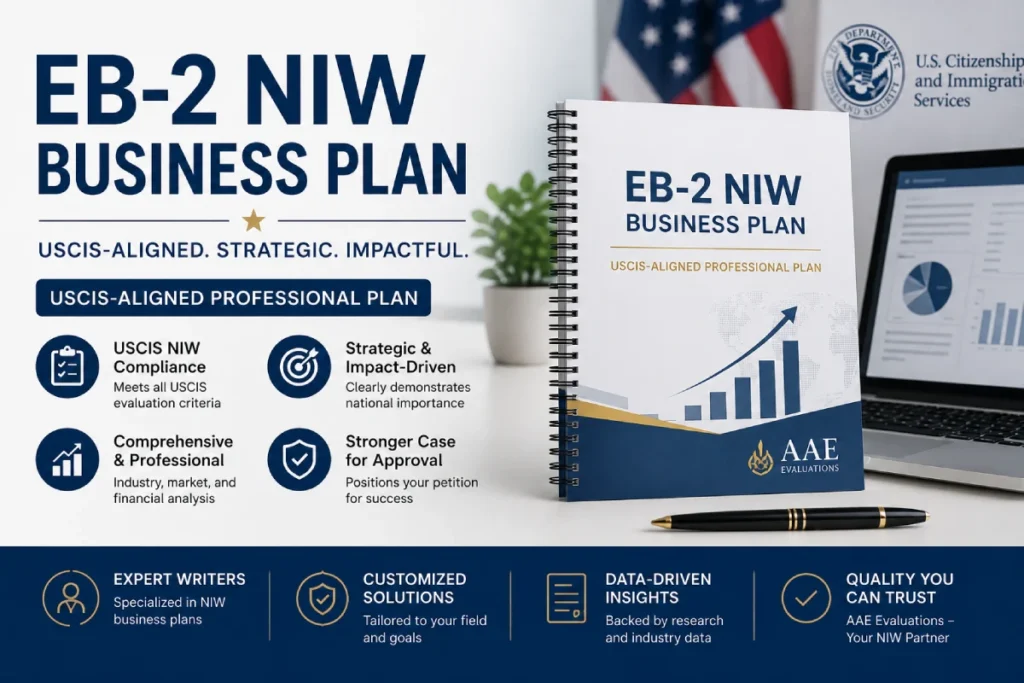
What You Get With Our EB-2 NIW Business Plan Service
Our EB-2 NIW business plan service delivers a complete, USCIS-ready document of 25 to 40 pages, written specifically for the National Interest Waiver standard rather than for investors. Each plan is mapped to the three Dhanasar prongs, built on sourced market data, and structured so an adjudicating officer can follow your national interest argument from the first page to the last.
Here is what every plan includes.
| Deliverable | What it covers |
|---|---|
| Dhanasar-aligned structure | Each section tied to substantial merit, national importance, positioning, and the waiver benefit |
| Executive summary | A national-importance hook written for a USCIS officer, not a venture capitalist |
| Founder profile | Your credentials and track record connected directly to the proposed endeavor |
| Market and industry analysis | Sourced government, academic, and sector data proving a documented national need |
| Operations and management plan | A realistic, executable roadmap with specific U.S. job creation |
| Five-year financial projections | Conservative, moderate, and optimistic scenarios, internally consistent throughout |
| National interest justification | Named federal priorities, policy documents, or measurable national gaps |
| Revision support | Refinements to keep the plan consistent with your full petition |
Every section reinforces the same argument rather than operating in isolation, because internal consistency is exactly what tells an officer the venture is real.
What an EB-2 NIW Business Plan Must Prove
An EB-2 NIW business plan is a legal-evidentiary document that demonstrates your proposed endeavor is real, executable, and nationally significant, and that you are well positioned to carry it out. Unlike a standard plan built around profitability, it is written for a USCIS officer applying the Dhanasar test. Its job is to make your national interest argument credible through specific evidence, not to sell a market opportunity. For a plain-language overview of the underlying category, the National Interest Waiver entry is a useful primer.
That single purpose changes how the document is written. A traditional plan answers “will this company return capital?” Ours answers a different question: “does the United States benefit enough from this specific person’s work to waive the labor certification requirement?” Every section we write is built to answer that question, which is why we map each one to a Dhanasar prong before we write a word.
Prong 1: Substantial Merit and National Importance
The January 2025 USCIS policy update tightened this prong sharply. General claims about economic benefit no longer carry weight, so we anchor your endeavor to named federal programs, policy reports, government data on critical gaps, or measurable national challenges. The market analysis and national interest sections are where we make this argument land.
Prong 2: Well Positioned to Advance the Endeavor
Positioning must be demonstrated as of your filing date, not projected into the future. We build your founder profile and operations sections around current traction: signed clients, contracts, investment commitments, incubator acceptance, patents, grants, or credible letters of interest. This is also where a strong EB-2 NIW expert opinion letter reinforces the plan by having an independent authority confirm your standing.
Prong 3: Why Waiving the Job Offer Benefits the U.S.
For founders and self-employed applicants, this prong is usually the most straightforward. We make the nature of your work and your independent role clear, which shows why the standard labor certification process does not fit your situation and why self-petitioning serves the national interest.
Inside Our EB-2 NIW Business Plan Sample: Section by Section
Every EB-2 NIW business plan sample we produce moves through eight core sections, each engineered to reinforce your national interest argument. The structure mirrors how a USCIS officer reads: orientation first, then proof, then justification. Below is what each section accomplishes and the standard we hold it to.
The executive summary frames everything that follows, so we lead with the national-scale problem your work addresses, then introduce you as the person positioned to solve it. The founder profile is a targeted narrative, never a résumé restatement, tying your education, patents, grants, and recognition directly to the endeavor. For advanced-degree applicants, this section leans on a formal credential evaluation, because a foreign degree means nothing to USCIS until it is shown to equate to a U.S. advanced degree.
The industry and market analysis establishes a documented national need using credible sources, not vague growth claims. The business description and operations plan explain what you offer, why it is distinct, and how it is executable today. The management and hiring plan names specific roles, timelines, and rationale for U.S. job creation. Five-year financial projections stay internally consistent with the market analysis across conservative, moderate, and optimistic scenarios. And the national interest justification, the section that decides most cases, names the specific federal initiative or measurable national gap your endeavor addresses.
Pro Tip: The fastest way a plan draws scrutiny is a financial projection that contradicts the market analysis, or a founder profile that reads like a CV. We pressure-test every plan for internal consistency before delivery, the same way an officer cross-references the document.
Who Needs a Business Plan for EB-2 NIW
A business plan for EB-2 NIW is essential for entrepreneurs, founders, and independent professionals whose endeavor is commercial or service-based. It is the wrong document for pure researchers and academics, who are better served by a research or professional plan. We prepare both, and we will tell you honestly which one your case needs before you commit, because submitting the wrong document type is one of the most avoidable causes of an RFE.
Entrepreneurs starting or scaling a U.S. company need a plan to show how the work drives innovation, creates jobs, or addresses a national challenge, especially before there is revenue or a full team. Independent professionals in tech, design, education, or public health use the plan to clarify scope, target clients, and how their services support U.S. industries without a fixed employer. Researchers and academics need a parallel research plan covering objectives, methodology, funding, dissemination, and national impact, and they often lean more heavily on EB-2 NIW recommendation letters.
Important: Applicants qualifying under the exceptional ability route rather than the advanced degree route need a different evidence mix, with the plan emphasizing the work itself over academic credentials. Our breakdown of the EB-2 exceptional ability standard explains when that path is the stronger argument.
Our EB-2 NIW Business Plan Writing Process
Our process is built to produce a defensible document with minimal back-and-forth, in five clear steps.
- Discovery and intake. We learn your endeavor, your field, your traction, and your qualifying basis, then confirm whether a commercial business plan or a research plan fits your case.
- National interest mapping. We identify the federal priorities, policy documents, or measurable national gaps your work addresses and build the Dhanasar argument before drafting.
- Research and drafting. We assemble sourced market data and write all eight sections so each reinforces the same national interest argument.
- Consistency review. We cross-check projections, dates, job titles, and degree equivalencies against your proposed endeavor statement, letters, and credential evaluation.
- Delivery and revisions. You receive a USCIS-ready plan, and we refine it so it stays aligned with the rest of your petition package.
We confirm exact turnaround and current rates during intake, scoped to your filing timeline.
Why Choose AAE Evaluations for Your EB-2 NIW Business Plan
We are not a generic business-plan shop adapting an investor template for immigration. We work exclusively in the immigration evidence space, preparing credential evaluations, expert opinion letters, and business plans for visa petitions, which means every plan is written from the start to do an evidentiary job under USCIS scrutiny.
Three things set our service apart. First, we build the plan around the current, post-2025 Dhanasar standard, so the national importance argument meets today’s stricter review rather than a pre-2025 strategy. Second, we coordinate the plan with your other documents in-house, so your credential evaluation, recommendation letters, and proposed endeavor statement all agree on the facts. Third, we tell you honestly when a business plan is not the right document, because a mismatched submission helps no one. With clients across more than 40 nationalities and PhD-credentialed subject-matter writers, we prepare plans that read as coherent, sourced, and serious.
How Your Business Plan Works With Your Full Petition
A business plan is one pillar of a multi-document petition, and it is strongest when every piece points the same direction. The plan establishes feasibility and national importance, your proposed endeavor statement carries the legal argument, expert and recommendation letters supply independent corroboration, and a credential evaluation translates a foreign qualification into the U.S. equivalency USCIS recognizes. We build these to reinforce each other, not contradict.
Credential evaluation is the piece applicants most often underestimate. USCIS does not accept foreign transcripts at face value, so a foreign degree needs a formal evaluation establishing U.S. degree equivalency before the advanced-degree prong is met. For applicants qualifying on experience, a work experience evaluation or a course-by-course evaluation does the equating work instead. On the letters side, our immigration recommendation letter template and our guide to choosing a credential evaluation service show how these documents fit together.
EB-2 NIW Filing Costs in 2026: Government Fees vs. Service Fees
USCIS government fees are set by the agency and paid separately from any plan-writing service. As an individual self-petitioner, you pay the reduced Asylum Program Fee by indicating on Form I-140 that you employ 25 or fewer full-time equivalent workers. Here is the current 2026 breakdown so you can budget the full petition.
| Item | 2026 Fee | Notes |
|---|---|---|
| Form I-140 base filing fee | $715 | Required for the petition |
| Asylum Program Fee (reduced) | $300 | Individual self-petitioners; check “Yes” to 25 or fewer employees on I-140, Part 1, Q6 |
| Premium processing (Form I-907) | $2,965 | Optional; effective March 1, 2026; 45 business-day action window for NIW |
| Form I-485 (adjustment of status) | $1,440 | Green card stage, filed when your priority date is current |
The core petition outlay is roughly $1,015 to USCIS at the I-140 stage, with premium processing and adjustment of status as separate later costs. Our business plan service fee is independent of these government fees. USCIS filing fees are non-refundable, so a complete, well-evidenced package filed once is far cheaper than an avoidable RFE or denial. See our service pricing for current rates, and pay online once you are ready to begin.
Processing Times and the Visa Bulletin
A standard I-140 NIW petition currently takes roughly 8 to 14 months. Premium processing requires USCIS to act within 45 business days, though it does not move your place in the green card line. For most applicants, the real timeline is set by when the Visa Bulletin allows the move to adjustment of status or consular processing.
| EB-2 country | Final Action Date (2026 Bulletin) | Dates for Filing |
|---|---|---|
| Most countries | October 1, 2024 | Current |
| China | September 1, 2021 | January 1, 2022 |
| India | September 15, 2013 | November 1, 2014 |
These dates move monthly, so always check the current month before planning. You can confirm your underlying eligibility against the EB-2 immigrant visa category requirements before filing.
Ready to Build Your EB-2 NIW Business Plan?
A strong plan is the difference between a petition that argues your case and one that merely describes your business. We build USCIS-ready EB-2 NIW business plans coordinated with your credential evaluation and expert letters, so your full petition tells one consistent, well-evidenced story. Start your order online today, and our team will take it from there.
Frequently Asked Questions
Is a business plan required for an EB-2 NIW petition?
A business plan is not a mandatory USCIS form, but for entrepreneurial and commercial endeavors it is the most effective way to satisfy the evidence USCIS does require. USCIS recognizes business plans as relevant evidence for entrepreneur-oriented cases and frequently requests one through an RFE when it is missing. Filing a strong plan upfront is generally better than waiting to be asked.
How much does an EB-2 NIW business plan cost?
Our business plan service fee is separate from USCIS government fees, which in 2026 are $715 for Form I-140 plus a $300 reduced Asylum Program Fee for individual self-petitioners. Service pricing varies by the complexity of your endeavor. Visit our pricing page or contact us with your details for an exact quote tailored to your case.
How long does it take to write the plan?
Turnaround depends on the complexity of your endeavor and how quickly you provide your background, traction, and supporting details. Contact our team with your filing timeline and we will confirm a realistic delivery window. We also coordinate timing with premium processing when your I-140 is on the 45-business-day clock.
Do you write the plan to match current USCIS requirements?
Yes. Every plan is built around the post-2025 Dhanasar standard incorporated into USCIS Policy Manual Volume 6, Part F, Chapter 5. We map each section to a Dhanasar prong, anchor the national importance argument to named federal priorities, and avoid the generic economic claims that draw scrutiny under current adjudication.
What information do you need from me to start?
We need your field, your proposed endeavor, your qualifying basis (advanced degree or exceptional ability), and any traction you already have, such as clients, contracts, patents, grants, or letters of interest. During intake we confirm whether a commercial business plan or a research plan fits your case before we begin drafting.
Can you write the business plan alongside my credential evaluation and letters?
Yes, and we recommend it. Preparing your plan, credential evaluation, and expert or recommendation letters together lets us keep the facts consistent across every document. Officers cross-reference these, and contradictions between a plan and an evaluation or letter are a frequent, avoidable cause of RFEs.
What if I do not have revenue yet?
Many successful NIW founders file before generating revenue. The plan compensates by demonstrating traction in other forms: signed clients, contracts, investment commitments, incubator acceptance, patents, or credible letters of interest. The second Dhanasar prong asks whether you are well positioned at filing, and early traction answers that without established revenue.
Do researchers and academics need a different document?
Usually, yes. Pure research and academic endeavors are better served by a research or professional plan covering objectives, methodology, funding, dissemination, and national impact. We prepare both document types and will tell you which one your case needs. The structure differs, but the purpose, showing the endeavor is real and nationally important, stays the same.
How long should an EB-2 NIW business plan be?
Most well-prepared plans run 25 to 40 pages, depending on the complexity of the venture, plus supporting exhibits. Length matters far less than substance. A focused plan that addresses the Dhanasar framework with specific evidence and consistent projections is more persuasive than a longer document padded with generic content.
What is the most common reason a business plan triggers an RFE?
The national importance argument under the first Dhanasar prong is the most frequent trigger in 2026. Officers want measurable evidence that the endeavor benefits the country broadly, not just the applicant’s clients. Generic economic claims, vague descriptions of the work, and projections disconnected from real market data are the usual culprits, all of which we are built to avoid.
Can you help if I already received an RFE?
Yes. We frequently strengthen petitions after an RFE by revising or rebuilding the business plan, adding sourced market data, and tightening the national interest argument to address exactly what the officer flagged. Contact us with your RFE notice and we will assess how the plan can be improved to respond.
How do revisions work?
After delivery, we refine the plan so it stays consistent with the rest of your petition package as it comes together. We focus revisions on keeping projections, dates, job titles, and degree equivalencies aligned across your plan, letters, and credential evaluation, rather than rewriting whole sections unnecessarily.
Why choose AAE Evaluations over a general business-plan writer?
We work exclusively in immigration evidence, so every plan is written from the start to satisfy USCIS scrutiny rather than impress investors. We build to the current Dhanasar standard, coordinate your plan with your evaluation and letters in-house, and advise honestly on document type. That combination is what produces a coherent, defensible petition.
Final Thoughts
Your EB-2 NIW business plan should do one thing exceptionally well: prove that a real, executable endeavor serves the national interest and that you are the person to advance it. We build that document around the current Dhanasar standard and coordinate it with your credential evaluation and expert letters so your full petition reads as one consistent, well-evidenced case. To get started, talk to our team today.
This page is general information, not legal advice. EB-2 NIW outcomes depend on case-specific facts, current USCIS guidance, and visa availability. Verify all fees and Visa Bulletin dates against official sources before filing.