
USCIS-Compliant O-1 Visa Business Plans
Need an O-1 Visa Business Plan for your USCIS petition? We create customized, immigration-focused business plans for entrepreneurs, executives, artists, scientists, and other extraordinary ability professionals seeking O-1 visa approval.
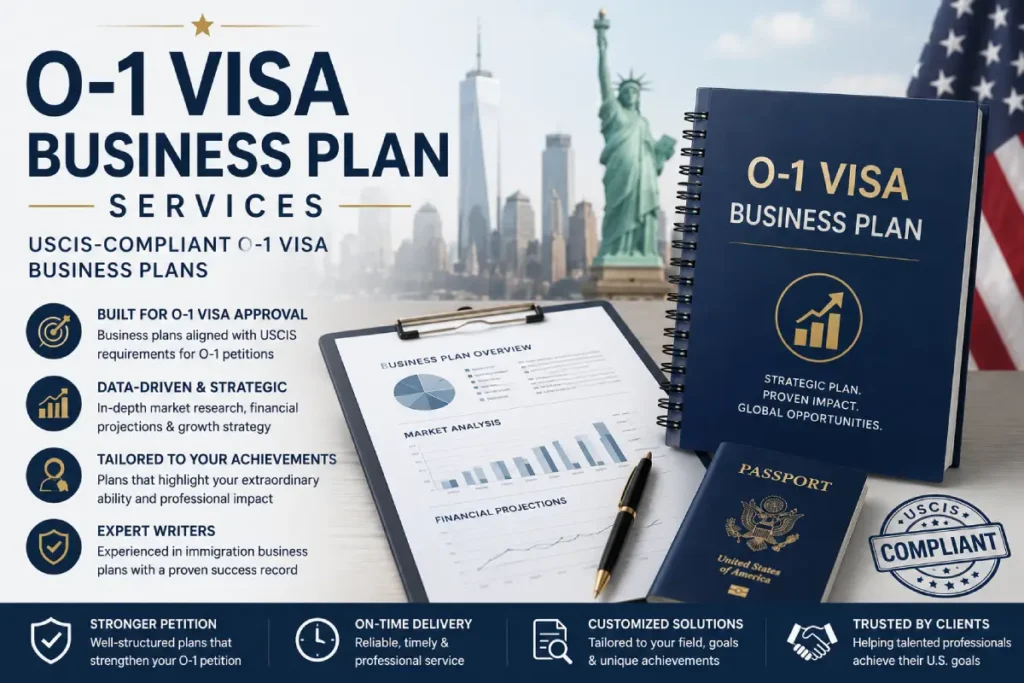
O-1 Visa Business Plan
An O-1 visa business plan is a tailored, USCIS-ready document that explains the work you will do in the United States, proves your venture is real and viable, and ties your extraordinary ability directly to a credible plan of activity. At AAE Evaluations, we write O-1 visa business plans that give adjudicators a clear, confident picture of your endeavor — so your petition reads as a serious case, not a hopeful one. Our plans are built to support your attorney’s filing, anticipate Requests for Evidence (RFEs), and stand on their own as evidence of a legitimate, fundable enterprise.
Get a Quote · View Pricing · Pay Online
What You Get With Our O-1 Visa Business Plan
Every engagement delivers a complete, submission-ready package — not a template. Your finished O-1 visa business plan includes:
- A fully written O-1 visa business plan (typically 25–40 pages) tailored to your field, your venture, and the O-1A or O-1B category you are filing under
- A beneficiary-centered narrative that positions you as the driving force behind the enterprise — the standard USCIS expects in O-1 cases
- A detailed market analysis with industry context, target market sizing, and competitive positioning
- Five-year financial projections — revenue model, profit-and-loss summary, cash-flow outlook, and key assumptions presented in clean, defensible tables
- A clear explanation of the employer–employee relationship, including governance structure where you petition through your own U.S. company
- A job-creation and U.S. economic-impact section that connects your work to tangible domestic benefit
- Professional formatting, charts, and source citations that match what immigration attorneys and adjudicators expect to see
- One round of revisions so the plan fits your final petition strategy
Direct answer: A strong O-1 visa business plan does three things at once — it describes your U.S. activities, demonstrates the venture is genuine and financially sound, and frames you as the individual of extraordinary ability at the center of it. We deliver all three in one cohesive document.
Why an O-1 Petition Benefits From a Business Plan
A business plan is not a mandatory USCIS form for the O-1 visa. So why include one? Because the O-1 petition is, at its core, an argument — and a well-built plan removes the doubt that leads to RFEs and denials.
When you petition through a startup or a small or newly formed company, USCIS scrutinizes whether the work is real, whether the employer can actually sustain the role, and whether your activities in the U.S. are concrete rather than speculative. A clear, credible plan answers those questions before an officer has to ask them. It is especially valuable for:
- Founders petitioning through their own U.S. entity, where the legitimacy and viability of the company is part of the case
- Startups and small employers, which typically face more questions about their ability to support the position
- Self-employed entrepreneurs and agent-filed cases, where the “endeavor” needs to be defined precisely
- Responding to an RFE, where a structured plan can directly address an officer’s stated concerns
The goal is to make the officer’s job easy. A petition that explains the venture clearly, backs it with realistic numbers, and connects your record to a defined plan of work is far harder to question.
What Goes Into Our O-1 Visa Business Plan
We build each plan around the questions an adjudicator is actually asking. Every section earns its place.
Executive Summary
A concise overview of the venture, your role, and the impact you will have in the U.S. — written so the entire case is understandable in the first read.
Beneficiary Profile (The Hero of the Plan)
Unlike a standard investor plan, an O-1 plan keeps you at the center. We document your background, recognition, and the extraordinary ability that makes the venture credible and you indispensable to it.
Market Analysis
Industry overview, demand evidence, target-market sizing, and competitive landscape — grounded in real, cited data, never invented statistics.
Products and Services
A clear description of what the business offers, how it operates, and why it is positioned to succeed.
Organization and the Employer–Employee Relationship
Because a founder cannot be the sole authority over their own employment, we document the company structure — board oversight, partners, or other governance — that establishes a bona fide employer–employee relationship consistent with USCIS expectations.
Marketing and Growth Strategy
How the venture will reach customers, scale, and sustain operations over the visa period.
Five-Year Financial Projections
Revenue forecasts, expense modeling, profit-and-loss summary, and cash-flow outlook — with stated assumptions so the numbers hold up under review.
Job Creation and Economic Impact
A realistic account of U.S. hiring, payroll, and broader contribution to the domestic economy.
O-1A vs O-1B: Which Plan You Need
The category you file under shapes how the plan is written. We tailor the document to match.
| O-1A | O-1B | |
|---|---|---|
| Who it’s for | Extraordinary ability in business, science, education, or athletics | Extraordinary ability in the arts, or extraordinary achievement in motion picture or television |
| Typical applicant | Founders, executives, researchers, technologists | Artists, designers, performers, directors, creative professionals |
| Plan emphasis | Venture viability, market traction, economic impact, financials | Proposed projects, engagements, body of work, and professional trajectory in the U.S. |
| Document framing | Traditional business plan structure | Strategic “professional plan” or endeavor document where a standard business plan doesn’t fit |
Featured-snippet answer: O-1A applicants (business, science, education, athletics) usually need a conventional business plan with financials, while O-1B applicants (arts, film, TV) are better served by a professional plan that maps their proposed U.S. projects and engagements. We build the right format for your category.
O-1 Visa Business Plan vs. a Standard Business Plan
An investor or bank business plan and an O-1 visa business plan share a skeleton — but they answer different questions. Using the wrong one weakens your petition.
| Feature | Standard Business Plan | O-1 Visa Business Plan |
|---|---|---|
| Primary audience | Investors, lenders | USCIS adjudicators |
| Central focus | Return on investment | The beneficiary’s extraordinary ability and defined U.S. activity |
| Financials | Growth and profitability story | Realistic, defensible viability that supports the role |
| Tone | Persuasive, optimistic | Credible, evidence-driven, RFE-aware |
| Employer relationship | Rarely addressed | Documented to satisfy employer–employee requirements |
| Compliance | Not a factor | Written to align with USCIS standards |
How Our Business Plan Helps You Avoid an RFE
A Request for Evidence delays your case by weeks or months and signals that the officer was not convinced. Our plans are written defensively to close the most common gaps before they become questions:
- “Is the work real?” — We define the endeavor, the timeline, and the deliverables in concrete terms.
- “Can the employer sustain the role?” — Financial projections and operational detail show the company can support you.
- “Is there a genuine employer–employee relationship?” — We document governance and oversight, critical for founder-owned entities.
- “Is this speculative?” — Cited market data, contracts or letters of intent where available, and a clear plan of activity establish that the work is grounded in reality.
Our Process — From Order to Delivery
A structured, predictable workflow keeps your filing on schedule.
- Consultation & Quote — Tell us your category, timeline, and venture. We confirm scope and pricing. Contact us to begin.
- Secure Payment — Confirm your order through our Pay Online page or review our pricing.
- Information Intake — You complete a focused questionnaire; we follow up for the details that strengthen the plan.
- Research & Drafting — Our team builds the plan: market research, financial modeling, and narrative, written to USCIS standards.
- First Draft & Review — You review the draft and share feedback.
- Revisions & Final Delivery — We refine the plan and deliver the submission-ready document, on time.
Featured-snippet answer: Most O-1 visa business plans are completed within a standard turnaround once intake is complete, with expedited options available when your filing date is tight. Confirm timing with us before you order.
Why Choose AAE Evaluations
- Immigration-focused, not generic. We write to the standards USCIS adjudicators apply — every plan is built for the petition, not repurposed from a startup template.
- Beneficiary-centered drafting. We keep your extraordinary ability at the heart of the document, the way O-1 cases are won.
- Defensible numbers. Financial projections are realistic and assumption-backed, never inflated to impress.
- A full evidence ecosystem. Beyond business plans, we provide O-1 expert and advisory letters and O-1 visa recommendation letters — so your supporting evidence is consistent and complete.
- Worldwide experience. We support applicants and attorneys across nationalities and industries.
- On-time delivery with revisions included.
Working on a different category? We also prepare L-1 expert opinions and business plans, EB-1 expert opinion letters, EB-1A recommendation letters, EB-2 NIW expert opinion letters, and H-1B expert opinion letters. Explore all our services.
O-1 Visa Costs and Timeline — What to Budget Around
Your O-1 visa business plan is one part of a larger filing. It helps to understand where it fits among the government costs your petitioner will pay. Note: these are USCIS government fees, separate from our business plan service fee.
- Form I-129 filing fee: Paid by the petitioner; the amount depends on the petitioner’s size and type. Always confirm the current figure on the official USCIS Fee Schedule.
- Premium processing (optional): $2,965 for Form I-129 as of March 1, 2026, which obligates USCIS to take action within 15 business days. This is filed on Form I-907 and is optional.
- Validity: The O-1 is granted for up to three years initially, with extensions available in increments of up to one year as long as the qualifying work continues.
Because USCIS fees and rules change, verify all current amounts directly with USCIS or your immigration attorney before filing. We keep our plans aligned with current standards so the document never becomes the weak link.
Featured-snippet answer: As of March 1, 2026, premium processing for an O-1 petition (Form I-129) costs $2,965 and guarantees USCIS action within 15 business days. The base I-129 filing fee is separate and depends on the petitioner; an O-1 business plan is a service cost, not a government fee.
Ready to Strengthen Your O-1 Petition?
Give your petition a business plan that does the convincing for you. Our team will build a tailored, USCIS-ready O-1 visa business plan that supports your case from the first page.
Get Started Today · See Pricing · Pay Online
Frequently Asked Questions
Is a business plan required for an O-1 visa?
No. A business plan is not a required USCIS form for the O-1 visa. However, it is one of the most effective ways to demonstrate that your venture is real and viable and that your proposed U.S. activities are concrete. It is especially valuable for founders, startups, and small or newly formed petitioning companies, and it can be a powerful tool when responding to a Request for Evidence.
Can I petition for an O-1 visa through my own company?
Yes, with conditions. You may form a U.S. entity and have it petition for you, but you cannot be the sole authority over your own employment. There must be a bona fide employer–employee relationship — usually established through a board of directors, partners, or other governance that can oversee your role. Our business plan documents this structure clearly so it supports your case.
What is the difference between an O-1 business plan and a regular business plan?
A regular business plan is written to persuade investors or lenders and centers on return on investment. An O-1 visa business plan is written for USCIS adjudicators, keeps the beneficiary’s extraordinary ability at the center, presents realistic and defensible financials, and is structured to satisfy immigration standards and pre-empt RFEs.
How long does an O-1 visa business plan take to prepare?
Most plans are completed within a standard turnaround once your intake questionnaire is complete and we have the information we need. Expedited options are available when your filing deadline is tight. Confirm timing with us before ordering so we can match your petition schedule.
Do you also provide O-1 supporting letters?
Yes. In addition to business plans, we prepare O-1 expert and advisory letters and O-1 visa recommendation letters, so all of your supporting evidence is consistent and works together.
How much does premium processing cost for an O-1 petition?
As of March 1, 2026, premium processing for Form I-129 is $2,965 and requires USCIS to act within 15 business days. This is a government fee filed on Form I-907 and is separate from both the base filing fee and our business plan service fee. Always confirm current amounts with USCIS before filing.
Does an O-1 business plan guarantee approval?
No service can guarantee a USCIS outcome, and any provider that promises approval should be treated with caution. What a strong, well-documented business plan does is materially strengthen your petition and reduce the risk of avoidable questions, RFEs, and denials.