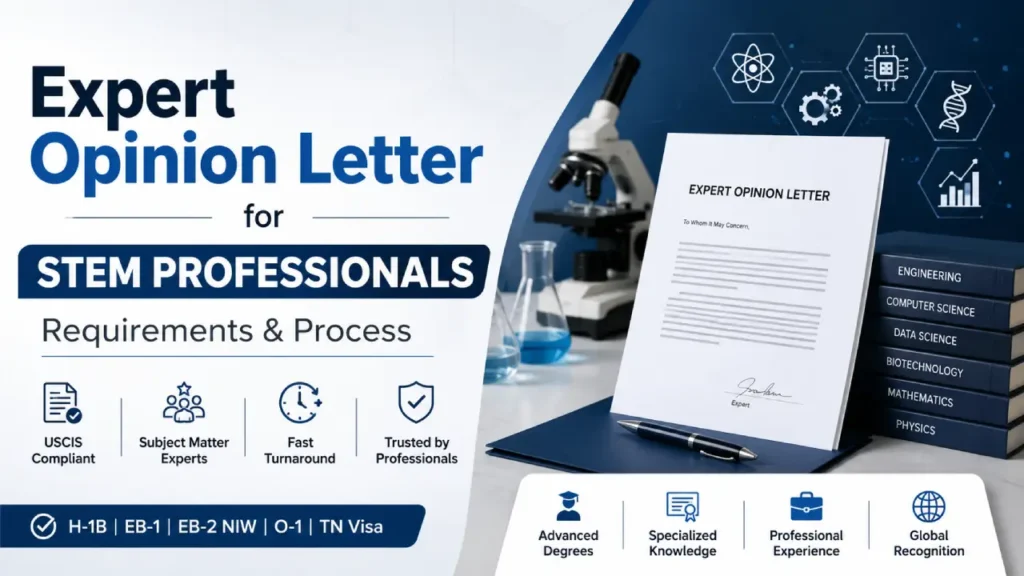
Quick Note: An expert opinion letter for STEM professionals is an independent, USCIS-facing document written by a credentialed authority in your field that evaluates your qualifications, achievements, and the national importance of your work. For scientists, engineers, mathematicians, and technology professionals, it’s often the most critical piece of evidence in EB-1, EB-2 NIW, H-1B, and O-1 visa petitions. A well-written letter directly maps your work to the legal standards USCIS adjudicators apply — and a poorly written one can sink an otherwise strong case.
📞 Get Started Today – Request a Free Consultation
Key Takeaways:
- Expert opinion letters carry disproportionate weight in STEM visa petitions because they translate technical achievements into the legal language USCIS officers understand
- STEM professionals face a unique challenge: their most impressive work (publications, patents, algorithms, research impact) needs reframing for a non-specialist adjudicator
- For EB-2 NIW, your letter must address all three Dhanasar prongs — not just your credentials
- The person who writes your letter matters as much as what they write — institutional affiliation, independence, and credentials all affect evidentiary weight
- RFE rates drop significantly when the letter is tailored to the specific visa category rather than reused across petitions
If you’re a STEM professional pursuing a U.S. visa, you’ve probably realized that your CV alone doesn’t tell the story USCIS needs to hear. A published paper in Nature is genuinely impressive — but an adjudicator reviewing hundreds of cases a week doesn’t have the domain knowledge to understand why it matters. That’s the gap an expert opinion letter fills.
The problem is that most professionals don’t fully understand what makes one of these letters strong, which means they either accept whatever their attorney hands them or they underestimate how much the quality of the letter affects outcomes. I’ve seen cases with genuinely extraordinary STEM backgrounds get RFE’d simply because the letter described the applicant’s work rather than analyzing its significance.
This guide covers everything you need to know: what the letter does, why it works differently for STEM fields, how to build a strong one, and what separates the letters that sail through from the ones that come back with a Request for Evidence. If you want to get a free case review from AAE Evaluations before reading further, that’s a solid starting point — but read on first so you understand exactly what you’re evaluating.
What Is an Expert Opinion Letter and Why Does It Matter for STEM Visas?
An expert opinion letter (also called an expert evaluation letter or expert reference letter) is an independent written analysis from a recognized authority in a specific field. It is not a character reference. It is not a recommendation letter. Those are different documents serving different evidentiary purposes — and conflating them is one of the most common mistakes STEM applicants make.
Think of it this way: a recommendation letter says “I’ve worked with this person and they’re excellent.” An expert opinion letter says “Based on my independent analysis of this person’s body of work, here is my expert judgment of its significance to the field and its national importance to the United States.”
That distinction matters enormously in immigration law. USCIS looks for independent, credible analysis — not praise from colleagues who have a personal stake in your success.
Why STEM Fields Require Specialized Letters
Most professional fields have relatively straightforward ways to demonstrate achievement: revenue generated, clients served, awards received. STEM is different. Your most meaningful contributions may be:
- A discovery that advances a subfield but won’t have commercial applications for a decade
- A patent that represents genuine innovation but isn’t yet licensed
- A citation count that’s high by academic standards but meaningless to a non-specialist
- Algorithm improvements measured in microseconds that power systems used by millions
An expert opinion letter for a software engineer, research scientist, or biomedical professional has to do something fundamentally harder than letters in other fields: it has to bridge the credibility gap between highly specialized achievement and general legal standards. The letter writer needs to explain why your H-index of 28 is extraordinary in your subfield, why your patent solves a problem that existing technology couldn’t, or why your research methodology has been adopted across the discipline.
That’s not something a generic template can accomplish.
Expert Opinion Letters by STEM Visa Category
EB-1A: Extraordinary Ability in Science, Technology, Engineering, or Mathematics
The EB-1A is the gold standard for STEM immigration — no employer sponsorship needed, no labor certification, priority processing. But the bar is correspondingly high: USCIS requires evidence that you’re among the top 1–5% of professionals in your field globally.
For STEM professionals pursuing EB-1A, the EB-1A expert opinion letter must do several things simultaneously:
Establish the writer’s credibility. The letter itself carries more weight when it comes from someone with a strong publication record, academic appointment, or industry recognition. An opinion from a full professor at a research university or a senior engineer at a top-tier technology company lands differently than one from a less-credentialed source.
Map your achievements to the ten regulatory criteria. USCIS uses a specific list of criteria for EB-1A — awards, judging, published material, original contributions, authorship in major media, critical role, high salary, and others. The letter needs to connect your record to the criteria you’re claiming, not just list your achievements chronologically.
Establish the field’s standards. This is where most generic letters fail STEM applicants. If you’re claiming “extraordinary” achievement, the letter needs to show what “ordinary” looks like in your field — and why your record stands above it. Citation rates that seem modest to the general public may be extraordinary for a narrow subfield. The letter needs to make that case explicitly.
One thing I’ve seen work particularly well: letters that quantify the peer review process itself. If an applicant has reviewed papers for journals that accept 8–12% of submissions, that reviewing role demonstrates expert-level standing in a way many adjudicators don’t initially recognize.
EB-1B: Outstanding Researcher or Professor
The EB-1B is employer-sponsored but doesn’t require a labor certification, making it highly attractive for STEM professionals in academic or research settings. The standard is slightly more accessible than EB-1A but still demanding: you need to show international recognition for outstanding achievements in your particular field.
The EB-1 expert opinion letters for EB-1B cases typically focus more heavily on peer recognition, the significance of your research contributions, and your standing within the research community. If your citation count is in the 90th percentile for your subfield, the letter should say so — and explain how citation analysis works in your discipline, because adjudicators often don’t know.
EB-2 NIW: National Interest Waiver for STEM
The EB-2 NIW is the most nuanced category for STEM professionals and, for many, the most accessible path to a green card without employer dependency. But the expert opinion letter for NIW is structurally different from all others — because it has to address three separate legal questions simultaneously.
The Matter of Dhanasar framework (the current legal standard for NIW adjudications) requires showing:
- Your proposed endeavor has substantial merit and national importance
- You are well-positioned to advance that proposed endeavor
- On balance, it would benefit the United States to waive the labor certification requirement
An EB-2 NIW expert opinion letter that only addresses your credentials — prong two — leaves two-thirds of the legal analysis to the adjudicator’s discretion. That’s a serious structural gap. The most effective NIW letters for STEM professionals weave all three prongs through the analysis, often using the applicant’s specific research area (machine learning safety, rare disease drug development, grid-scale energy storage) as the vehicle to demonstrate national importance.
The prong one opportunity that most letters miss: Many STEM fields have received explicit federal attention — through executive priorities, congressional funding, or agency initiatives. If your research area is listed in the National Science Foundation’s strategic priorities, or your engineering work addresses infrastructure that appears in federal legislative language, your letter can reference that alignment as evidence of national importance. It’s a stronger move than simply asserting that your field matters.
H-1B: Specialty Occupation Letters for Technology and Engineering
The H-1B expert opinion letter serves a more targeted purpose than immigrant visa letters: it establishes that the position qualifies as a specialty occupation and that your credentials meet those requirements.
For STEM roles, this often means:
- Demonstrating that the job requires theoretical and practical application of highly specialized knowledge
- Showing that a bachelor’s degree (or equivalent) in a specific STEM field is normally the minimum for entry into this role
- Establishing the equivalency of your degree if it came from a foreign institution or in a different field than your current role
STEM roles are generally easier to qualify as specialty occupations — but equivalency arguments for non-traditional educational backgrounds (a computer science PhD working in quantitative finance, for example) require more careful expert analysis.
O-1B Visa: Extraordinary Achievement in STEM-Adjacent Fields
The O-1 expert opinion letter for STEM professionals who work at the intersection of science and broader application — computational biology, climate data science, AI ethics — often needs to demonstrate how their work crosses from pure research into demonstrable achievement with commercial or public impact.
What Makes a Strong Expert Opinion Letter for STEM Professionals
The difference between a letter that strengthens your case and one that results in an RFE is rarely the quantity of praise. It’s the quality of analysis. Here’s what separates them:
Credential-Specific Context, Not Generic Praise
Weak letters say things like “Dr. X is a brilliant scientist with impressive publications.” Strong letters say: “Dr. X’s 2023 paper in the Journal of Computational Biology introduced a novel algorithmic approach to protein folding prediction that reduced computational overhead by 47% compared to existing AlphaFold-adjacent methodologies, as evidenced by its adoption in three subsequent studies from independent research groups at MIT, ETH Zurich, and the Broad Institute.”
The first sentence could describe anyone. The second sentence could only describe one person — and it gives an adjudicator something concrete to evaluate.
Comparative Context That Establishes Standing
USCIS adjudicators can’t independently assess what constitutes extraordinary achievement in quantum computing or synthetic biology. Your letter needs to provide that frame.
Strong letters establish what typical looks like in your field — typical publications, typical citation rates, typical career milestones — and then show where your record sits relative to those norms. This comparative analysis is often the single most important element missing from letters prepared by professionals who don’t specialize in STEM immigration.
Independence From the Applicant
Letters from direct supervisors, close collaborators, or co-authors carry less evidentiary weight — not because they’re dishonest, but because USCIS can’t rule out bias. The strongest portfolios include at least some letters from people who know your work but don’t have a direct professional relationship with you: researchers who cite your work but have never collaborated, industry practitioners who’ve adopted your methods, or technical leaders in adjacent organizations.
For EB-1A recommendation letters specifically, USCIS guidance emphasizes independent references — meaning letters from people who know your work primarily through the work itself, not through personal acquaintance.
Technical Accuracy Reviewed by a Field Expert
A letter that mischaracterizes your research, misstates what your algorithm does, or gets the name of your laboratory technique wrong does more harm than no letter at all. The person preparing and reviewing your letter — whether an attorney, a credentialing professional, or the letter writer themselves — needs enough STEM fluency to catch factual errors before submission.
The Expert Letter Writer: Who Should Write It?
Choosing who signs the letter matters as much as the content. Here’s how to think about this:
| Writer Profile | Strengths | Best For |
|---|---|---|
| Full professor at R1 university in your field | High academic credibility, known publication record | Research-heavy EB-1B, EB-2 NIW |
| Senior researcher at national lab (NIST, NIH, DOE) | Federal-adjacent credibility, clear field standing | NIW with national importance angle |
| Industry technical leader (VP Engineering, CTO, Principal Scientist) | Demonstrates real-world impact, non-academic recognition | EB-1A critical role criterion, H-1B specialty occupation |
| International academic authority | Establishes “international recognition” for EB-1 claims | EB-1A international acclaim criterion |
| Independent technical expert with no prior collaboration | Maximum independence, strongest evidentiary weight | Any category where independence is challenged |
The ideal portfolio for a strong STEM petition includes multiple letters across these profiles — not because any one letter is insufficient, but because different perspectives address different criteria and credibility signals.
How to Build Your Expert Opinion Letter: A Step-by-Step Framework
Step 1: Identify the Right Visa Category First
Before selecting letter writers or drafting content, confirm which visa category you’re pursuing and review its specific legal criteria. The services page at AAE Evaluations breaks down each category’s documentation requirements in detail. A letter structure that works for EB-2 NIW is not the same as one that works for EB-1A.
Step 2: Build Your Evidence Package First
Your letter writer can only analyze what you give them. Before requesting a letter, compile:
- Full publication list with citation counts (from Google Scholar, Web of Science, or Scopus)
- Patent filings and grants, with status
- Awards, honors, and fellowships — with selectivity data where available
- Invitations to present, peer review, or serve on editorial boards
- Evidence of your work being adopted, cited, or built upon by others
- Any media coverage, government references, or industry adoption of your methods
Your letter writer will draw from this package to build the analytical foundation of their opinion.
Step 3: Select Writers Who Know Your Work (Not Just You)
Reach out to academics or industry professionals who can speak to your work’s significance from the outside. An email explaining the visa category and asking if they’re willing to write a letter on your behalf — along with a brief overview of what the letter needs to address — is the standard approach. Most senior academics who know your work are willing to help.
Step 4: Provide a Detailed Briefing Document
Don’t leave the letter structure to your writer’s interpretation. A briefing document that includes your visa category, the specific criteria you’re claiming, the key achievements you want analyzed, and the comparative context you want established will result in a much stronger letter.
If you’re working with AAE Evaluations on EB-2 NIW expert opinion letters, the preparation team coordinates this briefing process — which is one of the reasons having a specialized credentialing firm manage the letter engagement usually produces better outcomes than assembling letters independently.
Step 5: Review for Legal Adequacy, Not Just Technical Accuracy
Your immigration attorney should review the letter before submission. But they’re reviewing for legal adequacy — does it address the right criteria, in the right legal framework, with adequate specificity? That’s a different review than the technical accuracy review your letter writer conducts. Both reviews are necessary.
Not sure which documents your petition needs? Get a free case review from AAE Evaluations and we’ll map out exactly what your category requires.
Common Mistakes STEM Professionals Make With Expert Letters
Reusing the Same Letter Across Multiple Petitions
An H-1B letter and an EB-2 NIW letter serve completely different legal purposes. An expert letter written for an H-1B specialty occupation argument that gets recycled for an NIW petition will likely miss the Dhanasar prong analysis entirely. Each visa category requires a letter structured around its specific evidentiary requirements.
Undervaluing Work Experience as Evidence
Many STEM professionals focus so heavily on academic publications that they overlook the evidentiary value of their industry experience. Patents developed in a commercial context, systems you’ve built that are now used at scale, or technical leadership roles in high-profile projects can all form the basis for strong expert analysis — sometimes stronger than publication records alone.
For professionals with work experience evaluations as part of their credential picture, integrating that experience into the expert letter’s analysis creates a more complete evidentiary record.
Choosing Letter Writers Based on Prestige Alone
A Nobel laureate who barely knows your work will write a weaker letter than a mid-career associate professor who has cited your papers, attended your conference presentations, and can speak to your specific contributions in detail. Prestige matters — but familiarity with your work matters more.
Missing the “National Importance” Narrative for NIW
This is the single most common gap in NIW letters for STEM professionals. “My research is important” is not a national importance argument. A national importance argument connects your specific work to documented federal priorities, national competitiveness objectives, or public health and safety needs. If your research addresses cybersecurity infrastructure, semiconductor supply chain resilience, pandemic preparedness, or clean energy transition — there are explicit federal frameworks that your letter can reference.
The EB-2 NIW recommendation letters that AAE Evaluations prepares specifically address this gap by researching the policy context of each applicant’s field before drafting.
Waiting Until After an RFE to Address Weaknesses
If you know your petition has a vulnerability — limited U.S. work history, a degree in a slightly different field, publications concentrated in one narrow subfield — address it proactively in the expert letter. A letter that anticipates and answers an adjudicator’s likely concern is far more effective than one that leaves the weakness to surface as an RFE.
Expert Opinion Letter vs. Recommendation Letter: Key Differences
This distinction matters, and it’s worth being explicit about it.
| Feature | Expert Opinion Letter | Recommendation Letter |
|---|---|---|
| Writer’s relationship to applicant | Independent — may not know applicant personally | Personal — knows applicant directly |
| Primary purpose | Independent analysis of qualifications/work significance | Personal endorsement of the applicant |
| Legal evidentiary role | Establishes facts and expert judgment | Supports character and direct observations |
| USCIS weight for EB-1 | High — especially from independent writers | Moderate — weighted by relationship distance |
| What it covers | Field standards, work significance, national importance, criteria mapping | Direct work history, personal qualities, professional relationship |
| Who typically writes it | Senior figures who know the work, not necessarily the person | Supervisors, mentors, collaborators, clients |
For strong STEM petitions, you typically need both — but they serve different roles and shouldn’t be confused. An attorney who submits only recommendation letters when independent expert analysis is needed (or vice versa) is leaving evidentiary value on the table.
If you’re building a complete petition document set, the EB-1A recommendation letters page explains specifically how the two document types interact in that context.
What Happens if USCIS Issues an RFE?
A Request for Evidence on expert opinion letter quality is more common than most applicants realize — and it’s almost always addressable. The most frequent RFE triggers for STEM petition letters:
- Insufficient prong analysis (NIW): The letter addressed credentials but not national importance
- Generic language: The adjudicator couldn’t determine why the applicant’s work was extraordinary vs. merely competent
- Relationship-based letters: Too many letters from direct supervisors or co-authors, insufficient independent analysis
- Missing comparative context: No frame of reference for what “extraordinary” means in the specific subfield
- Credential mismatch: The letter writer’s expertise didn’t clearly align with the applicant’s field
An RFE response is absolutely not a denial — but it requires a carefully structured response letter that directly addresses the concerns raised. AAE Evaluations handles RFE responses as a core service, and the approach is to diagnose exactly what the adjudicator flagged and build the response around that specific gap.
How AAE Evaluations Approaches STEM Expert Opinion Letters
Since 2018, AAE Evaluations has processed 1,500+ cases across EB-1, EB-2 NIW, H-1B, O-1, and L-1 categories — with a significant concentration in STEM fields. The approach is built around three things most credentialing firms don’t offer simultaneously:
Integrated documentation. Your education evaluation, expert opinion letter, and business plan (where applicable) are coordinated as a single case engagement. This means the narrative is consistent across all documents — something that matters because inconsistency across petition documents is itself a red flag for adjudicators.
Field-specific letter preparation. STEM fields aren’t monolithic. A letter for a computational neuroscientist requires different framing than one for a civil infrastructure engineer. The preparation process includes field research on the applicant’s specific domain, not a template applied across categories.
Attorney coordination. AAE Evaluations works directly with immigration attorneys on case strategy and document alignment. If you’re working with your own attorney, the teams coordinate so the letter content reinforces rather than contradicts the petition’s overall legal theory.
You can view pricing for expert opinion letter services directly on the site — no consultation required to get the numbers.
Frequently Asked Questions
How many expert opinion letters does a STEM visa petition typically need?
For EB-1A, USCIS expects to see evidence across multiple criteria, and a single expert opinion letter can’t cover all of them effectively. Most strong EB-1A STEM petitions include three to five letters, with at least two from independent sources (no prior collaboration with the applicant). For EB-2 NIW, two to three letters that collectively address all three Dhanasar prongs is standard. H-1B petitions often require just one specialty occupation letter unless there are credential equivalency issues.
Can a letter writer be from the same country as the applicant?
Yes — nationality has no bearing on the evidentiary value of an expert opinion letter. What matters is the writer’s credentials, their independence from the applicant, and the quality of the analysis. In practice, having at least one U.S.-based expert strengthens the “national recognition” narrative, but international experts carry full evidentiary weight for international recognition criteria.
What if the best expert for my field doesn’t want to write a letter?
This is common, and it doesn’t mean you’re stuck. Consider: researchers who have cited your work even without collaborating directly, technical leaders who’ve adopted your methods or frameworks, people who’ve reviewed your grant applications or journal submissions, or academic contacts from conferences. The relationship doesn’t have to be personal — it has to be substantive enough to support an informed expert opinion.
How long does an expert opinion letter need to be?
There’s no minimum page requirement, but credibility and length tend to correlate in USCIS adjudications. Cursory two-page letters that don’t engage with the specific criteria look thin compared to thorough four-to-six-page analyses. What matters more than length is completeness — does the letter address everything the category requires? A genuinely analytical letter naturally runs longer because it’s doing more evidentiary work.
Is an expert opinion letter the same as a credential evaluation?
No — these are distinct documents. An education evaluation for USCIS establishes what your foreign degree is equivalent to in U.S. terms. An expert opinion letter is an independent professional assessment of your qualifications, achievements, and the significance of your work. Many STEM petitions require both, and the position-by-position evaluation may also be relevant if you’re using work experience to supplement your educational credentials.
Can the same letter work for both EB-2 NIW and EB-1A if I’m pursuing both?
Technically you can file both categories simultaneously, but the letters serve different legal purposes and should be structured differently. An NIW letter organized around the Dhanasar three-prong analysis is not the same structure as an EB-1A letter mapping achievements to the ten regulatory criteria. If you’re pursuing both categories, you need category-specific letters for each — or at minimum, letters that explicitly address both frameworks. Contact AAE Evaluations if you’re navigating a dual-category filing.
What’s the difference between an expert opinion letter and an advisory opinion letter?
Advisory opinion letters are most commonly used in O-1 petitions, where a peer group or organization provides an opinion on the applicant’s standing in their field. For O-1 expert opinion letters, the advisory opinion is often the primary evidence of extraordinary achievement, while the independent expert opinion supplements it with individual analysis. In practice, STEM professionals pursuing O-1 often need both.
Conclusion: Your Expert Letter Is the Bridge Between Your Work and Your Visa
STEM professionals often underestimate how much interpretive work is required to turn a strong technical record into a successful immigration petition. Your achievements are real. The question is whether USCIS can see their significance without domain expertise to decode them — and that’s exactly what a well-constructed expert opinion letter does.
The stakes are high. An RFE can delay your case by months, and a denial means starting over. Getting the letter structure right the first time — with the right writers, the right analytical framework, and the right legal alignment for your specific visa category — is almost always worth the investment.
Ready to build a petition that represents your work accurately? Get a free case review from AAE Evaluations and find out exactly which letters your case needs, who should write them, and how to structure them for your specific category.
You can also view transparent pricing for expert opinion letters across all categories — EB-1A, EB-1C, EB-2 NIW, H-1B, O-1, and L-1 — before making any decisions.
Trusted by immigration attorneys and STEM professionals since 2018. 1,500+ cases processed across 43 nationalities.