Last Updated: August 2026 | Author: AAE Evaluations Team
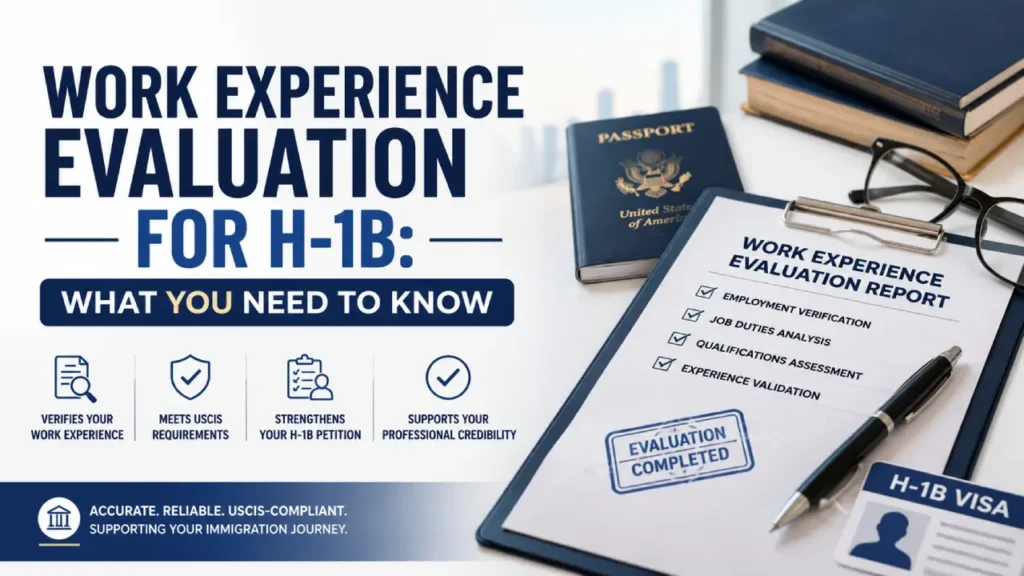
Quick Answer: A work experience evaluation for H-1B is a formal assessment — written by a credentialed expert or professor — that converts your professional history into an equivalent U.S. bachelor’s degree under USCIS’s three-for-one rule. Three years of specialized, progressive experience can substitute for one year of college education. The evaluation must be field-specific, detail your duties and seniority, and be prepared by a qualified evaluator to survive USCIS scrutiny.
Key Takeaways:
- The USCIS three-for-one rule allows three years of specialized work experience to substitute for one year of college — meaning 12 years of progressive experience can equal a four-year U.S. degree
- Work experience evaluations are distinct from academic credential evaluations and require an independent expert or professor to analyze your job duties, not just your employment dates
- USCIS does not accept years-in-service alone — experience must be progressive, field-specific, and documented with duty-level detail
- A combined education-plus-experience approach is often stronger than a pure experience path, especially for candidates with three-year foreign degrees
- Weak experience documentation is a leading trigger for H-1B RFEs in 2026, and fixing it after an RFE is harder and more expensive than getting it right the first time
You’ve spent years mastering your field. You’ve held roles with real responsibility, built expertise that most classroom settings can’t replicate, and now your employer is sponsoring your H-1B visa. But there’s one problem: your formal education doesn’t perfectly match what USCIS expects on paper.
This is far more common than people realize — and it’s entirely solvable. The path is called a work experience evaluation, and it’s one of the most important documents in your H-1B petition. Get it right, and it bridges the gap between your real-world qualifications and USCIS’s degree requirements. Get it wrong, and you’re looking at a Request for Evidence (RFE) that delays your case by months.
At AAE Evaluations, we’ve processed over 1,500 immigration credential cases. We’ve seen what separates evaluations that sail through adjudication from ones that invite unnecessary scrutiny. This guide covers everything you actually need to know — not just the textbook definition, but the real-world mechanics of how USCIS evaluates experience, what your documents must contain, and when a work experience evaluation alone isn’t enough.
This article is educational and does not constitute legal advice. Always consult a licensed immigration attorney for case-specific guidance.
What Is a Work Experience Evaluation for H-1B?
A work experience evaluation for H-1B is an independent, written assessment prepared by a credentialed expert — typically a university professor or a recognized authority in your field — that analyzes your professional history and formally concludes whether it’s equivalent to a U.S. bachelor’s degree (or higher) in your specialty.
It’s not a reference letter. It’s not your resume summarized by someone else. It’s a structured, analytical document that applies USCIS’s equivalency framework to your specific employment record and draws a defensible, expert-backed conclusion.
Why USCIS Requires It
The H-1B visa is restricted to “specialty occupations” — roles that typically require at least a U.S. bachelor’s degree in a specific field. When a beneficiary doesn’t hold a directly qualifying degree, USCIS needs a credible mechanism to assess their qualifications. That mechanism is the work experience evaluation.
Under 8 C.F.R. § 214.2(h)(4)(iii)(D), equivalency can be established through a combination of education, specialized training, and progressively responsible experience — evaluated by a recognized expert in the relevant field. Without that evaluation, USCIS has no framework to make the determination. They’ll issue an RFE asking for one. And at that point, you’re reacting rather than presenting.
Work Experience Evaluation vs. Education Credential Evaluation
These two documents serve different purposes, and confusing them is a costly mistake.
| Document | What It Analyzes | When You Need It |
|---|---|---|
| Education credential evaluation | Foreign academic degrees and transcripts converted to U.S. equivalents | When your foreign degree needs to be recognized for H-1B purposes |
| Work experience evaluation | Professional employment history evaluated as academic-equivalent | When your education alone doesn’t satisfy the specialty occupation requirement |
| Combined evaluation | Both education and work experience analyzed together | Most common in H-1B petitions involving three-year degrees or field mismatches |
Many H-1B petitions need both. A software engineer with a three-year Indian B.Tech. and eight years of progressive experience, for example, typically needs an education evaluation for H-1B plus a work experience evaluation to close the one-year gap and establish full equivalency.
How the Three-for-One Rule Actually Works
The three-for-one rule is the regulatory mechanism that makes experience-based H-1B qualification possible. But most summaries online explain it too simply — and that gap in understanding is where H-1B petitions run into trouble.
The Basic Formula
The rule, codified at 8 C.F.R. § 214.2(h)(4)(iii)(D)(5), states: for every year of college-level education a beneficiary lacks, they must demonstrate three years of specialized training and/or work experience in a related field.
In practice:
- Lacks 1 year of college → needs 3 years of progressive experience
- Holds a 3-year foreign degree (missing 1 year vs. U.S. standard) → needs 3 years of relevant experience
- Holds no degree → needs 12 years of specialized, progressive experience
For master’s degree equivalency, USCIS applies a different formula: a U.S. bachelor’s degree in the specialty plus five years of progressive experience in the specialty.
What “Progressive” Really Means
Here’s what most guides skip over: USCIS doesn’t just count years. They evaluate trajectory.
Progressive experience means your responsibilities increased in scope, complexity, and decision-making authority over time. A software developer who spent 12 years doing the same entry-level tasks doesn’t qualify under the three-for-one rule. A software developer who moved from junior developer to lead architect — progressively taking on system design, team leadership, and high-stakes technical decisions — does.
This distinction matters enormously at the evaluation stage. Your work experience evaluation must demonstrate the progression, not merely assert that it happened. That means the evaluator needs to document not just your job titles, but the specific duties you performed at each stage and how those duties evolved.
The Field-Specificity Requirement
Experience only counts toward H-1B equivalency when it’s directly related to the specialty occupation. A data scientist with 12 years of experience in unrelated fields — even if impressive — won’t qualify. USCIS adjudicators cross-reference the beneficiary’s experience against the Department of Labor’s Occupational Outlook Handbook (OOH) to verify that the duties performed align with what the specialty actually requires.
This is why generic experience evaluations — the kind that simply list years of employment without analyzing duties — consistently trigger RFEs. The analysis must be specific, and it must connect your experience to the field requirements of the H-1B position.
💡 Not sure whether your experience qualifies? Request a free case review from AAE Evaluations — we’ll assess your education and experience profile before you commit to a filing strategy.
When Do You Need a Work Experience Evaluation for H-1B?
Not every H-1B petition requires one. But the situations that do are more common than most applicants realize.
You Have a Three-Year Foreign Degree
This is the most frequent trigger, particularly for applicants from India, the UK, Australia, and other countries where a bachelor’s degree takes three years rather than four. USCIS treats a three-year degree as three years of college-level training — one year short of the U.S. four-year standard. To close that gap under the three-for-one rule, you need three years of relevant work experience, evaluated by a qualified expert.
Your Degree Field Doesn’t Match the H-1B Position
USCIS expects your education to be directly related to the specialty occupation. A mechanical engineer applying for an H-1B as a software developer faces a field mismatch. A biology major filing for a data science role faces the same challenge. In these cases, work experience in the target field — formally evaluated — can help establish that you’ve developed the equivalent expertise through professional practice.
This approach often combines your existing degree with years of experience in the target specialty. An eight-year track record as a working data scientist, properly evaluated, can bridge the gap left by an undergraduate biology degree.
You Have No Bachelor’s Degree at All
Twelve years of progressive, specialized experience can substitute for a four-year U.S. degree entirely. This path is demanding from a documentation standpoint — the experience must be rigorously progressive and field-specific — but it’s a legitimate and regularly approved route when the evaluation is well-prepared.
You Received an H-1B RFE Questioning Your Qualifications
RFEs citing inadequate qualification evidence are among the most common issued by USCIS. If your RFE questions whether you meet the specialty occupation requirement, a properly prepared work experience evaluation — combined, where relevant, with an H-1B expert opinion letter — is often the core of the response.
The difference between preparing an evaluation upfront and preparing one in response to an RFE: time, cost, and stress. Upfront is always the better path.
What Documents Do You Need for a Work Experience Evaluation?
The quality of your work experience evaluation depends almost entirely on the quality of the documents you provide. Evaluators can only analyze what they receive. Weak documents produce weak evaluations — and weak evaluations produce RFEs.
Employer Experience Letters
These are the backbone of your work experience evaluation, and they need to be far more detailed than most employers initially produce. Each letter should include:
- Your official job title at each position
- Exact start and end dates (month and year)
- A specific, duty-level description of what you actually did — tools used, decisions made, projects led, complexity of work
- Confirmation that the position was full-time (or part-time hours, if applicable)
- The letter must be on company letterhead, signed by a supervisor or HR representative with their contact information
Generic letters — “John Doe worked at Acme Corp from 2015 to 2020 as a software engineer” — are inadequate. USCIS adjudicators and evaluators alike need to see what you did, not just that you worked there.
Resume or Curriculum Vitae
A detailed, chronological resume serves as the evaluator’s roadmap through your career. It should complement your employer letters, not contradict them. Inconsistencies between your resume and your experience letters are a red flag for USCIS.
Academic Transcripts and Degree Certificates
Even when the primary equivalency argument is experience-based, USCIS wants to see your full academic picture. Include all degrees, diplomas, and transcripts — even if you’re relying on experience to close a gap. If your documents are in a language other than English, certified translations are required.
Professional Certifications and Licenses
Industry certifications, professional licenses, and continuing education records strengthen your case by showing that your field has recognized your expertise formally. AWS certifications for a cloud architect, a PMP for a project manager, a CPA for an accountant — these signal expertise beyond raw employment time.
Additional Supporting Documents
Depending on your field and case specifics, evaluators may also request:
- Project portfolios or work samples
- Publications, patents, or technical papers
- Performance reviews (if available)
- Professional organization memberships
- Awards or industry recognition
📋 Before you start gathering documents: Download our H-1B Work Experience Evaluation Checklist — it walks you through exactly what to prepare and what each document needs to include. (Ask us for it during your free case review.)
Work Experience Evaluation vs. Expert Opinion Letter: What’s the Difference?
This is one of the most common points of confusion — and it’s understandable, because the two documents are closely related.
Work Experience Evaluation
A work experience evaluation is an academic equivalency assessment. Its primary output is a conclusion that your education and/or experience equals a U.S. bachelor’s degree (or higher) in your specialty. It’s the foundational credential evidence that establishes you qualify for the H-1B category.
Expert Opinion Letter
An H-1B expert opinion letter is a broader document written by a recognized expert that addresses specialty occupation eligibility — including whether the position qualifies as a specialty occupation and whether you are qualified to fill it. It’s persuasive and analytical, going beyond equivalency formulas to speak directly to USCIS’s adjudication criteria.
When You Need Both
In many H-1B petitions, both documents work together. The work experience evaluation establishes the degree equivalency. The expert opinion letter addresses the specialty occupation and beneficiary qualifications in a more comprehensive, attorney-adjacent analytical framework.
A petition relying on experience equivalency is typically stronger with both — particularly in 2026, when USCIS scrutiny of experience-based claims has increased and adjudicators are looking for multiple layers of supporting evidence.
The position-by-position evaluation is another closely related document that formally analyzes the seniority and complexity of each role in your career — particularly useful when progression is the crux of your equivalency argument.
Common Mistakes That Trigger H-1B RFEs
The most preventable H-1B RFEs share the same root cause: inadequate documentation that forces USCIS adjudicators to draw their own conclusions — and those conclusions are rarely favorable. Here’s what we see go wrong most often.
Generic Employer Letters
An employer letter that describes your role in broad strokes — “managed software development projects” — gives USCIS nothing to evaluate. Adjudicators need specific duties, specific technologies, specific levels of authority. The letter shouldn’t describe a job category; it should describe your job.
Mismatched Documents
Your resume says one thing, your employer letters say another, your evaluation draws conclusions that don’t quite fit either. Internal inconsistency is a serious red flag. All your documents should tell the same coherent story about your career.
Non-Progressive Experience
Twelve years at the same company in the same role is not progressive experience. If your career history is flat rather than ascending, your evaluator needs to know this upfront — because the three-for-one path may not be the right strategy, and a different approach (combined education and experience, expert opinion letter, or a different visa category) may serve you better.
Choosing the Wrong Evaluator
Not every credential evaluation service has the expertise or reputation to produce evaluations that hold up under USCIS scrutiny. The evaluator’s qualifications, methodology, and documented analysis matter. An evaluation signed by someone without genuine credentials in your field can do more harm than no evaluation at all.
Filing Experience Evidence Without an Evaluation
Some petitions include extensive work experience documentation but rely on USCIS to make the equivalency determination themselves. That’s not how the process works. Without a credible evaluation applying the three-for-one framework to your specific record, you’re asking adjudicators to perform analysis they’re not equipped to do — and won’t do. They’ll RFE for the evaluation you should have included.
The AAE Evaluations Approach: What Makes Our Work Experience Evaluations Different
At AAE Evaluations, every work experience evaluation goes through a case-specific review before we begin. We don’t process files on an assembly line — we read your actual employment history, identify the strongest equivalency argument, and assign your case to a professor whose credentials are directly relevant to your field.
Our evaluators are working academics and industry professionals, not generalists signing off on standardized templates. When an adjudicator sees our evaluation, they see a document written by someone who actually understands the technical complexity of your work — and that credibility shows in how the analysis is presented.
We’ve also handled well over 1,500 cases across 43+ nationalities, which means we’ve seen virtually every credential combination that exists. Three-year Indian degrees, two-year Australian degrees, diploma holders with decades of experience, professionals with advanced degrees in adjacent fields — we know how to build the strongest equivalency argument the facts support.
And because we offer education evaluations, work experience evaluations, expert opinion letters, and business plans under one roof, your attorney gets a consistent, coordinated petition package — not three separate documents from three different vendors that need to be reconciled.
Ready to start? Get a free case review and we’ll tell you exactly which documents your H-1B petition needs, what your work experience evaluation should cover, and how long it will take.
How to Get a Work Experience Evaluation: Step-by-Step
The process doesn’t have to be complicated. Here’s how it works with AAE Evaluations.
Step 1: Request a Free Case Review
Before you submit anything, tell us about your situation. We’ll review your education and work history, identify what type of evaluation you need, and flag any potential issues upfront. This is where most of the strategic decisions happen — and where you find out whether a pure experience path or a combined approach is your strongest option.
Step 2: Gather and Submit Your Documents
Based on your case review, we’ll provide a specific document list. You’ll collect employer letters, academic records, your resume, certifications, and any other supporting materials. The more complete your document set, the stronger the analysis.
Step 3: Expert Review and Assignment
Your case is assigned to a professor or recognized expert in your specific field. They review your complete employment history, analyze duties and progression, and determine the appropriate equivalency conclusion under USCIS’s regulatory framework.
Step 4: Evaluation Drafting and Quality Review
The evaluator drafts your work experience evaluation. Our internal team reviews it for completeness, accuracy, and consistency with your other petition documents — especially critical when we’re producing your education evaluation or expert opinion letter at the same time.
Step 5: Delivery and Filing
You receive your completed evaluation — typically within 5–10 business days for standard processing, or faster for expedited cases. Your attorney incorporates it into your H-1B petition, and you file with confidence.
Frequently Asked Questions
What is a work experience evaluation for H-1B?
A work experience evaluation for H-1B is a formal assessment written by a qualified expert — typically a professor or credentialed authority in your field — that analyzes your professional employment history and determines whether it’s equivalent to a U.S. bachelor’s degree under USCIS’s three-for-one rule. It’s required when your formal education alone doesn’t satisfy the H-1B specialty occupation degree requirement.
How many years of experience do I need for H-1B without a degree?
Under USCIS’s three-for-one rule, you generally need 12 years of progressive, specialized experience to establish equivalency to a four-year U.S. bachelor’s degree. If you have a three-year foreign degree, you need three additional years of experience to close the one-year gap. The experience must be in a field directly related to the H-1B specialty occupation — and it must demonstrate increasing levels of responsibility over time.
Is a work experience evaluation the same as an expert opinion letter?
No. A work experience evaluation establishes degree equivalency by applying the three-for-one framework to your employment record. An expert opinion letter is a broader analytical document that addresses specialty occupation eligibility, beneficiary qualifications, and — in some cases — the relationship between your background and the specific H-1B position. Many petitions benefit from both documents working together.
Can I use work experience from outside the United States?
Yes. USCIS accepts relevant foreign work experience for equivalency purposes. The key requirements are the same regardless of where the experience was gained: it must be field-specific, progressive, and documented with duty-level employer letters. Non-English documents require certified translations.
How long does a work experience evaluation take?
Standard processing at AAE Evaluations typically takes 5–10 business days from receipt of complete documents. Expedited options are available for tighter filing timelines. Contact us for current turnaround estimates.
What if USCIS sends an RFE questioning my experience?
An RFE isn’t a denial — it’s a request for additional evidence. If USCIS questions your experience qualifications, a well-prepared work experience evaluation combined with a detailed H-1B expert opinion letter is typically the core of the RFE response. We prepare RFE-specific evaluations regularly — reach out for a case review as soon as you receive the notice.
Does my employer need to write the experience letter, or can I write it myself?
The employer experience letter must come from your employer — a supervisor, HR manager, or company officer who can verify your employment. It must be on official company letterhead with contact information for verification. You can help your employer understand what level of detail is required, but the letter must be authored and signed by the employer.
Can a work experience evaluation also help for EB-2 or EB-1?
Credential evaluations play a role in several visa categories beyond H-1B. For EB-2, both education evaluations and expert opinion letters are commonly needed. For EB-1, the evidentiary focus shifts to demonstrating extraordinary ability or outstanding research, which is where EB-1 expert opinion letters come in. Contact us to discuss your specific case.
Conclusion
Work experience evaluation for H-1B is not paperwork for its own sake. It’s the document that translates your real-world expertise into the language USCIS understands — and when it’s done well, it’s the difference between a clean approval and a months-long RFE process.
The three-for-one rule gives you a real path forward if your degree doesn’t perfectly fit the specialty occupation mold. But that path requires precision: progressive experience, field-specific duties, detailed employer documentation, and a qualified evaluator who knows how USCIS adjudicators actually read these assessments.
Don’t leave that to chance. The cost of a poorly prepared evaluation isn’t just the RFE — it’s the delay, the attorney fees, the stress, and the risk that your employer’s patience runs out while you’re waiting for USCIS to respond.
Get a free case review from AAE Evaluations — we’ll map out exactly which documents your petition needs, what your work experience evaluation must cover, and how we can get it done right the first time. Trusted by attorneys and applicants across 43 nationalities since 2018.
Have more questions? See our full service offerings or view our transparent pricing before you commit.