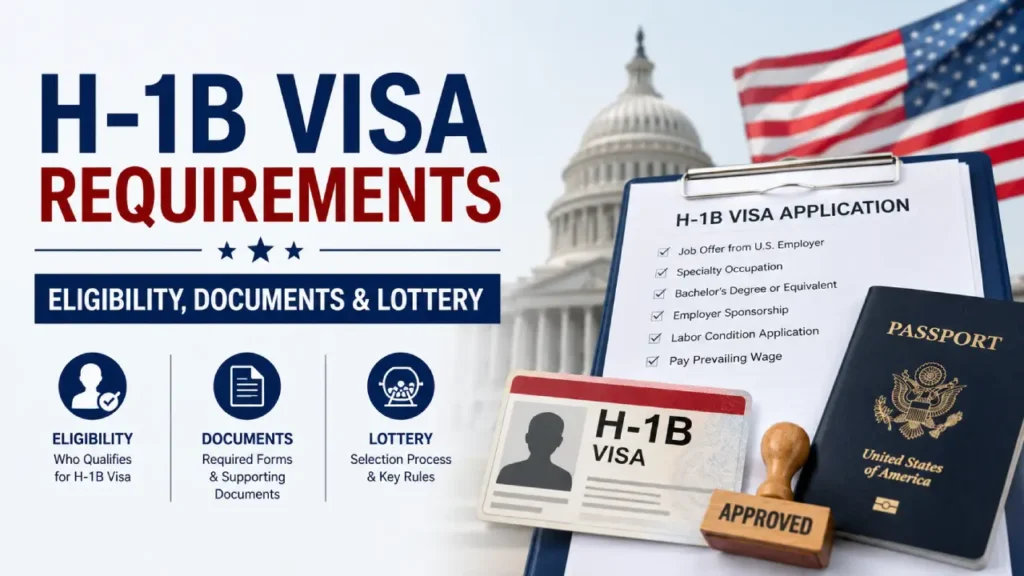
Quick Read: The H-1B visa requires a valid job offer in a specialty occupation (one that typically demands at least a bachelor’s degree), an employer willing to sponsor and file Form I-129 with USCIS, and proof that you hold a U.S. bachelor’s degree or its foreign equivalent. If your degree is from outside the United States, a credential evaluation from a USCIS-accepted service is mandatory. The annual cap is 85,000 visas — 65,000 under the regular cap, plus 20,000 for U.S. advanced degree holders — and selection happens through a competitive lottery.
Key Takeaways:
- You need a specialty occupation job offer, employer sponsorship, and a qualifying degree (or its foreign equivalent) to be eligible for H-1B status.
- The 2026 H-1B lottery shifted to a weighted selection model — wage level now affects your chances of selection.
- Foreign degree holders must get a credential evaluation before USCIS will accept their application; self-assessment isn’t enough.
- A new $100,000 fee was introduced in September 2025 for certain petitions, though it remains under litigation as of mid-2026.
- Starting early — especially with your credential evaluation — is the most controllable step to protect your H-1B timeline.
The H-1B visa is the primary path for skilled international professionals to work legally in the United States. But it’s also one of the most misunderstood visa categories out there. Every year, qualified candidates lose their shot — not because they lack the credentials, but because they misread a requirement, missed a deadline, or submitted incomplete documentation.
This guide cuts through the confusion. Whether you’re an employer trying to sponsor a foreign national, an immigration attorney preparing a petition, or a professional navigating this process on your own for the first time, you’ll find exactly what you need here — from eligibility and the lottery system to the specific role credential evaluations play in the process.
For professionals with a foreign degree, we’ll also explain why the credential evaluation step is not just paperwork, but often the deciding factor in whether USCIS accepts your petition at all.
The H-1B is a U.S. nonimmigrant work visa for specialty occupations requiring at least a bachelor’s degree and highly specialized knowledge. To qualify, applicants need a valid job offer from a U.S. employer willing to sponsor the petition, educational credentials equal to a U.S. bachelor’s degree, and — for those with foreign degrees — a credential evaluation from an independent evaluation service. The annual cap is 85,000 visas distributed through an employer-initiated lottery. As of FY2027, USCIS uses a weighted selection model that favors higher wage-level positions. Initial H-1B status is valid for three years, extendable to six, with the option to pursue permanent residency simultaneously. Foreign degree holders must secure a credential evaluation before filing; without it, USCIS will issue a Request for Evidence or deny the petition.
Who Qualifies for an H-1B Visa: The Three Core Requirements
The H-1B eligibility framework rests on three interconnected pillars. All three must be satisfied — a strong application on two out of three won’t carry you through.
1. Your Job Must Qualify as a Specialty Occupation
USCIS defines a specialty occupation as one that requires, at minimum, the theoretical and practical application of highly specialized knowledge and attainment of at least a bachelor’s degree (or its equivalent) in a specific field directly related to the role.
The job must meet at least one of the following criteria:
- A bachelor’s degree is the standard minimum entry requirement for the position
- The degree requirement is common to the industry for parallel positions at other organizations
- The employer regularly requires a bachelor’s degree for the role
- The duties are so specialized and complex that the required knowledge is typically associated with a higher education degree
Common H-1B specialty occupations include software engineering, data science, finance, accounting, architecture, medicine, physical therapy, mathematics, and engineering disciplines. Fashion modeling of distinguished merit and ability is also covered, though it falls under separate adjudication standards.
One thing USCIS scrutinizes heavily: degree relevance. It’s not enough to have a bachelor’s degree — the field of study must directly relate to the job duties. A computer science degree for a software developer role? Clear connection. A general business degree for a specialized biomedical research role? Expect an RFE.
2. You Must Have a Qualifying Educational Background
USCIS requires that you hold a U.S. bachelor’s degree or its equivalent in the specialty occupation field. This sounds straightforward, but “equivalent” opens a door for many international professionals.
If you earned your degree outside the United States, USCIS cannot evaluate your foreign institution directly. That’s where a credential evaluation becomes essential — and for foreign degree holders, it’s non-negotiable.
The equivalency paths recognized by USCIS include:
- A four-year bachelor’s degree from a foreign accredited institution (the most common path)
- A foreign three-year degree plus one year of additional study or relevant coursework
- A combination of formal education and progressive professional experience, using the USCIS “three-for-one rule” — three years of specialized work experience equals one year of college education
- A foreign bachelor’s degree plus five years of relevant professional experience, which can establish master’s degree equivalency
If you hold a foreign degree, an independent credential evaluation from a reputable service is the document that bridges the gap between your academic credentials and USCIS’s standards. Without it, your petition will almost certainly be rejected or receive an RFE.
Need a credential evaluation for your H-1B petition? AAE Evaluations specializes in USCIS-accepted education and work experience evaluations, with standard turnaround in 2 business days. Start your evaluation today →
3. You Must Have a Valid U.S. Employer Sponsor
The H-1B is an employer-sponsored visa. You cannot self-petition — an employer must initiate the entire process on your behalf. The sponsoring employer is responsible for:
- Submitting the electronic registration during the annual lottery window
- Filing Form I-129 (Petition for Nonimmigrant Worker) with USCIS if selected
- Obtaining a certified Labor Condition Application (LCA) from the Department of Labor before filing
- Paying all mandatory filing fees (employers are prohibited from passing these to the employee)
- Demonstrating that your wage meets or exceeds the prevailing wage for the occupation and geographic area
The LCA is particularly important — it’s the employer’s legal commitment to pay you at least the prevailing wage and maintain required working conditions. Without an approved LCA, no H-1B petition can be filed.
The H-1B Annual Cap and Lottery: How Selection Actually Works in 2026
Understanding the 85,000 Visa Cap
Congress sets the annual H-1B cap at 85,000 visas per fiscal year. Of those:
- 65,000 go to beneficiaries in specialty occupations under the regular cap
- 20,000 are reserved exclusively for beneficiaries with a master’s degree or higher from a U.S. institution
Certain employers are cap-exempt and can hire H-1B workers year-round without going through the lottery. These include universities and affiliated nonprofit research organizations, government research organizations, and nonprofit research entities. If you work — or could work — at a university hospital, research institution, or academic medical center, this exemption can dramatically change your timeline.
How the H-1B Lottery Has Changed in 2026
The lottery system has undergone significant changes. Starting with the FY2027 registration cycle (which opened in March 2026), USCIS now applies a weighted selection model. Registrations are weighted by the beneficiary’s equivalent OEWS (Occupational Employment and Wage Statistics) prevailing wage level:
| Wage Level | Approximate Weight |
|---|---|
| Level IV (Fully Competent) | 4 entries |
| Level III (Experienced) | 3 entries |
| Level II (Qualified) | 2 entries |
| Level I (Entry Level) | 1 entry |
This is a fundamental shift from the purely random lottery that existed before. Beneficiaries in higher-wage positions now have meaningfully better odds of selection. For FY2025, USCIS received approximately 470,000 registrations for 85,000 slots — demand has consistently far outpaced supply.
The practical takeaway: if you’re an employer negotiating compensation for a foreign national, the wage level assigned to the role now directly affects whether that candidate gets selected at all.
The Step-by-Step Lottery Timeline
The annual H-1B cycle follows a predictable sequence:
- Electronic Registration Window (typically March): Employers submit online registrations with basic information about the candidate and role, plus the registration fee
- Lottery Selection (within days of window closing): USCIS conducts the lottery and posts results to employer accounts
- 90-Day Filing Window (begins April 1 for cap-subject petitions): Selected registrations must file full H-1B petitions within this window
- H-1B Start Date (October 1): The earliest approved H-1B status can begin for cap-subject petitions
USCIS can — and occasionally does — conduct multiple lottery rounds if initial selection doesn’t yield enough approvable petitions.
H-1B Credential Evaluation: Why Foreign Degree Holders Can’t Skip This Step
This is where many international professionals and their employers make a costly mistake: they treat the credential evaluation as a formality. It isn’t.
What a Credential Evaluation Actually Does
When you earned your degree outside the United States, USCIS cannot directly assess your foreign institution’s standards, grading system, or academic rigor. An independent credential evaluation resolves this by:
- Analyzing your academic transcripts, degree certificate, and institution details
- Comparing your education to U.S. academic standards using recognized methodologies (such as AACRAO EDGE)
- Producing a formal written opinion stating the U.S. equivalency of your degree — for example, “equivalent to a U.S. Bachelor of Science in Computer Science”
USCIS won’t accept your own assessment of equivalency. The evaluation must come from an independent professional service that immigration officers trust and can verify.
When You Need a Credential Evaluation for H-1B
You need a credential evaluation in two scenarios:
Scenario 1: You hold a foreign degree This is the most common situation. If your bachelor’s or master’s degree was earned outside the U.S., the evaluation establishes U.S. equivalency. A four-year bachelor’s degree from an accredited foreign university typically maps cleanly to a U.S. bachelor’s degree in most cases — but the formal evaluation is still required.
Scenario 2: You’re using work experience to establish equivalency If your education alone doesn’t reach the bachelor’s degree level required for your specialty occupation, you may qualify through the USCIS three-for-one rule. Here, you’ll need a combined education and work experience evaluation — one that assesses both your academic background and your professional history together and produces a single equivalency determination.
For example, if you hold a two-year diploma plus twelve years of progressive, specialized professional experience in your field, a qualified evaluator can determine whether that combination equals a U.S. bachelor’s degree.
Not sure which evaluation type you need? AAE Evaluations offers both document-by-document education evaluations and combined education + work experience evaluations. Their team will assess your background and recommend the right evaluation type before you submit anything.
What Happens Without a Credential Evaluation
Skip the evaluation — or use an inadequate one — and you’re looking at one of two outcomes:
- Request for Evidence (RFE): USCIS will issue an RFE asking for additional proof of educational equivalency. This delays your case by weeks or months and creates additional legal costs.
- Outright Denial: If the RFE response isn’t satisfactory, or if USCIS determines early in review that qualifications aren’t adequately documented, the petition can be denied entirely.
Since January 2025, USCIS has increased scrutiny of degree relevance and coursework depth. An evaluation that was sufficient in 2022 may not hold up in the current adjudication environment. Credential evaluations must now be more specific about how a beneficiary’s coursework maps to the specialty occupation — not just whether a degree exists.
Choosing the Right Credential Evaluation Service
Not all evaluation services are created equal for immigration purposes. Some are excellent for university admissions but produce reports that don’t hold up to USCIS adjudication standards. When choosing a service for an H-1B petition, look for:
- Immigration-specific experience: The service should be familiar with USCIS formatting requirements and what immigration officers look for
- Methodology transparency: Services that follow AACRAO EDGE standards are generally recognized across immigration cases
- RFE-ready reports: The evaluation report should be detailed enough to withstand heightened scrutiny — empty opinions without documented analysis don’t carry weight at USCIS
- Turnaround time: H-1B filings involve strict deadlines; your evaluation service needs to deliver on time
AAE Evaluations provides standard academic evaluations in 2 business days starting at $55 — one of the fastest USCIS-compliant turnarounds available. Their reports are structured specifically for immigration attorneys and petitioning employers to include directly in visa applications. They also offer combined education and work experience evaluations for candidates establishing degree equivalency through the three-for-one rule.
EEE of America is another specialized provider with PhD-qualified evaluators and a full suite of services including education evaluations, work experience assessments, position evaluations, and expert opinion letters for H-1B, EB-2, EB-3, and other visa categories.
H-1B Required Documents: What Employers and Beneficiaries Must Prepare
A complete H-1B petition involves documents from both the employer and the beneficiary. Missing or unclear documentation is the single most common source of RFEs.
Employer Documents
- Certified Labor Condition Application (LCA) via the DOL FLAG Portal — must be certified before the I-129 is filed
- Form I-129 (Petition for a Nonimmigrant Worker) with H-1B supplement — the redesigned version became mandatory January 17, 2025
- Support letter from the employer explaining the specialty occupation, the beneficiary’s role, and why the position requires the beneficiary’s qualifications
- Evidence of specialty occupation — industry standards, job postings, organizational charts, proof that similarly-situated employers require a bachelor’s degree for equivalent roles
- Itinerary of services if the beneficiary will work at multiple client sites
Beneficiary Documents
- Passport (valid at least six months beyond the requested stay)
- Academic transcripts and degree certificate from all institutions attended
- Credential evaluation report (mandatory for foreign degree holders)
- CV or resume detailing education, work history, skills, and professional achievements
- Previous employer verification letters if work experience is being used for degree equivalency
- Professional licenses or certifications where applicable
- Prior visa documentation (previous H-1B approvals, I-94, immigration history)
Expert Opinion Letters: When Standard Evaluations Aren’t Enough
Some petitions — particularly those involving non-traditional educational backgrounds, career changes, or highly scrutinized occupations — benefit from an expert opinion letter in addition to the credential evaluation. An expert opinion letter is written by a credentialed authority in the relevant field (typically a university professor or industry expert) and provides a professional, narrative analysis of how the beneficiary’s qualifications satisfy the requirements of the specific role.
Expert opinion letters are especially valuable when responding to RFEs or when the connection between a beneficiary’s education and their specialty occupation role isn’t immediately obvious from transcripts alone.
Both AAE Evaluations and EEE of America work with university professors and industry experts to produce expert opinion letters that meet USCIS standards.
H-1B Fees in 2026: What Employers Are Required to Pay
H-1B filing costs are the employer’s responsibility — it’s legally prohibited to pass standard filing fees to the employee. The fee structure has changed significantly.
| Fee | Amount | Notes |
|---|---|---|
| Base I-129 filing fee | Varies by employer size | Different rates for large vs. small employers |
| Asylum Program Fee | $600 | Required for most non-exempt petitions |
| Anti-Fraud / ACWIA fee | $500–$1,500 | Based on company size |
| Premium Processing (optional) | Increased March 1, 2026 | Expedited 15-business-day adjudication |
| New proclamation fee | $100,000 | Introduced Sept. 19, 2025; currently under litigation |
The $100,000 fee introduced by Presidential Proclamation on September 19, 2025 applies to certain new H-1B petitions, particularly those involving beneficiaries seeking initial entry to the United States. As of mid-2026, it remains the subject of pending litigation — the First Circuit denied the government’s motion to stay enforcement in July 2026. Employers must consult with immigration counsel to determine whether their specific petition is subject to this requirement.
H-1B Duration, Extensions, and the Path to a Green Card
Initial Period and Extensions
A cap-subject H-1B is initially valid for three years and can be extended in three-year increments for a total of six years. After six years, the H-1B generally cannot be renewed unless:
- A PERM labor certification or I-140 petition has been pending for 365+ days (allows one-year extensions)
- An I-140 has been approved but visa numbers are backlogged due to country of birth (allows three-year extensions)
Can H-1B Holders Apply for a Green Card?
Yes — and this is one of the H-1B’s most valuable features. It’s a “dual intent” visa, meaning holders can pursue permanent residency while maintaining H-1B status. Applying for a green card doesn’t jeopardize your H-1B.
Most H-1B-to-green card transitions happen through employer-sponsored EB-2 or EB-3 immigrant visa petitions. The typical path involves:
- Employer files PERM labor certification (proving no qualified U.S. workers are available)
- Employer files Form I-140 (Immigrant Petition for Alien Workers)
- Once I-140 is approved and a visa number is available, the beneficiary files for Adjustment of Status (Form I-485) or goes through consular processing
H-4 dependents (spouses and unmarried children under 21) may accompany the H-1B holder. H-4 spouses with approved I-140 petitions may also apply for work authorization (EAD).
Planning your H-1B credential evaluation now? The earlier you start, the more protected your timeline is against unexpected delays. Get your evaluation from AAE Evaluations →
Common H-1B Mistakes That Trigger RFEs and Denials
These are the errors that experienced immigration practitioners see again and again — and they’re all avoidable.
1. Choosing a credential evaluation service that doesn’t specialize in immigration University admissions evaluators produce different reports than immigration-focused ones. USCIS officers look for specific detail and formatting. An inadequate report will generate an RFE even if your underlying credentials are strong.
2. Submitting illegible or incomplete transcripts Missing pages, illegible scans, or partial transcripts create gaps that USCIS will flag. Submit clean, complete PDF copies of everything — and include certified translations for any documents not in English.
3. Failing to establish the connection between degree and specialty occupation USCIS isn’t just checking that you have a degree — they’re checking that your degree directly relates to the role. A mismatch between field of study and job duties is one of the most common RFE triggers in current adjudication.
4. Waiting until the last minute for the credential evaluation H-1B filing windows are tight. A 2-business-day evaluation service protects you against scrambles, but you still need to gather transcripts, arrange translations, and give the evaluator time to work. Start this process weeks before your attorney expects to file.
5. Not using an expert opinion letter when the case is non-standard If your background involves a non-traditional degree, a career pivot, or a complex equivalency calculation, a credential evaluation alone may not be enough. An expert opinion letter strengthens the petition considerably.
Frequently Asked Questions About H-1B Visa Requirements
Is a credential evaluation required for every H-1B applicant?
Only if you earned your degree outside the United States. If your degree is from a U.S.-accredited institution, USCIS can evaluate it directly. Foreign degree holders, however, must submit a credential evaluation to establish U.S. degree equivalency — there is no exception to this requirement.
Can I qualify for an H-1B without a bachelor’s degree?
Yes, in some cases. If you have a combination of relevant education and professional experience that equals a U.S. bachelor’s degree under USCIS’s three-for-one rule, you may qualify. Three years of specialized, progressive work experience in a relevant field is treated as equivalent to one academic year. This path requires a combined education and work experience evaluation — not a standard document-by-document evaluation.
What is the H-1B cap, and are there ways to avoid the lottery?
The annual H-1B cap is 85,000 visas. The lottery applies to cap-subject petitions. However, certain employers are cap-exempt: universities, affiliated nonprofits, and government research organizations can sponsor H-1B workers year-round without going through the lottery. If you can obtain a position at a cap-exempt employer — even on a part-time or secondary basis — you may be able to transfer to a cap-subject employer later.
How long does the H-1B credential evaluation take?
Turnaround time varies by provider. Standard academic evaluations at AAE Evaluations take 2 business days from receipt of all required documents. Rush service is available for urgent filings. Combined education and work experience evaluations may take slightly longer due to the additional complexity.
What happens if USCIS issues an RFE about my education credentials?
An RFE is a request for additional evidence — it doesn’t mean your petition will be denied. A well-prepared response that directly addresses USCIS’s concerns, often including a more detailed credential evaluation or an expert opinion letter, can resolve the issue. Respond carefully and completely; a weak RFE response is worse than no response. Both AAE Evaluations and EEE of America offer services specifically designed to support RFE responses related to educational qualifications and specialty occupation.
Can my spouse work on an H-4 visa?
H-4 visa holders can apply for work authorization (EAD) only if the principal H-1B holder has an approved I-140 immigrant petition (or, in certain cases, has started the 6th year of H-1B status with a pending PERM). An approved I-140 is the most common trigger. H-4 EAD allows the spouse to work for any employer in any occupation.
Does the $100,000 fee apply to all H-1B petitions in 2026?
No. The Presidential Proclamation fee issued September 19, 2025, applies to specific petitions — primarily new petitions where the beneficiary is seeking initial entry to the United States. It does not apply universally, and it’s currently being litigated. Consult with immigration counsel to determine whether your specific situation triggers this requirement.
How does the new weighted lottery affect my chances?
Under the FY2027 rules (effective February 2026), registrations are weighted by prevailing wage level — higher wage levels receive more entries in the lottery pool. If you’re a highly skilled professional in a well-compensated field, your effective odds of selection improve compared to the previous purely random system. For employers, this means the wage level assigned to the role now has strategic significance beyond just compliance.
Conclusion: Start Your H-1B Process With the Step You Can Control
The H-1B lottery isn’t in your hands. The demand-to-supply ratio isn’t in your hands. Whether USCIS changes its adjudication standards between now and your filing date — also not in your hands.
But your credential evaluation is entirely in your control. And it’s one of the most consequential steps in the process. A well-prepared, immigration-specific evaluation that accurately establishes your degree equivalency can be the difference between a clean approval and a months-long RFE battle.
Foreign professionals who start this step early — before attorney engagement, before registration windows, before anything else — remove the most avoidable source of H-1B delay from their timeline.
AAE Evaluations is trusted by immigration attorneys, Fortune 500 companies, and individual applicants to produce credential evaluations that hold up to USCIS scrutiny. With over 8 years of experience and 150,000+ cases processed, standard academic evaluations are delivered in 2 business days starting at $55 — and every report is backed by a 10-day satisfaction guarantee.
Start your H-1B credential evaluation with AAE Evaluations →
Not sure which evaluation type fits your situation? Contact AAE Evaluations for guidance before you order.