Receiving a Request for Evidence (RFE) on an EB-2 National Interest Waiver (NIW) petition can be frustrating, particularly when you believed your original filing already contained substantial documentation.
An RFE does not automatically mean that your EB-2 NIW petition will be denied. It means USCIS has identified an issue, missing evidence, or insufficient explanation that needs to be addressed before the agency can make a final decision.
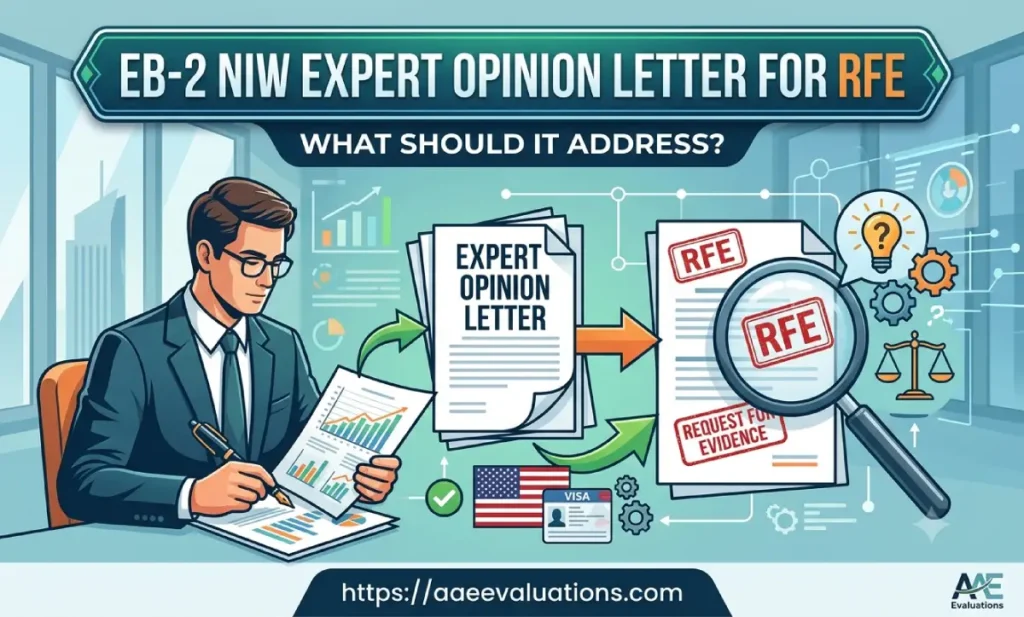
For some petitioners, an EB-2 NIW expert opinion letter for an RFE can provide useful independent, field-specific analysis that directly responds to the concerns raised by USCIS.
However, an expert letter should not be treated as a generic endorsement or as a substitute for the complete RFE response prepared with appropriate legal guidance. Its value depends heavily on whether it addresses the actual issues identified in the RFE and connects the expert’s analysis to the evidence in the petition.
What Is an EB-2 NIW Expert Opinion Letter for an RFE?
An EB-2 NIW expert opinion letter for an RFE is a professional assessment prepared by a qualified expert to address specific concerns raised by USCIS in a Request for Evidence.
Unlike a general recommendation letter, an RFE-focused expert letter should be responsive to the adjudicator’s questions.
For example, if the RFE questions whether your proposed endeavor has national importance, an expert may explain:
- What the proposed endeavor actually involves
- Why the endeavor has substantial merit
- How the proposed work relates to broader U.S. interests
- What potential impact the endeavor could have
- Why the petitioner’s background is relevant to advancing the endeavor
- How the expert reached those conclusions based on the evidence reviewed
The objective is not simply to say that the petitioner is talented or that the field is important.
The analysis should focus on the specific proposed endeavor and the petitioner’s evidence.
If you are still determining whether you need an expert opinion letter or a recommendation letter, see our guide to Expert Opinion Letters vs. EB-2 NIW Recommendation Letters.
Why Might USCIS Issue an NIW RFE?
An EB-2 NIW RFE can address different parts of the petition. The concerns will vary depending on the evidence submitted and the facts of the individual case.
Common areas of concern can include:
1. National Importance of the Proposed Endeavor
USCIS may determine that the evidence establishes the importance of the petitioner’s general field but does not sufficiently establish the national importance of the specific proposed endeavor.
For example, saying that artificial intelligence, healthcare, engineering, cybersecurity, or renewable energy is important is not necessarily the same as demonstrating the national importance of a particular endeavor within that field.
An expert opinion letter can help explain the connection between the proposed work and broader national interests, provided that the analysis is supported by the evidence available in the case.
2. Whether the Petitioner Is Well Positioned
The second Dhanasar prong focuses on the petitioner rather than only on the proposed endeavor.
USCIS considers evidence relating to factors such as the person’s education, skills, knowledge, record of success, plans for future activities, progress toward the proposed endeavor, and interest from relevant customers, users, investors, or other entities.
An expert can therefore evaluate how the petitioner’s qualifications and documented accomplishments relate specifically to the proposed work.
The letter should avoid simply listing the petitioner’s resume.
Instead, it should explain why particular accomplishments are relevant to the proposed endeavor.
3. The Third NIW Prong
The third prong asks whether, on balance, it would be beneficial to the United States to waive the job offer and permanent labor certification requirements.
An RFE may question whether the evidence establishes this part of the Dhanasar framework.
An expert may provide professional analysis explaining how the petitioner’s proposed work could benefit the United States and why the nature of the proposed endeavor makes the waiver relevant.
This should be coordinated with the overall legal response rather than presented as an isolated statement from the expert.
What Should an NIW RFE Expert Letter Address?
A useful RFE expert opinion letter should be built around the specific questions raised by USCIS in the RFE.
Although the structure will vary by case, the following elements are commonly important.
1. The Expert’s Qualifications
The letter should establish why the expert has sufficient knowledge and professional authority to evaluate the petitioner’s proposed endeavor.
Depending on the field, relevant credentials may include:
- Advanced academic degrees
- University appointments
- Research experience
- Publications
- Citations
- Patents
- Industry leadership
- Professional certifications
- Government or institutional work
- Professional awards
- Relevant research or technical expertise
The expert’s qualifications should be relevant to the subject matter being evaluated.
A highly accomplished professional in an unrelated discipline may not provide the same evidentiary value as an expert whose background closely aligns with the proposed endeavor.
2. The Expert’s Relationship to the Petitioner
The letter should clearly explain the expert’s relationship, if any, with the petitioner.
Independence can be particularly useful when the expert is able to provide an objective professional assessment rather than merely describing a personal working relationship.
The letter should not conceal an existing professional or personal relationship.
Transparency about the relationship allows USCIS to understand the context in which the opinion was provided.
3. A Clear Description of the Proposed Endeavor
The expert should explain the petitioner’s proposed endeavor in language that a non-specialist adjudicator can understand.
This is important because USCIS focuses on the specific endeavor rather than simply the petitioner’s occupation.
A clear description should answer questions such as:
- What exactly does the petitioner intend to do?
- What problem is the work intended to address?
- Who could benefit from the work?
- What methods, technology, research, or expertise will be involved?
- What is the expected scope of the work?
- What potential impact could result?
The explanation should be consistent with the proposed endeavor statement and the rest of the petition.
Addressing Prong 1: Substantial Merit and National Importance
If the RFE challenges the first Dhanasar prong, the expert opinion should distinguish between importance of the field and importance of the specific endeavor.
For example, instead of simply stating:
“Cybersecurity is nationally important.”
an expert could explain the specific cybersecurity problem the petitioner intends to address, the affected population or industries, the potential consequences of the proposed work, and the evidence demonstrating the broader relevance of that work.
Depending on the field, supporting analysis might involve:
- Federal policy priorities
- Government reports
- Industry data
- Scientific literature
- Economic indicators
- Public health data
- Technology adoption
- Infrastructure needs
- Workforce implications
- Research findings
- Documented industry problems
The expert’s role is to provide informed professional analysis. The underlying claims should be supported by appropriate evidence.
Addressing Prong 2: Why the Petitioner Is Well Positioned
A common mistake is to use an expert letter to repeat the petitioner’s entire professional biography.
An RFE response generally benefits more from a focused explanation of which qualifications and accomplishments matter to the proposed endeavor and why.
For example, an expert could analyze:
- Relevant publications
- Citation history
- Patents
- Grant information
- Research projects
- Commercial implementations
- Clinical outcomes
- Awards
- Leadership positions
- Previous projects
- Institutional collaborations
- Industry recognition
- Demonstrated progress
- Existing plans for future work
The important connection is:
Past achievement → relevant expertise → proposed endeavor → ability to advance the endeavor
This creates a logical relationship between the petitioner’s existing evidence and the future work described in the NIW petition.
If you are researching the broader eligibility requirements before responding to an RFE, see our EB-2 National Interest Waiver (NIW) guide.
Addressing Prong 3: Why the Waiver Would Benefit the United States
The third prong should not simply repeat that the petitioner wants to work in the United States.
The analysis should explain why, considering the particular facts of the case, waiving the job-offer and labor-certification requirements would be beneficial to the United States.
An expert may discuss issues such as:
- The nature of the proposed endeavor
- The need for flexibility to pursue the proposed work
- The petitioner’s ability to collaborate across organizations
- The potential national benefits of the proposed work
- The relationship between the petitioner’s activities and broader U.S. interests
The expert’s analysis should complement the attorney’s legal argument rather than attempt to replace it.
The Expert Letter Should Respond to the Actual RFE
One of the most important principles when preparing an NIW expert letter for an RFE is specificity.
Start with the RFE.
Identify:
- What USCIS says is missing
- What evidence USCIS found insufficient
- Which Dhanasar prong is involved
- Which factual claims need clarification
- What additional evidence is available
- How the expert can provide relevant professional analysis
The letter should then be developed around those issues.
For example:
RFE concern: USCIS questions whether the proposed endeavor has national importance.
Expert analysis: Explain the specific endeavor, its potential impact, relevant national or industry-level problems, and why the proposed work extends beyond the petitioner’s ordinary employment.
Or:
RFE concern: USCIS questions whether the petitioner is well positioned.
Expert analysis: Explain which accomplishments demonstrate relevant expertise and how those accomplishments provide a credible foundation for the proposed endeavor.
This approach is more useful than simply obtaining another generic letter saying the petitioner is “highly qualified.”
Should You Submit the Same Expert Letter Again?
An RFE response should be evaluated based on what USCIS actually requested and what evidence is available to address those concerns.
Simply resubmitting the same evidence without addressing the issues identified in the RFE may not resolve the evidentiary problem.
Whether a new, supplemental, or revised expert opinion is appropriate depends on the actual RFE and the overall evidence in the case.
For this reason, petitioners should review the RFE carefully and coordinate any new expert documentation with the attorney handling the immigration case.
Expert Opinion Letter vs. Recommendation Letter for an NIW RFE
These documents can serve different purposes.
Expert Opinion Letter
An expert opinion letter generally provides an independent professional assessment of issues relevant to the petition.
It may analyze:
- The proposed endeavor
- Its significance
- The petitioner’s qualifications
- Technical or industry-specific issues
- The petitioner’s ability to advance the endeavor
- Relevant aspects of the Dhanasar framework
Recommendation Letter
A recommendation letter generally provides firsthand testimony about the petitioner’s work, accomplishments, expertise, or contributions from someone familiar with the petitioner or their work.
For an RFE, the appropriate document depends on what USCIS is questioning and what evidence is already available.
In some cases, the petition may benefit from both types of documentation, with each serving a distinct evidentiary purpose.
AAE Evaluations also provides EB-2 NIW Recommendation Letters for petitioners who need supporting letters from professionals familiar with their work.
What Makes an NIW RFE Expert Letter More Persuasive?
There is no guaranteed format or document that guarantees approval.
However, an RFE-focused expert opinion should generally be:
Specific
It should address the petitioner’s actual endeavor rather than discussing the field in broad terms.
Evidence-Based
Professional conclusions should be connected to identifiable evidence.
Relevant
The expert’s credentials should relate meaningfully to the subject being evaluated.
Consistent
The letter should not contradict the proposed endeavor statement, petition, exhibits, or other evidence.
Independent Where Appropriate
An independent professional perspective can provide useful context when the expert has the appropriate qualifications and no undisclosed conflict or relationship.
Responsive
The letter should answer the concerns raised in the RFE rather than simply repeat the original petition.
Easy to Follow
Technical information should be explained clearly enough for a USCIS adjudicator who may not be an expert in the petitioner’s field.
What Evidence Should Accompany an NIW RFE Expert Letter?
An expert opinion letter should normally be considered one component of a broader RFE response.
Depending on the concerns in the notice, supporting documentation could include:
- Updated publications
- Citation evidence
- Patent documentation
- Grant information
- Contracts or agreements
- Letters from organizations
- Evidence of implementation
- Media coverage
- Government or industry reports
- Research documentation
- Business plans
- Evidence of customers or users
- Professional awards
- Employment or project records
- Other documentation directly responsive to the RFE
The appropriate evidence depends on the petition.
The goal is not to add documents simply to increase the size of the filing. Each exhibit should help address a specific evidentiary issue.
How Long Do You Have to Respond to an NIW RFE?
Your RFE notice will specify the response deadline.
Do not rely on a general internet estimate when determining your actual deadline. Instead, review the RFE itself and follow the instructions provided by USCIS.
Because an RFE response often requires coordination among the petitioner, immigration attorney, experts, and other professionals, it is sensible to begin organizing the response as soon as possible after receiving the notice.
How AAE Evaluations Can Help With an EB-2 NIW RFE
AAE Evaluations prepares field-specific EB-2 NIW Expert Opinion Letters for both initial petitions and RFE responses.
The service is designed around the petitioner’s professional background, proposed endeavor, field, and the specific evidentiary issues involved in the case.
For RFE cases, the expert opinion can be structured around the issues identified by USCIS rather than relying on a generic NIW template.
If you are comparing document types, AAE also provides expert opinion letters for EB-1, EB-2 NIW, O-1, H-1B, and L-1 cases.
You can also review the pricing page for current service pricing and turnaround information.
Frequently Asked Questions
Can an expert opinion letter help with an EB-2 NIW RFE?
It can provide additional professional analysis relevant to the concerns identified in an RFE. Its usefulness depends on the specific issue USCIS raised, the expert’s qualifications, and how well the opinion is supported by the evidence.
An expert letter does not guarantee approval of an NIW petition.
What should an expert opinion letter for an NIW RFE address?
It should address the specific concerns identified by USCIS and explain the relevant facts through the expert’s professional knowledge. Depending on the RFE, this may involve the proposed endeavor, national importance, the petitioner’s qualifications and positioning, or the benefit of granting the waiver.
Does an NIW RFE expert letter need to address all three Dhanasar prongs?
Not necessarily in the same way in every case. The letter should respond to the issues raised in the RFE and should be consistent with the overall legal strategy of the petition. If USCIS raises concerns involving multiple prongs, the expert analysis may address the relevant portions of each.
Is an independent expert required for an EB-2 NIW RFE?
USCIS does not universally require every NIW petitioner to submit an independent expert opinion letter. However, an appropriately qualified expert may provide useful third-party analysis in cases where professional interpretation of the petitioner’s work is relevant.
Can I use my original NIW expert opinion letter for the RFE?
Whether the original letter should be reused, supplemented, revised, or replaced depends on the RFE and the evidence available. The important question is whether the submission actually addresses the concerns identified by USCIS. Your immigration attorney should determine the appropriate approach for the overall response.
How many expert opinion letters should I submit for an NIW RFE?
There is no universal number that guarantees a successful outcome. The appropriate number depends on the issues in the RFE, the petitioner’s evidence, and the role each expert can play.
Additional letters should contribute meaningful, relevant analysis rather than simply repeat the same conclusions.
Can AAE Evaluations prepare an expert letter specifically for my NIW RFE?
AAE Evaluations provides EB-2 NIW expert opinion letters for RFE responses and develops the document around the petitioner’s field, proposed endeavor, evidence, and the issues identified in the RFE.
Final Thoughts
An EB-2 NIW RFE should be approached as a response to specific evidentiary concerns, not simply as a request to submit more documents.
When an expert opinion letter is appropriate, its purpose should be clear: provide qualified, professional analysis that helps address the particular issue identified by USCIS.
The strongest approach is usually to connect the expert’s analysis to the petitioner’s actual proposed endeavor, documented accomplishments, and available evidence while keeping the letter consistent with the overall RFE response.
Because an NIW RFE involves legal and evidentiary issues, petitioners should coordinate the expert opinion letter with their immigration attorney or other qualified legal representative handling the case.
If you need professional analysis tailored to an EB-2 NIW RFE, learn more about AAE Evaluations’ EB-2 NIW Expert Opinion Letter.