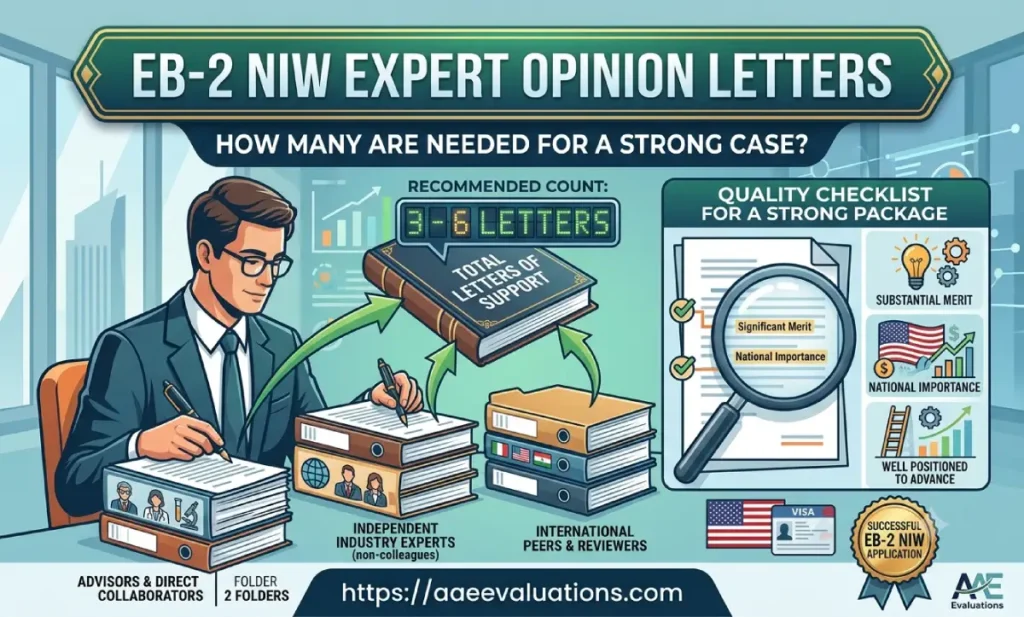
Preparing an EB-2 National Interest Waiver (NIW) petition often raises an important question: How many expert opinion letters should you include?
Should you obtain one? Two? Three? More?
The answer is important because USCIS does not prescribe a fixed number of expert opinion letters for an EB-2 NIW petition. The strength of the evidence depends on the overall record, including the proposed endeavor, the petitioner’s qualifications, supporting documentation, and the quality and relevance of any expert opinions submitted.
In other words, adding more letters does not automatically make an NIW petition stronger.
A better approach is to determine what each expert letter contributes to the petition and whether another independent opinion adds meaningful evidence that is not already present.
This guide explains how to think about the number of EB-2 NIW expert opinion letters you may need without relying on an arbitrary letter count.
Is There a Required Number of Expert Opinion Letters for EB-2 NIW?
No. There is no USCIS rule stating that an EB-2 NIW petitioner must submit a specific number of expert opinion letters.
USCIS evaluates the petition based on the evidence presented in the record. For an NIW case, the adjudication framework established in Matter of Dhanasar considers whether:
- The proposed endeavor has substantial merit and national importance.
- The petitioner is well positioned to advance the proposed endeavor.
- On balance, it would benefit the United States to waive the job offer and labor certification requirements.
An expert opinion letter can provide useful professional analysis within that broader evidentiary record, but the letter itself does not replace the rest of the evidence.
That means there is no simple formula such as:
“You need exactly three expert letters for EB-2 NIW.”
The appropriate number depends on the individual petition.
How Many Expert Opinion Letters Should You Get?
Rather than starting with a number, start with the evidentiary purpose.
Ask:
- What does my petition need an independent expert to explain?
- Are there important technical issues that a general adjudicator may need help understanding?
- Does my proposed endeavor require professional context?
- Do my existing documents adequately explain the significance of my work?
- Does another expert provide a genuinely different perspective?
- Are the proposed experts sufficiently qualified and relevant to my field?
- Would another letter add evidence, or simply repeat what another letter already says?
For some petitioners, one highly relevant independent expert opinion may address an important evidentiary gap.
For others, multiple experts may be useful because their proposed endeavor crosses several disciplines or because different experts can address distinct aspects of the professional evidence.
The goal should therefore be coverage and evidentiary value rather than volume.
A Better Way to Decide the Number of EB-2 NIW Letters
One useful way to evaluate your letter package is to divide the potential expert opinions into four questions.
1. Does the petition need specialized field analysis?
The first question is whether an independent professional perspective adds something that your other evidence cannot easily provide.
For example, a petitioner may have extensive documentation describing a highly specialized area of:
- Artificial intelligence
- Biomedical research
- Renewable energy
- Semiconductor engineering
- Public health
- Advanced manufacturing
- Cybersecurity
- Financial technology
- Environmental engineering
- Scientific research
The documents may establish what the petitioner has accomplished, but an appropriately qualified expert can provide professional context about why those accomplishments matter within the relevant field.
If your existing evidence already provides that context clearly, another letter may add relatively little.
If important technical significance remains difficult for a non-specialist to understand, an independent expert opinion may provide useful additional analysis.
2. Does another expert offer a different perspective?
Two letters that make essentially the same argument are not necessarily twice as valuable as one.
Suppose two experts both state that:
- the petitioner is highly qualified;
- the proposed endeavor is important;
- the work has potential U.S. benefits; and
- the petitioner has strong professional experience.
If the letters reach those conclusions using nearly identical reasoning, the second letter may contribute less than expected.
A more useful additional expert may address a different evidentiary dimension.
For example:
Expert A: Provides technical analysis of the significance of the proposed endeavor.
Expert B: Provides industry-level context about the practical applications of the work.
Expert C: Provides specialized context concerning the potential broader impact of the petitioner’s proposed work.
The point is not to create three versions of the same endorsement.
The point is to create three distinct professional perspectives where those perspectives are genuinely relevant to the case.
3. Does the Expert’s Background Match the Proposed Endeavor?
The number of letters should not be separated from the quality of the experts.
An additional letter from someone whose expertise is only loosely connected to the petitioner’s work may contribute less than a single letter from a professional whose expertise closely matches the proposed endeavor.
For example, if a petitioner is proposing specialized medical-device research, an expert with direct knowledge of that technical area may be more relevant than a prominent professional whose expertise is limited to a broader but unrelated area of healthcare.
Similarly, a technology entrepreneur may benefit more from an expert who understands the specific technology and its industry applications than from someone whose only connection is general business experience.
When evaluating potential experts, consider:
- Field of expertise
- Academic or professional credentials
- Relevant research or industry experience
- Publications or professional contributions
- Knowledge of the specific subject area
- Relationship to the petitioner
- Ability to independently evaluate the petitioner’s work
- Relevance to the proposed endeavor
This is why independent expert selection should be considered before deciding how many letters to obtain.
4. Does Each Letter Add Something New?
This is one of the most useful questions to ask before adding another expert opinion letter.
Create a simple evidence map.
| Potential Letter | Main Contribution | Already Covered? | Adds New Value? |
|---|---|---|---|
| Expert 1 | Technical significance | No | Yes |
| Expert 2 | Industry application | Partly | Yes |
| Expert 3 | Research impact | Yes | Possibly limited |
| Expert 4 | Policy relevance | No | Yes |
This exercise can reveal an important problem.
You may have four potential experts but only two genuinely distinct evidentiary needs.
In that situation, obtaining all four simply because more letters appear stronger may not be the most efficient approach.
Instead, consider whether each selected expert can provide a meaningful, independent perspective supported by their own professional knowledge.
How Many Independent Expert Letters Are Appropriate?
There is no universal number that applies to every EB-2 NIW petitioner.
In practice, many petition strategies use multiple independent experts, particularly when independent professional analysis is important to the case. AAE Evaluations’ current EB-2 NIW service guidance likewise emphasizes that the appropriate number depends on the facts, evidence, and strategy of the individual petition rather than a USCIS-prescribed number.
The key distinction is:
Multiple letters can be useful when they provide multiple meaningful perspectives.
They become less useful when they simply repeat the same conclusion.
For that reason, a petitioner should not select an expert-letter count first and then try to find reasons for each letter afterward.
Instead:
Evidence needs → expert perspectives → letter package
is generally a more logical planning sequence than:
Target number → find that many experts → repeat the same arguments
Does More Than One Expert Letter Make an EB-2 NIW Petition Stronger?
Not automatically.
USCIS does not award additional evidentiary value simply because a petition contains a larger number of letters.
The relevant question is what the letters establish and how well they fit within the complete record.
For example, consider two hypothetical packages.
Package A
Four letters:
- All discuss the same accomplishments
- All use similar conclusions
- All provide limited independent analysis
- None adds substantial evidence beyond the others
Package B
Three letters:
- One analyzes the technical significance of the proposed endeavor
- One explains its industry or practical implications
- One provides an independent professional assessment of the petitioner’s ability to advance the endeavor
The second package may provide more useful coverage despite containing fewer letters.
This is why quality, relevance, independence, and distinct evidentiary purpose should be considered alongside quantity.
How Many NIW Recommendation Letters Do You Need?
Expert opinion letters and recommendation letters should not be treated as interchangeable documents.
A recommendation letter generally relies on the writer’s firsthand knowledge of the petitioner, such as knowledge gained through employment, collaboration, supervision, research, or other professional interaction.
An expert opinion letter serves a different function: it provides an independent professional assessment based on the expert’s subject-matter authority.
AAE Evaluations’ existing recommendation-letter service explains this distinction and the different roles the two types of letters can play in an EB-2 NIW evidence package.
Therefore, the question “How many NIW recommendation letters do I need?” should be considered separately from “How many independent expert opinion letters do I need?”
The two numbers do not have to be identical.
A petition might use recommendation letters to document firsthand knowledge of specific achievements while using independent expert opinions to provide outside professional analysis.
If you need help understanding the distinction, see our guide on Expert Opinion Letters vs. EB-2 NIW Recommendation Letters.
Should Every Expert Letter Address All Three Dhanasar Prongs?
Not necessarily in exactly the same way.
An expert opinion letter should have a clear purpose within the overall petition.
One expert may be particularly well positioned to explain the broader significance of the proposed endeavor.
Another may be better suited to evaluate the petitioner’s technical accomplishments and professional positioning.
A third may provide specialized industry or research context.
This does not mean that each letter should ignore the other issues. Rather, the letters can be coordinated so that the overall package provides comprehensive coverage without unnecessary duplication.
The petitioner and immigration counsel should determine how the letters fit into the legal strategy of the petition.
An expert provides professional analysis; the expert should not be expected to replace the attorney’s legal argument.
When Might You Need Additional Expert Opinion Letters?
An additional expert opinion may be worth considering when it fills a genuine gap in the evidence.
Examples include:
Your Proposed Endeavor Is Highly Specialized
If your work involves technical concepts that may not be readily understood without field-specific knowledge, an additional expert perspective may provide useful context.
Your Work Crosses Multiple Disciplines
A proposed endeavor involving multiple fields may benefit from experts who understand different components of the work.
For example, a project might involve both:
- artificial intelligence and healthcare;
- engineering and environmental policy;
- biotechnology and public health; or
- financial technology and economic policy.
The relevant issue is not simply the number of disciplines involved. The additional expert should have a meaningful reason for contributing to the record.
Your Existing Evidence Leaves an Important Question Unanswered
If your documentation establishes your accomplishments but does not adequately explain their significance within the field, a qualified expert may be able to provide that professional context.
You Need Independent Perspective
A petition containing extensive firsthand statements may benefit from independent professional analysis where appropriate.
The purpose is not to make the record longer.
The purpose is to make the evidentiary record more complete.
When Is Another Expert Letter Probably Unnecessary?
There are also situations where obtaining another letter may not add much value.
For example, an additional letter may have limited usefulness when:
- It repeats another expert’s analysis;
- The writer’s credentials are only loosely related to the proposed endeavor;
- The letter adds no new evidence or professional perspective;
- The same claims are already strongly supported by objective documentation;
- The letter is primarily generic praise;
- The proposed expert has a questionable connection to the subject matter;
- The petition already has adequate independent analysis addressing the relevant issue.
This is particularly important because an NIW petition is not a contest to see how many supporting letters can be submitted.
The objective should be a coherent evidentiary record.
What Matters More Than the Number of Expert Letters?
When evaluating your EB-2 NIW letter package, consider these factors before simply increasing the number.
1. Independence
Does the expert have a genuine basis for providing an independent professional opinion?
2. Relevant Expertise
Does the expert actually understand the field or technical subject involved in the proposed endeavor?
3. Specificity
Does the expert discuss the petitioner’s actual work rather than offering generic statements?
4. Evidence
Are the expert’s opinions grounded in identifiable facts, achievements, research, projects, publications, patents, or other documentation?
5. Distinct Perspective
Does this expert contribute something that the other letters do not?
6. Consistency
Does the letter accurately reflect the rest of the petition?
7. Professional Credibility
Can the expert’s credentials reasonably support the opinions being expressed?
These factors can be more important than simply increasing the letter count.
Should You Get Independent Expert Letters for an EB-2 NIW?
Independent expert letters can provide an outside professional perspective that may be particularly useful when the petition involves specialized work.
The important word is independent.
An expert should have an appropriate basis for evaluating the petitioner’s work and should be able to explain their conclusions through their own professional knowledge.
Independence also does not mean the expert must be unfamiliar with the petitioner’s work.
An expert may have learned about the petitioner’s work through publications, professional achievements, industry recognition, conferences, research, or other legitimate professional channels.
What matters is that the expert can provide a credible professional assessment rather than simply repeating a personal endorsement.
What If You Are Preparing an EB-2 NIW RFE Response?
An RFE changes the question.
Instead of asking:
“How many expert letters should I have?”
the more useful question becomes:
“What specifically did USCIS identify as insufficient, and would a new expert opinion directly address that concern?”
For an RFE response, adding several general letters may not be useful if the RFE identifies a specific evidentiary deficiency.
A targeted expert opinion may be more relevant when it provides professional analysis directly connected to the issue identified in the RFE.
For example, if the concern involves the significance of a specialized proposed endeavor, the expert may need to provide field-specific context that was missing from the original filing.
If the concern relates to the petitioner’s positioning, the relevant professional analysis may need to focus on the petitioner’s documented accomplishments and ability to advance the proposed endeavor.
The number should therefore be determined by the specific RFE issue, not by a standard letter quota.
For detailed RFE-specific guidance, see our EB-2 NIW Expert Opinion Letter for RFE guide.
A Practical Checklist for Deciding How Many Letters You Need
Before ordering or preparing additional expert opinion letters, ask:
Evidence Coverage
- What evidence does my petition already contain?
- What important issue remains difficult to establish?
Expert Relevance
- Does this expert have meaningful expertise in my proposed endeavor?
- Can this person provide an opinion that is professionally credible?
Independence
- Is the expert sufficiently independent?
- Can the expert explain the basis for their opinion?
Unique Contribution
- What will this letter establish that another letter does not?
- Does it provide a different professional perspective?
Case Strategy
- Does the letter support an identified evidentiary need?
- Does it fit with the overall petition strategy?
- If there is an RFE, does it directly address a concern raised by USCIS?
Quality Control
- Is the information accurate?
- Are the expert’s conclusions supported by evidence?
- Does the letter avoid unsupported or exaggerated claims?
- Does it remain consistent with the rest of the petition?
If you cannot identify a clear purpose for an additional letter, obtaining another letter simply to increase the number may not be necessary.
What Is the Right Number of Expert Letters for Your EB-2 NIW Case?
There is no single number that applies to every petitioner.
The appropriate number depends on:
- The complexity of the proposed endeavor
- The strength and type of existing evidence
- The petitioner’s professional background
- The number of distinct issues requiring expert analysis
- The availability of genuinely qualified independent experts
- The role each letter will play in the overall evidence package
- Whether the petition is an initial filing or an RFE response
The most useful way to think about the question is not:
“How many letters should I buy?”
Instead, ask:
“How many independent professional perspectives are actually needed to make the evidentiary record clearer, stronger, and more complete?”
That approach avoids unnecessary duplication while allowing important gaps to be addressed.
Need an EB-2 NIW Expert Opinion Letter?
If you are unsure how many expert opinion letters your petition needs, the first step should be to evaluate your existing evidence and identify what an independent expert would actually contribute.
AAE Evaluations provides EB-2 NIW Expert Opinion Letters prepared by field-matched independent experts for initial petitions and RFE responses.
The service includes case and evidence review, expert matching, customized drafting, professional expert review, and a signed final document.
You can also review our EB-2 NIW Recommendation Letters service if your petition requires firsthand professional recommendations in addition to independent expert analysis.
Final Takeaway
There is no USCIS-prescribed number of expert opinion letters for an EB-2 NIW petition.
The strongest approach is not to chase a particular number. Instead, select qualified experts whose opinions serve a clear evidentiary purpose.
One well-matched expert may provide more useful analysis than several repetitive letters. Conversely, a complex petition may legitimately benefit from multiple independent perspectives when each one contributes something different.
For EB-2 NIW letters, think in terms of evidence coverage, independence, relevance, and unique value—not simply quantity.