
USCIS-Compliant EB-1A Business Plans
Get a professionally written EB-1A Visa Business Plan tailored for extraordinary ability applicants. Our USCIS-compliant business plans include market analysis, financial projections, and strategic growth plans to strengthen your EB-1A petition and support immigration success.
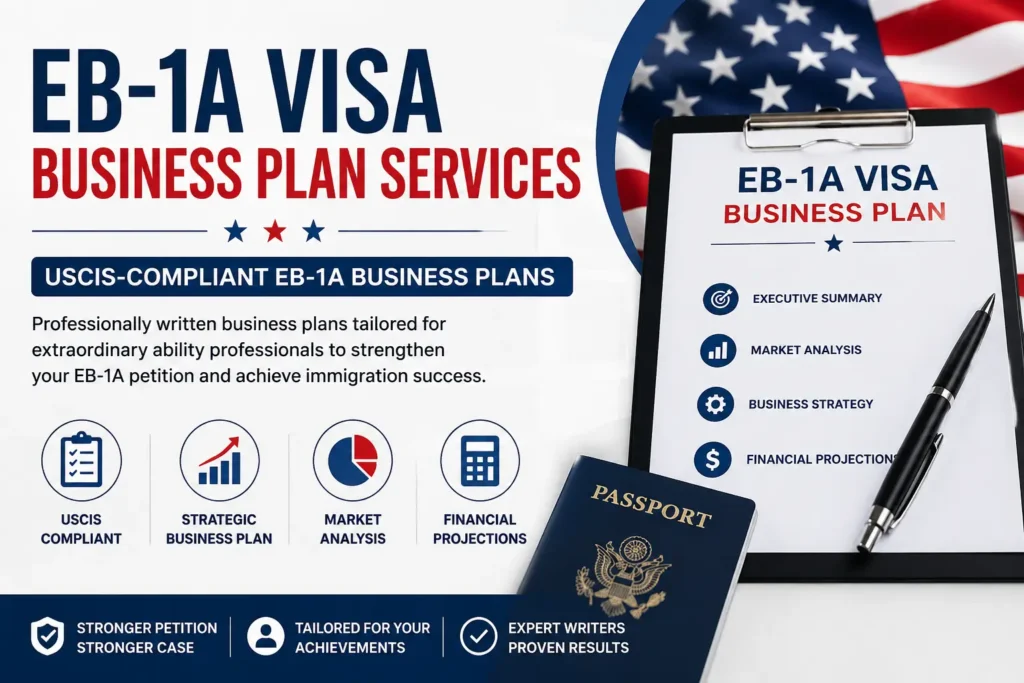
EB-1A Visa Business Plan — Prove Your Prospective Benefit to the United States
An EB-1A visa business plan is the document that answers the one question every EB-1A petition must satisfy beyond your past achievements: what will you do in the United States, and why does it matter? The EB-1A is a self-petitioning green card for individuals of extraordinary ability — but extraordinary ability alone is not enough. USCIS also requires evidence that you are coming to continue work in your field and that your entry will substantially benefit the United States prospectively. A well-built business plan is how you prove it.
At AAE Evaluations, we prepare USCIS-compliant EB-1A visa business plans that translate your record of acclaim into a forward-looking, evidence-grounded case for your U.S. endeavor. Every plan is custom-researched around your specific field, your intended work, and the national impact you will create — structured to support both the regulatory criteria and the final merits review.
✅ USCIS-Compliant Structure ✅ Built Around Your Prospective Endeavor ✅ Financial Projections & Market Analysis ✅ Attorney-Ready ✅ Fast Turnaround
Apply for Your EB-1A Business Plan →
Do You Need a Business Plan for an EB-1A Visa?
Direct answer: A business plan is not a mandatory USCIS form for the EB-1A, but it is one of the most effective ways to satisfy the visa’s prospective-benefit requirement. EB-1A law requires you to show you will continue working in your area of extraordinary ability and that your work will substantially benefit the United States. A business or personal endeavor plan documents exactly that — making it especially valuable for entrepreneurs, founders, and independent professionals.
Unlike the E-2 or EB-5 categories, where a detailed business plan is effectively required, the EB-1A treats the plan as supporting evidence. That does not make it optional in practice. When your case rests on entrepreneurial work, a startup, a consultancy, a research venture, or any self-directed endeavor, a credible plan is often the clearest proof that your extraordinary ability will produce real, ongoing benefit on U.S. soil.
What Is an EB-1A Visa Business Plan?
Definition: An EB-1A visa business plan is a tailored document that describes the work an extraordinary-ability applicant intends to pursue in the United States, the market and industry context for that work, the resources and qualifications behind it, and its projected economic, scientific, cultural, or social impact. It exists to demonstrate the EB-1A’s “prospective benefit” and “continued work” requirements — not to launch a company in the conventional sense.
This is a frequent point of confusion. A traditional investor business plan is built to raise money. An EB-1A business plan is built to persuade a USCIS adjudicator. The audience, the emphasis, and the success metric are completely different. Our plans speak the language of adjudication — connecting your endeavor to the legal standard rather than to a funding round.
Why a Business Plan Strengthens Your EB-1A Petition
The Prospective Benefit Requirement
The EB-1A statute does more than ask whether you have been extraordinary. It asks whether your presence will benefit the country going forward. A petition heavy on past awards but silent on future work leaves a gap an officer can challenge. A clear, specific business plan closes that gap by spelling out what you will build, advance, or contribute — and for whom.
The Final Merits Determination — and What Changed in 2026
For more than a decade, USCIS has evaluated EB-1A petitions under the two-step framework from Kazarian v. USCIS. Step one checks whether you meet at least three of the ten regulatory criteria. Step two, the final merits determination, weighs the totality of your evidence to decide whether you truly sit among the small percentage at the very top of your field with sustained acclaim.
In early 2026, a federal district court in Mukherji v. USCIS held that the final merits determination, as applied, was unlawful. Immigration practitioners have been clear, however, that the ruling is not binding nationwide — it does not bind USCIS officers outside the parties to that case, and the two-step approach remains the practical reality for most petitions. The takeaway for applicants is unchanged: build a petition strong enough to win on the totality of the evidence. A business plan that documents national-level impact directly supports that totality.
Bridging the Adjudicator Knowledge Gap
USCIS officers are generalists who review cases across dozens of disciplines. A plan that explains your endeavor in clear, accessible terms — and ties it to measurable benefit — helps a non-specialist adjudicator understand why your work matters at a national scale.
What We Include in Your EB-1A Business Plan
We lead with deliverables. Every EB-1A visa business plan we prepare is custom-built, never templated, and typically includes:
| Section | What it establishes |
|---|---|
| Executive summary | A concise overview of your endeavor and how it aligns with EB-1A requirements |
| Applicant profile & extraordinary ability summary | Your field, recognition, and the qualifications behind the work |
| Proposed U.S. endeavor | The specific projects, venture, research, or services you will pursue |
| Industry & market analysis | The significance of your field and where your contribution fits |
| Competitive positioning | What sets your work apart and why it is needed |
| National impact analysis | Job creation, economic value, scientific or cultural benefit at a national level |
| Management & personnel | Roles, structure, and how the endeavor will be executed |
| Financial projections | Realistic, defensible projections (typically 3–5 years) |
| Implementation timeline | A credible roadmap for your work in the U.S. |
| Alignment with EB-1A criteria | An explicit bridge from your plan to the regulatory standard |
Verified internal references, current government data points, and a structure designed to slot directly into your attorney’s petition package are standard. You can review full scope and turnaround on our pricing page.
EB-1A Eligibility — The 3-of-10 Criteria Your Plan Supports
To qualify, you must meet at least three of the ten USCIS criteria for extraordinary ability (or show a one-time major achievement, such as a Nobel, Pulitzer, or Oscar). Many strong petitions document four or five to build a margin of safety. The ten criteria are:
| # | EB-1A regulatory criterion |
|---|---|
| 1 | Lesser nationally or internationally recognized prizes or awards for excellence |
| 2 | Membership in associations requiring outstanding achievement |
| 3 | Published material about you in professional or major trade publications or major media |
| 4 | Participation as a judge of the work of others in your field |
| 5 | Original scientific, scholarly, artistic, athletic, or business-related contributions of major significance |
| 6 | Authorship of scholarly articles in professional or major media |
| 7 | Display of your work at artistic exhibitions or showcases |
| 8 | Leading or critical role for distinguished organizations |
| 9 | High salary or remuneration relative to others in the field |
| 10 | Commercial success in the performing arts |
A business plan most directly reinforces criteria tied to original contributions of major significance, leading or critical roles, and commercial success — and, crucially, it carries the prospective-benefit argument that the criteria themselves do not address.
How Our EB-1A Business Plan Process Works
We keep the process structured and fast.
- Discovery & scope. We learn your field, your record of acclaim, and the endeavor you intend to pursue in the U.S. If you are working with an immigration attorney, we coordinate with them from the start.
- Questionnaire & document intake. You complete a focused questionnaire and share supporting materials by email. We do not need originals.
- Research & drafting. Our team researches your industry, market, and national-impact context, then drafts a plan structured around the EB-1A standard.
- Review & revisions. You and your attorney review the draft. We refine until the plan fully reflects your endeavor and meets USCIS expectations.
- Final delivery. You receive a polished, attorney-ready plan formatted for direct inclusion in your I-140 petition package.
When deadlines are tight, ask us about rush turnaround. You can begin anytime at our secure payment page.
What Sets Our EB-1A Business Plans Apart
| Generic / template plan | AAE Evaluations EB-1A plan | |
|---|---|---|
| Audience | Investors or lenders | USCIS adjudicators |
| Focus | Profit and funding | Prospective benefit & national impact |
| Customization | Boilerplate sections | Built around your specific endeavor |
| Legal alignment | None | Mapped to EB-1A criteria & merits review |
| Attorney integration | Rare | Structured for direct petition use |
| Research | Surface-level | Field-specific, current data |
We do not use cookie-cutter documents. The scrutiny of an EB-1A adjudication cannot be met with a generic product, and your case deserves better.
EB-1A Business Plan vs. Other Immigration Business Plans
Different visas demand different plans. Here is how the EB-1A compares to the categories we also support:
| Visa | Plan’s role | Self-petition? | Job offer required? |
|---|---|---|---|
| EB-1A | Supporting evidence of prospective benefit | Yes | No |
| EB-2 NIW | Documents the proposed endeavor’s merit & national importance | Yes | No |
| EB-5 | Core required document; investment & job creation focus | Yes | No |
| E-2 / L-1 | Required; viability & operations focus | No | Varies |
If you are weighing pathways, explore our EB-2 NIW business plan, EB-2 business plan, and EB-5 visa business plan services. For intracompany cases, see our L-1 expert opinion and business plans.
EB-1A Costs and Timelines in 2026
Understanding the broader filing picture helps you plan. As of 2026:
- Form I-140 base filing fee: $715. Depending on your filing profile, an additional Asylum Program Fee may apply — confirm current fees on the USCIS website or with your attorney.
- Premium processing (Form I-907): $2,965, effective March 1, 2026 (increased from $2,805). It guarantees USCIS action — approval, RFE, NOID, denial, or investigation — within 15 business days, but it does not improve your odds of approval.
- Standard processing: generally 6 to 12+ months, occasionally longer during peak periods.
- Concurrent filing: if your priority date is current, you may file Form I-485 alongside your I-140.
Key point: Premium processing buys speed, not strength. The quality of your petition — including a well-built business plan — is what determines the outcome. For nationals of India and China, where EB-1 priority dates have retrogressed, a faster approval does not advance your place in the green card queue.
These figures change. Always verify current fees and processing times with USCIS or a licensed immigration attorney before filing.
Who Needs an EB-1A Business Plan
A business plan adds the most value when your EB-1A case is built around forward-looking, self-directed work, including:
- Founders and entrepreneurs launching or scaling a U.S. venture
- Independent consultants and advisors with a defined U.S. practice
- Researchers and scientists pursuing a specific program of work with national impact
- Artists, athletes, and performers with a concrete U.S. endeavor and economic footprint
- Professionals transitioning from O-1 or H-1B status who need to document prospective benefit
If your acclaim is established but your future U.S. work is not yet documented, that is precisely the gap a plan fills.
Pair Your Business Plan with Expert Opinion Letters
A business plan is strongest as part of a complete evidentiary package. Many petitioners pair it with independent letters that interpret their achievements for USCIS. Explore our EB-1 expert opinion letters and EB-1A recommendation letters to round out your case. If you are also considering the national interest pathway, our EB-2 NIW expert opinion letters and O-1 expert and advisory letters cover adjacent categories.
If your petition also relies on foreign credentials or professional experience, we can support that too — see our academic evaluation and work experience evaluation services, or browse all our services.
EB-1A Business Plan FAQs
Is a business plan required for an EB-1A visa?
No. Unlike the EB-5 or E-2, the EB-1A does not require a business plan as a mandatory form. However, it is highly recommended for entrepreneurial, research, and self-directed cases because it documents the prospective benefit and continued-work requirements that the petition must satisfy.
How is an EB-1A business plan different from an investor business plan?
An investor plan is written to raise capital. An EB-1A business plan is written to persuade a USCIS adjudicator that your work will benefit the United States. The structure emphasizes national impact and alignment with EB-1A criteria rather than return on investment.
How long is an EB-1A business plan?
Length depends on your endeavor, but immigration-focused plans typically run from roughly 25 to 45 pages, covering your profile, the proposed U.S. work, market and industry analysis, national impact, and financial projections.
Can a business plan help if my acclaim is strong but my future plans are vague?
Yes — that is exactly where it helps most. The EB-1A requires evidence that you will continue working in your field and benefit the U.S. prospectively. A plan turns a vague intention into documented, specific, and credible future work.
Does the 2026 Mukherji ruling mean the final merits review no longer applies?
Not for most applicants. The ruling came from a single federal district court and is not binding nationwide. The two-step Kazarian framework remains the practical standard, so building a petition strong on the totality of evidence — including a business plan — is still the right strategy.
Do you work with my immigration attorney?
Yes. We coordinate directly with your attorney and structure the plan so it integrates cleanly into your I-140 petition package.
How much does premium processing cost in 2026?
Premium processing for Form I-140 is $2,965 as of March 1, 2026, and guarantees USCIS action within 15 business days. It is a timing tool only and does not increase approval odds.
How fast can you deliver my EB-1A business plan?
Turnaround depends on scope and the materials you provide. Rush service is available for tight filing deadlines — contact us with your timeline and we will confirm what is possible.
Get Started with Your EB-1A Visa Business Plan
A strong EB-1A petition proves two things: that you have risen to the top of your field, and that your work will keep benefiting the United States. We build the document that carries the second half of that argument.
Get an attorney-ready EB-1A visa business plan custom-built around your endeavor.
📞 (+1) 813-816-3969 ✉️ Contact@aaeevaluations.com
Apply Now → · View Pricing → · Pay Online →
AAE Evaluations provides business and professional plans, expert opinion letters, credential evaluations, and certified translations for U.S. immigration. We are not a law firm and do not provide legal advice. Immigration laws, fees, and processing times change frequently; verify current requirements with USCIS or a licensed immigration attorney.