
EB-1C Visa Business Plan - USCIS Compliant Executive Immigration Plans
Get a professionally prepared EB-1C visa business plan tailored for multinational managers and executives. USCIS-compliant plans with market analysis, financial projections, organizational structure, and business growth strategy.
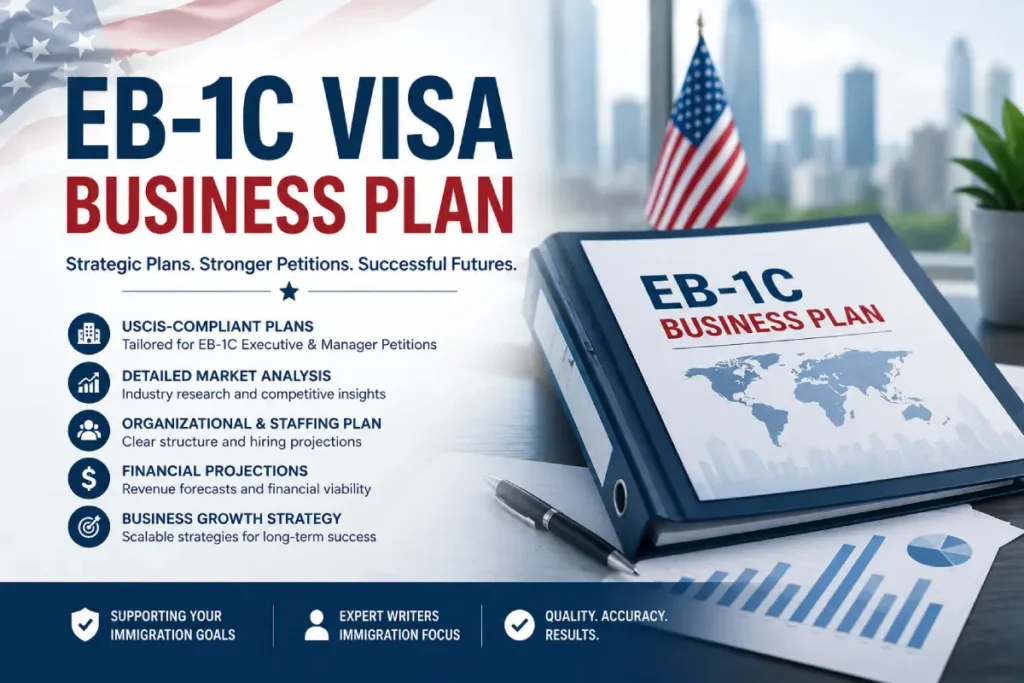
EB-1C Visa Business Plan
In short: An EB-1C visa business plan is a USCIS-ready document that proves your U.S. company is a real, viable operation capable of supporting a multinational manager or executive on a permanent basis. We write custom EB-1C business plans with financial projections, organizational charts, hiring plans and market analysis that speak directly to the standard adjudicators apply under 8 CFR 204.5(j). Contact us to start yours.
When you petition for an EB-1C green card, USCIS is not asking whether your executive is talented. It is asking whether your U.S. entity genuinely needs a senior leader and can pay for one. That question is answered on paper, in the language adjudicators use, or it is not answered at all. We build that document.
At AAE Evaluations, we prepare professional, fully customized EB-1C visa business plans for multinational managers, executives, company owners and the immigration attorneys who represent them. Every plan we write is designed to support the I-140 petition, anticipate Requests for Evidence before they arrive, and demonstrate that your business is doing exactly what an EB-1C petition claims it is doing. Get a quote today.
What We Deliver in Your EB-1C Visa Business Plan
Direct answer: We deliver a custom, USCIS-compliant EB-1C business plan that documents your U.S. company’s viability, financial outlook, staffing structure and growth trajectory, framed to prove the petitioned position is genuinely managerial or executive and that the company can sustain it permanently.
Your finished plan is more than a financial document. It is petition evidence. We write it to do four jobs at once:
- Prove viability — that your U.S. entity is actively doing business and will continue to grow.
- Justify the role — that the position you are filling is primarily managerial or executive, not operational.
- Demonstrate ability to pay — that the company can fund the proffered salary and the wider organization around it.
- Tell one consistent story — so your business plan, organizational charts, financials and support letter all point in the same direction.
We pair this work naturally with our EB-1 expert opinion letters and credential and work-experience evaluations when a case needs the executive’s qualifications independently verified.
Why Your EB-1C Petition Needs a Business Plan
Direct answer: USCIS approves EB-1C petitions on documentary precision, not job titles. Most denials happen because the petition fails to prove managerial capacity and company viability in writing. A strong business plan supplies that proof and is the single most controllable variable in your case.
EB-1C is one of the few employment-based green cards that skips PERM labor certification, which makes it faster and far less paperwork-heavy than EB-2 or EB-3 filings. But that advantage comes with a trade-off: USCIS scrutinizes the substance of the role and the legitimacy of the business much more closely.
Adjudicators do not infer managerial capacity from a senior title or impressive revenue. They want to see named direct reports, an organizational chart, a breakdown of duties showing that managerial tasks dominate the executive’s time, and evidence that day-to-day operations are handled by other staff. Roughly one in four EB-1C petitions draws a Request for Evidence, and a large share of those RFEs target precisely the weaknesses a well-written business plan is built to close.
A generic, template plan does the opposite of helping. It signals to an officer that the business itself may be thin. We write every EB-1C plan from your facts, your numbers and your corporate structure, so it reads as the document of an operating company, because it is.
What Goes Inside Your EB-1C Business Plan
Each plan is tailored to your company and your filing strategy. A complete EB-1C visa business plan from us typically includes:
- Executive summary — a concise, officer-friendly overview of the U.S. entity, the qualifying relationship and the executive’s role.
- Company description and ownership — incorporation details, ownership structure and the parent/subsidiary/affiliate/branch relationship that makes the case qualify.
- Qualifying relationship analysis — a clear explanation, supported by structure diagrams, of how the foreign and U.S. entities are linked.
- Managerial/executive role definition — duty breakdowns, percentage-of-time allocations and direct-report mapping that satisfy the 8 CFR 204.5(j) definitions.
- Organizational charts — current and projected, showing the executive’s position above professional and managerial staff.
- Market and industry analysis — the U.S. market opportunity, competitive landscape and demand that justify the operation.
- Marketing and operations strategy — how the U.S. company generates and delivers revenue.
- Financial projections — 3-to-5-year revenue, expense, payroll and cash-flow statements demonstrating ability to pay and sustained growth.
- Hiring and staffing plan — headcount growth that supports a permanent managerial layer.
- Funding and capitalization — sources of capital and evidence the company is financed to operate.
We align this structure with the same rigor we apply across our immigration business plan services, including our L-1 visa business plans and EB-5 visa business plans.
EB-1C vs. L-1A: How the Business Plan Bridges the Two
Most EB-1C petitions come from executives who entered the U.S. on an L-1A intracompany transfer. The two categories share a foundation, but the EB-1C burden is higher because it leads to permanent residency. The business plan is what carries an applicant from a temporary transfer to a green card.
| Factor | L-1A Visa | EB-1C Green Card |
|---|---|---|
| Type | Nonimmigrant (temporary) | Immigrant (permanent residency) |
| Foreign employment | 1 continuous year in past 3 | 1 continuous year in past 3 |
| Qualifying role abroad | Managerial, executive or specialized knowledge | Managerial or executive only |
| U.S. business age | Can start a new office | Must have been doing business ~1 year |
| Labor certification | Not required | Not required |
| Evidentiary bar | Lower | Higher |
| Business plan role | Often required for new-office cases | Central to proving viability and role |
If you are still in the planning stage of an L-1A or moving toward an EB-1C, our L-1A and L-1B expert opinion letters and our L-1 expert opinion and business plan service work together to strengthen both stages of the journey.
EB-1C vs. EB-1A vs. EB-5: Which Plan Do You Need?
All three are paths to a green card, but they are built on different proof. Choosing the right plan matters, and we prepare each one.
| Category | Who it fits | What the plan must prove |
|---|---|---|
| EB-1C | Multinational managers and executives transferring to a related U.S. company | Company viability, qualifying relationship, permanent managerial/executive role |
| EB-1A | Individuals with extraordinary ability | A credible plan of continued work in the field of expertise in the U.S. |
| EB-5 | Investors making a qualifying capital investment | Job creation, investment at risk, detailed financial feasibility |
If your case fits a different category, see our dedicated EB-1A visa business plans, EB-2 NIW business plans and EB-2 business plans. Not sure which path is yours? Talk to our team and we will point you to the right one.
EB-1C Eligibility Our Plan Is Built Around
Direct answer: To qualify for EB-1C, the beneficiary must have worked abroad in a managerial or executive role for at least one continuous year in the past three years, the U.S. company must have a qualifying relationship with the foreign entity, and the U.S. company must have been actively doing business for at least one year.
We write every plan around the core EB-1C requirements so your evidence lines up with the law:
- Qualifying foreign employment — at least one continuous year, full-time, in a managerial or executive capacity within the three years before filing.
- Qualifying relationship — the U.S. company is a parent, branch, subsidiary or affiliate of the foreign employer.
- U.S. company doing business — “doing business” means the regular, systematic and continuous provision of goods or services, not the mere existence of an office, for at least one year before filing.
- Permanent managerial/executive role in the U.S. — the offered position must be primarily managerial or executive.
- Ability to pay — the company can fund the proffered wage for the role.
These requirements are the backbone of the plan’s financial projections, organizational charts and role descriptions. For the executive’s underlying degree or experience, we can support the file with education evaluations and course-by-course evaluations where relevant.
New Office and Startup EB-1C Cases
Smaller companies and recently established U.S. operations can absolutely qualify for EB-1C, but USCIS applies heightened scrutiny when the business has been operating for a short time. Two challenges come up again and again, and our plans are written to address both.
First, the managerial trap: in a small company, the executive often touches day-to-day work. We document how operational tasks are distributed across staff and contractors so the executive’s role reads as genuinely managerial or executive.
Second, ability to pay and growth: a low founder salary or thin early financials can suggest the position is not truly senior. We build realistic, defensible financial projections and a staffing roadmap that show the company growing into a structure that supports a permanent managerial layer.
If your case involves a brand-new operation, our experience with new-office filings carries over directly from our L-1 visa business plan work, where new-office viability is the central question.
Our EB-1C Business Plan Process
We keep the process simple, collaborative and fast. Here is how it works from first contact to final delivery:
- Consultation and quote. Reach out with your case details. We review your situation, confirm fit and send a quote with turnaround.
- Onboarding and questionnaire. You complete a focused questionnaire about your business, the executive’s role and your filing timeline. We request supporting documents.
- Research and drafting. Our writers and financial analysts build your market analysis, projections, charts and role descriptions from your facts, framed for USCIS.
- Draft review. You and your attorney review the draft. We refine financials, duties and structure until the plan is exactly right.
- Final delivery. You receive a polished, petition-ready EB-1C business plan, formatted and ready to file.
Attorneys who refer multiple cases can contact us about ongoing collaboration and volume arrangements.
Why Choose AAE Evaluations
We are a credential evaluation and immigration documentation firm trusted by clients in 43 nationalities and immigration professionals worldwide. When you work with us on an EB-1C business plan, you get:
- Petition-focused writing. We do not write generic startup plans. We write evidence framed to the EB-1C standard adjudicators apply.
- A complete documentation partner. Business plans, expert opinion letters, recommendation letters and credential evaluations under one roof.
- Custom financials. Real projections built around your numbers, not recycled templates.
- Attorney-friendly workflow. Clear drafts, responsive revisions and dependable turnaround that fit your filing schedule.
- Worldwide experience. We support clients and counsel across the U.S. and internationally.
Learn more about our team and track record.
EB-1C Business Plan Pricing & Turnaround
Pricing depends on the complexity of your business, the depth of financial modeling required and your timeline. New-office and multi-entity cases need more analysis than established operations, and rush timelines are available when a deadline is close.
For current rates on our EB-1C business plans and related immigration documents, see our pricing page or request a custom quote. We will give you a clear price and delivery date before any work begins.
Frequently Asked Questions
Do I really need a business plan for an EB-1C petition?
While USCIS does not list a business plan as a standalone form requirement, it is strongly expected, especially for newer U.S. operations and small companies. The plan is your primary vehicle for proving viability, ability to pay and the managerial nature of the role. In practice, a strong plan is one of the most effective ways to reduce the risk of a Request for Evidence or denial.
What is the “doing business” requirement for EB-1C?
“Doing business” means the regular, systematic and continuous provision of goods or services. The U.S. company must have been actively conducting business, not merely existing as a registered entity, for at least one year before the EB-1C petition is filed. Our plan documents this activity with financials and operational detail.
Can a new U.S. company or startup qualify for EB-1C?
Yes, but USCIS applies extra scrutiny when the business is young or small. The petition needs a detailed business plan showing growth, realistic financials, a hiring roadmap and evidence that day-to-day tasks are handled by other staff so the executive’s role remains managerial. We specialize in writing exactly this kind of plan.
Can I move from an L-1A visa to an EB-1C green card?
Yes, and it is the most common pathway. L-1A holders already meet the foreign-employment and qualifying-relationship tests, which makes the transition natural. The EB-1C bar is higher because it leads to permanent residency, and the business plan is what carries the case across that gap. See our L-1 visa business plan service.
Does EB-1C require PERM labor certification?
No. Like other EB-1 first-preference categories, EB-1C does not require PERM labor certification, which streamlines and shortens the process compared with EB-2 and EB-3 filings. There must still be a genuine offer of employment from the U.S. employer.
Can my spouse and children get green cards through my EB-1C?
Yes. Your spouse and unmarried children under 21 can obtain permanent residency as dependents of the principal EB-1C beneficiary, filing alongside or after your petition.
How long does an EB-1C business plan take to prepare?
Standard turnaround typically runs about 7 to 10 business days after onboarding, depending on complexity. Rush options are available. Contact us with your filing deadline and we will confirm a delivery date.
Start Your EB-1C Visa Business Plan Today
Your executive’s green card should not hinge on a thin or generic document. Give your I-140 petition a business plan written to prove exactly what USCIS needs to see.
Get your EB-1C business plan quote → | View pricing →
Email Contact@aaeevaluations.com or call (+1) 813-816-3969 to speak with our team.