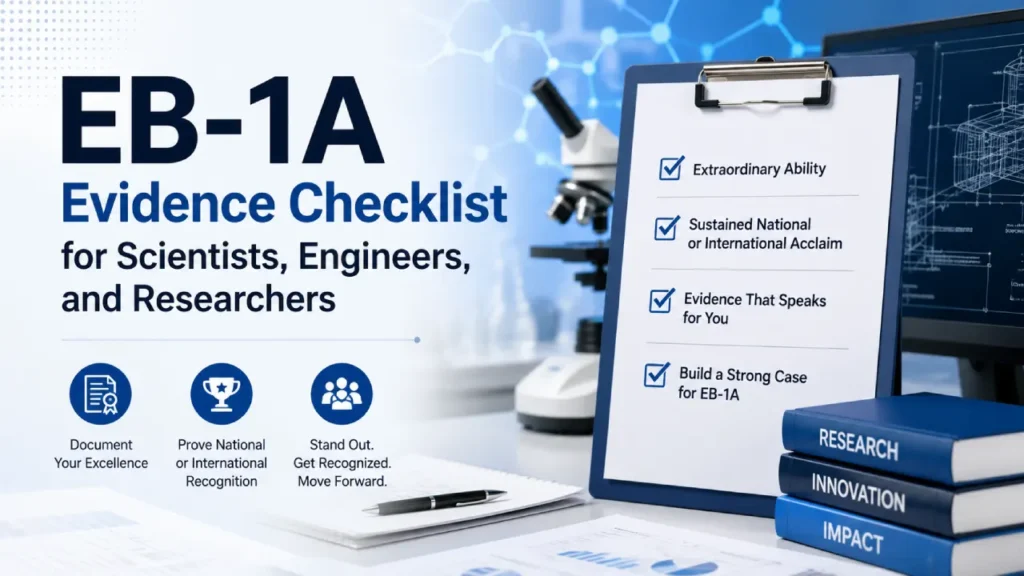
Quick Answer: To qualify for the EB-1A green card, scientists, engineers, and researchers must document extraordinary ability by satisfying at least three of ten USCIS regulatory criteria under 8 CFR § 204.5(h)(3) — then survive a holistic “final merits determination” that evaluates the entire record for sustained national or international acclaim. The most relevant criteria for STEM professionals are: original contributions of major significance, scholarly articles, judging/peer review, awards and grants, high salary, and leading or critical roles. This checklist walks through every criterion with the specific documents you need, common mistakes, and what USCIS actually looks for in 2026.
Key Takeaways:
- EB-1A approval rates fell from 77.8% in FY 2022 to 66.6% in Q3 2025 — most denials now happen at the final merits stage, not at the three-criteria threshold
- Meeting exactly three criteria with thin evidence is the riskiest filing strategy; strong petitions typically satisfy four to six criteria with deep documentation
- Citation counts, adoption evidence, and field-normalized metrics matter far more than publication volume alone
- Independent expert opinion letters are no longer optional — they’re the connective tissue between your evidence and USCIS criteria
- Engineers and industry researchers qualify through patents, product impact, and leading roles — not just academic publishing
- No employer sponsorship or job offer is required for EB-1A; you can self-petition at any time
Getting an EB-1A green card as a scientist, engineer, or researcher is genuinely achievable — far more so than most people realize when they first hear the words “extraordinary ability.” You don’t need a Nobel Prize. You don’t need to be the most cited researcher in your field. What you need is a well-documented record that, read together, shows you’ve achieved sustained recognition at a national or international level that places you among the top percentage of people in your specialty.
What actually separates approvals from denials in 2026 isn’t the achievement gap. It’s the documentation gap.
The denial rate for EB-1 petitions nearly doubled between Q4 FY 2024 and Q4 FY 2025 — and most of those denials came at Step 2 of the Kazarian analysis, after petitioners had already cleared the three-criteria threshold. That’s the critical insight. You can satisfy the letter of three criteria and still have your petition denied because the record, read holistically, didn’t tell a clear story about where you stand in your field.
This checklist is built for STEM professionals who want to understand exactly what to gather, how to document it, and what the evidence actually needs to show — not just what category it falls under. For petitioners who need credential evaluations or EB-1A expert opinion letters that speak directly to USCIS criteria, getting those right from the start matters more than it ever has.
Before You Start: Understanding the Two-Step EB-1A Standard
Every EB-1A petition goes through two distinct stages of USCIS review. Understanding both changes how you think about building your evidentiary record.
Step 1 — The Criteria Count
USCIS first asks: has the petitioner submitted qualifying evidence for at least three of the ten regulatory criteria? This is the threshold. You’re either over it or under it.
For scientists, engineers, and researchers, the most commonly available criteria are:
- Criterion 1 — Prizes or awards for excellence
- Criterion 4 — Judging the work of others (peer review, grant panels)
- Criterion 5 — Original contributions of major significance
- Criterion 6 — Authorship of scholarly articles
- Criterion 8 — Leading or critical role for a distinguished organization
- Criterion 9 — High salary or remuneration relative to peers
You don’t need all six. You need three — well documented. But you should aim for four or five, because thin evidence across exactly three criteria creates maximum risk at Step 2.
Step 2 — The Final Merits Determination
After Step 1, USCIS steps back and asks a harder question: does the totality of this evidence show that the petitioner has sustained national or international acclaim and belongs among the small percentage at the very top of their field?
This is where the Kazarian v. USCIS framework (2010) plays out in practice. The officer evaluates every letter, citation count, award, role description, and salary comparison as a single picture. A petition that barely met three criteria on paper often falls apart here — not because the applicant is unqualified, but because the record didn’t make the case clearly enough.
The practical implication: every document you submit should not only satisfy a criterion, it should also contribute to the final merits narrative. If a piece of evidence doesn’t do both, think carefully about whether it belongs in the petition at all.
The EB-1A Evidence Checklist: Criterion by Criterion
✅ Criterion 1 — Prizes and Awards for Excellence
What qualifies: Nationally or internationally recognized prizes or awards for excellence in the field. The award must genuinely honor excellence — not participation, professional membership, or completion of a program.
For scientists and researchers:
- Competitive fellowship awards (NSF CAREER Award, NIH K-series awards, Fulbright Scholar designation)
- Best paper or best poster awards at highly selective conferences (NeurIPS, Nature-indexed journals’ annual recognitions)
- Named lectures or invited distinctions from professional societies (ACS, IEEE, ACM Fellows)
- Government-funded research grants won competitively (these function as recognition awards when the selection is merit-based and competitive)
For engineers:
- IEEE, ACM, or ASME award programs with documented selection criteria
- Patent innovation awards with documented competitive selection
- Industry recognition awards from organizations with known standards (not “who’s who” directories)
Documents to gather:
- [ ] Award certificate or official notification letter
- [ ] Documentation of the award’s selection criteria and judging process
- [ ] Information about the organization granting the award (reputation, membership standards)
- [ ] Evidence of the award’s competitive scope: how many were eligible, how many were selected
- [ ] Media coverage of the award, if any
- [ ] Expert letter contextualizing the award’s prestige within the field
Common mistake: Submitting an award without explaining why it’s selective. USCIS needs to understand that this wasn’t a participation trophy — documentation of the selection process, number of nominees, and prominence of the granting institution does that work.
✅ Criterion 2 — Membership in Associations Requiring Outstanding Achievement
What qualifies: Membership in associations in the field whose requirements for admission are outstanding achievements, as judged by recognized national or international experts. Fee-based, open, or credential-based memberships don’t qualify.
For scientists and researchers:
- Fellowship status in national academies: National Academy of Sciences, National Academy of Engineering, American Academy of Arts and Sciences
- Fellowship status in selective professional societies: IEEE Fellow, ACM Fellow, ACS Fellow, AAAS Fellow (not general membership — Fellowship specifically)
- Membership in invitation-only scientific bodies with documented admission criteria
What won’t work:
- Standard professional society membership (IEEE member, ACM member) — these require only dues
- Membership in any group where the admission process isn’t demonstrably merit-based and expert-judged
Documents to gather:
- [ ] Membership certificate or official election/fellowship notification
- [ ] The organization’s bylaws or documented admission criteria
- [ ] Evidence that admission is judged by recognized experts in the field
- [ ] Statistics on membership selectivity (what percentage of nominees are admitted)
- [ ] Organization’s history, reputation, and recognition within the field
Note for engineers: Many IEEE and ACM members are surprised to learn that standard membership doesn’t qualify — but Fellowship level (awarded to less than 0.1% of members based on extraordinary accomplishments) does. If you hold Fellow status, this criterion is a strong one for your petition.
✅ Criterion 3 — Published Material About You in Professional or Major Media
What qualifies: Published material in professional publications, major trade publications, or other major media about the petitioner and their work. The material must be about the petitioner — not simply citing or mentioning them in passing.
For scientists:
- Profile pieces or features in scientific journals’ news sections (Nature News, Science News)
- Coverage in major trade publications or scientific press (IEEE Spectrum, MIT Technology Review, Chemical & Engineering News)
- Media coverage in mainstream outlets discussing your research findings specifically
For engineers and industry researchers:
- Features in technology publications (Wired, TechCrunch, IEEE Spectrum, ACM Queue)
- Company or product coverage where your individual role and contribution is specifically named and described
- Industry analyst reports or expert roundups that identify you specifically
Documents to gather:
- [ ] Full copies of published articles (print or digital)
- [ ] Publication name, date, author, and URL/permalink
- [ ] Circulation data or readership figures for the publication
- [ ] Evidence of the publication’s reputation in the field (editorial standards, industry recognition)
- [ ] Translation if not in English (certified)
What to avoid: Press releases, company blog posts written by you or your employer, and social media posts don’t qualify. Coverage must come from independent third-party sources with editorial standards.
✅ Criterion 4 — Judging the Work of Others
What qualifies: Participation as a judge of the work of others in the same or an allied field. This is one of the most accessible criteria for STEM professionals and one of the most frequently mishandled.
What clearly qualifies:
- Peer review for recognized scientific journals (Nature, Science, Cell, Physical Review Letters, IEEE Transactions series, JACS, etc.)
- Grant panel reviewer for federal funding agencies (NSF, NIH, DOE, DARPA, HHMI)
- Conference paper reviewer for selective, peer-reviewed conferences (NeurIPS, ICML, CVPR, ICCB, AICHE annual meetings)
- Program committee member for recognized scientific conferences
- Thesis committee member or external examiner (particularly for outside institutions)
- Journal editor or editorial board member
Documents to gather:
- [ ] Invitation emails from journal editors requesting your review
- [ ] Confirmation emails or reviewer acknowledgment pages from journals
- [ ] List of journals reviewed for, with evidence of each journal’s impact factor, ranking, and selectivity
- [ ] Number of manuscripts reviewed (total and per journal, where documentable)
- [ ] Evidence of being specifically selected based on expertise — quotes from invitation emails help
- [ ] Grant panel confirmation letters or agency correspondence
- [ ] Conference program committee invitations and acceptance letters
The critical piece most petitions miss: A list of journals you’ve reviewed for is not sufficient by itself. USCIS needs to understand that you were specifically selected based on recognized expertise in your specialty — and that the journals you reviewed for are genuinely selective and reputable. An expert letter that contextualizes your peer review activity within the standards of your field is often necessary to make this criterion land properly.
✅ Criterion 5 — Original Contributions of Major Significance
This is the most important criterion for STEM professionals — and the one with the widest gap between what petitioners submit and what USCIS actually needs to see.
What qualifies: Original scientific, scholarly, or technical contributions that have had major significance in the field. The key word is major — the contribution must have demonstrably influenced or advanced the field beyond the petitioner’s own work.
For researchers — strong evidence:
- Research that has been cited frequently by independent scholars across multiple institutions
- Methodologies, algorithms, or frameworks that other researchers have adopted in their own work
- Studies that changed clinical practice guidelines, safety standards, or regulatory frameworks
- Publications that seeded or launched a recognized research subfield
For engineers — strong evidence:
- Patents that have been licensed, implemented, or cited by other patent holders
- Technical innovations that were adopted into products, standards, or specifications used by the broader industry
- Open-source software or technical frameworks with documented adoption metrics (GitHub stars, download counts, organizational adoptions)
- Engineering solutions that changed industry practice, with documented examples of adoption
Documents to gather:
- [ ] Publication list with citation counts (Google Scholar, Web of Science, Scopus)
- [ ] H-index and i10-index from Google Scholar
- [ ] Field-normalized citation metrics — critically important; raw citation counts mean nothing without context showing how they compare to peers in your specialty
- [ ] Evidence of specific researchers or organizations citing or building on your work (beyond routine references)
- [ ] Patent grant certificates with patent numbers
- [ ] Evidence of patent licensing, implementation, or forward citations
- [ ] Adoption evidence: organizations or products using your methodology or technology
- [ ] Expert opinion letters explaining why the contribution matters — this is essential and non-negotiable
The part most petitions get wrong: Submitting a list of publications and their citation counts without any contextual analysis. USCIS adjudicators aren’t specialists in your field. They cannot independently evaluate whether 800 citations is remarkable or ordinary for a computational chemist with 10 years of post-PhD work. An EB-1A expert opinion letter from an independent authority in your field — someone who can explain the significance, contextualize the citation metrics, and describe specific examples of how your work influenced the field — is what closes this gap.
✅ Criterion 6 — Authorship of Scholarly Articles
What qualifies: Authorship of scholarly articles in professional journals, major trade publications, or other major media in the field. This is the most foundational criterion for academic scientists and researchers.
Strong evidence:
- First-author or corresponding-author publications in peer-reviewed journals recognized in your field
- Publications in high-impact journals with recognized selectivity (acceptance rates below 20-30% are favorable)
- Conference papers in highly selective, peer-reviewed venues (in computer science and engineering, top conferences can be more prestigious than many journals)
- Review articles or book chapters in recognized scientific references
What’s weaker than it looks:
- A long list of publications in low-impact or predatory journals
- Conference abstracts or poster presentations (these typically don’t meet the “scholarly article” standard)
- Preprints without formal peer-reviewed publication
- Papers where you are a middle author in a large collaboration with no documented independent contribution
Documents to gather:
- [ ] Complete publication list (formatted consistently — APA or field-standard citation format)
- [ ] First-page copies or full PDFs of key publications
- [ ] Journal information: impact factor, acceptance rate, h-index of the journal, ranking within the field
- [ ] Author position documentation — clarify which papers are first-author vs. collaborative
- [ ] Citation counts for each paper (from Google Scholar or Web of Science)
- [ ] Evidence of journal’s reputation: editorial board, peer review standards, field ranking
For computer scientists and engineers: Conference publications in top-tier venues (ICML, NeurIPS, CVPR, ICDM, OSDI, SOSP) carry enormous weight in your field. Make sure your petition explains this clearly — USCIS adjudicators trained on academic journal norms may not automatically recognize selective conferences as equivalent to top journals without explicit explanation.
✅ Criterion 7 — Display of Work at Exhibitions or Showcases
Relevance for STEM professionals: This criterion is primarily designed for artists and is rarely the best fit for scientists, engineers, or researchers. However, it can apply in limited circumstances:
- Engineering demonstrations at major trade shows (CES, MWC) where your specific technology or invention was prominently featured
- Scientific exhibits at world-recognized venues (Smithsonian Institution science exhibitions, major science museums)
- Product launches or technology demonstrations with documented audience reach and media coverage
For most STEM petitioners, don’t force this criterion. Your effort is better spent building stronger documentation for Criteria 1, 4, 5, 6, 8, and 9.
✅ Criterion 8 — Leading or Critical Role for a Distinguished Organization
What qualifies: Performance in a leading or critical role for an organization or establishment that has a distinguished reputation. Two things must be proven separately: (1) the organization is distinguished, and (2) your role was genuinely leading or critical — not just senior or senior-titled.
For researchers:
- Principal Investigator or Co-PI of a federally funded research project (NSF, NIH, DOE grants)
- Laboratory director or department head at a recognized research university or national laboratory
- Lead scientist or Chief Scientist at a research institution with a documented reputation
- Founder or technical lead of a research center or recognized research group
For engineers:
- Lead engineer, principal engineer, or distinguished engineer at a company with demonstrable distinction (Fortune 500, well-known tech organization, recognized defense contractor)
- Technical lead on a major project that can be independently corroborated
- CTO, VP of Engineering, or Senior Director of Engineering at an organization with verifiable reputation
Documents to gather:
- [ ] Official job title and formal job description
- [ ] Organizational chart showing reporting structure and the scope of the role
- [ ] Evidence of the organization’s distinguished reputation: rankings, awards, funding levels, revenue scale, research output
- [ ] Documentation of specific responsibilities that demonstrate leading or critical function (not just seniority)
- [ ] Evidence of discretionary authority: budget control, personnel decisions, strategic direction
- [ ] Employer letters explaining the significance of the role within the organization
- [ ] Press coverage, investor recognition, or industry rankings of the organization
What USCIS scrutinizes here: A job title alone means nothing. USCIS wants to see that the organization is genuinely distinguished (not internally significant but publicly unknown), and that your specific role was critical to the organization’s mission — not merely important to your team. An expert letter that contextualizes the organization’s reputation and your role’s significance within it is extremely valuable here.
✅ Criterion 9 — High Salary or Remuneration Relative to Others in the Field
What qualifies: Evidence that you command a high salary or remuneration for services in comparison to others in the field. USCIS typically looks for compensation at or above the 95th percentile for your specialty and career stage.
For researchers:
- Base salary plus any research stipends, consulting fees, or supplemental income
- Comparison to peers at similar career stages in similar roles (use Bureau of Labor Statistics data, NSF Salary Surveys, or field-specific compensation data)
- Grant funding where the researcher’s compensation package is drawn from competitive grants can be a supporting factor
For engineers:
- Total compensation including base salary, annual bonus, and equity (RSUs, stock options at current valuation)
- Industry salary benchmarks from credible sources (levels.fyi for tech engineers, BLS OES data, industry association salary surveys)
- Offer letters showing offered compensation packages
Documents to gather:
- [ ] Official pay stubs, W-2 forms, or offer letter showing total compensation
- [ ] Breakdown of equity, bonuses, and other non-base compensation components (often overlooked)
- [ ] Bureau of Labor Statistics Occupational Employment and Wage Statistics data for your role and geography
- [ ] Industry salary surveys specific to your field (IEEE Salary Survey, ACM/CSTA survey, Radford, Mercer, or Levels.fyi data for tech)
- [ ] Expert letter or employer letter confirming that the compensation is reserved for top performers
- [ ] If applicable: licensing royalties, consulting fee documentation, patent royalty income
Common documentation failure: Submitting only base salary without equity, bonuses, or other compensation components systematically understates total compensation. For senior engineers at technology companies, base salary may be only 40–60% of total compensation. Always document the full package and compare total compensation to peer benchmarks — not just salary-to-salary.
✅ Criterion 10 — Commercial Success in the Performing Arts
Relevance for STEM professionals: This criterion does not apply to scientists, engineers, or researchers. Skip it.
The Evidence That Connects Everything: Independent Expert Opinion Letters
You’ll notice that expert opinion letters appear repeatedly throughout this checklist — and that’s not an accident. They’re not optional supplementary documents. For STEM EB-1A petitions in 2026, they’re the evidentiary infrastructure that allows USCIS to evaluate technical achievements it cannot independently assess.
Here’s the core problem: USCIS adjudicators are legal professionals, not scientists or engineers. They cannot independently determine whether your H-index of 28 is exceptional for a computational neuroscientist with 8 years post-PhD, or whether your patent for a novel semiconductor deposition process was genuinely influential in the industry. Without an expert to explain this, the adjudicator is making judgment calls with incomplete context.
An EB-1A expert opinion letter from an independent, credentialed authority in your field provides:
- Context that raw metrics can’t convey — why your citation count or H-index is exceptional relative to field norms and career stage
- Impact analysis — specific examples of how your contributions influenced subsequent work, products, or standards
- Criterion mapping — explicit connection between your achievements and the regulatory criteria USCIS applies
- Independent credibility — the evaluator has no personal relationship or institutional affiliation with you, which matters for final merits credibility
Strong expert letters are analytical, not testimonial. They don’t open with “I’ve known Dr. [Name] for years and she is exceptional.” They open with the evaluator’s credentials, explain the field context, identify specific contributions, and connect them to the regulatory standard with reasoned analysis.
A credential evaluation for USCIS is also essential if your degrees were obtained outside the United States. An ambiguous or missing equivalency evaluation gives USCIS reason to question your baseline qualifications before evaluating your extraordinary ability — and that’s a problem that’s entirely preventable.
How to Structure Your EB-1A Evidence Package
Step 1: Audit Your Record First
Before you start writing anything, gather everything. List every publication with its citation count. Identify every journal you’ve reviewed for. Document every award, grant, fellowship, or recognition. Pull your Google Scholar profile, Scopus data, and any H-index analytics. For engineers, catalog every patent with its filing date, grant date, and any licensing or implementation you’re aware of.
Then map each item to the ten criteria. You’re looking for where you have depth (multiple strong pieces of evidence for one criterion) and where you have nothing. That map tells you what to prioritize — and what to skip.
Step 2: Choose Your Three to Five Primary Criteria
Pick the criteria where you have the strongest, most independently verifiable evidence. For most academic researchers, that’s some combination of Criteria 4, 5, 6, and potentially 1 or 9. For industry engineers, it’s often 5, 8, and 9 with 1 or 4 as support.
Don’t stretch for criteria where your evidence is thin. Meeting three strong criteria is considerably more persuasive than meeting six weak ones.
Step 3: Commission Your Expert Letters Early
Expert opinion letters take time to do properly. Identify two to four independent evaluators in your field — people who have no close personal or institutional relationship with you, who are themselves recognized in the specialty, and who are willing to write an analytical assessment rather than a testimonial.
If you’re working with AAE Evaluations for EB-1 expert letters, the process starts with a review of your record and then builds letters specifically structured to address the USCIS criteria your petition relies on. This is different from asking a colleague or mentor for a letter — the structure, the regulatory framing, and the independence all matter for how the letter is received.
Step 4: Build the Petition Narrative
Your petition letter — typically filed by your attorney — should walk USCIS through your evidence criterion by criterion and then make an explicit final merits argument. It’s not enough to say “the petitioner has met Criterion 5 through the following publications.” The letter should explain why those publications are extraordinary, what they changed in the field, and how they collectively establish that the petitioner stands among the top percentage of professionals in their specialty.
The petition letter should read as a coherent argument, not a catalogue.
Step 5: Review for Consistency Before Filing
Inconsistencies between your expert letters, credential evaluations, and petition narrative are a common RFE trigger. If your expert letter says your H-index is exceptional for a computational biologist with 7 years post-PhD, but your CV shows your first publication was 10 years ago, that inconsistency needs to be addressed — not ignored.
When one coordinated team handles your education evaluation, expert opinion letters, and supporting documents together, the record is consistent from the start.
Quick Reference: Evidence Checklist by Criterion
| Criterion | Key Documents Needed | Strongest For |
|---|---|---|
| 1 — Awards | Certificate, selection criteria, competitive scope, expert context | Academic scientists, government-grant recipients |
| 2 — Membership | Bylaws, admission criteria, selectivity data | IEEE/ACM/ACS Fellows; national academy members |
| 3 — Media Coverage | Full article copies, publication data, circulation evidence | Researchers with public-facing work; industry engineers |
| 4 — Judging | Invitation emails, journal rankings, review confirmation, expert context | Peer reviewers; grant panelists; conference committee members |
| 5 — Contributions | Citations, H-index, field-normalized metrics, adoption evidence, expert letters | All STEM professionals — most important criterion |
| 6 — Scholarly Articles | Full publication list, citation data, journal impact factors, author position | Academic researchers; publishing engineers |
| 8 — Leading Role | Job description, org chart, org reputation evidence, employer letters | Senior researchers; principal engineers; CTOs |
| 9 — High Salary | Full compensation (base + equity + bonus), salary benchmarks, expert context | Industry engineers; senior researchers with competitive packages |
Frequently Asked Questions
Do I need a PhD to qualify for EB-1A?
No. EB-1A has no degree requirement. USCIS evaluates extraordinary ability — defined as sustained national or international acclaim — based on your achievements and their recognition within your field, not your educational credentials. That said, a PhD combined with publications, peer review activity, and competitive grants forms a strong foundational record for most academic scientists. Industry engineers and researchers without PhDs have received EB-1A approvals when their technical contributions, leading roles, and compensation evidence was well-documented.
How many publications do I need for EB-1A?
USCIS doesn’t set a minimum publication count. What matters is whether your publications demonstrate field impact — primarily through citation patterns, journal reputation, and independent expert recognition. Three highly cited papers in top-tier journals are more persuasive than thirty papers in low-impact outlets. For Criterion 6 (scholarly articles), even a modest publication record can satisfy the criterion. The impact evidence is what determines whether it contributes to your final merits case.
Can patents help my EB-1A petition?
Yes — but only when documented properly. Patents that have been granted, licensed, commercially implemented, or forward-cited by other patent holders carry real evidentiary weight toward Criterion 5 (original contributions) and can support Criterion 8 (critical role) when tied to a specific product or technology initiative. Patents that are granted but sit unused, unlicensed, and uncited in the literature are weak evidence. The key is demonstrating impact beyond the patent’s existence.
What citation count is needed for EB-1A?
There’s no universal threshold. Citation metrics must always be evaluated in field-normalized context — 200 citations means something very different for a molecular biologist than for a structural engineer. What USCIS needs is a comparison showing that your citation record places you notably above the norm for researchers at your career stage and in your specific specialty. This is precisely what a well-constructed expert opinion letter provides.
Can I file EB-1A while on an H-1B visa?
Yes. EB-1A self-petitions (Form I-140) can be filed regardless of your current nonimmigrant status. Your H-1B status is independent of the I-140 filing. Once the I-140 is approved, the path to adjustment of status (Form I-485) or consular processing depends on your country of birth and the current Visa Bulletin priority dates.
How does EB-1A compare to EB-2 NIW for researchers?
Both categories allow self-petitioning without employer sponsorship. EB-1A requires demonstrating extraordinary ability and sustained national or international acclaim — a higher standard. EB-2 NIW requires demonstrating advanced degree + exceptional ability + that your work is in the national interest of the United States. For researchers early in their careers with strong publication records but not yet a full sustained acclaim narrative, NIW is often the more accessible path. EB-1A becomes the better option as the research record matures and independent recognition accumulates. Many researchers pursue both simultaneously.
What is the role of an expert opinion letter in an EB-1A petition?
Expert opinion letters from independent, credentialed authorities in your field serve two functions: they provide technical context that USCIS adjudicators can’t independently evaluate, and they make the explicit argument that your achievements meet the extraordinary ability standard. They’re analytically structured to address specific USCIS criteria — not testimonials. For Criterion 5 (original contributions), they’re essentially mandatory. For final merits determination, having two to four strong independent letters is a significant factor in approval outcomes.
Build Your Record Before You File — Not After
The single most common mistake STEM professionals make with EB-1A is filing before their evidentiary record is ready. An RFE that asks you to strengthen your Criterion 5 evidence doesn’t change what evidence you have — it just delays your case while you scramble to gather it.
The better approach: audit your record first, identify which three to five criteria you can satisfy with depth, commission your expert opinion letters, get your education evaluation completed if you hold foreign degrees, and then file a petition that’s genuinely ready.
AAE Evaluations works with scientists, engineers, and researchers to provide the documentation that EB-1A petitions need: USCIS-compliant education and work experience evaluations, rigorously structured EB-1A expert opinion letters, and coordinated support so your complete petition package tells a consistent story from the first page to the last.
If you’d like to know where your record stands — and which criteria your current evidence satisfies most strongly — get a free case review and we’ll walk through it with you.
Disclaimer: This article is for informational purposes only and does not constitute legal advice. Immigration law is complex and fact-specific. Always consult a licensed immigration attorney before filing any USCIS petition.