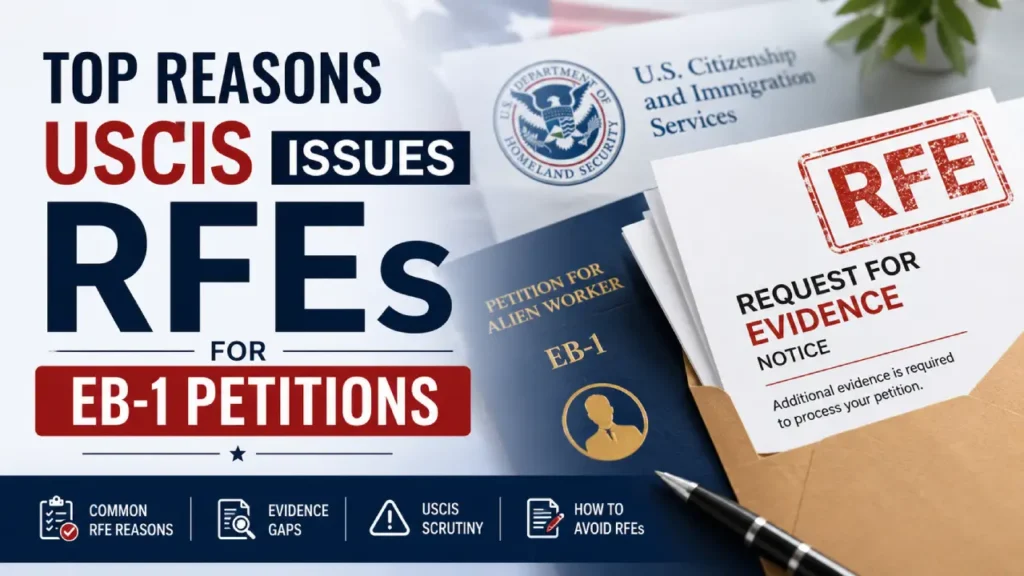
Quick Answer: USCIS issues Requests for Evidence (RFEs) on EB-1 petitions when officers find insufficient proof of extraordinary ability, outstanding research, or multinational executive status. The most common triggers include weak evidence narratives, failure to clearly meet at least three of the ten regulatory criteria (EB-1A), unverified claims of original contributions, generic recommendation letters, and poorly documented job duties. Understanding these patterns before you file is far better — and cheaper — than responding to an RFE after the fact.
Key Takeaways:
- EB-1A RFE rates now hover between 40–50%, even for well-credentialed applicants — most RFEs are avoidable with better evidence strategy
- Simply meeting three criteria isn’t enough; USCIS performs a “final merits determination” that weighs the entire record holistically
- Generic expert letters, vague job duty descriptions, and undocumented contribution claims are the top petition killers
- EB-1B RFEs most often challenge whether citations reflect true peer influence, not just publication volume
- EB-1C scrutiny has intensified around what qualifies as “managerial” versus “operational” roles
- A proactive credential evaluation and expert opinion letter from a trusted provider can resolve many of these issues before USCIS ever asks
An EB-1 petition represents one of the highest-stakes immigration filings you’ll ever make. It’s your argument that you belong in the top tier of your profession — and USCIS doesn’t take that claim lightly.
What surprises most applicants is that receiving an RFE doesn’t mean you’re unqualified. More often, it means your petition didn’t make the case clearly enough for a USCIS adjudicator who may have limited familiarity with your specific field. The officer can only evaluate what’s on the page in front of them.
If you’ve received an RFE or want to avoid one, this guide breaks down exactly why USCIS issues RFEs across all three EB-1 subcategories — EB-1A (extraordinary ability), EB-1B (outstanding researcher), and EB-1C (multinational executive or manager) — and what stronger petitions actually look like. For applicants who want to get this right the first time, EB-1 expert opinion letters from credentialed evaluators play a direct role in closing the gaps USCIS most commonly cites.
Understanding Why USCIS Issues EB-1 RFEs in the First Place
Before we get into specific triggers, it helps to understand what USCIS is actually doing when it issues an RFE.
An RFE — a Request for Evidence — is a formal notice telling you the petition as filed doesn’t yet contain enough information to support approval. It’s not a denial, and it’s not a red flag about your qualifications. It is USCIS telling you, in writing, exactly what they need to say yes.
The Two-Step EB-1A Adjudication Framework
Since the 2010 Kazarian v. USCIS decision, EB-1A petitions go through a two-step review:
Step 1 — Criteria Count: Did the petitioner submit qualifying evidence for at least three of the ten regulatory criteria under 8 CFR § 204.5(h)(3)?
Step 2 — Final Merits Determination: Does the totality of evidence show sustained national or international acclaim, placing the petitioner among the small percentage at the very top of their field?
Many applicants focus almost entirely on Step 1 and assume that checking three boxes is sufficient. It isn’t. Officers who are satisfied by Step 1 still conduct a holistic evaluation in Step 2. This is where strong cases fall apart — not because the evidence was fabricated, but because it wasn’t framed to answer the right question at the right stage.
Why RFE Rates Are Climbing
RFE rates for EB-1 petitions have increased noticeably since 2024. Current estimates place EB-1A RFE issuance between 40–50% of filed petitions, while overall approval rates remain around 67%, meaning many cases now require a second round of review before approval.
Several factors are contributing to this trend:
- USCIS policy guidance updated in October 2024 gave adjudicators clearer (but stricter) frameworks for evaluating extraordinary ability
- Staffing shifts within USCIS have placed some cases with officers less familiar with specialized fields in technology, research, and entrepreneurship
- Premium processing (15-day review window) leaves less time for nuanced evaluation, which can push borderline cases toward an RFE rather than an approval
The lesson: filing a strong initial petition — one that preemptively addresses likely concerns — is now more important than ever.
Top Reasons USCIS Issues RFEs for EB-1A (Extraordinary Ability) Petitions
1. Not Clearly Meeting Three Qualifying Criteria
This is the most foundational reason for EB-1A RFEs. USCIS requires evidence across at least three of these ten categories:
- Receipt of nationally or internationally recognized prizes or awards for excellence
- Membership in associations that require outstanding achievement
- Published material about the alien in professional or major trade publications
- Judging the work of others in the field
- Original scientific, scholarly, artistic, athletic, or business-related contributions of major significance
- Authorship of scholarly articles in professional journals or major media
- Display of work at artistic exhibitions or showcases
- Performance in a leading or critical role for distinguished organizations
- High salary or remuneration relative to peers
- Commercial success in the performing arts
An RFE doesn’t always mean you failed to meet three criteria on paper. Often, it means the evidence you submitted didn’t clearly demonstrate that the criteria was met — a subtle but important distinction.
For example, submitting a list of awards without documentation of the award’s selection process, scope, and competitive nature gives USCIS no way to confirm the award qualifies. The same problem applies to membership in professional associations: if you don’t demonstrate that the membership required outstanding achievement (rather than just a fee and a form), USCIS will question whether it satisfies the criterion at all.
What stronger petitions do: They don’t just list evidence — they connect each piece of evidence to the specific regulatory language it’s meant to satisfy, explain the significance in plain English, and include supporting documentation that validates the claim independently.
2. Weak or Missing “Original Contributions of Major Significance” Evidence
This criterion is one of the most frequently cited in EB-1A RFEs, and it’s the one that trips up accomplished professionals more than any other.
The problem isn’t usually a lack of original contributions. Most EB-1A candidates have genuinely contributed to their field. The problem is that contributions are documented internally — in job descriptions, project summaries, and self-assessments — without any independent validation of their significance.
USCIS officers ask a specific set of questions when evaluating original contributions:
- Has the contribution been adopted, cited, or recognized by others in the field?
- Did it change how practitioners approach a problem?
- Is there independent evidence (peer citations, adoption metrics, industry coverage) that establishes significance beyond the petitioner’s own claims?
A list of patents, products, or research findings doesn’t answer these questions. An expert opinion letter that explains — in the language of the field — why the contribution matters, who has adopted it, and what changed because of it, does.
This is one area where credential evaluations for USCIS paired with a well-structured expert opinion letter can carry significant evidentiary weight.
3. Recommendation and Expert Letters That Are Too Generic
If there’s one thing experienced immigration attorneys agree on, it’s this: a weak recommendation letter is almost as harmful as no letter at all.
USCIS adjudicators have seen thousands of letters that open with “I’ve known [name] for many years and can attest to their exceptional abilities.” These letters provide no analytical substance. They’re testimonials, not evidence.
What USCIS is actually looking for in expert letters:
- The letter writer’s independent credentials in the field
- Specific, documented assessment of the petitioner’s achievements
- Explanation of why those achievements meet an extraordinary standard — not just an assertion that they do
- Context about the petitioner’s standing relative to peers in the field
- Evidence the letter writer has no close personal or professional relationship that would bias the assessment
Generic letters — even from genuinely prominent figures — frequently trigger RFEs because they read more like character references than professional evaluations.
The fix: Expert opinion letters structured to directly address USCIS criteria, written by independent authorities with no conflicts of interest, and organized to build an analytical argument rather than offer personal praise. EB-1A expert opinion letters built for this purpose look fundamentally different from standard recommendation letters.
4. Failing the Final Merits Determination (Even After Meeting Three Criteria)
Here’s the part that genuinely surprises many applicants: satisfying three criteria is the floor, not the approval.
After Step 1, USCIS steps back and asks whether the complete evidentiary record — every letter, citation count, award, media mention, and role description — collectively demonstrates sustained national or international acclaim at the highest level of the field.
This holistic assessment is where petitions with strong individual criteria still receive RFEs. Officers may determine that while the petitioner has met criteria technically, the overall picture doesn’t place them “among the small percentage at the very top” of the field.
Common Step 2 failure patterns:
- Criteria that barely meet the threshold — when each of your three criteria represents a minimum-qualifying piece of evidence, the cumulative record feels thin
- No comparative context — the petition never establishes how the petitioner’s achievements compare to field peers, making it impossible to evaluate whether “top 1%” is an accurate description
- Accomplishments that don’t translate — international achievements that haven’t been contextualized for a U.S. adjudicator who may not recognize their significance
A strong final merits record doesn’t just show you’ve done impressive things. It shows, with specificity, how those impressive things stack up in your field.
5. Insufficient Evidence of Continuing Work in the Field
This one’s easy to overlook: USCIS requires evidence that you intend to continue working in your field of extraordinary ability in the United States. If your petition documents past achievements brilliantly but doesn’t establish future intent with verifiable evidence, you may receive an RFE on this point alone.
Acceptable evidence includes contracts, letters of intent, speaking invitations, grants, or a detailed plan showing ongoing activity in the specialty area.
Top Reasons USCIS Issues RFEs for EB-1B (Outstanding Researcher or Professor) Petitions
6. Publication Record Doesn’t Demonstrate Peer Influence
EB-1B requires recognition in the academic field as outstanding in a specific academic area. Publication volume alone is no longer persuasive. A long list of publications with low citation counts can actually work against you.
What USCIS now evaluates more carefully:
- Citation impact: Are other researchers citing your work? In high-impact journals? Across different institutions?
- Publication venue reputation: Publishing in high-impact, peer-reviewed journals carries more weight than publishing frequently in lower-tier outlets
- Independent recognition: Has your research been discussed, adopted, or built upon by researchers with no relationship to you?
If your citation metrics are modest, the petition needs to compensate with stronger contextual explanation — why the research matters, what problem it addresses, and how the field has responded to it.
7. Peer Review Participation Without Context
Many EB-1B petitioners list peer review activity as evidence of recognition, but submitting a list of journals you’ve reviewed for isn’t sufficient. USCIS wants to understand whether that review work reflects genuine standing in the field or whether it’s simply a professional courtesy common among academics at your level.
Include evidence of why you were specifically selected to review for those journals, your review volume relative to peers, and any acknowledgment of your expertise from journal editors.
8. Permanent Position Requirement Gaps
EB-1B requires the petitioner to have a permanent research position (or tenure-track position in academia) at a university, institution of higher learning, or private employer with a qualified research department.
RFEs in this area typically challenge whether:
- The employer qualifies as an institution of higher learning or a recognized research entity
- The offered position is genuinely permanent or indefinite in nature (not contract-based)
- The research department of a private employer has the required track record of outstanding research
This documentation gap is surprisingly common and completely avoidable with a thorough initial filing.
Top Reasons USCIS Issues RFEs for EB-1C (Multinational Executive or Manager) Petitions
9. Failure to Establish the Qualifying Multinational Relationship
EB-1C requires a qualifying relationship between the U.S. employer and the foreign entity where the beneficiary worked. Since 2025, RFEs in this area have increased significantly. USCIS is scrutinizing corporate structures more carefully, particularly in cases involving:
- Holding companies, subsidiaries, or affiliates with complex ownership structures
- Companies that have undergone mergers, acquisitions, or restructuring since the beneficiary’s tenure abroad
- Entities operating in multiple jurisdictions where the corporate relationship isn’t straightforward on paper
Petitions that submit basic corporate ownership charts without accompanying documentation of shared ownership, board control, or financial interdependency frequently receive RFEs demanding more.
10. Blurring the Line Between “Managerial” and “Operational”
This is the most common EB-1C RFE trigger in 2025–2026, and it’s the one that catches experienced executives off-guard.
USCIS uses INA § 101(a)(44) to distinguish between true managers — who direct organizations or departments, exercise discretionary authority, and supervise professional employees — and employees who perform hands-on operational work alongside or instead of supervisory duties.
RFEs in this category typically ask for:
- Detailed breakdown of daily responsibilities (what the person actually does, not what their title implies)
- Organizational charts showing reporting structures above and below the beneficiary
- Evidence of personnel authority: hiring, firing, performance reviews, compensation decisions
- Documentation of budgetary control and resource allocation authority
Petitions that rely on job titles and generic duty descriptions without substantiating the exercise of discretionary management authority are almost certain to receive this type of RFE.
If the beneficiary’s role blends managerial and technical/operational work — which is common in growing companies where executives wear multiple hats — the petition needs to proactively address this, explain the context, and establish that the core of the role is managerial.
For EB-1C cases involving complex structures, EB-1C expert opinion letters that directly address managerial capacity analysis can significantly reduce RFE risk.
Common Across All EB-1 Subcategories: Errors That Trigger RFEs Regardless of Category
| Issue | Why It Triggers an RFE | What USCIS Wants Instead |
|---|---|---|
| Generic expert letters | No analytical substance; reads as personal praise | Independent, field-specific evaluation with regulatory alignment |
| Missing credential evaluations | Can’t verify foreign education equivalency | USCIS-compliant education evaluation with clear U.S. equivalency |
| Self-reported achievements only | No independent corroboration | Third-party validation, citations, media coverage, adoption metrics |
| Narrative that doesn’t map to regulatory language | Officers can’t locate the evidence under the right criterion | Explicit criterion-by-criterion structure in the petition letter |
| Vague “continuing work” evidence | No evidence of post-approval employment intent | Contracts, invitations, grants, or detailed personal statement |
| Poorly documented foreign credentials | Equivalency unclear to USCIS adjudicators | Comprehensive education evaluation for USCIS |
How to Respond to an EB-1 RFE Effectively
If you’ve already received an RFE, the first thing to understand is that it’s not an appeal. You’re not arguing that USCIS was wrong — you’re submitting what they’ve told you they need to approve the case.
Step 1: Read Every Line of the RFE Carefully
USCIS RFEs are specific. They identify the exact criteria they found insufficient and describe what additional evidence they need. Many RFE responses fail because petitioners respond to what they assumed USCIS wanted rather than what was actually asked.
Step 2: Address Each Issue Directly and Sequentially
Structure your response to mirror the RFE’s structure. Address each concern in order. Use clear headings that match the RFE language. This makes it easy for the officer reviewing your response to find what they asked for.
Step 3: Get the Right Supporting Documents
The most common RFE responses that succeed include:
- New or revised expert opinion letters for EB-1 written specifically to address the RFE concerns
- Updated credential evaluations if the original evaluation was incomplete or unclear
- Additional recommendation letters from independent, credentialed evaluators
- Comparative data establishing the petitioner’s standing relative to field peers
Step 4: Don’t Wait
Most EB-1 RFEs give you 87 days to respond. Start immediately. Gathering new expert opinions, supplemental letters, and updated evaluations takes time, and a rushed response is rarely a strong one.
Step 5: Consider Whether Your Initial Petition Can Be Strengthened
Sometimes, an RFE reveals that the petition was filed before the evidentiary record was complete. If that’s the case, it’s worth asking honestly whether additional supporting documents — a stronger expert letter, a more thorough education evaluation, documentation of adoption or impact for your contributions — would substantially improve your position before you respond.
How to Avoid an EB-1 RFE Before You File
The best time to address RFE triggers is before the petition is submitted. Here’s how strong petitions approach it:
1. Build your evidentiary record before you start writing.
The petition letter should describe evidence that exists, not evidence you hope to gather. Compile awards documentation, citation metrics, peer review records, and organizational charts first.
2. Commission expert opinion letters that are analytically rigorous.
Work with evaluators who understand USCIS criteria — not just your field — and who can explain the significance of your work in regulatory terms. Expert opinion letters from AAE Evaluations are specifically structured to address the criteria USCIS applies, not generic professional assessments.
3. Get a credential evaluation that explicitly states U.S. equivalency.
If your education or work experience was obtained outside the United States, an ambiguous or missing evaluation gives USCIS a reason to question your qualifications. A complete education evaluation for USCIS removes that uncertainty entirely.
4. Have your attorney review the petition through an RFE lens.
Before filing, ask: “What would an officer question here?” If there are obvious gaps, fill them proactively rather than reactively.
5. Coordinate all documents before submission.
Inconsistencies between your expert letters, credential evaluations, and petition narrative are a common RFE trigger. When one team handles your education evaluation, expert opinion letters, and supporting materials together, the record is consistent — which matters.
Frequently Asked Questions
What is an RFE in an EB-1 petition?
An RFE (Request for Evidence) is a formal USCIS notice stating that your I-140 petition doesn’t yet contain enough documentation to support an approval decision. USCIS specifies exactly which criteria or requirements need additional evidence and gives you a deadline — typically 87 days — to respond. An RFE is not a denial. It’s an opportunity to strengthen your case, provided you respond with the right evidence.
How long does USCIS give you to respond to an EB-1 RFE?
USCIS typically allows 87 days from the RFE notice date to submit a response. Missing this deadline — or submitting an incomplete response — results in the petition being adjudicated based only on the original filing, which is likely to result in denial. Start your response preparation immediately after receiving the RFE.
Can you get an RFE even if your EB-1A petition is strong?
Yes. Even well-documented petitions receive RFEs if the evidence isn’t framed clearly for USCIS adjudication standards. The two-step Kazarian framework means that meeting three criteria is necessary but not sufficient — the final merits determination is a holistic evaluation that can result in an RFE even when individual criteria appear satisfied. Clarity of narrative, quality of expert letters, and comparative context all affect this outcome.
Does premium processing increase EB-1 RFE rates?
There’s no definitive evidence that premium processing increases RFE rates. However, the 15-business-day review window under premium processing leaves officers less time to evaluate nuanced evidence, which may make borderline petitions more likely to receive an RFE. The best way to reduce RFE risk under any processing track is to file a complete, clearly documented petition from the start.
What types of expert letters does USCIS want for EB-1 petitions?
USCIS looks for independent expert opinion letters — written by credentialed authorities who have no close personal or professional relationship with the petitioner — that analytically assess the petitioner’s qualifications and achievements in the context of the applicable criteria. Letters should explain why the petitioner’s work is significant, how it compares to peer-level work, and how it satisfies specific regulatory criteria, not simply assert that it does. Generic testimonial letters rarely provide meaningful evidentiary value.
How are EB-1C RFEs different from EB-1A RFEs?
EB-1C RFEs primarily focus on two areas: (1) establishing the qualifying multinational corporate relationship between the U.S. entity and the foreign employer, and (2) proving the beneficiary held a genuinely executive or managerial role — not a primarily operational or technical one. EB-1A RFEs, by contrast, focus on extraordinary ability criteria and the final merits determination. The documentation strategies and supporting evidence needed are quite different between the two subcategories.
Can an EB-1 expert opinion letter help if I’ve already received an RFE?
Yes — in fact, a revised or supplemental expert opinion letter structured to directly address the specific concerns USCIS raised in the RFE is one of the most effective response components. The letter should explicitly cite the RFE’s language, address each gap identified, and provide independent validation of the petitioner’s qualifications with the clarity the original petition lacked.
Strengthen Your EB-1 Petition Before USCIS Asks the Questions
Receiving an RFE isn’t the end of your case. But it does add time, cost, and uncertainty to a process that’s already demanding. And many RFEs are entirely preventable.
The most common triggers — weak expert letters, missing credential evaluations, vague contribution evidence, inconsistent documentation — all reflect preparation problems, not qualification problems. If you’re genuinely EB-1 caliber, the issue is usually how your case is documented, not whether you qualify.
AAE Evaluations works with immigration attorneys and individual petitioners to provide the foundational documents that EB-1 petitions require: USCIS-compliant education evaluations, analytically rigorous expert opinion letters for EB-1A, EB-1B, and EB-1C, and coordinated support across your entire petition package.
If you’ve received an RFE or want to build a stronger initial filing, get a free case review — we’ll tell you exactly which documents your petition needs and how to structure them to address USCIS scrutiny directly.
Disclaimer: This article is for informational purposes only and does not constitute legal advice. Immigration law is complex and fact-specific. Consult a licensed immigration attorney for guidance on your specific case.