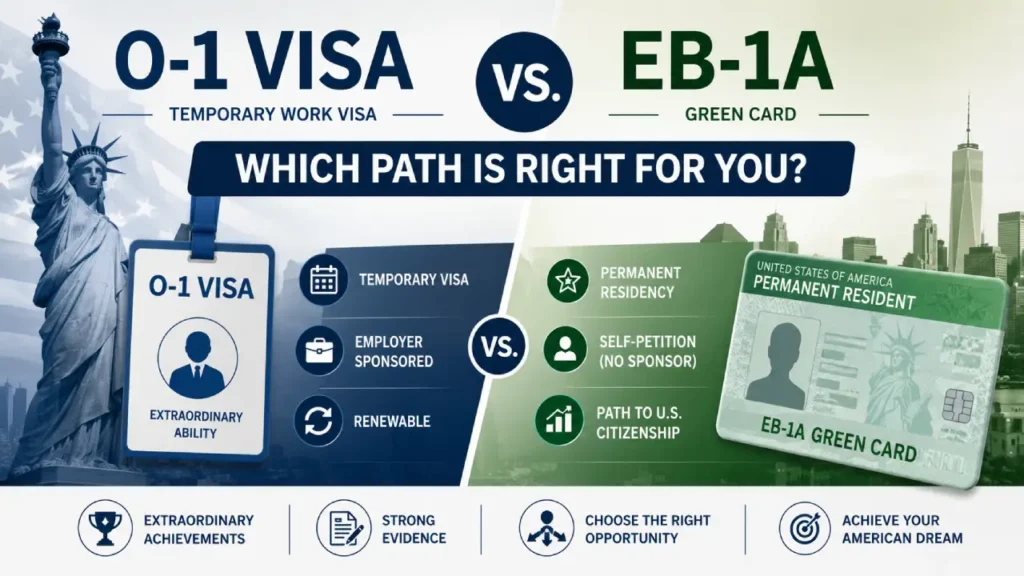
Quick Read: The O-1 is a temporary nonimmigrant work visa tied to a specific employer or agent. The EB-1A is a permanent green card you can self-petition without a job offer. Both require proof of extraordinary ability — but the evidentiary bar, timeline, and long-term outcome are very different. Many professionals pursue the O-1 first, then use the documentation they built to power an EB-1A petition.
If you are weighing the O-1 vs EB-1A, you are probably at a career stage where extraordinary ability is no longer in question — the question is which immigration tool serves you best right now, and how one path can set you up for the other.
This guide breaks down every meaningful difference between the two: eligibility, petition requirements, processing timelines, self-petition rules, country-of-birth backlogs, and — critically — how to build your O-1 expert letters so they double as the foundation of a future EB-1A case.
What Is the O-1 Visa?
The O-1 visa is a nonimmigrant (temporary) work visa for foreign nationals with extraordinary ability in science, education, business, athletics (O-1A) or extraordinary achievement in the arts, film, or television (O-1B).
It is employer-sponsored: a U.S. employer, agent, or U.S.-based representative must file the petition on your behalf. You cannot file it yourself.
Key O-1 facts:
- Granted in increments of up to 3 years, renewable in 1-year extensions with no hard cap
- Requires an advisory opinion letter from a peer group, labor organization, or recognized expert in your field
- Does not lead to permanent residence on its own — it is a pathway to green card only if you separately pursue one
- Dependents (spouse and children under 21) receive O-3 status; they may study but cannot work
- Premium processing available: decision in 15 business days
What Is the EB-1A Green Card?
The EB-1A is an immigrant visa — a green card — for individuals of extraordinary ability in the sciences, arts, education, business, or athletics. It is the highest-priority employment-based green card category in the U.S. immigration system.
Unlike every other employment-based green card category, the EB-1A does not require a job offer, employer sponsorship, or labor market test (PERM). You file it yourself, on your own behalf.
Key EB-1A facts:
- Leads directly to lawful permanent residence
- Self-petition only: no employer, no job offer, no PERM process required
- Requires sustained national or international acclaim — a higher bar than the O-1
- Dependents receive green cards as derivative beneficiaries and can live and work in the U.S.
- Premium processing available for Form I-140 (decision in 15 business days), though this does not accelerate the adjustment of status stage
O-1 vs. EB-1A: Side-by-Side Comparison
| Factor | O-1 Visa | EB-1A Green Card |
|---|---|---|
| Immigration status | Nonimmigrant (temporary) | Immigrant (permanent) |
| Who can file | Employer or agent only | You (self-petition) |
| Job offer required | Yes | No |
| PERM labor certification | Not required | Not required |
| Duration | Up to 3 years, renewable | Permanent |
| Family work rights | O-3: study only, no work | Full green cards for spouse/children |
| Path to green card | Does not confer one | Is the green card |
| Country-of-birth backlog | None | Yes — India and China affected |
| Standard of proof | Extraordinary ability | Extraordinary ability + sustained acclaim |
| Approval rate (FY2026 Q1) | ~91% | ~47% |
| Premium processing | Yes (15 business days) | Yes for I-140 (15 business days) |
| Standard USCIS processing | 11–13 months | 6–12 months for I-140, then I-485 |
The Difference Between “Extraordinary Ability” and “Sustained Acclaim”
Both categories use the phrase “extraordinary ability,” but USCIS applies a meaningfully different standard in practice.
O-1 Standard
For the O-1, USCIS requires evidence that you have risen to the top of your field. This is a high bar — but it is evaluated in the context of your current position or project. The O-1 is tied to an employer and to specific work, so USCIS is asking: does this person have the exceptional ability required for this specific engagement?
EB-1A Standard
The EB-1A requires evidence of sustained national or international acclaim and that you are among the small percentage at the very top of your field. USCIS applies the Kazarian two-step analysis: first, whether your evidence meets at least three of the ten regulatory criteria; second, whether the totality of evidence demonstrates the extraordinary ability threshold.
An approved O-1 visa is strong evidence for an EB-1A petition — but it does not guarantee one. USCIS treats them as separate adjudications. The 47% approval rate for EB-1A in FY2026 Q1, compared to 91% for O-1, reflects how much more stringent the evidentiary review is.
The 10 EB-1A Criteria (Meet at Least 3)
- Receipt of lesser nationally or internationally recognized prizes or awards
- Membership in associations requiring outstanding achievement
- Published material about you in professional or major trade publications
- Participation as a judge of others’ work in your field
- Original scientific, scholarly, or business-related contributions of major significance
- Authorship of scholarly articles in professional journals or major media
- Display of your work at artistic exhibitions or showcases
- Performance in a leading or critical role for organizations with distinguished reputations
- High salary or remuneration in relation to others in your field
- Commercial success in the performing arts
Self-Petition vs. Employer-Required: Why This Matters More Than People Think
The O-1’s employer requirement is not just a bureaucratic technicality — it has real consequences for your career and immigration stability.
With an O-1, your status is tied to your petitioning employer or agent. If you change jobs, your new employer must file a new O-1 petition. If you are laid off, you have a very limited grace period (60 days) to find a new sponsor or change status. Your immigration status depends on your employment relationship remaining intact.
The EB-1A flips this entirely. Because you self-petition, your green card case belongs to you — not your employer. You can change jobs, take a sabbatical, start a company, or move between roles without affecting your pending petition. Once your I-140 is approved, that approval is yours to keep even if you leave the sponsoring context entirely (since there was no sponsor to begin with).
For professionals at or near the top of their field — especially entrepreneurs, consultants, and those in high-demand sectors — the EB-1A’s independence is often the decisive advantage.
The O-1 Visa Pathway to Green Card: Using One to Build the Other
This is where strategy matters most, and where most guides leave practitioners underserved.
The O-1 visa pathway to green card is real, but it does not happen automatically. The O-1 does not confer or convert to a green card. What it does do — if approached strategically — is generate the documentation, expert relationships, and evidentiary record that can power an EB-1A petition.
What Transfers from O-1 to EB-1A
Expert opinion letters.
Your O-1 required an advisory opinion from a peer group or recognized expert. A well-drafted O-1 expert letter that addresses your original contributions, critical role in your field, and international recognition can be updated and adapted for EB-1A use — it is not automatically reusable, but the expert relationship and the underlying analysis carry significant value.
Evidence of recognition. Awards, media coverage, judging roles, and citation records gathered for your O-1 form the backbone of your EB-1A criteria evidence. If you were strategic about documenting these during your O-1 period, you enter the EB-1A with a mature evidentiary record.
Demonstrated extraordinary ability. An approved O-1 signals that USCIS already found you credible as a person of extraordinary ability. Your attorney can reference this in your EB-1A cover letter and strategy — while being clear that the standards differ.
What Does Not Transfer Automatically
- O-1 expert opinion letters cannot be submitted as-is for EB-1A. They must be updated, reframed, and typically re-authored by your experts to address the higher sustained acclaim standard.
- The O-1’s employer-specific context does not help with EB-1A’s self-petition framing.
- Time spent on O-1 status does not shorten backlogs or change your EB-1A priority date.
The Strategic Timeline
The optimal approach for many professionals looks like this:
- File O-1 to maintain lawful work status quickly (higher approval rate, faster processing).
- During O-1 period, build the evidentiary record — publications, awards, judging roles, media coverage, salary benchmarks.
- Commission EB-1A-caliber expert letters from the same experts who wrote your O-1 advisory letters, or from a broader pool. The relationship is already warm.
- File EB-1A I-140, with or without concurrent O-1 status.
- If your country’s priority date is current, file I-485 simultaneously with or immediately after I-140 approval.
Dual Filing Strategy: Running O-1 and EB-1A Simultaneously
Some professionals file both simultaneously — maintaining or obtaining O-1 status while an EB-1A I-140 is pending. This is not only permitted but often the smartest strategic move for the right candidate.
Why dual filing makes sense:
- The I-140 can take 6–12 months under standard processing, and adjustment of status can take longer. Filing O-1 first ensures you maintain valid work authorization throughout.
- An approved I-140 (even before I-485 is filed or approved) locks in your EB-1A priority date — critical for country-backlogged nationals.
- If your O-1 renewal is coming up and your EB-1A is pending, having both in process reduces risk of status gaps.
What to coordinate:
- O-1 and EB-1A expert letters must be distinct documents. They serve different legal purposes and are filed with different forms. An expert who wrote your O-1 advisory opinion should write a separate, updated letter for your EB-1A petition.
- Your attorney should align the evidentiary narrative across both petitions. Inconsistencies between your O-1 and EB-1A filings can create problems if USCIS reviews both.
AAE Evaluations prepares both O-1 expert opinion letters and EB-1A expert opinion letters as coordinated engagements — built from the same research base, structured for different evidentiary purposes, and delivered without the coordination cost of working across multiple vendors.
Green Card Backlogs by Country: The Variable That Changes Everything
The O-1 has no country-of-birth backlog. If you are approved, you get your visa. The EB-1A is a different story for nationals of India and China.
How the Backlog Works
U.S. immigration law limits green cards issued per country to 7% of the total annual employment-based allocation. When demand from a country — like India — far exceeds that cap, a backlog forms. Your EB-1A I-140 can be approved, but you cannot file for adjustment of status (Form I-485) until your priority date becomes current in the monthly Visa Bulletin.
Current Backlog Data (as of mid-2026)
| Country | EB-1 Status | Note |
|---|---|---|
| Most countries | Current | File I-485 immediately after I-140 approval |
| India | Backlogged | Final Action Date: October 2022; wait ~3.8 years |
| China | Backlogged | Final Action Date: June 2023; shorter than India’s EB-2/EB-3 |
| Philippines, Mexico | Generally current for EB-1 | Check monthly Visa Bulletin |
Priority dates move monthly and can retrogress. Always verify the current Visa Bulletin at travel.state.gov before filing.
What This Means Strategically for India- and China-Born Professionals
File your I-140 as early as possible. Your priority date is set when USCIS receives your I-140 petition. Even if you cannot yet file I-485, locking in an early priority date means you wait less. Every month you delay is a month added to the back of the line.
Maintain O-1 status through the wait. Because the EB-1A backlog can mean years between I-140 approval and I-485 eligibility, Indian and Chinese nationals in particular often maintain O-1 status as their bridge. The O-1 can be renewed indefinitely, which gives you a lawful, work-authorized pathway while you wait for your priority date to become current.
File I-485 and I-140 concurrently if eligible. If your priority date is already current at the time of I-140 filing, you can file both together — eliminating the wait between approvals.
How Expert Opinion Letters Work for Each Petition
Expert opinion letters are the most critical documents in both O-1 and EB-1A petitions. They are also the most commonly misunderstood.
O-1 Expert Letters (Advisory Opinions)
Federal regulations (8 CFR §214.2(o)(7)) require an O-1 petition to include a written advisory opinion from a peer group, labor organization, or individual with expertise in your field. This letter must attest to your extraordinary ability and, for O-1A, comment on the nature of the work you will be performing.
A strong O-1 advisory letter:
- Is authored by a recognized authority in your specific field
- Speaks to your prominence relative to peers in your industry
- Addresses the specific O-1 criteria your attorney has identified as primary
- Is tailored to the scope of the employment or engagement at issue
EB-1A Expert Letters
The EB-1A requires independent expert letters — ideally from people who do not know you personally, and who can speak to the field-wide significance of your work from an objective standpoint. For a typical initial EB-1A petition, you need 5–7 expert letters covering the criteria your attorney is using to establish eligibility.
A strong EB-1A expert letter:
- Addresses at least one of the 10 USCIS regulatory criteria explicitly
- Demonstrates the letter author’s own credentials and why they are qualified to assess your work
- Provides specific, contextualized analysis — not general praise
- Establishes why your contributions are of major significance to the field, not just your employer or a single project
- Is written by someone who does not have a close personal or professional relationship with you (arms-length independence)
Using O-1 Experts to Build Your EB-1A Letter Pool
This is one of the most underutilized strategies in extraordinary ability immigration.
The experts who wrote your O-1 advisory opinion are already familiar with your work. They have reviewed your achievements, can speak to your standing in the field, and have established a relationship with you. When you are ready to file EB-1A, these experts — supplemented by others you have cultivated during your O-1 period — form the nucleus of a strong letter pool.
The letters themselves must be entirely rewritten. An EB-1A letter must be independent, address the USCIS criteria framework, and meet a higher evidentiary standard than an O-1 advisory opinion. But the expert relationships you built for your O-1 give you a significant head start.
AAE Evaluations’ O-1 expert opinion letter service is designed with this forward-looking strategy in mind — structured to meet O-1 requirements today while positioning your case for the EB-1A standard when you are ready.
Which Path Is Right for You? A Decision Framework
Choose the O-1 First If:
- You need to begin or continue working in the U.S. in the next 3–6 months
- You have a U.S. employer or agent who can sponsor the petition
- Your evidentiary record is strong for your current role but may not yet demonstrate the sustained, field-wide acclaim EB-1A requires
- You are from India or China and want to lock in an early EB-1A priority date while maintaining status during the backlog wait
- You are in the arts or entertainment and qualify under O-1B (which has no EB-1A equivalent in the same form)
Pursue EB-1A Directly If:
- You have a mature, well-documented record of extraordinary ability with sustained recognition
- You want to self-petition without depending on an employer
- Your country of birth does not face a green card backlog (most countries)
- Permanent residence and full family work authorization are your primary goals
- You have already gathered evidence meeting three or more of the 10 USCIS criteria
Pursue Both Simultaneously If:
- You are India- or China-born and want to lock in the earliest possible EB-1A priority date
- You have a pending O-1 but your record is now strong enough for EB-1A
- Your current O-1 employer supports the parallel filing and your attorney can coordinate the narratives
- You want maximum flexibility: O-1 work authorization now, green card independence when your date becomes current
Frequently Asked Questions
Can an O-1 visa convert to a green card automatically?
No. The O-1 is a nonimmigrant visa; it does not automatically lead to or convert to any green card category. To obtain a green card, you must separately file an immigrant petition (such as EB-1A via Form I-140) and, once eligible, adjust status or go through consular processing. The O-1 can coexist with a pending EB-1A petition, but they are entirely separate filings.
Does an approved O-1 visa guarantee EB-1A approval?
No. USCIS treats them as independent adjudications. An approved O-1 demonstrates that USCIS previously found you to have extraordinary ability, which is useful context — but the EB-1A applies a stricter “sustained national or international acclaim” standard and requires a separate evidentiary record meeting at least 3 of the 10 regulatory criteria. The EB-1A’s 47% approval rate in FY2026 Q1 (compared to 91% for O-1) reflects this gap.
Can I self-petition for EB-1A while on O-1 status?
Yes. Being on O-1 status does not prevent you from filing a self-petition for EB-1A. Many professionals file both concurrently. You simply maintain your O-1 status (and its employer relationship) while your EB-1A petition is pending.
Do I need new expert letters for EB-1A if I already have O-1 advisory letters?
Yes. O-1 advisory letters and EB-1A expert opinion letters serve different evidentiary purposes under different legal frameworks. You cannot submit your O-1 advisory letters as EB-1A evidence without revising them substantially. The underlying expert relationships carry over, but the letters must be independently rewritten to address the EB-1A criteria.
How does country of birth affect the O-1 vs. EB-1A decision?
Country of birth does not affect O-1 eligibility or wait times at all. For EB-1A, nationals of India and China face per-country backlogs — meaning that even after an I-140 is approved, they may wait years before they can file Form I-485 to adjust status. As of mid-2026, the EB-1 India Final Action Date is October 2022, representing roughly a 3–4 year wait for recently-filed cases. This makes early I-140 filing — even while on O-1 — critical for these nationals.
What is the difference between an O-1 advisory opinion and an EB-1A expert opinion letter?
An O-1 advisory opinion is a regulatory requirement under 8 CFR §214.2(o)(7) — it must come from a peer group, labor organization, or recognized expert and address the nature of your work and your extraordinary ability. An EB-1A expert opinion letter is an evidentiary document that must independently address one or more of the 10 USCIS criteria, demonstrate the author’s own credentials, and establish that your contributions are of major significance to your field on a national or international level. The EB-1A letter must come from someone who can speak objectively and independently, without a close personal relationship with you.
Can I include my O-1 approval notice as evidence in an EB-1A petition?
Yes, and it can carry persuasive weight. An O-1 approval notice can be submitted as part of the totality of evidence in an EB-1A petition to show that USCIS has previously recognized your extraordinary ability. However, it does not satisfy any of the 10 specific criteria on its own and should never be treated as a substitute for the required evidentiary record.
Featured Snippet Blocks
Query: What is the difference between O-1 and EB-1A?
The O-1 is a temporary nonimmigrant visa requiring employer sponsorship; it allows extraordinary ability professionals to work in the U.S. for a defined period. The EB-1A is a permanent green card that allows self-petitioning with no job offer required. Both require proof of extraordinary ability, but the EB-1A applies a stricter sustained national or international acclaim standard and leads to permanent residence.
Query: Can O-1 visa lead to green card?
An O-1 visa does not automatically lead to a green card and does not convert to one. However, it is a common first step for professionals who later self-petition for an EB-1A green card. The documentation, expert relationships, and evidentiary record developed for an O-1 petition can be strategically structured to support a future EB-1A filing — though the expert letters must be separately authored for the EB-1A.
Query: Do I need a job offer for EB-1A?
No. The EB-1A is one of the few green card categories that allows self-petitioning — you file Form I-140 yourself, without an employer sponsor, a job offer, or a labor market test (PERM). This is one of the primary advantages of the EB-1A over other employment-based green card categories, and a key difference from the O-1, which requires an employer or U.S. agent to petition on your behalf.