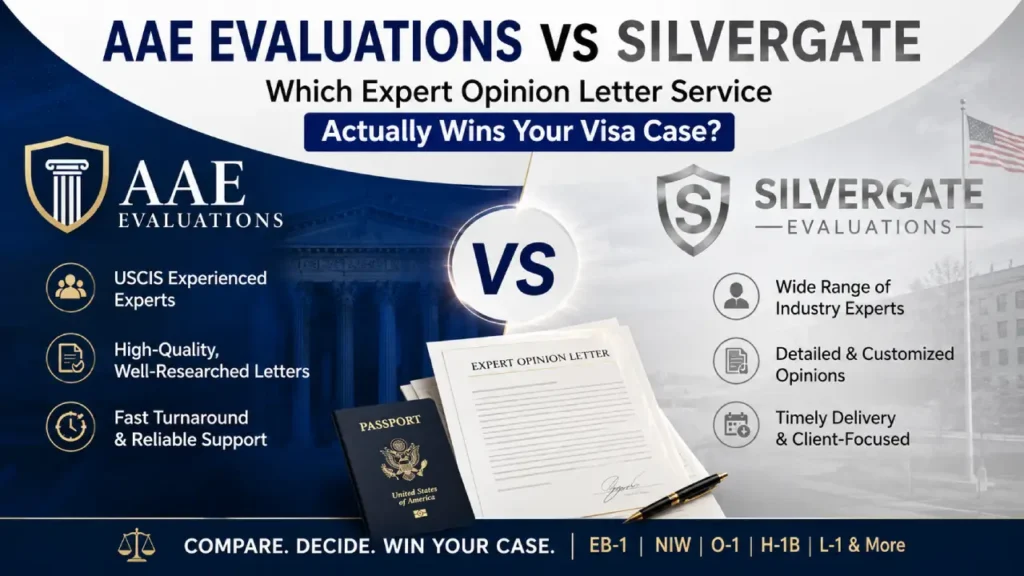
Quick Answer: Both AAE Evaluations and Silvergate Evaluations provide expert opinion letters for U.S. immigration visas. AAE Evaluations delivers a fully integrated service — credential evaluations, expert opinion letters, recommendation letters, and business plans under one roof — with faster turnaround, transparent pricing, and dedicated support for EB-1, EB-2 NIW, H-1B, O-1, and L-1 cases. Silvergate offers a wider list of letter types but operates as a standalone letter vendor, requiring you to coordinate separate vendors for your full petition package.
If you’ve been comparing services for your U.S. immigration petition, you’ve likely come across two names: AAE Evaluations and Silvergate Evaluations. Both claim to write strong expert opinion letters. Both have been around for years. And both cover the visa categories that matter most to skilled immigrants and international professionals.
But there’s a real difference between them — and that difference could affect not just the quality of your letter, but whether your petition gets approved the first time.
This guide breaks it all down: what each service does, where each one falls short, and which one is actually the better fit for your case.
What Is an Expert Opinion Letter — and Why Does It Matter?
Before we compare the two services, it’s worth understanding exactly what’s at stake.
An expert opinion letter is a formal document written by a credentialed, independent authority in your professional field. It’s submitted directly to USCIS as part of your visa petition, and it carries significant evidentiary weight. For categories like EB-1A extraordinary ability, EB-2 NIW, and H-1B specialty occupation, a well-crafted expert letter is often the single strongest piece of evidence in the entire filing.
A weak letter — one that’s generic, poorly structured, or fails to address the specific legal standard for your visa category — can lead to an RFE (Request for Evidence) or an outright denial. According to USCIS policy guidance on extraordinary ability, officers evaluate expert opinion letters as part of the totality of the evidence, which means a vague or boilerplate letter doesn’t just underperform — it can actively harm the rest of your petition.
That’s why choosing the right service matters more than most applicants realize.
AAE Evaluations: The Integrated Petition Support Model
AAE Evaluations has been processing credential evaluations and expert opinion letters since 2018. What makes them stand out isn’t any single service — it’s the architecture of how they work.
Most immigration petitions require multiple documents: an academic credential evaluation, one or more expert opinion letters, recommendation letters from people who know the applicant directly, and sometimes a business plan. The typical applicant ends up coordinating three or four separate vendors who’ve never spoken to each other. The academic evaluator writes one thing, the expert letter writer assumes something different, and the attorney has to reconcile inconsistencies under deadline pressure.
AAE solves this by handling everything internally. Their team manages education evaluations, work experience evaluations, expert letters, recommendation letters, and business plans as a coordinated engagement. The academic evaluator and the expert letter writer are working from the same case file. The business plan reflects the same narrative as the NIW petition. Everything is consistent because it’s built together.
What AAE Evaluations Covers
Expert Opinion Letters:
- EB-1A Expert Opinion Letter — Extraordinary ability across sciences, arts, education, business, or athletics
- EB-1C Expert Opinion Letter — Multinational executives and managers
- EB-2 NIW Expert Opinion Letter — All three Dhanasar prongs, built for self-petitioners and RFE responses
- H-1B Expert Opinion Letter — Specialty occupation establishment and credential evaluation
- O-1 Advisory Letter — Extraordinary ability in arts, entertainment, or athletics
- L-1 Expert Opinion Letter — Specialized knowledge and managerial/executive capacity
Credential Evaluations:
- Education Evaluation for USCIS
- Education Evaluation for H-1B
- Work Experience Evaluation
- Course-by-Course Evaluation
- Position-by-Position Evaluation
Business Plans:
- EB-2 NIW Business Plan
- EB-5 Visa Business Plan
- E-2 Treaty Investor Business Plan
- L-1 New Office Business Plan
- EB-1C Visa Business Plan
- O-1 Visa Business Plan
Recommendation Letters:
This breadth isn’t padding — it directly addresses the reality that most petitions need multiple supporting documents that work together coherently.
🎯 Free Case Review: Not sure which documents your petition actually needs? AAE Evaluations offers a free case review where their team maps out exactly what USCIS will expect from your specific visa category and background.
Silvergate Evaluations: The Letter Specialist Model
Silvergate Evaluations, based in Baltimore, Maryland, has been offering expert opinion letters and academic evaluations since around 2017. Their expert opinions page covers a wide range of letter types, primarily focused on H-1B, EB-2, L-1, O-1/EB-1A, and niche categories like CPT/OPT letters, PERM audit responses, and TN visa letters.
Their strength is in the range of letter types they’ve documented. They clearly articulate what each letter type does, what documents are required, and how to get started. For a straightforward H-1B specialty occupation letter with a complete employer support package, Silvergate can get the job done.
However, there are real limitations to their model:
What Silvergate doesn’t offer in-house:
- Integrated business plans coordinated with expert letters
- EB-2 NIW business plans built alongside the NIW opinion letter
- Unified credential evaluation + expert letter packages
- Recommendation letter services (separate from expert opinions)
If you’re working on an EB-2 NIW petition — which typically requires an opinion letter, a business plan, and recommendation letters all working from the same strategic narrative — you’ll be sourcing at least two or three of those from different providers, then hoping your attorney can stitch them into a coherent story.
That coordination burden lands entirely on you.
Side-by-Side Comparison: AAE Evaluations vs Silvergate
| Feature | AAE Evaluations | Silvergate Evaluations |
|---|---|---|
| Expert Opinion Letters | ✅ EB-1A, EB-1C, EB-2 NIW, H-1B, O-1, L-1 | ✅ H-1B, EB-2, L-1, O-1/EB-1A, TN, PERM |
| Academic Credential Evaluations | ✅ In-house, USCIS-compliant | ✅ In-house |
| Work Experience Evaluations | ✅ With expert professor sign-off | ✅ By professor |
| Business Plans | ✅ EB-5, E-2, L-1, EB-2 NIW, EB-1C, O-1 | ✅ E-2, L-1 (limited) |
| Recommendation Letters | ✅ EB-1A, EB-2 NIW, O-1 | ❌ Not offered |
| RFE Response Letters | ✅ Directly addressed | ✅ Available |
| Integrated Coordination | ✅ One team, one engagement | ❌ Letters only; other docs require separate vendors |
| Founded | 2018 | ~2017 |
| Free Case Review | ✅ Yes | ❌ Not prominently offered |
| Transparent Pricing Page | ✅ Full pricing listed | ✅ Pricing page available |
| Online Payment | ✅ Direct online portal | ✅ Via external portal |
The EB-2 NIW Case: Where Integration Actually Wins Cases
Let’s get specific, because the NIW category is where the difference between AAE and Silvergate becomes most concrete.
The EB-2 National Interest Waiver requires you to satisfy the three-prong Matter of Dhanasar standard:
- Your proposed endeavor has substantial merit and national importance
- You are well-positioned to advance the proposed endeavor
- It would be beneficial to the United States to waive the job offer requirement
Satisfying all three of these — convincingly — requires three documents that all tell the same story: an expert opinion letter from someone in your field, a business plan or personal statement that maps your work to national interest, and ideally one or more recommendation letters from people who know your work directly.
When those three documents come from three different providers who’ve never coordinated, USCIS officers frequently identify inconsistencies. Different terminology for your research area. Different characterizations of your role. A business plan that describes your “proposed endeavor” differently than the expert letter does.
With AAE Evaluations’ integrated EB-2 NIW service, the expert opinion letter, the NIW business plan, and the recommendation letters are built from the same case intake. The expert who writes your opinion letter knows what the business plan says about your endeavor’s national importance. The recommendation letters reinforce the same narrative thread. Your attorney gets a complete, internally consistent package.
That’s not a convenience feature — it’s a strategic advantage that directly reduces your RFE risk.
Have you already received an RFE? AAE Evaluations specializes in RFE response letters and structures them to directly address the specific concerns USCIS raised — not generic defenses that miss the point.
H-1B Expert Opinion Letters: What You Actually Need
The H-1B category has its own complexity. Depending on your specific situation, you might need one of several distinct letter types:
Specialty Occupation Letter — Establishes that the offered position requires at minimum a bachelor’s degree in a specific specialty. This is the most common H-1B letter and the minimum requirement for most petitions.
Comprehensive Letter — Goes further: establishes specialty occupation and evaluates the beneficiary’s credentials as equivalent to the required degree. Needed when the beneficiary holds a degree in a somewhat different field or has a non-U.S. degree that requires equivalency analysis.
Suitability Letter — Evaluates the beneficiary’s total credential profile (academics + experience) and establishes their suitability for the specific role based on their unique background.
AAE’s H-1B expert opinion letter service can be bundled with an H-1B education evaluation from the same team, so the expert letter and the credential evaluation use identical language about your degree equivalency — rather than potentially conflicting characterizations from two separate evaluators.
Silvergate offers the same letter types individually and does them well. The difference is purely in whether you need the accompanying evaluation, which would require a separate engagement.
EB-1A and O-1: Extraordinary Ability Letters Done Right
EB-1A and O-1 petitions are among the most scrutinized filings USCIS processes. Both require demonstrating sustained national or international acclaim — and the expert letters submitted have to go beyond credentials to analyze the applicant’s specific contributions, the impact of their work in the field, and how their level of recognition exceeds that of their peers.
Generic letters don’t work here. Officers reviewing EB-1A petitions have seen thousands of them, and they recognize when an expert letter is a template with the applicant’s name swapped in.
AAE Evaluations’ EB-1A expert opinion letters are built around your specific body of work — publications, citations, patents, awards, media coverage, peer recognition — and structured to satisfy the evidentiary criteria USCIS uses in the extraordinary ability analysis. The accompanying EB-1A recommendation letters from individuals who know your work directly are drafted to complement the expert opinion letter, not duplicate it.
For O-1 cases, AAE’s advisory and expert letters serve the same function: establishing that the beneficiary has reached the top of their field with specific, verifiable evidence.
Starting your EB-1A or O-1 petition? Get a free case review from AAE Evaluations to map out exactly which expert letters and supporting documents your petition needs to succeed.
Credential Evaluations: An Often-Overlooked Decision Point
Most people focus exclusively on expert opinion letters and forget that the credential evaluation — the formal academic equivalency analysis of your foreign degree — is often equally important.
For H-1B petitions with a foreign degree, for EB-2 cases where your educational background is the foundation of your exceptional ability claim, and for any petition where USCIS needs to understand exactly what your degree is equivalent to in the U.S. system, a thorough credential evaluation isn’t a formality. It’s evidence.
The education evaluation services at AAE Evaluations are USCIS-compliant and, critically, they’re written by the same team that will write your expert opinion letter. So when the expert letter says your degree is equivalent to a U.S. Master’s in Computer Science, the credential evaluation says exactly the same thing — with the same framing, the same technical terminology, and the same supporting analysis.
Silvergate also offers academic evaluations and is competent in this area. The distinction, again, is coordination.
If you need a work experience evaluation — especially valuable when formal education alone doesn’t meet the degree requirement for H-1B specialty occupation — AAE handles those as well, with professor sign-off that aligns with whatever expert letter is accompanying the petition.
What Happens After You Submit: RFE Response Expertise
USCIS denials and RFEs are a reality even for strong petitions. When they happen, the letter you submit in response needs to be precisely targeted — it has to address the specific language of the RFE, not generic counterarguments.
Both AAE and Silvergate have experience with RFE responses. AAE explicitly lists this as one of their most common requests and specifically mentions structuring response letters to address the exact concerns USCIS raised. For EB-2 NIW petitions specifically, Silvergate’s “Well-Positioned Letter” has been updated to address the third Dhanasar prong — the immediacy of the proposed endeavor’s benefit to national interest — which USCIS has been using more frequently in RFEs.
For ongoing RFE work, having an established relationship with the provider who wrote your original letter is a significant advantage. They already know your case. They don’t need to rebuild the narrative from scratch. That’s another argument for starting with a provider — like AAE — who can handle the full petition lifecycle.
Pricing Transparency
Both services maintain pricing pages.
AAE Evaluations’ pricing is organized by service type and visa category, with clear turnaround options so you can make tradeoffs between speed and cost depending on your petition timeline. They also offer online payment directly through their site.
Silvergate’s pricing page lists their rates separately and provides a payment portal through a third-party system.
For complex cases where you’re ordering multiple documents, AAE’s integrated pricing model typically reflects the coordination savings — you’re not paying separate intake fees to separate vendors for documents that should have been built together.
Who Should Choose AAE Evaluations?
AAE Evaluations is the right choice if:
- You’re self-petitioning for EB-1A, EB-2 NIW, or O-1 and need a complete, coordinated document package
- Your attorney has asked you to source multiple supporting documents and you want one point of contact
- You’ve received an RFE and need a response letter that directly addresses USCIS’s specific concerns
- You’re filing H-1B and need both a credential evaluation and an expert letter that use consistent language
- You need a business plan that’s built around the same narrative as your expert opinion letter
- You want transparent pricing, a free case review, and direct communication throughout the process
Start with a free case review at AAE Evaluations →
Who Might Choose Silvergate?
Silvergate is a reasonable choice if:
- You need a very specific letter type (like a CPT/OPT letter, a PERM “Not Substantially Comparable” letter, or a Business Necessity letter for a PERM audit) and you already have all your other petition documents handled
- Your attorney has a long-standing relationship with Silvergate and is handling the coordination themselves
- Your case is a standalone H-1B with a clear specialty occupation and no credential equivalency questions
For cases where all you need is the letter and nothing else, Silvergate can deliver. For cases where the letter is one part of a broader petition strategy — which describes most skilled immigrant petitions — the coordination advantage of AAE is hard to overlook.
Frequently Asked Questions
What’s the difference between an expert opinion letter and a recommendation letter?
These serve different evidentiary roles in your petition. An expert opinion letter is written by an independent authority who may not know you personally — their credibility comes from their standing in the field and their objective analysis of your qualifications relative to USCIS standards. A recommendation letter comes from someone who knows your work directly — a colleague, collaborator, supervisor, or peer — and speaks to your specific contributions and recognition within the professional community. Most strong EB-1A, EB-2 NIW, and O-1 petitions include both. AAE Evaluations provides both as part of their integrated service.
How long does it take to get an expert opinion letter?
Turnaround varies by provider and visa category. For standard cases, expect 5–15 business days. Rush options are typically available. AAE Evaluations provides turnaround timelines as part of their free case review so you can plan your petition filing schedule accordingly.
Do I need an expert opinion letter for every visa category?
Not always, but frequently. Expert opinion letters are standard for H-1B specialty occupation cases, EB-1A extraordinary ability petitions, EB-2 NIW self-petitions, O-1 extraordinary ability petitions, and L-1 specialized knowledge or managerial capacity cases. For some categories, they’re technically optional but strategically important. Your immigration attorney or a free case review can clarify what your specific petition needs.
Can AAE Evaluations help if I’ve already received an RFE?
Yes. RFE responses are among AAE’s most common requests. The key to a successful RFE response letter is addressing the specific language of the USCIS notice — generic defenses that don’t directly respond to the officer’s stated concerns rarely succeed. Contact AAE Evaluations with your RFE notice for an assessment.
What’s the difference between a course-by-course evaluation and a general education evaluation?
A general education evaluation assesses your degree level and U.S. equivalency at a summary level. A course-by-course evaluation goes deeper — analyzing each individual course from your transcripts and mapping it to U.S. equivalents. Course-by-course evaluations are typically required for graduate school admissions, professional licensing, and some credential-intensive visa categories.
Does AAE Evaluations work with immigration attorneys?
Yes. AAE Evaluations works directly with immigration attorneys on case strategy and coordinates document production to align with the attorney’s filing approach. They also work directly with individual self-petitioners, particularly for EB-1A and EB-2 NIW cases. If you have an attorney, AAE can coordinate directly with them.
How do I know which expert opinion letters my petition actually needs?
The answer depends on your visa category, your educational background, your work history, and the specific strategy your attorney is using. The simplest way to get a clear answer is through AAE Evaluations’ free case review, where their team maps out exactly which documents your petition requires.
Summary
What is the difference between AAE Evaluations and Silvergate Evaluations?
AAE Evaluations is a full-service immigration document provider offering expert opinion letters, credential evaluations, recommendation letters, and business plans as an integrated engagement — all coordinated by one team. Silvergate Evaluations specializes primarily in expert opinion letters and academic evaluations, requiring applicants to source business plans and recommendation letters from separate vendors. AAE Evaluations covers EB-1A, EB-1C, EB-2 NIW, H-1B, O-1, and L-1 visa categories with internally consistent documentation, while Silvergate covers a broad range of letter types with strength in H-1B specialty occupation letters and niche PERM categories. For self-petitioners and complex cases requiring multiple coordinated documents, AAE Evaluations’ integrated model reduces RFE risk and attorney coordination burden.
Conclusion: Your Petition Is Too Important for Fragmented Support
Here’s the bottom line. A visa petition isn’t a collection of individual documents — it’s an argument. And like any argument, it has to be internally consistent, strategically structured, and persuasive at every point of contact with the officer reviewing it.
Silvergate Evaluations writes good letters. Their documentation is clear, their letter types are well-defined, and for a standalone H-1B case with a complete employer package, they can do the job.
But for most skilled professionals navigating the EB-1, EB-2 NIW, O-1, or complex H-1B landscape, the real risk isn’t a single bad document — it’s fragmentation. Different vendors. Different characterizations. Different terminology. An attorney trying to reconcile documents that were never designed to work together.
AAE Evaluations was built to solve that problem. One team. One intake. Every document your petition needs, built to tell the same story.
If your petition matters — and it does — get a free case review from AAE Evaluations today and find out exactly what your case needs to succeed.
AAE Evaluations | 896 S State Street Suite #1359, Dover, DE 19901 | Contact@aaeevaluations.com | (+1) 813-816-3969