Most H-1B professionals don’t think about their EB-2 NIW petition until they’re a year or two from their visa’s expiration. That’s a mistake — and one that costs many applicants the strongest version of their case.
The EB-2 National Interest Waiver isn’t a filing you complete in a few weeks. It’s a professional record you build over years. The H-1B period, with all its employer constraints and six-year countdown, is actually the best window you have to lay that foundation deliberately — if you know what you’re building toward.
This guide explains how the two pathways differ, why the transition matters, what USCIS actually evaluates under the Matter of Dhanasar framework, and what you can do right now to prepare a stronger NIW petition — even if you just started your H-1B.
The H-1B and EB-2 NIW Are Not the Same Type of Path
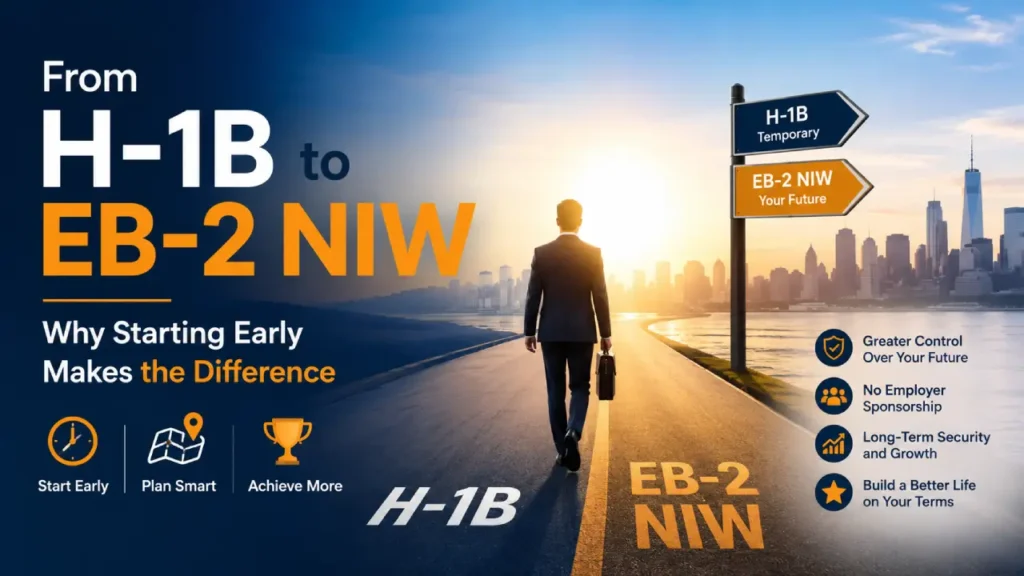
Direct Answer: The H-1B is a temporary, employer-sponsored work visa. The EB-2 NIW is a self-petitioned, permanent immigrant pathway based on your professional merit and proposed endeavor. Most H-1B holders pursue the NIW in parallel or after their initial visa period.
These two classifications are fundamentally different in purpose, structure, and what USCIS evaluates.
The H-1B is a nonimmigrant (temporary) visa. Your employer files it. Your authorization to work is tied entirely to that employer and that specific position. Duration is capped — typically three years with a three-year extension, totaling six years in most cases. After that, further extensions require an approved immigrant petition or some other qualifying factor. The H-1B is also subject to an annual cap and a lottery, which introduces substantial uncertainty that no amount of preparation can fully eliminate.
The EB-2 NIW is an immigrant pathway. You file it yourself. No employer sponsor is required, and there is no lottery. It falls under INA §203(b)(2) and allows USCIS to waive the standard job offer and labor certification requirements when your work is deemed to serve U.S. national interests. The analytical standard comes from Matter of Dhanasar (AAO 2016), which we’ll discuss in detail below.
What connects them for most professionals: the skills, publications, recognition, and work record you accumulate on H-1B status are exactly the raw material your NIW petition will later draw on.
Why H-1B Holders Should Start NIW Planning Early
The H-1B period is typically the most active professional development window in a foreign national’s career. You’re building expertise, accumulating citations, getting promoted, presenting at conferences, or leading projects with measurable business impact.
None of that is automatically documented for USCIS. You have to build the record intentionally.
Here’s what changes when you start early:
You document impact as it happens. Trying to reconstruct evidence of influence two years after a project ended is difficult. Contemporaneous documentation — emails, project outcomes, metrics, third-party coverage — is far stronger.
You have time to fill gaps. If USCIS typically looks for publications, presentations, or professional recognition, and your field doesn’t produce those naturally, you have time to seek opportunities that generate that evidence legitimately.
You align your professional narrative. The NIW requires a cohesive story about a proposed endeavor — what you will do, why it matters to the U.S., and why you’re the person positioned to do it. That story is easier to build when you’ve been living it deliberately, not reverse-engineered from a job description.
Your supporting documents are more accurate and consistent. An EB-2 NIW expert opinion letter prepared by professionals who understand your full career arc — not just the last 12 months — is materially stronger. At AAE Evaluations, we work with many applicants who begin preparing their documentation a year or more before their intended filing date, and the difference in petition quality is clear.
The Matter of Dhanasar Framework: What USCIS Actually Evaluates
Every EB-2 NIW petition is evaluated under the three-prong Matter of Dhanasar standard established by the USCIS Administrative Appeals Office in 2016. Understanding these prongs isn’t optional — it determines how you should build your record during your H-1B years.
Prong 1: Substantial Merit and National Importance
Your proposed endeavor must have substantial merit in an area like business, entrepreneurship, science, technology, culture, health, education, or the arts. It must also have national importance — meaning its impact extends beyond your immediate employer or local community.
This is where many petitions stumble. “I am a senior software engineer at a Fortune 500 company” doesn’t establish national importance on its own. “I am developing a machine learning framework that improves diagnostic accuracy for rare diseases, with applications across U.S. hospital networks” starts to get there.
The more specific and evidence-backed your proposed endeavor, the more clearly this prong is satisfied.
Prong 2: Well-Positioned to Advance the Endeavor
USCIS evaluates whether you specifically are the right person to carry this work forward. This is where your credentials, publication record, citations, awards, recognition from peers, and track record of advancing similar work become directly relevant.
An expert opinion letter from a credentialed evaluator plays a significant role here. It provides an independent, third-party assessment of your qualifications and how they position you to advance your stated endeavor — something a personal statement or cover letter alone cannot accomplish.
Prong 3: Waiver Benefits the United States
Finally, USCIS asks whether, on balance, it benefits the U.S. to waive the usual labor certification requirement for you. This prong often intersects with the first two, but it also rewards:
- Urgency or shortage (your work addresses a demonstrated national need)
- Unique expertise not easily sourced domestically
- Prior record of U.S.-based contribution
What the EB-2 NIW Requires Before You Even Get to Dhanasar
Before USCIS applies the Dhanasar test, you need to qualify for the EB-2 category itself. There are two pathways:
Advanced Degree: A U.S. master’s degree or higher (or foreign equivalent), or a U.S. bachelor’s degree (or equivalent) plus at least five years of post-degree progressive experience in the specialty. Many H-1B professionals qualify here — and if your degree is foreign, a credential evaluation for USCIS that confirms U.S. equivalency is a required part of the petition package.
Exceptional Ability: A level of expertise significantly above what is ordinarily encountered in your field. USCIS evaluates this using a list of factors: academic records, 10+ years of experience, licenses or certifications, high salary relative to peers, professional memberships, and recognized achievements or contributions.
At AAE Evaluations, we prepare work experience evaluations that document the depth and progression of your professional record — essential when years of experience need to be converted into a form USCIS can evaluate directly.
The H-1B Documents That Don’t Carry Over (and What to Build Instead)
A common misconception: if your H-1B was approved, the EB-2 NIW is a natural next step that reuses the same evidence. It doesn’t work that way.
Your H-1B was approved because your employer demonstrated you qualify for a specialty occupation position. That’s employer-centric evidence — it’s about the job, not your individual merit or proposed endeavor.
The EB-2 NIW case is built on a completely different evidentiary framework:
| H-1B Evidence | EB-2 NIW Evidence |
|---|---|
| Job offer from U.S. employer | Proposed endeavor statement |
| Specialty occupation analysis | Dhanasar prong analysis |
| Degree meets position requirements | Degree or Exceptional Ability meets EB-2 threshold |
| Employer’s LCA and wage documentation | Evidence of peer recognition, impact, and contributions |
| H-1B Expert Opinion Letter | EB-2 NIW Expert Opinion Letter |
Both types of expert opinion letters serve critical roles — they simply address different things. An H-1B expert opinion letter focuses on the specialty occupation standard and whether your credentials match the role. An EB-2 NIW expert opinion letter focuses on your individual qualifications, your proposed endeavor, and why waiving labor certification serves U.S. interests.
What Stricter USCIS Scrutiny Means for Your Timeline
Since 2024, practitioners and applicants alike have observed more rigorous EB-2 NIW adjudication, including higher rates of Requests for Evidence (RFEs) and tighter scrutiny of proposed endeavor statements that read as generic or employer-anchored.
This is not a reason to delay — it’s a reason to start earlier.
A petition filed with a strong, contemporaneous evidentiary record, a coherent endeavor narrative, and a well-prepared expert opinion letter will hold up to RFE scrutiny far better than one assembled quickly at the end of an H-1B extension.
If you’ve already received an RFE, AAE Evaluations also prepares RFE-specific expert opinion letters structured to directly address USCIS’s stated concerns — which is a different product from a first-filing letter and requires specific expertise to execute correctly.
How to Use Your H-1B Years to Build a Stronger NIW Case
You don’t need to change careers or become a prolific academic researcher. You need to be intentional about how you document and develop the work you’re already doing.
Here are the highest-impact actions during your H-1B period:
1. Define your proposed endeavor early.
Even a rough articulation of the national-interest work you plan to do helps orient your professional decisions. What problem does your expertise address? Who benefits at scale?
2. Seek peer recognition in your field.
Invitations to review papers, speak at industry events, judge awards programs, or serve on standards committees all generate evidence of standing in your field.
3. Document measurable outcomes.
Project impact is strongest when quantified: revenue generated, efficiency improvements, patients served, systems deployed. Build the habit of recording these metrics as you go.
4. Build your publication or contribution record.
This doesn’t require academic publishing. White papers, industry reports, patents, open-source contributions, and technical standards documentation all demonstrate field-level contribution.
5. Keep records of third-party recognition.
Media mentions, citations by others, nominations for professional awards, and testimonials from collaborators are all evidence of external validation — which carries more weight than self-attestation.
6. Get your credentials formally evaluated.
If your degree is from outside the U.S., an education credential evaluation from AAE Evaluations establishes formal U.S. equivalency, which is a standard requirement in NIW petitions.
The Role of Expert Opinion Letters in EB-2 NIW Petitions
An expert opinion letter is not a formality. It is often one of the most analytically demanding documents in an NIW petition — and one of the most scrutinized by adjudicators.
A strong EB-2 NIW expert opinion letter should:
- Establish the author’s credibility and independence from the petitioner
- Assess the petitioner’s qualifications against the specific EB-2 criteria (Advanced Degree or Exceptional Ability)
- Address each Dhanasar prong with specific reference to the petitioner’s record and proposed endeavor
- Use field-specific language that demonstrates genuine domain expertise
- Avoid generic praise in favor of evidence-anchored analysis
At AAE Evaluations, our expert opinion letters are prepared by credentialed professionals with direct expertise in the petitioner’s field. Letters are tailored to the specific visa category, the petitioner’s individual record, and the adjudication standards USCIS applies — not templated documents with names swapped in.
This matters because USCIS officers reviewing NIW petitions read hundreds of letters. A letter that reads like a form document does not serve your case.
Frequently Asked Questions
Can I file an EB-2 NIW while on H-1B status?
Yes. The H-1B is a “dual intent” visa, meaning you can lawfully pursue permanent residency while maintaining valid H-1B status. Filing an I-140 for the EB-2 NIW does not violate H-1B nonimmigrant intent. Many H-1B holders file the NIW petition while still employed under H-1B and before their authorized period expires.
How early should I start preparing for the EB-2 NIW?
There is no fixed answer, but most immigration practitioners recommend beginning to think about your NIW record at least two to three years before you intend to file. This gives you time to build the professional evidence base, clarify your proposed endeavor, and prepare supporting documents like expert opinion letters without rushing.
What is the biggest difference between an H-1B and EB-2 NIW expert opinion letter?
The H-1B letter focuses on whether your role qualifies as a specialty occupation and whether your credentials match that role — it’s employer and position-centric. The EB-2 NIW letter focuses on your individual qualifications, your proposed endeavor, and why waiving labor certification serves the national interest. They serve entirely different legal purposes and require different expertise to write effectively.
What happens if my H-1B runs out before my EB-2 NIW is approved?
A filed and pending I-140 (the NIW petition) may allow for H-1B extensions beyond the six-year cap, but the specifics depend on timing, priority dates, and individual circumstances. Immigration counsel should guide this aspect of your case. The key takeaway: filing your I-140 earlier gives you more flexibility.
Does AAE Evaluations work with immigration attorneys on EB-2 NIW cases?
Yes. AAE Evaluations works directly with immigration attorneys as well as individual self-petitioners. For attorney-represented clients, we coordinate with counsel on document strategy, review attorney notes, and structure our letters to align with the petition narrative the attorney is building. You can request a free case review here.
What documents does AAE Evaluations prepare for EB-2 NIW petitions?
AAE Evaluations prepares EB-2 NIW expert opinion letters, EB-2 NIW recommendation letters, education credential evaluations, work experience evaluations, and EB-2 NIW business plans — giving your attorney a consistent, coordinated evidentiary package from a single source.