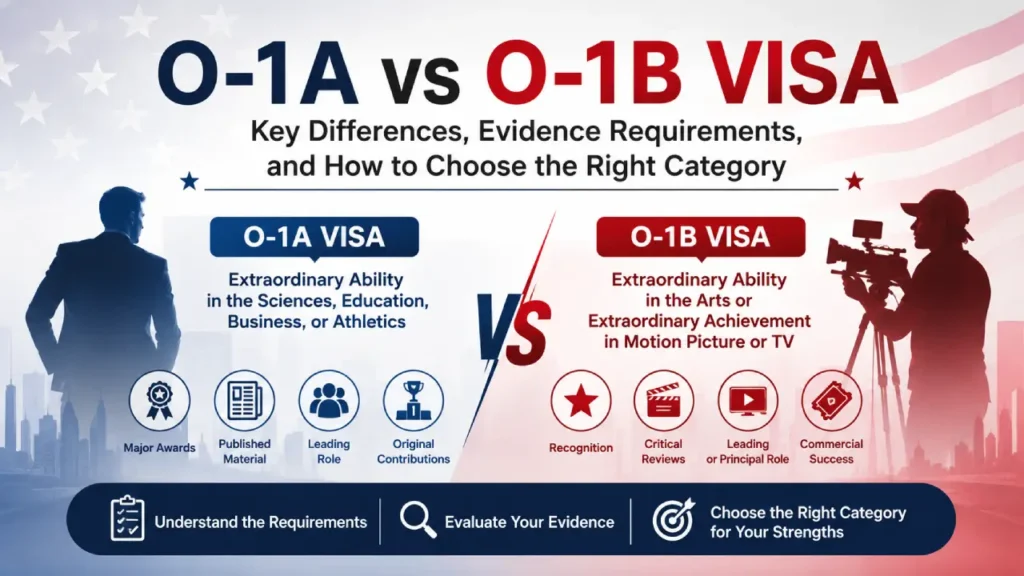
Quick Read: The O-1A visa is for professionals with extraordinary ability in science, education, business, or athletics, while the O-1B visa covers extraordinary ability in the arts and extraordinary achievement in motion picture or television. Your field — not your evidence strength or preference — determines which subcategory applies. Choosing the wrong one is one of the most avoidable reasons O-1 petitions get denied or trigger costly RFEs.
Picking the wrong O-1 subcategory can derail a petition that should have sailed through. And yet, most guides spend their first 600 words defining what “extraordinary ability” means at a surface level — as if that’s the hard part.
Here’s what actually trips people up: the O-1A and O-1B don’t just serve different fields. They operate under different legal standards, use different evidence frameworks, and have meaningfully different approval dynamics. An O-1A for a software engineer is adjudicated under a completely different set of rules than an O-1B for a choreographer — even if both applicants have equally impressive careers.
At AAE Evaluations, we prepare O-1 expert opinion letter that directly address the evidentiary standards USCIS applies to each subcategory. We’ve seen how a poorly framed advisory letter — or a petition filed under the wrong subcategory — can unravel an otherwise strong case.
This guide covers everything you need to know: how the two categories differ, what USCIS actually looks for in each, how evidence requirements compare, and how to avoid the mistakes that generate RFEs.
Key Takeaways:
- The O-1 visa splits into two distinct subcategories: O-1A (sciences, education, business, athletics) and O-1B (arts, film/TV)
- Your professional field determines which category you file under — USCIS won’t let you choose based on which is “easier”
- O-1A uses 8 evidentiary criteria; you must satisfy at least 3 (plus meet the overall “extraordinary ability” standard)
- O-1B arts applicants face a “distinction” standard; film/TV O-1B applicants face a stricter “extraordinary achievement” standard
- Both subcategories allow up to 3 years initially, with indefinite one-year extensions
- A strong advisory opinion letter is required for both — and its quality can make or break your petition
- The O-1 is a natural steppingstone to an EB-1A green card
What Is the O-1 Visa and Who Is It For?
The O-1 is a U.S. nonimmigrant work visa for individuals who have risen to the top of their field. It’s authorized under INA §101(a)(15)(O) and governed by 8 CFR §214.2(o).
Three features make it stand out from other employment-based visas:
- No annual cap or lottery. Unlike the H-1B, which is limited to 65,000 regular cap visas each year and selected by random lottery, the O-1 has no numerical limit. You can file at any time.
- No labor certification. There’s no PERM process, no need to advertise the position to U.S. workers, and no employer has to “prove” you couldn’t be replaced by an American.
- Indefinite renewability. The initial period is up to three years. Extensions come in one-year increments and can continue indefinitely as long as the qualifying work continues.
The O-1 divides into two subcategories based on professional field. A third category — the O-2 — applies to certain essential support personnel accompanying an O-1 artist or athlete, while the O-3 covers qualifying spouses and children of O-1 and O-2 holders.
O-1A: Extraordinary Ability in Sciences, Education, Business, or Athletics
The O-1A applies to four domains:
- Sciences: All scientific disciplines — computer science, AI, engineering, biology, chemistry, medicine, environmental science, mathematics, and applied sciences
- Education: Professors, academic administrators, researchers, and educators with recognized contributions to their field
- Business: Executives, entrepreneurs, founders, management consultants, economists, and other business professionals with demonstrated influence and achievement
- Athletics: Professional and elite amateur athletes with documented performance records, national or international recognition, and competitive success
The key phrase in every O-1A case is “extraordinary ability,” which USCIS defines as a level of expertise placing the applicant among the small percentage at the very top of their field. That’s a genuinely high bar — but it doesn’t require a Nobel Prize. It requires building a record that, when evaluated holistically, demonstrates sustained national or international acclaim.
O-1B: Extraordinary Ability in Arts or Extraordinary Achievement in Motion Picture/Television
The O-1B actually contains two sub-flavors with different legal standards:
O-1B Arts: For performers, musicians, visual artists, designers, writers, choreographers, and others in the arts. The legal standard is “distinction” — a high level of achievement in the field evidenced by skill and recognition substantially above the ordinary.
O-1B Motion Picture/Television: For actors, directors, producers, cinematographers, editors, and others in film and TV production. The standard here is “extraordinary achievement,” defined as a degree of skill and recognition significantly above the ordinary, to the extent the applicant is recognized as outstanding, notable, or leading in their field.
The distinction matters: the arts O-1B standard is noticeably lower than the motion picture/TV standard. A classically trained dancer with lead roles in notable productions may qualify more comfortably than a supporting-role film actor trying to meet the “extraordinary achievement” bar.
The Core Difference Between O-1A and O-1B Visas
The single most important thing to understand: your field determines your category — not your evidence, your attorney’s strategy, or your preference.
A biotech researcher cannot elect to file O-1B because they find its evidence framework more manageable. A filmmaker cannot pivot to O-1A because they have strong publication records. USCIS adjudicates based on the field of intended U.S. employment — and if the petition doesn’t match the applicant’s actual work, expect an RFE or denial.
Here’s where it gets nuanced for dual-field professionals. What if you’re a scientist who also creates original artwork? What if you’re a musician with an MBA who’s also built a successful business? In these cases, the determining factor is your primary field of intended U.S. employment as stated in the petition. Your secondary achievements can support the petition as supplemental evidence, but they don’t change the classification.
| Feature | O-1A | O-1B (Arts) | O-1B (Film/TV) |
|---|---|---|---|
| Eligible fields | Sciences, education, business, athletics | Arts | Motion picture/television |
| Legal standard | Extraordinary ability | Distinction | Extraordinary achievement |
| Evidentiary threshold | High | Moderate | High |
| # of criteria | 8 criteria (meet at least 3) | 7 criteria (meet at least 3) | Different criteria set |
| Advisory opinion | Required (peer group or expert) | Required (relevant guild/union) | Required (union or organization) |
| Employment flexibility | Limited to petitioned employer(s) | More flexible; can add projects | More flexible; can add projects |
| Path to EB-1A | Strong alignment | Less direct | Less direct |
The Advisory Opinion Requirement
Both O-1A and O-1B petitions require a written advisory opinion from a peer group, labor organization, or expert with knowledge of the applicant’s field. But what’s acceptable differs.
For O-1A petitions, the advisory opinion typically comes from a professional association, academic institution, or a recognized expert who can evaluate the applicant’s standing within their field. The letter must address the applicant’s extraordinary ability — not simply confirm their employment history.
For O-1B petitions, relevant guilds and unions (such as SAG-AFTRA for actors, or the American Federation of Musicians) can provide the advisory opinion. If no appropriate union exists, an expert in the field can substitute.
The quality of this letter is often underestimated. A generic letter that praises the applicant without specifically addressing the regulatory criteria is worse than useless — it signals to the adjudicator that the case lacks genuine expert corroboration. Well-drafted O-1 advisory letters analyze the applicant’s specific achievements against the applicable legal standard, field by field.
O-1A Eligibility Criteria: The 8-Criteria Framework
To qualify for an O-1A visa, an applicant must either:
- Provide evidence of a single major internationally recognized award (Nobel Prize, Olympic medal, Pulitzer, etc.), OR
- Satisfy at least 3 of 8 specific evidentiary criteria under 8 CFR §214.2(o)(3)(iii)(B)
Meeting three criteria isn’t automatically enough. USCIS conducts a two-step review: first, confirming that at least three criteria are satisfied; then, assessing the overall record to determine whether it genuinely demonstrates extraordinary ability. Many petitions clear step one and stumble at step two because the evidence is technically present but not compelling.
The 8 O-1A Criteria
1. Awards and prizes.
Receipt of nationally or internationally recognized prizes or awards for excellence in the field. A local industry award or internal company recognition doesn’t cut it. The recognition must carry weight outside the applicant’s immediate circle.
2. Membership in selective associations.
Membership in associations in the field that require outstanding achievement as judged by recognized experts. Being a member of a professional society anyone can join doesn’t satisfy this. The association must have meaningful admission criteria based on achievement.
3. Published material about the applicant.
Published material in professional or major trade publications (or major media) about the applicant and their work. The articles must be about the applicant — not merely citing them in passing. Quality and reach of the publication matter.
4. Participation as a judge.
Judging the work of others in the field, either individually or as part of a panel. Peer review of academic papers, grant committee work, competition judging, and technical advisory roles can all qualify — with proper documentation.
5. Original contributions of major significance.
Evidence of original scientific, scholarly, artistic, athletic, or business-related contributions of major significance to the field. This is often the strongest criterion for STEM professionals and entrepreneurs — and the hardest to document well. The emphasis is on major significance: the contribution must have meaningfully moved the field forward, not just added incrementally to it.
6. Scholarly articles.
Authorship of scholarly articles in the field in professional journals or other major media. For technology professionals, patent filings, technical white papers, and open-source contributions with wide adoption can supplement traditional academic publishing.
7. Critical or essential role.
Evidence of performance in a critical or essential role for distinguished organizations or establishments. An engineering lead at a top-tier technology company, a principal investigator at a leading research university, or a C-suite executive at a recognized corporation — each can satisfy this if documented properly.
8. High salary or remuneration.
Evidence of commanding a high salary or other substantial remuneration relative to others in the field. This one is straightforward — but the comparison must be to peers in the same field, not the general workforce.
Important: USCIS issued a 2024 policy clarification specifically addressing how STEM applicants — particularly founders, AI researchers, and engineers without traditional academic publishing records — can satisfy these criteria. The memo explicitly recognizes that quantifiable impact (product adoption, funding raised, patents commercialized) can demonstrate extraordinary ability even when publication counts are modest.
Want to understand how your specific profile maps to these criteria? Get a free case review from AAE Evaluations — we’ll tell you which criteria your background best supports.
O-1B Eligibility Criteria: Arts vs. Film/TV
The O-1B uses a separate evidence framework that differs meaningfully from O-1A — and the arts subcategory differs from the film/TV subcategory.
O-1B Arts Criteria (at least 3 of 7)
1. Prizes and awards. Prizes or awards for distinction in the field at a nationally or internationally recognized level — Grammys, Tony nominations, major film festival awards, or equivalent recognition in fine art, design, or literary fields.
2. Membership in associations requiring distinction. Membership in organizations that require outstanding achievement as a condition of admission, as judged by recognized experts.
3. Published material about the applicant. Material in professional publications or major media about the applicant and their work in the arts.
4. Judging. Participation as a judge of the work of others in the arts field, individually or on a panel.
5. Original contributions. Evidence of original artistic contributions of major significance to the field.
6. Leading or starring roles. Evidence of leading or starring roles in productions or events with a distinguished reputation — major theater productions, concert tours, gallery exhibitions with national reach.
7. High salary or remuneration. Evidence of commanding a high salary or substantial remuneration relative to others in the arts.
O-1B Film/TV Criteria (at least 3 of the following)
The film and television subcategory uses a similar structure but with industry-specific evidence types:
- Lead or starring roles in productions with distinguished reputations (major network or streaming productions, award-winning films)
- Critical reviews or commentary demonstrating extraordinary achievement
- Recognition from critics, organizations, or government agencies
- Record of major commercial or critically acclaimed success
- Significant recognition from organizations or critics for distinguished contributions
- High salary or substantial remuneration compared with others in the film/TV industry
Unlike O-1A, O-1B allows considerably more flexibility in employment. An O-1B holder can add projects in their field — including new employers or engagements — without requiring a new petition each time. An O-1A holder, by contrast, is generally restricted to work with the petitioning employer(s) named in the original petition.
Evidence Documentation: What Makes a Strong O-1 Petition
Choosing the right category is step one. Building the evidentiary record is where petitions are won or lost.
Evidence Strategy for O-1A Petitions
O-1A evidence should be objective and quantifiable wherever possible. The adjudicator is looking for things they can verify, count, and compare:
- Awards: Letters confirming the award, selection criteria, and the organization’s standing in the field
- Publications: Journal articles with citation counts, h-index data, and impact factor of the journals
- Salary: W-2s, offer letters, and comparison data showing salary relative to field peers (Bureau of Labor Statistics occupational wage data often works well here)
- Judging: Formal invitation letters from the organizing body, the scope of the panel, and the reputation of the program being judged
- Contributions: Expert letters that don’t just praise the applicant but explain how the contribution moved the field — citing adoption, influence, or downstream research that builds on the work
The expert opinion letter is especially critical for original contributions and judging criteria. A letter that simply says “Dr. X is an exceptional researcher” tells USCIS nothing useful. A letter that explains how Dr. X’s published algorithm was adopted by three major tech companies and cited in 147 peer-reviewed papers — and why that constitutes extraordinary ability — is a different document entirely.
Evidence Strategy for O-1B Petitions
O-1B evidence is more qualitative and interpretive, which is both its strength and its challenge. USCIS adjudicators evaluating arts or entertainment petitions don’t always have deep familiarity with the field, so the petition must do more translation work.
Strong O-1B evidence includes:
- Critical reviews: Published reviews from credible outlets — trade publications, mainstream media, respected blogs in the niche — that specifically address the applicant’s skill and distinction
- Leading roles: Contracts, programs, posters, and promotional materials documenting lead or starring roles, along with the production’s reputation
- Commercial success: Box office data, streaming numbers (where available), album sales, or venue capacity filled
- Peer recognition: Letters from established peers in the field that explain how the applicant is viewed within the industry — not just that they’re “talented” but that they’re recognized as leading or outstanding
One common mistake with O-1B petitions: submitting a high volume of evidence without quality filtering. A stack of 40 mediocre reviews is not more compelling than 8 reviews from major outlets. Adjudicators notice when evidence is padded.
AAE Evaluations prepares expert opinion letters for O-1 visa petitions that are specifically structured to address evidentiary criteria — not generic praise letters. Learn how we approach O-1 documentation.
Common Mistakes That Sink O-1A and O-1B Petitions
Plenty of strong candidates file weak petitions. Here’s where things go wrong:
Mistake 1: Filing Under the Wrong Category
The most damaging error — and not as rare as you’d hope. Technology professionals who have done significant creative work sometimes try to file O-1B because they perceive it as having a lower bar. What they get is a denial and a delay that could have been avoided by filing O-1A correctly from the start.
Mistake 2: Meeting the Criteria but Not the Standard
You can technically check three boxes and still get denied. The two-tier USCIS review means that satisfying criteria is necessary but not sufficient. The overall petition must demonstrate that the applicant genuinely belongs “among the small percentage at the very top of their field.” If the criteria met are weak or marginal, the second-tier review becomes the kill zone.
Mistake 3: A Generic Advisory Opinion Letter
The advisory letter is not a formality. USCIS takes it seriously, and when it reads like a form letter, it raises questions about whether the organization or expert truly reviewed the applicant’s case. The letter must be specific, substantive, and written by someone with genuine authority in the relevant field.
Mistake 4: Ignoring the “Sustained” Requirement
Extraordinary ability must be sustained — not a one-time spike. A musician who had a hit album five years ago and has been largely inactive since will struggle to demonstrate sustained national acclaim. USCIS looks for a pattern of recognition over time, not a single peak moment.
Mistake 5: Over-relying on Employer Prestige
Working for Google, NASA, or a Fortune 100 company is a supporting data point — not evidence of extraordinary ability by itself. The petition must demonstrate the applicant’s individual standing, not just their employer’s reputation. The “critical or essential role” criterion helps here, but it requires showing what the applicant personally contributed, not just where they worked.
O-1 Visa Validity, Extensions, and Employer Rules
Both O-1A and O-1B share the same basic validity structure:
- Initial validity: Up to 3 years from the date of approval
- Extensions: Available in 1-year increments, with no statutory maximum
- Premium processing: Available via Form I-907. As of 2026, the premium processing fee is $2,965, guaranteeing USCIS action within 15 business days
But there’s a meaningful difference in employment flexibility between the two subcategories.
O-1A holders can generally only work for the petitioning employer named in the approved petition. Adding a new employer requires filing an additional Form I-129 petition. This matters for consultants, contractors, and anyone whose work naturally spans multiple clients.
O-1B holders benefit from considerably more flexibility. They can add projects — including with different companies or engagements — within their approved field without necessarily requiring a new petition each time. For a working actor or touring musician, this is a practical necessity, and USCIS accommodates it.
Both subcategories can accommodate an agent-filed petition, which is useful for applicants who work across multiple employers rather than for a single organization.
From O-1 to Green Card: The Natural Path
One of the less-discussed advantages of the O-1A visa is how cleanly it connects to permanent residence — specifically, the EB-1A extraordinary ability green card.
The EB-1A uses essentially the same evidentiary framework as the O-1A, with nearly identical criteria and the same “extraordinary ability” standard. Applicants who file a strong O-1A petition often have most of the materials needed to subsequently self-petition for an EB-1A. Because the EB-1A doesn’t require employer sponsorship or a PERM labor certification, O-1A holders can control their own immigration timeline without depending on an employer to initiate or sustain the process.
For O-1B holders, the transition to a green card is less direct. The closest immigrant visa — the EB-1B — applies to outstanding professors and researchers, not arts or entertainment professionals. O-1B holders who want to pursue permanent residence often look at the EB-2 NIW (National Interest Waiver), particularly if their work has a cultural, educational, or social impact argument to make.
O-1A vs O-1B: Which Is Right for You?
Here’s the honest answer: it’s not a choice. USCIS will classify your petition based on your field, and misfiling is worse than not filing at all.
But “which is right for you” is still a meaningful question — because it’s really asking: does my background actually support an O-1 petition at all, and which subcategory does my work genuinely fall under?
Work through these three questions:
1. What field will you be working in during your U.S. stay?
If it’s sciences, education, business, or athletics → O-1A. If it’s arts, film, or TV → O-1B.
2. Do you meet at least 3 of the relevant criteria with strong, documentable evidence?
Not just technically satisfying criteria with thin evidence — but having real, verifiable proof that meets a high evidentiary standard.
3. Does your record demonstrate sustained national or international recognition?
Not just one great achievement, but a pattern of recognition that establishes you as someone who has risen to the top of your field over time.
If you’re confident on all three, you’re likely a strong candidate. If the answers are uncertain, that’s exactly the kind of conversation a free case review is designed to resolve before you commit to filing.
Frequently Asked Questions
What is the main difference between O-1A and O-1B visas?
The O-1A covers extraordinary ability in sciences, education, business, and athletics. The O-1B covers extraordinary ability in the arts and extraordinary achievement in motion picture or television. The categories use different legal standards and different evidentiary criteria. Your professional field determines which one applies — it’s not a strategic choice.
Can I choose between O-1A and O-1B based on which is easier to qualify for?
No. USCIS classifies petitions based on the applicant’s field and the nature of their intended U.S. work. Filing under the wrong category is a recognized basis for denial or an RFE. The category must match your profession.
Is O-1A harder to get than O-1B?
The O-1A “extraordinary ability” standard is widely considered the most demanding across all three O-1 sub-flavors. The O-1B arts standard uses “distinction,” which sets a somewhat lower threshold. O-1B motion picture/TV uses “extraordinary achievement,” which sits closer to the O-1A standard in difficulty. That said, evidentiary complexity depends heavily on the individual case — a well-documented O-1A petition from a highly accomplished scientist can be more straightforward than a poorly documented O-1B petition from an artist with diffuse career evidence.
What is an advisory opinion letter, and why does it matter for O-1 petitions?
An advisory opinion letter is a written statement from a peer group, labor union, or recognized expert confirming the applicant’s standing in their field. It’s a required part of every O-1 petition. Its quality significantly affects petition outcomes — a generic letter is far less effective than one that specifically addresses the regulatory criteria and explains how the applicant’s achievements satisfy the applicable standard.
How long does O-1 visa processing take in 2026?
Standard processing varies by service center and petition complexity, typically ranging from 2 to 5 months. Premium processing via Form I-907 guarantees USCIS action within 15 business days for a fee of $2,965 (as of 2026). Check the USCIS website for current processing times, as USCIS updates these weekly.
Can an O-1A holder change jobs?
O-1A holders are generally tied to the petitioning employer. Adding a new employer requires a new Form I-129 petition. O-1B holders have more flexibility to add projects and engagements in their field without necessarily requiring a new filing each time.
Is the O-1 visa a path to a green card?
The O-1A aligns closely with the EB-1A extraordinary ability green card — the same criteria framework applies, making it a natural transition path for applicants who want permanent residence. O-1B holders typically look at the EB-2 NIW or other pathways. Neither the O-1A nor O-1B directly “converts” to a green card, but both are dual-intent-friendly, meaning holding an O-1 doesn’t preclude pursuing an immigrant visa simultaneously.
Do I need an employer to sponsor an O-1 petition?
Yes — someone must file the Form I-129 petition on your behalf. This can be a U.S. employer, a U.S. agent, or a foreign employer working through a U.S. agent. Unlike EB-1A, the O-1 does not allow direct self-petition. However, the employer or agent requirement is relatively flexible compared to visa categories like H-1B or L-1.
What is the O-2 visa?
The O-2 is a companion visa for essential support personnel who accompany O-1 artists or athletes. The O-2 holder must have critical skills and experience that are not of a general nature — and must actually be needed to perform alongside the O-1 holder. Scientists and business professionals filing under O-1A do not typically have O-2 counterparts.
Can AAE Evaluations help with O-1 advisory letters?
Yes. AAE Evaluations prepares O-1 expert opinion and advisory letters for both O-1A and O-1B petitions. Our letters are structured to directly address the relevant USCIS evidentiary criteria — not generic reference letters. We work with attorneys and individual applicants across a wide range of fields.
Conclusion: Know Your Category, Build Your Record
The O-1 visa is one of the most powerful nonimmigrant work visas available — no lottery, no cap, and a genuine pathway to permanent residence for the right candidates. But it rewards preparation.
Knowing whether your case falls under O-1A or O-1B is step one. Building an evidentiary record that satisfies not just the three-criteria minimum but the overall extraordinary ability standard is what separates approvals from RFEs.
The mistake most applicants make is treating the petition as a paperwork exercise. It’s not. It’s a legal argument, and it requires evidence that’s not just present but persuasive.
If you’re weighing an O-1 petition and want to understand how your background maps to the criteria — and whether the evidence you have is strong enough to support a filing — get a free case review with AAE Evaluations. We’ll review your profile, tell you which subcategory applies, and identify any gaps in your evidence before you commit to the filing process.
Our team has prepared O-1 expert opinion letters and advisory letters for applicants across sciences, technology, business, and the arts — and we understand what USCIS adjudicators actually look for in 2026.