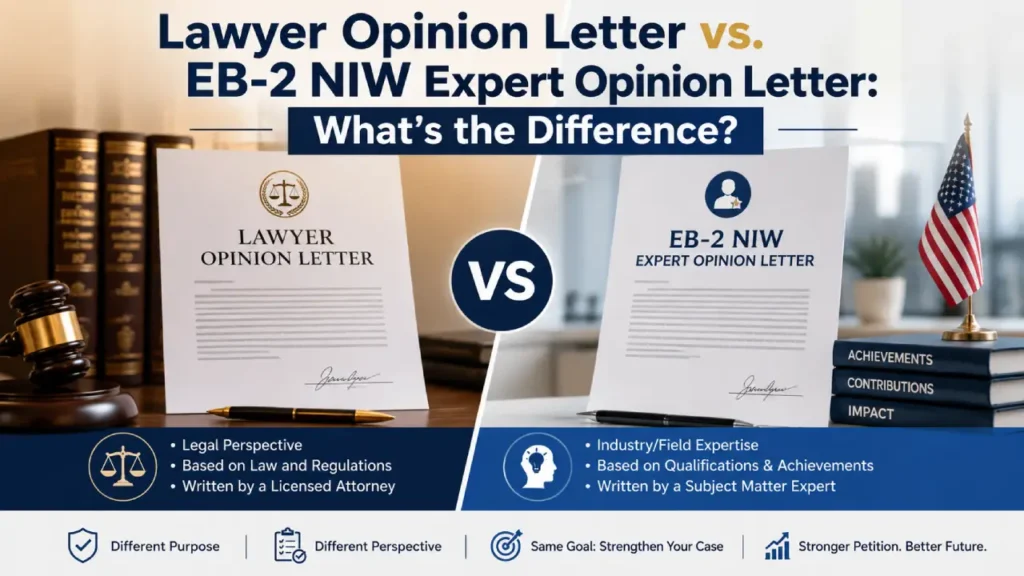
Quick Answer: A lawyer opinion letter is a legal analysis written by a licensed immigration attorney — it argues your legal position, explains statutory interpretation, or addresses admissibility concerns. An EB-2 NIW expert opinion letter is written by an independent field expert — a professor, researcher, or senior professional — who evaluates your qualifications and explains why your work serves the U.S. national interest. Both can appear in the same immigration petition, but they serve completely different evidentiary roles.
Why This Distinction Matters for Your EB-2 NIW Petition
Confusing these two document types is one of the most common and costly mistakes EB-2 NIW applicants make. USCIS adjudicators review both — but they carry different weight, serve different purposes, and are evaluated under entirely separate standards.
Getting this wrong can lead to:
- A Request for Evidence (RFE) that delays your case by months
- A weak evidentiary record that fails to satisfy the three-prong Dhanasar test
- An outright denial on qualifications or national interest grounds
This guide breaks down exactly what each document is, who writes it, what it must contain, and how each fits into a competitive EB-2 NIW petition strategy.
What Is a Lawyer Opinion Letter?
A lawyer opinion letter — also called an attorney opinion letter or legal opinion letter — is a formal written document prepared by a licensed immigration attorney. It presents a legal analysis, interprets applicable statutes and regulations, and argues a specific legal conclusion on behalf of a client.
In the immigration context, lawyer opinion letters are used in several ways:
- Criminal inadmissibility: An attorney explains why a past conviction should not bar a petitioner from entering the United States or receiving an immigration benefit
- Petition cover letters: The attorney summarizes the factual and legal basis for why a petitioner meets visa requirements
- RFE response briefs: The attorney provides a structured legal rebuttal to USCIS concerns
- Specialty occupation analysis: In H-1B cases, an attorney may draft a legal argument that the offered position qualifies as a specialty occupation
What makes a lawyer opinion letter distinct is who writes it and what it argues. It is authored by a member of the bar — someone with legal authority to render a professional legal opinion. The letter analyzes law, interprets regulations, and makes legal arguments.
It does not evaluate your professional qualifications from a field expert’s perspective. That is the job of an expert opinion letter.
What Is an EB-2 NIW Expert Opinion Letter?
An EB-2 NIW expert opinion letter (EOL) is a formal, research-backed document written by a credentialed independent authority in your professional or academic field. Its purpose is to provide USCIS with an objective, evidence-based evaluation of:
- Your qualifications, credentials, and contributions to your field
- The substantial merit and national importance of your proposed endeavor
- Why it would benefit the United States to waive the normal labor certification process for you
The letter is not a personal reference. It is not a character endorsement. It is a legal evidentiary document that methodically connects your background to the three prongs established by Matter of Dhanasar (2016) — the governing USCIS framework for all NIW petitions.
USCIS adjudicators are generalists. When a petition involves advanced research in bioengineering, urban infrastructure, or machine learning, the adjudicator may not have the background to independently assess the petitioner’s standing in that field. The expert opinion letter bridges that gap by providing an authoritative, field-specific analysis in terms a non-expert can evaluate against legal criteria.
You can learn more about what goes into a high-quality evaluation on the AAE Evaluations expert opinion letter page.
Side-by-Side Comparison: Lawyer Opinion Letter vs. EB-2 NIW Expert Opinion Letter
| Feature | Lawyer Opinion Letter | EB-2 NIW Expert Opinion Letter |
|---|---|---|
| Who writes it | Licensed immigration attorney | Independent credentialed expert (professor, researcher, senior professional) |
| Primary function | Legal argument and statutory interpretation | Field-level evaluation of qualifications and national interest |
| What it addresses | Legal admissibility, petition strategy, RFE legal rebuttal | Dhanasar prongs: merit, national importance, and waiver benefit |
| Evidentiary nature | Legal opinion | Expert evaluation |
| Independence requirement | Authored by your attorney (your advocate) | Must be independent — no prior working relationship preferred |
| Audience | USCIS as a legal argument | USCIS as objective expert evidence |
| When used | Cover letter, RFE response, admissibility arguments | Initial filing, RFE response, NOID response |
| USCIS evidentiary weight | Taken as advocacy | Taken as independent third-party evidence |
The Independence Factor: Why It Matters So Much
One of the most important — and most misunderstood — principles in EB-2 NIW petition strategy is evidentiary independence.
USCIS draws a clear distinction between:
- “Inner circle” letters from colleagues, supervisors, collaborators, or anyone with a direct professional relationship with the petitioner
- “Outer circle” letters from distinguished independent experts who evaluate the petitioner’s work without any prior personal or professional connection
Inner circle letters carry less evidentiary weight because USCIS may perceive them as personally motivated. A letter from your dissertation advisor, your direct supervisor, or your long-time collaborator — however well-written — can be discounted as a potential favor.
Your immigration attorney’s cover letter is inherently advocacy. It is expected to present your case in the best possible light. USCIS reads it that way.
An independent expert opinion letter, by contrast, carries the weight of a third-party assessment. The expert has no stake in the outcome. Their evaluation is grounded in field knowledge, research, and independent review — not personal loyalty.
This is why the two documents play fundamentally different roles. The lawyer opinion letter frames your case legally. The expert opinion letter proves your case factually and professionally.
For petitioners building a strong NIW evidentiary record, EEE of America’s EB-2 NIW expert opinion letter services are built specifically around this independence standard.
The Matter of Dhanasar Framework: What the Expert Opinion Letter Must Address
Since the landmark 2016 Matter of Dhanasar administrative decision, USCIS evaluates NIW petitions under a three-prong test. A well-structured expert opinion letter addresses all three prongs:
Prong 1: Substantial Merit and National Importance
The expert must explain why your proposed endeavor matters — not just to your employer or industry, but to the United States as a nation. This section typically includes field-specific context, citations to relevant research or policy, and a clear explanation of how your work connects to national priorities in areas like healthcare, technology, STEM, education, or national security.
Prong 2: Positioned to Advance the Endeavor
The expert must demonstrate why you specifically are well-positioned to achieve the goals you have outlined. This is where your credentials, publications, prior achievements, and professional recognition are evaluated and connected to your proposed work. An expert from your field can speak to this with an authority that neither you nor your attorney can provide.
Prong 3: National Interest Waiver Benefit
The expert must support the argument that it would benefit the United States to waive the standard job offer and labor certification requirements. This prong often references the difficulty of finding another qualified individual to do this work, the urgency of the endeavor, or the unique value the petitioner brings.
A lawyer opinion letter may summarize these prongs legally — but it cannot substitute for the expert’s field-level analysis.
Can a Lawyer Write an Expert Opinion Letter?
No. This is a critical point.
A licensed attorney can write a legal opinion letter. An attorney cannot serve as the “expert” in an expert opinion letter for immigration purposes — unless the attorney is also an independently credentialed authority in your specific professional field (which is exceedingly rare and would still raise independence concerns).
USCIS specifically looks for letters from professionals recognized as authorities in the petitioner’s field — not in law. The expert’s qualifications must be in the same domain as the petitioner’s work. A Ph.D. professor in mechanical engineering, for example, can credibly evaluate the contributions of a mechanical engineer. An immigration attorney cannot.
What Does a Strong EB-2 NIW Expert Opinion Letter Include?
An effective expert opinion letter for an EB-2 NIW petition typically contains:
- Expert credentials — The letter opens with a summary of the expert’s own qualifications: their academic degrees, institutional affiliation, publications, awards, and relevant experience. This establishes their authority to render an opinion in your field.
- How the expert knows your work — Not a personal relationship, but an explanation of how the expert has reviewed your materials: publications, patents, citations, professional plans, or other documentation.
- Evaluation of your qualifications — A detailed, evidence-grounded analysis of your credentials, achievements, and standing within your field relative to peers.
- Connection to national importance — A field-expert assessment of how your proposed endeavor aligns with U.S. national priorities, current challenges, or strategic interests.
- Prong-by-prong Dhanasar analysis — Explicitly addressing all three prongs, using language and framework familiar to immigration adjudicators.
- Supporting citations — References to published research, government reports, industry data, or other credible sources that corroborate the expert’s claims.
- Conclusion and recommendation — A clear statement that the petitioner qualifies for an EB-2 NIW and that it would be in the national interest to grant the waiver.
You can review the full structure of a USCIS-compliant expert opinion letter on the AAE Evaluations EB-2 NIW expert opinion letter service page.
How Many Expert Opinion Letters Does an EB-2 NIW Petition Need?
There is no USCIS-mandated number. However, the general practitioner consensus is that 5 to 7 letters from qualified independent experts significantly strengthens a petition. A mix of inner circle and outer circle letters is typical, though outer circle letters carry more independent weight.
What matters more than quantity:
- Independence of the letter writers
- Credentials of the experts relative to your field
- Specificity of the analysis (generic praise letters are not persuasive)
- Clear connection to the Dhanasar three-prong framework
A single compelling, research-backed letter from a highly credentialed independent expert often outweighs five generic letters from colleagues.
When You Need Both: Lawyer Opinion Letter AND Expert Opinion Letter
Most competitive EB-2 NIW petitions include both document types — but for different purposes:
The attorney’s cover letter (lawyer opinion letter):
- Frames the entire petition legally
- Identifies which EB-2 subcategory applies (advanced degree or exceptional ability)
- Organizes evidence around USCIS policy interpretations
- Responds to any specific legal concerns flagged in an RFE
- Connects all evidentiary elements into a coherent legal argument
The expert opinion letters:
- Provide independent, third-party field validation
- Translate complex technical achievements into terms USCIS can evaluate
- Address each Dhanasar prong with professional authority
- Carry evidentiary weight that attorney advocacy cannot replicate
The two work together. The attorney’s letter tells USCIS what the law requires and how the evidence satisfies those requirements. The expert opinion letters prove the factual foundation those legal arguments rest on.
Common Mistakes That Weaken This Evidence
Submitting only the attorney’s cover letter without independent expert letters
USCIS expects independent corroboration. A petition supported only by attorney arguments and the petitioner’s own documents — with no independent expert validation — is significantly more vulnerable to an RFE.
Using inner circle letters only
If all your support letters come from people who know you personally — your co-authors, your former advisors, your direct colleagues — USCIS may discount them as potentially biased. Aim for a mix that is weighted toward independent outer circle experts.
Recycling recommendation letters for an RFE response
An RFE is a USCIS challenge to a specific aspect of your petition. Submitting the same letters that failed to satisfy the adjudicator the first time will almost never resolve the concern. RFE responses require targeted expert opinion letters that directly answer the questions USCIS raised.
Confusing a reference letter with an expert opinion letter
A reference letter describes a professional relationship and vouches for character or competence. It is not an expert opinion letter. A true expert opinion letter is structured around legal criteria, not personal familiarity.
Recommendation Letters vs. Expert Opinion Letters: One More Distinction
For complete clarity, here is how all three document types differ in an EB-2 NIW context:
| Document Type | Author | Based On | Function |
|---|---|---|---|
| Lawyer opinion letter | Your immigration attorney | Legal analysis and statutory interpretation | Frames the case legally; argues admissibility and eligibility |
| Recommendation letter | Someone who knows you professionally (inner circle) | Personal working relationship | Adds credibility, professional trajectory, and firsthand account of your work |
| Expert opinion letter | Independent expert in your field (outer circle) | Independent review of your credentials and proposed endeavor | Provides objective, field-authoritative validation for all three Dhanasar prongs |
All three can appear in the same petition. None replaces the others.
Where to Get an EB-2 NIW Expert Opinion Letter
Not all expert opinion letter providers are created equal. USCIS adjudicators are experienced at identifying generic, templated letters — and they discount them accordingly.
When evaluating providers, look for:
- Genuine subject-matter experts — Your letter should be signed by a credentialed professor, researcher, or senior industry authority in your field, not a generalist
- Research-backed process — Strong letters cite published sources, field data, and specific evidence rather than offering vague praise
- Dhanasar-specific structure — The letter must address all three prongs explicitly, not just discuss your achievements in general terms
- Independence — The expert should have no prior relationship with you
- RFE experience — If you have received an RFE, you need a provider who has successfully crafted targeted RFE responses
AAE Evaluations prepares research-backed expert opinion letters for EB-2 NIW, EB-1A, H-1B, O-1, and L-1 petitions, coordinated directly with immigration attorneys. EEE of America also provides field-specific expert evaluations trusted by attorneys and self-petitioners nationwide.
Frequently Asked Questions
What is a lawyer opinion letter in immigration?
A lawyer opinion letter is a formal document written by a licensed immigration attorney that provides a legal analysis of a petitioner’s eligibility, admissibility, or position under applicable immigration law. In EB-2 NIW petitions, it most commonly appears as the attorney’s cover letter, framing the legal basis for the petition and organizing the evidentiary record around USCIS standards.
Can a lawyer write an expert opinion letter for an EB-2 NIW?
No. An expert opinion letter must be authored by a credentialed independent authority in the petitioner’s professional field — not in law. An immigration attorney can write a legal opinion letter (advocacy), but USCIS specifically values the independent perspective of a field expert who has no stake in the petition outcome.
Do I need both a lawyer opinion letter and an expert opinion letter for EB-2 NIW?
Most strong EB-2 NIW petitions include both. The attorney’s cover letter provides the legal framework; independent expert opinion letters provide the evidentiary foundation. They serve complementary roles and should not be treated as substitutes for each other.
How many expert opinion letters should I submit for an EB-2 NIW?
Most immigration practitioners recommend 5 to 7 letters from a mix of inner circle and outer circle experts, with a weighting toward independent experts. Quality and specificity matter far more than quantity. A single well-constructed, research-backed letter from a recognized authority in your field typically carries more weight than multiple generic support letters.
What happens if I receive an RFE on my EB-2 NIW — do I need a new expert opinion letter?
Yes, in most cases. An RFE signals that USCIS was not satisfied by the evidence initially submitted. Submitting the same documents again rarely resolves the concern. A targeted expert opinion letter that directly addresses the specific prong or criterion USCIS questioned is the most effective response strategy.
What is the Matter of Dhanasar test?
The Matter of Dhanasar (2016) is the administrative appellate decision that established the current three-prong framework USCIS uses to evaluate NIW petitions. The three prongs are: (1) the proposed endeavor has substantial merit and national importance; (2) the petitioner is well-positioned to advance the endeavor; and (3) it would benefit the United States to waive the job offer and labor certification requirements. All three prongs must be satisfied, and a strong expert opinion letter addresses each one explicitly.
Is an expert opinion letter the same as a recommendation letter?
No. A recommendation letter comes from someone who knows you personally and speaks to your work from a relationship-based perspective. An expert opinion letter is authored by an independent authority who may not know you at all — and whose value lies precisely in that independence. USCIS weighs them differently, with independent expert opinions carrying substantially more objective evidentiary weight.