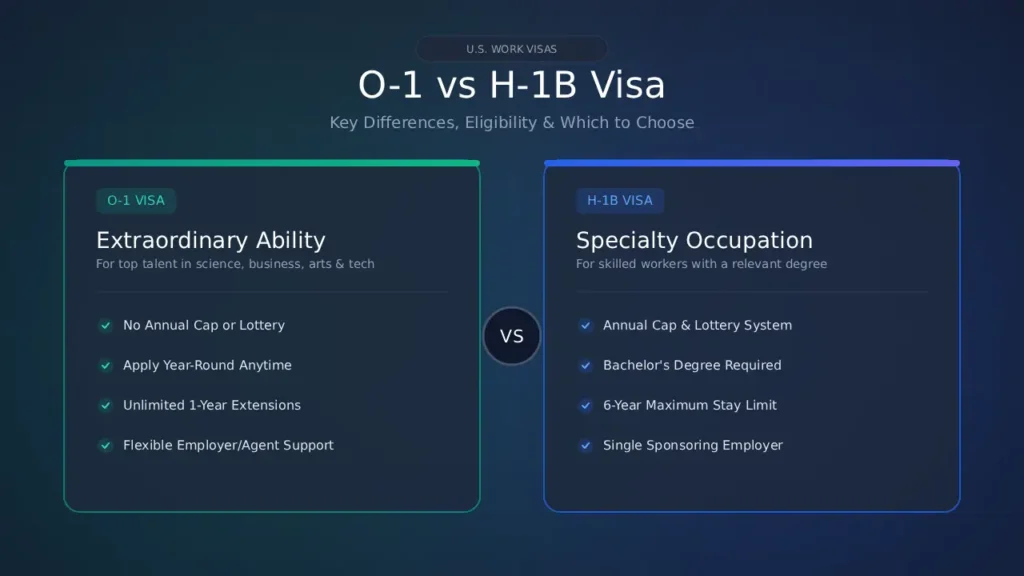
Quick Answer: The O-1 visa is for individuals with extraordinary ability — no lottery, no cap, no fixed start date. The H-1B is for specialty occupation workers — subject to an annual lottery, an 85,000-visa cap, and a strictly defined filing window. If you qualify for both, the O-1 almost always wins on flexibility. If you don’t meet the extraordinary ability bar, the H-1B is the standard path. This guide breaks down every difference that matters: eligibility, costs, timelines, green card options, and how credential evaluations play a role in both.
Choosing between the O-1 vs H-1B visa isn’t just a paperwork decision — it shapes where you work, how long you stay, what you can do if your employer disappears, and how quickly you can pursue permanent residence. Get it wrong and you could spend a year waiting for a lottery result that never comes — or file an O-1 petition without the evidence to back it up.
This guide cuts through the confusion. Whether you’re a skilled professional weighing your first U.S. work visa, a J-1 holder looking for a next step, or an employer trying to figure out which path works for your international hire, here’s exactly what you need to know in 2026.
What Is the O-1 Visa?
The O-1 work visa is a U.S. nonimmigrant visa for individuals who have reached the very top of their field. USCIS defines the standard as demonstrating a level of expertise that places you among “the small percentage who have arisen to the very top of the field of endeavor.” That standard is deliberately high — but it’s more achievable than most people assume.
The O-1 splits into two subcategories:
- O-1A covers extraordinary ability in science, education, business, or athletics.
- O-1B covers extraordinary ability in the arts, or extraordinary achievement in the motion picture or television industry.
Most professionals in STEM, tech, finance, and academia will be evaluating the O-1A work visa. Artists, musicians, performers, and filmmakers fall under O-1B.
There’s also an O-2 visa — that’s the designation for essential support personnel accompanying an O-1 holder, typically used in film productions or performing arts tours. The O-2 doesn’t grant independent work authorization; it’s tied specifically to assisting the O-1 holder.
O-1A Criteria: What USCIS Looks For
Unless you’ve received a single major internationally recognized award (like a Nobel Prize, Olympic medal, or Academy Award), you need to satisfy at least three of eight O-1A criteria:
- Receipt of nationally or internationally recognized prizes or awards for excellence
- Membership in associations that require outstanding achievement
- Published material in professional or major trade publications about you and your work
- Judging the work of others in your field (peer review, grant panels, competition panels)
- Original scientific, scholarly, or business-related contributions of major significance
- Authorship of scholarly articles in professional journals or major media
- Critical or essential role in distinguished organizations
- Evidence of a high salary relative to others in your field
Meeting three is the floor — not the goal. Strong petitions typically demonstrate four or five criteria with detailed, well-documented evidence packages. A USCIS policy memo issued in 2024 explicitly encouraged adjudicators to consider the full record of a STEM applicant’s work in context, not just check individual criteria in isolation. That’s actually good news if your profile is strong but doesn’t tick obvious boxes.
What Is the H-1B Visa?
The H-1B visa is the standard U.S. work visa for specialty occupation professionals — roles that typically require at least a bachelor’s degree in a directly related field. Technology, engineering, finance, accounting, architecture, and many healthcare roles commonly qualify.
The visa is capped at 85,000 per fiscal year (65,000 regular cap + 20,000 reserved for U.S. master’s degree holders), and because demand far exceeds supply, USCIS runs an annual lottery. In 2026, USCIS shifted to a salary-weighted lottery system, meaning petitions with higher salaries receive priority — a significant structural change from the previous random selection process.
Filing is only possible in April, for an October 1 start date. If you’re not selected in the lottery, you have to try again the following year.
For many new H-1B petitions filed for workers outside the U.S., a $100,000 supplemental fee now applies as of September 2025. That fee does not affect candidates already inside the U.S. extending or changing status, and it is subject to ongoing legal proceedings — a federal court struck it down in June 2026, though that decision may be appealed. Either way, this fee added enormous cost uncertainty to employer-sponsored H-1B filings in the past year.
O1 vs H1B: Side-by-Side Comparison
| Factor | O-1 Visa | H-1B Visa |
|---|---|---|
| Who qualifies | Extraordinary ability (top of field) | Specialty occupation (bachelor’s + related field) |
| Annual cap | None | 85,000 per year |
| Lottery required | No | Yes |
| Filing window | Year-round | April only (Oct 1 start) |
| Initial validity | Up to 3 years | 3 years |
| Maximum duration | Unlimited 1-year extensions | 6 years (with exceptions) |
| Employer flexibility | More flexible (agents allowed) | Tied to sponsoring employer |
| Spouse work authorization | O-3 dependents cannot work | H-4 EAD available (if I-140 approved) |
| Self-petition | Possible via U.S. company (founder cases) | Limited |
| Green card alignment | EB-1A (strong overlap) | EB-2, EB-3 (employer-sponsored) |
| Premium processing | Available (~$2,965) | Available (~$2,965) |
| Salary requirements | No federal floor | Prevailing wage required |
Key Differences That Actually Matter
1. The Lottery Problem
This is the defining difference for most people comparing o1 vs h1b in 2026. The H-1B lottery means even a perfectly qualified candidate with an offer from a strong employer has no guarantee of a visa. Lottery selection rates have fluctuated between 20% and 35% in recent years, depending on registration volume.
The O-1 has no lottery. You file, USCIS reviews, and you get an approval or an RFE. That predictability alone makes it the preferred path for candidates who qualify — especially after the lottery closes in April and leaves thousands of professionals with no H-1B options for another year.
2. O-1 Visa Validity and Extensions
The O-1 visa validity is initially up to three years, matching the length of the underlying employment or project. After that, it can be extended in one-year increments with no upper limit, as long as the qualifying work continues. There’s no six-year hard stop.
The H-1B caps at six years total. Once that clock runs out, you either need to have an approved I-140 (green card petition) with a sufficiently early priority date, or you leave the U.S. For nationals of India and China, where green card backlogs run decades long, this creates a real crisis point.
3. Employer Flexibility and the O-1 Sponsor
The O-1 visa sponsor doesn’t have to be a traditional employer. The O-1 can be filed by a U.S. employer, a U.S. agent, or an agent acting on behalf of a foreign employer. This matters if you work on projects, consult for multiple clients, or are a founder.
Speaking of founders: under USCIS guidance updated in January 2025, a U.S. company owned by the beneficiary can file an O-1 petition for the founder — provided there’s a legitimate employer-employee relationship, typically demonstrated through a board of directors or similar oversight structure. This opened a real pathway for startup founders who don’t have a traditional employer sponsor.
The H-1B, by contrast, ties you to a specific employer. If that employer goes under or lays you off, you have a 60-day grace period to find a new sponsor, file a change of status, or leave the U.S. In a volatile tech job market, that exposure is real.
4. O-1 Visa Benefits: The Green Card Connection
One of the most underappreciated o1 visa benefits is its direct alignment with the EB-1A green card — the fastest employment-based permanent residence category, with no employer sponsor required and typically no backlog for most nationalities.
The evidentiary criteria for the O-1A and the EB-1A are nearly identical. Many immigration attorneys use the O-1A petition as a deliberate bridge: build the evidence record now, get the O-1 approved, then file the EB-1A self-petition using the same documentation base. It’s one of the cleanest pathways to a green card for extraordinary ability professionals.
The H-1B doesn’t offer that direct alignment. H-1B holders typically pursue EB-2 or EB-3 green cards, both of which require employer sponsorship and face multi-year — sometimes multi-decade — backlogs for Indian and Chinese nationals.
5. No O-1 Visa Salary Requirements
There is no federal salary floor for the O-1 visa. You can be paid whatever your employer or the market supports. The only salary-related criterion in the O-1A is the optional eighth criterion — evidence of a high salary compared to others in your field — which can strengthen but isn’t required for approval.
The H-1B requires employers to pay the prevailing wage for the occupation and location, determined by the Department of Labor. This creates additional administrative burden and cost for employers, and ties visa status to the wage level certified in the Labor Condition Application.
J-1 to O-1 Visa: A Common Transition
Many international professionals arrive in the U.S. on J-1 exchange visitor visas — as researchers, scholars, au pairs, or trainees — and need a path to continued work authorization. The J-1 to O-1 visa transition is a popular route, particularly because:
- The O-1 does not require a two-year home residency fulfillment (unlike an H-1B if your J-1 program was subject to that requirement)
- The O-1 can be filed year-round, so there’s no waiting for an April filing window
- Researchers and academics who’ve spent a few years building a publication record and peer-review history may already meet three or more O-1A criteria
If your J-1 visa to O-1 visa transition is on the table, the first step is an honest assessment of whether your credentials meet the extraordinary ability threshold. That assessment includes reviewing your publication record, awards, advisory roles, and any media coverage. AAE Evaluations provides expert opinion letters specifically for O-1 visa petitions that map your achievements to USCIS regulatory criteria — which is the document that makes or breaks an O-1 petition.
How to Apply for the O-1 Visa
The O-1 petition (also written as O 1 petition) is filed by the U.S. petitioner — your employer, agent, or U.S.-based company — using Form I-129, Petition for Nonimmigrant Worker.
Here’s the full how to apply for O visa process:
- Find a U.S. petitioner. This can be a U.S. employer, a U.S. agent, or an agent acting on behalf of a foreign employer. You cannot file the O-1 petition yourself as an individual.
- Build the evidence package. Gather documentation for each O-1A criterion you’re claiming — award certificates, media articles, employment letters confirming critical roles, peer review invitations, salary comparisons, and publication records.
- Obtain a consultation letter. The O-1 requires a written advisory opinion from a peer group, union, or management organization in your field. For many STEM professionals, this comes from a recognized professional association or an immigration-focused expert opinion provider.
- Prepare the expert opinion letter. This is the analytical document that connects your achievements to the USCIS criteria. It’s written by a credentialed expert in your field, not by your attorney. AAE Evaluations’ O-1 expert opinion letters are drafted by Ph.D.-level experts with field-specific authority.
- File Form I-129 with USCIS. Petitions can be filed up to one year before the intended start date but should reach USCIS at least 45 days before employment begins. As of August 2026, USCIS may deny petitions without issuing an RFE if required initial evidence is missing — so file complete.
- Choose standard or premium processing. Standard processing takes 2–4 months. Premium processing guarantees a USCIS response within 15 business days for an additional $2,965 (as of March 2026). Most petitioners choose premium.
- Apply for visa issuance at a U.S. consulate (if outside the U.S.). USCIS petition approval and consular visa issuance are separate steps.
Filing the O-1 complete and correct the first time matters more than ever. USCIS’s August 2026 guidance allows denials without an opportunity to supplement missing evidence. Contact AAE Evaluations to ensure your credential evaluation and expert opinion letter are ready before your attorney files.
H-1B Extension and Premium Processing
If you’re currently on an H-1B and approaching your extension, premium processing for H-1B extension is available and strongly recommended in 2026 given increased USCIS workloads. Premium processing guarantees a response within 15 business days, compared to standard processing times that can run 3–6+ months depending on the service center.
H-1B extension premium processing time has remained consistent at 15 business days from the date USCIS receives the premium processing request. For extensions where cap-exemption applies (university employees, nonprofit research organizations), the visa can be extended beyond the six-year maximum.
If your H-1B extension is denied or you receive an RFE challenging the specialty occupation determination, an H-1B expert opinion letter from AAE Evaluations — written specifically around the adjudicator’s concerns — is typically the most effective response document.
The Role of Credential Evaluations in O-1 and H-1B Cases
Whether you’re filing for an O-1 visa america application or an H-1B petition, your foreign academic credentials don’t automatically translate for USCIS. A credential evaluation is the document that establishes how your international degree, diploma, or professional training compares to U.S. educational standards.
For H-1B petitions: USCIS requires credential evaluation when the beneficiary’s highest degree was earned outside the U.S. — to confirm it’s equivalent to a U.S. bachelor’s degree in the specialty field. Without it, expect an RFE.
For O-1 petitions: A credential evaluation supports the overall evidence package and helps establish the baseline of the beneficiary’s educational foundation. Combined with an expert opinion letter that maps achievements to O-1A criteria, it creates a coherent and complete petition package.
AAE Evaluations provides USCIS-compliant credential evaluations with standard 2–5 business day turnaround and rush options available — alongside expert opinion letters for O-1, H-1B, EB-1, and EB-2 NIW petitions. Ordering both from a single provider means consistent language and framing across documents, which matters when a USCIS adjudicator reads them side by side.
Learn more about credential evaluation for H-1B visa applications and O-1 expert and advisory letters on the AAE Evaluations website.
Who Should Choose the O-1 vs H-1B?
Choose the O-1 if:
- You meet three or more of the O-1A criteria and have documentation to back them up
- The H-1B lottery has already closed or you weren’t selected
- You want flexibility to work across multiple employers, projects, or clients
- You’re a founder or self-employed professional who needs to sponsor your own petition
- You’re transitioning from a J-1 and the two-year home residency requirement applies to H-1B but not O-1
- You’re planning for an EB-1A green card and want to build the evidence record now
- You’re a researcher, scientist, academic, or engineer with publications, peer review activity, or notable contributions
Choose the H-1B if:
- Your credentials and role clearly meet specialty occupation requirements
- You don’t yet have the achievement record to qualify for extraordinary ability
- Your spouse wants work authorization via H-4 EAD (O-3 dependents cannot work)
- Your employer’s legal team is more experienced with H-1B filings
- You’re willing to accept lottery risk in exchange for a lower evidentiary burden
Consider Both if:
- You’re currently employed on an H-1B but have been building achievements that might now qualify for the O-1 — especially if you’re approaching the six-year limit
- You received an H-1B lottery rejection and are evaluating alternative pathways for the current year
Common Mistakes to Avoid
On the O-1:
- Filing without meeting at least three criteria with strong documentation. Meeting the number is the floor; the quality of evidence is what drives approval.
- Confusing seniority with extraordinary ability. Years of experience at a respected company is not the same as being among the top in your field.
- Skimping on the expert opinion letter. The consultation requirement exists because USCIS relies on field experts to contextualize achievements. A generic letter from a professional acquaintance won’t hold up.
- Filing without premium processing when timelines matter. Given the August 2026 guidance allowing denials without RFE, you want a fast, complete response — not months of uncertainty.
On the H-1B:
- Missing the April registration window. If you miss it, you wait a full year.
- Submitting without a credential evaluation for foreign-educated beneficiaries. It’s the single most common cause of RFEs in H-1B cases.
- Assuming lottery selection is guaranteed with multiple petitions. USCIS has cracked down on related-entity multiple registrations.
- Waiting too long before starting the green card process. With six-year limits and long EB-2/EB-3 backlogs for many nationalities, the clock matters.
Frequently Asked Questions
What is the main difference between the O-1 and H-1B visa?
The O-1 is for individuals with extraordinary ability — no lottery, no cap, no fixed filing window. The H-1B is for specialty occupation workers and is subject to an annual 85,000-visa cap, a salary-weighted lottery, and April-only filing. The O-1 requires a higher evidentiary standard but offers more flexibility and no annual limits.
Can I switch from H-1B to O-1?
Yes. If you’ve built an extraordinary ability record while on H-1B status — publications, awards, critical roles, peer review — you can file for a change of status to O-1 at any time. Many professionals do this as they approach H-1B limits or when the H-1B lottery threatens their future status.
Is there a salary requirement for the O-1 visa?
There is no federal salary floor for the O-1. The H-1B requires payment of the prevailing wage as certified in the Labor Condition Application. The O-1A criteria include an optional salary criterion (evidence of high salary compared to peers), but it’s one of eight criteria and not required.
How long does the O-1 visa last?
The O-1 is initially granted for up to three years, matching the duration of the qualifying employment or project. It can then be extended in one-year increments without any upper limit, as long as the qualifying work continues. This is one of the major advantages over the H-1B’s six-year maximum.
Can I apply for an O-1 without an employer sponsor?
You cannot file the O-1 petition yourself as an individual, but you don’t need a traditional employer. A U.S. agent can file on your behalf, or — under USCIS guidance updated in 2025 — a U.S. company that you own can file the petition for you as a founder, provided a legitimate employer-employee relationship can be demonstrated.
What is the O-2 visa?
The O-2 visa is for essential support personnel accompanying an O-1 visa holder — typically used in performing arts, film productions, or athletic events. An O-2 holder cannot work independently; the authorization is tied specifically to assisting the O-1 holder. The O-3 visa covers dependents (spouses and children) of O-1 and O-2 holders, but O-3 holders are not authorized to work.
What credential documents do I need for an O-1 petition?
A credential evaluation establishing your academic background, combined with an expert opinion letter that maps your achievements to O-1A regulatory criteria. The expert opinion letter is particularly critical — it’s the analytical document that makes the case to USCIS for extraordinary ability. AAE Evaluations provides both.
How long does O-1 premium processing take?
Premium processing guarantees a USCIS response within 15 business days from the date USCIS receives the premium processing request. As of March 2026, the premium processing fee is $2,965.
Can I go from J-1 to O-1 visa?
Yes, and it’s a common transition. The J-1 to O-1 pathway is attractive because the O-1 doesn’t trigger the two-year home residency requirement that would block an H-1B for certain J-1 exchange programs. Researchers, scholars, and academics who’ve built peer-review records, publication histories, and critical roles during their J-1 tenure are often well-positioned for O-1A.
What is the ob1 visa?
“OB-1” or “ob1 visa” is not an official USCIS visa classification — it’s a common misspelling of O-1B, the subcategory for extraordinary ability in the arts or extraordinary achievement in the motion picture or television industry.
The Bottom Line on O-1 vs H-1B
The o1 vs h1b decision comes down to one core question: do you have the achievement record to make an extraordinary ability case?
If you do — or you’re close — the O-1 is the better visa in almost every dimension. No lottery risk. No six-year clock. No rigid April filing window. No employer lock-in. And a direct evidence overlap with the EB-1A green card category that can meaningfully accelerate your path to permanent residence.
If your profile is strong in your field but doesn’t yet reach the extraordinary ability threshold, the H-1B remains the standard path for specialty occupation professionals — with its own strategic considerations around the lottery, timing, and the green card process.
Either way, the documentation you submit to USCIS defines how adjudicators see your case. A credential evaluation that clearly establishes your academic background, paired with an expert opinion letter that maps your achievements to the specific legal criteria, is the foundation of any successful petition.
Need the right credential documents for your O-1 or H-1B petition? AAE Evaluations provides USCIS-compliant credential evaluations and expert opinion letters for O-1, H-1B, EB-1, EB-2 NIW, and L-1 cases — delivered in 2–5 business days, with rush options available. Start with a free consultation or view pricing.
This article is for informational purposes only and does not constitute legal advice. Immigration law is complex and fact-specific. Consult a qualified immigration attorney before making decisions about your visa category.