Not everyone who makes an important contribution to their profession publishes academic research papers. Some professionals spend years developing new technologies, managing engineering projects, improving healthcare systems, building businesses, solving cybersecurity challenges, or creating solutions that have a meaningful impact on their industries.
Yet when these professionals start researching the EB-2 National Interest Waiver (NIW), they often encounter the same concern:
Can I qualify for EB-2 NIW without research publications or citations?
The answer is yes. Academic publications are not a mandatory requirement for an EB-2 NIW petition. However, applicants must still demonstrate that they meet the underlying EB-2 eligibility requirements and satisfy all three requirements of the National Interest Waiver framework.
This distinction is particularly important for experienced industry professionals whose achievements are reflected in projects, products, business results, technical innovations, and leadership responsibilities rather than academic journals.
For example, a software engineer who has developed security systems used by multiple organizations may have a different professional profile from a university researcher with several published papers. Both may have meaningful contributions to present, but their evidence needs to tell different stories.
At AAE Evaluations, we work with professionals and immigration attorneys who need independent expert analysis of academic and industry achievements. We understand that a person’s professional value cannot always be measured by publication counts or citation records.
In this guide, we explain what evidence applicants without publications can use, how to demonstrate professional contributions, what USCIS looks for, and how an independent expert opinion letter may help explain specialized achievements.
Can You Apply for EB-2 NIW Without Research Publications?
Yes. You can apply for an EB-2 NIW without having published academic papers.
There is no general USCIS requirement stating that every NIW applicant must have a certain number of publications, citations, or research papers.
Publications can help establish professional expertise and demonstrate the significance of research. However, they are only one possible form of supporting evidence.
Consider two hypothetical applicants.
Applicant 1: Academic researcher
- Holds a Ph.D. in biomedical engineering.
- Has published several peer-reviewed research papers.
- Has received citations from other researchers.
- Has participated in university research projects.
Applicant 2: Experienced industry professional
- Holds a master’s degree in computer science.
- Has developed enterprise software systems.
- Has led cybersecurity implementation projects.
- Has documented improvements in system performance and security.
- Has managed technical teams and delivered projects for major organizations.
The second applicant does not need to turn their professional experience into artificial academic achievements. Instead, the petition should explain what they accomplished, how they contributed, and why their experience is relevant to their proposed work in the United States.
This is an important point: the absence of publications is not automatically a weakness, but the absence of convincing evidence can be.
At AAE Evaluations, we encourage applicants to start with their actual professional achievements rather than assuming that every strong NIW petition must resemble an academic researcher’s application.
First, Understand the Two Parts of EB-2 NIW Eligibility
Before looking at alternative evidence, it helps to understand how an EB-2 NIW petition is evaluated.
There are two separate questions:
- Does the applicant qualify for the underlying EB-2 immigrant classification?
- Does the applicant qualify for the National Interest Waiver?
These requirements should not be confused.
1. Qualifying for the EB-2 Classification
Applicants generally qualify through an advanced degree or exceptional ability.
Advanced-degree professionals
You may qualify through:
- A U.S. advanced degree or a foreign equivalent degree above a bachelor’s degree.
- A U.S. bachelor’s degree or foreign equivalent followed by at least five years of progressive post-baccalaureate experience in the specialty.
For the second route, the experience must be progressive and related to the specialty. Simply having five years of unrelated employment does not automatically satisfy this requirement.
If you earned your degree outside the United States, an appropriate academic credential evaluation may help explain how your educational qualifications compare with U.S. standards.
Individuals with exceptional ability
Applicants who do not qualify through the advanced-degree route may seek EB-2 classification based on exceptional ability in the sciences, arts, or business.
The applicable regulations identify six categories of initial evidence:
- An official academic record related to the area of exceptional ability.
- Letters documenting at least ten years of full-time experience in the occupation.
- A license to practice the profession or certification for the particular profession or occupation, where applicable.
- Evidence of a salary or other remuneration demonstrating exceptional ability.
- Membership in professional associations.
- Recognition for achievements and significant contributions to the industry or field by peers, government entities, or professional or business organizations.
Generally, applicants must satisfy at least three of these six evidentiary categories, unless they can provide comparable evidence where the regulatory requirements permit it.
Meeting three categories does not automatically establish exceptional ability. USCIS also evaluates the evidence as a whole.
Notice that academic publications are not a separate mandatory category in this list.
2. Meeting the Three EB-2 NIW Requirements
After establishing eligibility for EB-2 classification, applicants must satisfy the three-part framework established in Matter of Dhanasar.
First requirement: The proposed endeavor must have substantial merit and national importance.
Applicants need to explain what they intend to accomplish in the United States and why that particular work matters.
Second requirement: The applicant must be well positioned to advance the proposed endeavor.
This is where professional achievements, specialized knowledge, previous projects, education, experience, and available resources become particularly relevant.
Third requirement: On balance, it must benefit the United States to waive the job offer and labor certification requirements.
Applicants must explain why granting the waiver would benefit the United States when the relevant circumstances are considered.
These requirements apply whether an applicant has 50 publications or none.
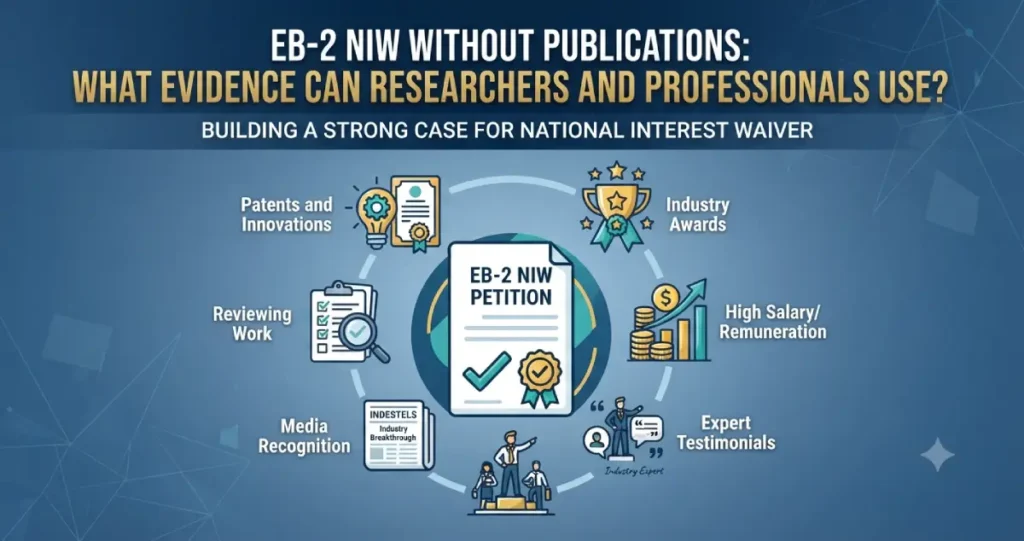
10 Types of Evidence You Can Use for EB-2 NIW Without Publications
If you have not published academic papers, do not immediately assume that your professional background lacks sufficient evidence.
Start by reviewing what you have actually accomplished.
Many professionals have spent years working on projects, developing systems, managing organizations, implementing improvements, or solving problems that can be documented.
Here are ten evidence categories worth considering.
1. Professional Experience and Employment Achievements
Your employment history can help demonstrate your professional expertise, but a résumé alone rarely tells the complete story.
USCIS needs to understand more than your job title and the number of years you have worked.
What responsibilities did you hold? What projects did you complete? What problems did you solve? Did your work produce measurable results?
Potential supporting documents include:
- Employment verification letters.
- Detailed job descriptions.
- Promotion records.
- Performance evaluations.
- Project assignment documents.
- Technical responsibility records.
- Management and leadership documentation.
- Evidence of specialized professional responsibilities.
For example, consider a senior software engineer who has worked in cybersecurity for twelve years.
Instead of simply documenting twelve years of employment, the applicant could explain their involvement in developing security systems, implementing technical safeguards, identifying vulnerabilities, and managing enterprise-level security projects.
Supporting documents could establish the applicant’s responsibilities, technical contribution, and results.
What matters is the substance of your experience, not simply the length of your résumé.
2. Successful Projects and Measurable Results
This is an important evidence category for industry professionals.
Many people have contributed to projects that produced measurable improvements without ever publishing research.
Examples include:
| Professional background | Potential supporting evidence |
|---|---|
| Software engineer | Software development, system deployment, technical improvements |
| Civil engineer | Infrastructure projects, engineering designs, safety improvements |
| Cybersecurity specialist | Security implementation, vulnerability reduction, compliance projects |
| Healthcare professional | Clinical improvement projects, healthcare delivery initiatives |
| Business manager | Operational improvements, revenue growth, organizational development |
| Manufacturing engineer | Production efficiency, quality improvements, process development |
| AI professional | Deployed AI systems, technical implementation, model development |
| Supply chain specialist | Logistics optimization, reduced delays, operational improvements |
Imagine a manufacturing engineer who introduced a new production process that reduced equipment downtime.
The applicant could provide project reports, implementation records, operational data, and documentation from the organization confirming their contribution.
This is much more informative than simply stating that the applicant worked as a manufacturing engineer.
Where possible, use measurable results and explain how those results were achieved. Avoid presenting estimated improvements as verified outcomes.
3. Patents, Innovations, and Intellectual Property
Not all professional innovation happens inside universities.
Engineers, developers, technology specialists, and entrepreneurs often contribute to innovations that are protected through patents or other intellectual property arrangements.
Potential evidence includes:
- Granted patents.
- Patent applications.
- Software development records.
- Product specifications.
- Intellectual property documentation.
- Licensing agreements.
- Technical innovation records.
- Product development documentation.
For example, an engineer who helped develop an advanced monitoring system could document their role through patent records, technical specifications, development reports, and implementation agreements.
However, simply owning a patent does not establish NIW eligibility.
The applicant should explain their personal contribution, the practical significance of the innovation, and its relevance to the proposed endeavor.
If the patent was developed by a team, clearly distinguish your own contribution from that of other inventors.
4. Evidence That Organizations Use Your Work
One of the strongest ways to explain professional contributions is to show that other people or organizations have used, implemented, or benefited from your work.
This is particularly relevant for applicants who develop products, technical systems, business solutions, or specialized services.
Potential supporting documents include:
- Commercial agreements.
- Product licensing records.
- Client contracts.
- Implementation documents.
- Customer acceptance records.
- Technology adoption records.
- Letters confirming actual use.
- Product deployment documentation.
For example, a data scientist may have developed an analytical platform that is now used by several organizations.
Rather than relying only on a description of the platform, the applicant could provide implementation agreements, product documentation, customer confirmation, and records identifying their role in its development.
This helps demonstrate that the applicant’s work has moved beyond an idea or proposal.
The important distinction is that the documentation should establish the applicant’s own contribution, not merely the reputation of the company that purchased or used the product.
5. Professional Licenses and Industry Certifications
Professional licenses and specialized certifications can help establish expertise in a particular field.
Examples include:
- Professional Engineer licenses.
- Relevant healthcare licenses.
- Project management certifications.
- Cybersecurity qualifications.
- Cloud architecture certifications.
- Engineering credentials.
- Specialized industry certifications.
However, not all certifications have the same value.
A professional license that is required to practice a regulated occupation is different from a general online course completion certificate.
The relevance of a qualification depends on its recognition, professional standards, and relationship to the applicant’s proposed endeavor.
For example, a cybersecurity professional proposing to develop security solutions for healthcare infrastructure may use relevant cybersecurity credentials alongside documented technical experience and implementation results.
The strongest evidence explains how the qualification supports the work the applicant intends to pursue.
6. Awards and Professional Recognition
Have you received an industry award, been recognized for a technical contribution, or been selected for a professional distinction?
Such achievements may help demonstrate your professional standing.
Potential evidence includes:
- Industry awards.
- Innovation awards.
- Competitive grants.
- Recognition from professional organizations.
- Government or institutional recognition.
- Technical leadership awards.
- Invitations to specialized committees.
- Recognition for significant industry contributions.
The quality of recognition matters more than the number of certificates.
For example, a competitive national engineering award may carry more evidentiary significance than a general participation certificate.
When presenting an award, explain:
- Who issued it?
- Why was it awarded?
- What were the selection criteria?
- How competitive was the process?
- What specific achievement was recognized?
- How does it relate to your proposed endeavor?
Include supporting documentation whenever available.
7. Leadership and Responsibility for Important Projects
Senior professionals often make substantial contributions through leadership, management, and technical decision-making.
This experience may be particularly relevant for:
- Engineering managers.
- Technology directors.
- Healthcare administrators.
- Business executives.
- Research and development managers.
- Infrastructure project leaders.
- Manufacturing managers.
Potential supporting documents include organizational charts, project appointments, management records, technical approval documents, and employer letters explaining the applicant’s responsibilities.
Consider a technology director who led the implementation of cybersecurity infrastructure across multiple business units.
A useful evidence package could explain the project’s scope, the applicant’s responsibilities, the technical decisions involved, and the results achieved.
However, having a senior job title is not enough.
The petition should establish what the applicant personally contributed and how that experience prepares them to advance their proposed endeavor.
8. Business Achievements, Contracts, and Entrepreneurial Experience
Entrepreneurs and business professionals often have evidence that looks very different from traditional academic research.
They may have developed businesses, introduced new services, created products, secured commercial partnerships, or improved existing operations.
Potential evidence includes:
- Business registration and ownership records.
- Investment agreements.
- Commercial contracts.
- Revenue documentation.
- Customer agreements.
- Product development records.
- Partnership agreements.
- Job creation records.
- Letters of intent.
- Business expansion documentation.
For example, an entrepreneur developing a healthcare technology platform could document product development, customer adoption, investment, partnerships, and plans for expansion in the United States.
A business plan can help explain the proposed endeavor, but unsupported financial projections or general promises of job creation are not enough by themselves.
The business plan should be specific, realistic, and supported by relevant evidence.
AAE Evaluations also provides EB-2 NIW business plan preparation services for applicants whose proposed endeavors involve establishing or expanding a business.
9. Recommendation Letters and Independent Professional Opinions
Letters from people who know your work can help explain achievements that may otherwise be difficult for a general reader to understand.
These may include letters from:
- Senior engineers.
- Industry executives.
- Research supervisors.
- Technical collaborators.
- Healthcare administrators.
- Professional organization representatives.
- Clients and business partners.
However, not every recommendation letter is equally persuasive.
A generic statement such as “This applicant is an outstanding professional” does not explain much.
A more useful letter identifies the writer’s qualifications, explains how they know the applicant’s work, discusses specific achievements, and describes why those achievements matter.
Where possible, statements should be supported by independent documents.
For applicants who need professional supporting letters, AAE Evaluations offers EB-2 NIW recommendation letter services.
10. A Clear and Realistic Plan for Your Proposed U.S. Endeavor
Your proposed endeavor deserves particular attention.
It should explain what you intend to accomplish in the United States, rather than simply describe your occupation.
Consider the difference:
General description:
“I plan to continue working as a software engineer in the United States.”
More specific description:
“I plan to develop and implement cybersecurity monitoring solutions that help healthcare organizations identify vulnerabilities, improve data protection, and strengthen the security of their digital infrastructure.”
The second description gives a clearer understanding of the applicant’s intended work.
Depending on the case, supporting evidence may include:
- A detailed professional plan.
- Project milestones.
- Technical development objectives.
- Letters of interest.
- Partnership discussions.
- Available resources.
- Funding arrangements.
- Existing progress toward the endeavor.
- Relevant industry documentation.
The proposed endeavor must be credible and consistent with the applicant’s actual background.
For additional guidance, explore AAE Evaluations’ EB-2 NIW proposed endeavor examples.
How to Organize Your Evidence Without Academic Publications
Having ten different types of documents does not automatically make a petition strong.
The real challenge is explaining what each document proves and how the evidence fits together.
A practical approach is to organize your documentation around your proposed endeavor and the three Dhanasar requirements.
Step 1: Start With Your Actual Professional Achievements
Before preparing additional letters or evaluations, review your career history.
Identify the projects, responsibilities, innovations, and achievements that best demonstrate your professional expertise.
Ask yourself:
- Which projects have had the greatest impact?
- What problems have I solved?
- What did I personally contribute?
- Can I demonstrate the results?
- Has another organization used my work?
- Have I received professional recognition?
- What experience directly relates to my proposed U.S. endeavor?
Do not focus exclusively on impressive job titles. Specific achievements are often more informative.
Step 2: Connect Your Previous Work to Your Proposed Endeavor
Your professional history should support the work you intend to pursue.
For example, a civil engineer with experience in transportation infrastructure may propose developing more resilient transportation systems.
The petition should explain how the applicant’s previous engineering projects, technical knowledge, and professional experience prepare them for that work.
A clear connection makes the proposed endeavor more credible.
Step 3: Organize Evidence Around the Three Prongs
The following table can help applicants understand how different documents may contribute to their petition.
| Requirement | Main question | Possible evidence |
|---|---|---|
| Prong 1 | Why is the proposed endeavor important? | Government and industry reports, project documentation, evidence of broader impact |
| Prong 2 | Why is this applicant capable of advancing it? | Education, experience, patents, achievements, contracts, expert letters |
| Prong 3 | Why would waiving the job offer and labor certification benefit the United States? | Case-specific explanation of the applicant’s work, circumstances and potential contributions |
A document may be relevant to more than one prong. Its significance should be explained in the context of each requirement.
Step 4: Support Important Claims With Verifiable Documents
Avoid relying entirely on personal statements.
For example:
- Use project reports to document technical contributions.
- Use contracts to establish commercial relationships.
- Use patent records to document intellectual property.
- Use employment letters to confirm professional responsibilities.
- Use implementation records to establish practical use.
- Use independent assessments to explain specialized achievements.
The goal is to make your claims understandable and verifiable.
Step 5: Make Sure Your Documents Tell a Consistent Story
Your résumé, employment letters, proposed endeavor statement, business plan, recommendation letters, and expert opinion letter should present a consistent account of your professional history.
Pay attention to dates, project responsibilities, individual contributions, and the work you intend to pursue.
Inconsistencies can create unnecessary questions and make an otherwise credible petition harder to evaluate.
At AAE Evaluations, we recommend reviewing the available documentation before commissioning an expert opinion letter. This allows the expert to assess the relevant evidence rather than prepare a document based on a brief résumé alone.
How an Independent Expert Opinion Letter Can Help Applicants Without Publications
For some applicants, the challenge is not a lack of professional achievements. It is explaining those achievements in a way that someone outside their industry can understand.
Consider a senior cybersecurity engineer who has:
- Twelve years of professional experience.
- Experience implementing enterprise security systems.
- Technical leadership responsibilities.
- Documented work protecting sensitive information.
- No academic publications.
An independent cybersecurity expert with relevant qualifications may be able to review the applicant’s work and explain the technical significance of specific contributions.
For example, the expert may discuss the complexity of the systems developed, the applicant’s role in implementation, and the relationship between previous achievements and the proposed endeavor.
This is where an expert opinion letter may add value.
What Makes an Expert Opinion Letter Useful?
A professional expert opinion letter should be based on an actual review of the applicant’s background and supporting evidence.
Depending on the case, it may address:
Expert qualifications
The expert’s education, professional experience, relevant specialization, and ability to evaluate the applicant’s work.
Applicant’s professional background
An explanation of the applicant’s education, experience, and relevant professional accomplishments.
Specific contributions
An assessment of technical projects, innovations, leadership responsibilities, and documented outcomes.
Proposed endeavor
An explanation of the applicant’s intended work and its relationship to their professional experience.
Relevant NIW considerations
An evidence-based professional assessment of issues relevant to the Dhanasar framework, within the expert’s area of competence.
Supporting documentation
Relevant project records, technical materials, professional achievements, and other documents considered during the evaluation.
An expert opinion letter should not simply repeat a résumé or make unsupported statements about an applicant’s importance.
Its value comes from the expert’s qualifications, independence, methodology, and reasoning.
How AAE Evaluations Helps Professionals From Different Backgrounds
At AAE Evaluations, we recognize that applicants have different professional histories and different types of achievements.
An academic researcher may need an assessment of research contributions and specialized expertise. An experienced engineer may need an evaluation of technical projects, innovations, and industry accomplishments. An entrepreneur may need an expert to examine the professional significance of their business-related work.
Our EB-2 NIW expert opinion letter service is designed around the applicant’s individual background and documentation.
Our process generally involves:
- Reviewing the applicant’s CV and relevant supporting materials.
- Understanding their professional background and proposed endeavor.
- Identifying an appropriately qualified expert.
- Reviewing relevant achievements and documentation.
- Preparing a customized professional assessment.
- Having the expert review and approve the final document.
We work with professionals in technology, engineering, healthcare, business, research, and other specialized fields.
An expert opinion letter is not required in every NIW case, and whether one is useful depends on the individual evidence and the applicant’s overall legal strategy. Applicants should discuss their documentation needs with their immigration attorney.
Learn more about AAE Evaluations and our services.
Evidence Examples for Professionals Without Publications
To make these concepts easier to understand, consider how different professionals might document their achievements.
The following examples are hypothetical and are intended only to illustrate possible evidence strategies.
Software Engineers and AI Professionals
A software engineer may not have research papers, but they may have developed software products, implemented AI systems, designed technical infrastructure, or contributed to cybersecurity solutions.
Potential evidence includes:
- Software architecture documentation.
- Product development records.
- Deployment and implementation reports.
- Open-source project contributions.
- Patent documentation.
- Technical leadership records.
- Evidence of adoption by other organizations.
- Documented improvements in system performance.
The petition should identify the applicant’s individual contribution rather than relying solely on the reputation of the employer or product.
Healthcare Professionals
Healthcare professionals may have contributed through clinical improvement projects, healthcare technology, medical administration, or public health initiatives.
Potential evidence includes:
- Clinical quality improvement documentation.
- Healthcare program records.
- Hospital project documentation.
- Medical technology implementation.
- Healthcare leadership records.
- Evidence of improvements in service delivery.
- Relevant professional licenses and qualifications.
Patient information should always be handled with appropriate privacy protections.
Civil and Mechanical Engineers
Engineering professionals may have worked on infrastructure, transportation, industrial development, manufacturing, or technical innovation.
Potential evidence includes:
- Engineering designs.
- Project approvals.
- Technical reports.
- Safety improvement records.
- Infrastructure project documentation.
- Patents and innovations.
- Project management records.
- Evidence of successful implementation.
The applicant should explain their specific responsibilities and how their engineering experience relates to the proposed endeavor.
Business Professionals and Entrepreneurs
Entrepreneurs may have built businesses, introduced products, created commercial partnerships, or developed innovative services.
Potential evidence includes:
- Business ownership records.
- Investment agreements.
- Commercial contracts.
- Customer adoption.
- Revenue documentation.
- Business expansion plans.
- Job creation records.
- Product development.
- Partnership agreements.
The focus should remain on the applicant’s individual achievements and the specific work they plan to pursue.
Common Mistakes to Avoid When Applying for EB-2 NIW Without Publications
Not having academic publications is not necessarily the biggest issue in an NIW petition.
In many cases, the more important problem is failing to explain professional achievements properly.
Here are some mistakes applicants should avoid.
Mistake 1: Assuming Years of Experience Are Enough
Ten or fifteen years of employment does not automatically establish NIW eligibility.
Applicants should explain what they accomplished during that time and how their experience prepares them to advance the proposed endeavor.
Mistake 2: Submitting Generic Recommendation Letters
A collection of letters containing similar praise may not provide meaningful evidence.
Each letter should have a clear purpose, identify specific contributions, and explain the writer’s basis for evaluating the applicant.
Mistake 3: Treating an Important Industry as Proof of National Importance
Working in artificial intelligence, healthcare, engineering, or cybersecurity does not automatically establish that an applicant’s proposed endeavor has national importance.
The specific work and its potential prospective impact must be explained.
Mistake 4: Depending Entirely on a Business Plan
A business plan can explain future objectives, but it should not be the only evidence supporting the petition.
Relevant professional experience, project progress, market information, available resources, and other supporting documentation may also be important.
Mistake 5: Using an Expert Letter Without Supporting Documentation
An expert opinion should be grounded in actual evidence.
A qualified expert cannot make an unsupported professional achievement credible simply by describing it in impressive language.
Mistake 6: Ignoring the Third Dhanasar Requirement
Applicants sometimes concentrate heavily on their professional achievements and proposed endeavor but overlook the need to explain why waiving the job offer and labor certification requirements would benefit the United States.
All three requirements deserve attention.
If you are concerned about potential weaknesses in your petition, read our guide on common EB-2 NIW USCIS questions.
Frequently Asked Questions About EB-2 NIW Without Publications
1. Can I get EB-2 NIW approval without research publications?
Yes. Academic publications are not a mandatory EB-2 NIW requirement. However, you must qualify for the underlying EB-2 classification and satisfy all three Dhanasar requirements with appropriate supporting evidence.
2. Are citations required for EB-2 NIW?
No. USCIS does not establish a universal minimum citation requirement for EB-2 NIW petitions. Citations may help demonstrate the influence of research, but they are only one possible form of evidence.
3. Can I apply for EB-2 NIW with a master’s degree and no publications?
Yes. A qualifying advanced degree may satisfy the educational requirement for EB-2 classification. You must still demonstrate that your proposed endeavor meets the NIW requirements.
4. Can I qualify for EB-2 NIW with a bachelor’s degree and no publications?
Potentially. A bachelor’s degree followed by at least five years of progressive post-baccalaureate experience in the specialty may satisfy the regulatory advanced-degree equivalency definition.
You must also satisfy the three NIW requirements.
5. Can industry professionals qualify for EB-2 NIW without academic research?
Yes. Industry professionals may use documented projects, technical innovations, patents, professional licenses, business achievements, leadership experience, and evidence that organizations use their work.
The relevance of this evidence depends on the applicant’s individual circumstances.
6. Are patents better than publications for EB-2 NIW?
Neither is automatically better. A patent may be particularly relevant for an inventor or technology professional, while publications may be more relevant for an academic researcher.
USCIS evaluates the evidence in the context of the complete petition.
7. Are recommendation letters enough for EB-2 NIW without publications?
Recommendation letters can be useful, but relying exclusively on letters is generally not a strong evidence strategy. Whenever possible, support important statements with independent documents.
8. Is an independent expert opinion letter mandatory for EB-2 NIW?
No. USCIS does not universally require an independent expert opinion letter. However, it may help explain specialized professional contributions when the case would benefit from independent technical or industry analysis.
9. Can I qualify for EB-2 NIW based only on work experience?
Work experience alone does not automatically satisfy the EB-2 classification requirements.
You must qualify through the advanced-degree or exceptional-ability route and independently establish all three Dhanasar requirements.
10. What if I have no publications, patents, or awards?
You may still have other relevant evidence, such as project achievements, technical contributions, employment records, professional licenses, contracts, business accomplishments, and documented results.
The important question is whether the available evidence establishes your qualifications and supports your proposed endeavor.
11. Does an expert opinion letter guarantee EB-2 NIW approval?
No. An expert opinion letter is supporting documentation, not an approval guarantee. USCIS independently evaluates the complete petition.
12. Can AAE Evaluations help professionals who do not have academic publications?
Yes. AAE Evaluations works with applicants from academic and industry backgrounds. Our experts assess relevant professional documentation and prepare customized expert opinion letters where appropriate.
You can contact AAE Evaluations to discuss your documentation needs.
Final Thoughts: Your Professional Achievements Matter Beyond Publications
A lack of academic publications does not automatically prevent you from pursuing an EB-2 National Interest Waiver.
Many professionals make meaningful contributions through engineering projects, technology development, healthcare initiatives, business innovation, infrastructure improvements, and industry leadership.
The important thing is to demonstrate those contributions with credible documentation and connect them to a clear proposed endeavor.
Instead of concentrating only on what is missing from your résumé, start by identifying what you have actually accomplished.
Have you developed a product? Improved an important process? Led a technical project? Introduced a new system? Helped an organization solve a significant problem? Received recognition for your professional work?
These achievements may provide useful evidence when properly documented and connected to the applicable NIW requirements.
At AAE Evaluations, we believe every applicant deserves an individualized assessment of their professional background. Academic researchers and experienced industry professionals may have very different achievements, and their supporting documentation should reflect those differences.
If you are preparing an EB-2 NIW petition without academic publications and need an independent assessment of your professional achievements, explore our EB-2 NIW expert opinion letter services.
Let AAE Evaluations help you present your professional contributions through clear, credible, and evidence-based expert documentation.
Contact AAE Evaluations to discuss your requirements.
Disclaimer: This article is intended for general educational purposes only and does not constitute legal advice or an individual assessment of immigration eligibility. AAE Evaluations provides professional evaluation and supporting documentation services, not immigration legal representation. Consult a qualified U.S. immigration attorney regarding your individual circumstances.