Quick Answer: An EB-1 expert opinion letter is a formal, independent document written by a credentialed authority in your field — someone who can evaluate your work and testify, in writing, that your achievements meet the extraordinary ability, outstanding researcher, or multinational executive standards required under U.S. immigration law. These letters are not character references. They are evidentiary documents that help USCIS adjudicators understand technical accomplishments they may not be trained to assess. A strong expert letter can be the difference between an I-140 approval and a costly RFE.
Key Takeaways:
- Expert opinion letters are legally substantive evidence — not formalities — that directly influence EB-1 adjudication outcomes.
- The letter must address specific USCIS criteria under 8 CFR § 204.5, not simply praise the applicant.
- EB-1A, EB-1B, and EB-1C petitions each require letters tailored to their distinct legal standards.
- Independent letters from experts who have no personal relationship with the applicant carry significantly more evidentiary weight.
- The applicant may draft the letter for the expert to review and sign — but only if done transparently and strategically.
If you’re preparing an EB-1 petition, chances are you’ve already heard that expert opinion letters matter. What most guides don’t tell you is why they matter — and more importantly, what separates a letter that strengthens your case from one that USCIS quietly ignores.
This guide covers the entire expert opinion letter process for EB-1 green card petitions: what these letters must say, who should write them, how many you actually need, and the structural elements that make adjudicators take notice. Whether you’re filing for the first time or responding to a Request for Evidence (RFE), what you’ll find here goes deeper than the standard checklists.
For help putting together the full evidentiary package — including EB-1 expert opinion letters written by credentialed professionals — AAE Evaluations has supported over 1,500 immigration cases since 2018.
What Is an EB-1 Expert Opinion Letter?
An EB-1 expert opinion letter is a written declaration from a recognized authority in your professional field — a professor, senior researcher, industry executive, or similarly credentialed figure — that assesses your qualifications against the specific legal criteria that govern EB-1 classification.
The term “opinion” is accurate but potentially misleading. These aren’t subjective endorsements. They are structured, quasi-expert-witness statements that walk USCIS through your career evidence and explain, clearly and technically, why it constitutes extraordinary ability, outstanding research, or multinational executive experience under U.S. immigration law.
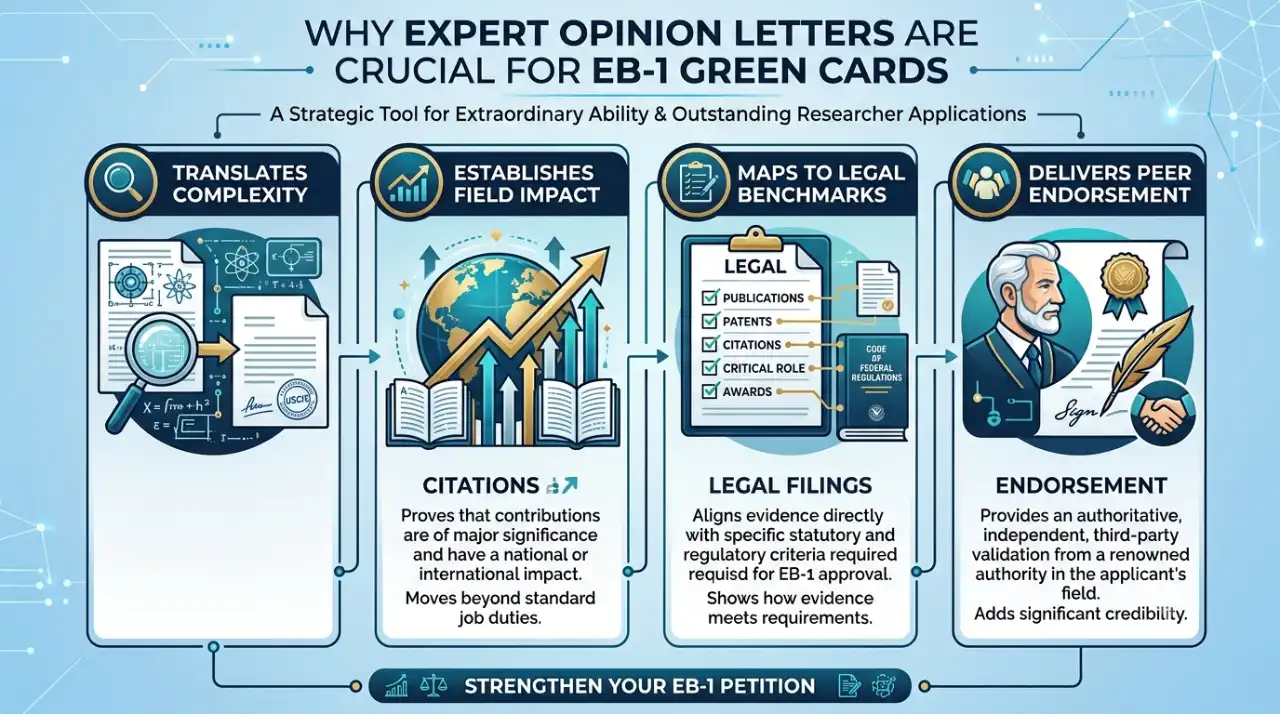
Think of it this way: USCIS adjudicators process thousands of petitions across dozens of fields. The officer reviewing your case may have no background in machine learning, cardiovascular surgery, or architectural design. A well-written expert letter provides the bridge — translating your accomplishments from field-specific language into the legal evidentiary standard the officer must apply.
That bridge is what makes these letters so valuable. And it’s why letters that simply say “Dr. X is an outstanding professional whom I respect” accomplish almost nothing.
A proper EB-1 expert opinion letter must:
- Establish the writer’s credentials and standing in the field
- Explain, specifically, how the writer knows of the petitioner’s work
- Map the petitioner’s achievements to the relevant USCIS criteria
- Use technical and objective language, not superlatives
- Conclude with a clear opinion on whether the petitioner qualifies
Why Are Expert Opinion Letters So Important in EB-1 Cases?
USCIS does not take your word for it. That’s the short answer. But there’s a longer one worth understanding.
The EB-1 classification is one of the most competitive preference categories in U.S. immigration law — and one of the few that doesn’t require a labor certification or, in the case of EB-1A, even a job offer. That flexibility comes with a demanding evidentiary threshold. You must demonstrate that you sit “at the very top of the field of endeavor,” in USCIS’s words, through concrete, documented evidence.
Documentary evidence alone — publications, awards, salary letters, press mentions — establishes facts. Expert letters interpret those facts. They explain why a particular citation count is significant in your subfield, why a specific award carries prestige, why your salary places you in the top tier of your profession. USCIS needs both: the evidence and the expert context.
Without expert letters, even genuinely accomplished applicants risk adjudicators undervaluing their credentials because the significance of those credentials isn’t self-evident outside the field.
And here’s something worth understanding about how USCIS adjudicates these cases: officers perform a two-step analysis — first confirming that you meet at least three of the evidentiary criteria, then performing a “final merits determination” to assess whether your body of evidence, taken as a whole, demonstrates sustained extraordinary achievement. Expert letters are influential at both steps. They help establish the criteria and contextualize the final merits picture.
For EB-1B outstanding researcher petitions, expert letters also serve an additional function: independent letters can partially substitute for or reinforce the required letters from current or former employers. And for EB-1C, letters from executives at comparable organizations can speak to the multinational managerial standards that USCIS expects.
The bottom line: expert letters are not optional paperwork. They are active evidentiary tools that shape how an adjudicator reads everything else in your petition.
EB-1 Categories and the Role of Expert Letters
The EB-1 visa category has three distinct classifications, and the role — and required content — of expert letters differs significantly across them.
EB-1A: Extraordinary Ability
This category covers aliens of extraordinary ability in the sciences, arts, education, business, or athletics. There’s no employer sponsor required, which makes it the most autonomous path to a green card — but also the most demanding. You must show sustained national or international acclaim and recognition in your field at the very top level.
Expert letters for EB-1A are the most complex because they must directly address the USCIS criteria under 8 CFR § 204.5(h)(3). Each letter should map the petitioner’s evidence to specific prongs: peer review, original contributions, critical roles, salary in the upper percentile, and so on. The best EB-1A letters don’t just affirm — they analyze.
Our EB-1A expert opinion letter service is specifically built around this two-step adjudication framework.
EB-1B: Outstanding Professor or Researcher
EB-1B requires a job offer from a university, research institution, or qualifying private employer, and proof of at least three years of experience in the field. The petitioner must be recognized internationally for outstanding achievements in a specific academic field.
Expert letters here carry a particular kind of weight because USCIS expects recognition from the international research community. Independent letters from researchers at other institutions — especially overseas — signal that your reputation extends beyond your employer or institution. Letters from direct supervisors, while acceptable, are given less independent evidentiary weight.
EB-1C: Multinational Manager or Executive
EB-1C is employer-driven: you need a qualifying U.S. employer to file on your behalf, and you must have worked for a related entity abroad in a managerial or executive capacity for at least one year in the past three years.
Expert letters for EB-1C serve a different purpose. They’re typically used to explain the organizational structure of the companies involved, confirm that the role abroad and the role in the U.S. both meet the legal definition of managerial or executive, and provide third-party corroboration of the petitioner’s standing. Our EB-1C expert opinion letter service addresses these unique structural requirements.
Legal Criteria Expert Letters Must Support
To understand what a strong expert letter must say, you first need to understand what USCIS is looking for. For EB-1A, USCIS requires evidence that satisfies at least three of the following ten criteria — plus a final merits determination showing sustained extraordinary achievement:
| Criterion | What It Covers |
|---|---|
| Awards/prizes | Recognition for excellence in the field |
| Membership | Membership in associations requiring outstanding achievement |
| Published material | Media coverage of the petitioner’s work |
| Judging | Service as a judge of others’ work in the field |
| Original contributions | Contributions of major significance to the field |
| Scholarly articles | Authored works in professional publications |
| Critical role | Key roles in distinguished organizations |
| High salary | Remuneration in the upper percentile for the field |
| Artistic exhibitions | Displayed work in prestigious venues |
| Commercial success | Box office or sales performance (arts/athletics) |
For EB-1B, the criteria are narrower but still demanding: evidence of receipt of major prizes, membership in associations requiring outstanding achievement, published material, participation as a reviewer, original scientific contributions, and authorship of scholarly works.
Expert letters should not attempt to cover every criterion in a single letter — that dilutes focus. Assign experts based on which criteria they are best positioned to address. A former collaborator speaks to original contributions. A journal editor speaks to the significance of published work. A department head speaks to a critical role at a distinguished organization.
This is why working with an experienced team like AAE Evaluations — which coordinates expert selection strategically — produces stronger outcomes than simply asking colleagues for generic letters.
Who Should Write an EB-1 Expert Opinion Letter?
This is one of the most underappreciated decisions in the entire petition process. The credentials and independence of the letter writer matter almost as much as what the letter says.
An ideal EB-1 expert letter writer should:
Have established standing in the field.
The more senior and recognized the expert, the more weight USCIS assigns their assessment. A full professor at a top-20 research university carries more inherent credibility than an adjunct lecturer, all else being equal. Industry leaders with named executive titles, senior research fellows at well-known institutions, and award recipients carry particular authority.
Be familiar with the petitioner’s work — but not too close.
There’s a meaningful distinction between a writer who knows your work through the field (citations, publications, presentations) and one who is your friend, co-author, or supervisor. The former is more valuable. Letters from direct supervisors, former advisors, or co-investigators are treated as “dependent” and given less independent weight. Letters from recognized experts who know your work but have no personal or professional obligation to you are “independent” — and far more persuasive.
Be able to speak to the specific criteria.
Not every senior expert can credibly write about the significance of your work to the broader field, the novelty of your contributions, or the prestige of your awards. Writers should only address areas where they have genuine knowledge and standing to assess.
Hold credentials that match the field.
For a machine learning researcher, letters from computer science professors and AI industry researchers are appropriate. Letters from experts in unrelated fields — even if those individuals are impressive on paper — raise questions rather than resolve them.
Structure of a Strong EB-1 Expert Opinion Letter
There’s a significant difference between a letter that reads authoritative and one that is authoritative. Many letters written by well-meaning colleagues are earnest but legally thin. Here’s what the structure of a genuinely strong EB-1 expert letter looks like in practice.
1. Expert’s Credentials and Introduction
The letter should open by establishing who the writer is — not just their job title, but their standing in the field. This means citing:
- Current and past academic or professional positions
- Degrees and institutions
- Awards, recognitions, or fellowships
- Publications, patents, or other demonstrable contributions
- Experience with peer review, grant evaluation, or industry panels
This section isn’t bragging — it’s establishing the expert’s authority to render an opinion. USCIS needs to trust the source before trusting the assessment.
2. Relationship Explanation
The writer must explain clearly how they are familiar with the petitioner’s work. Are they citing published research? Have they reviewed the petitioner’s work as a peer reviewer? Have they seen presentations at major conferences? Do they know the petitioner’s contributions through the broader literature?
This section establishes the basis for the opinion. A writer who cannot explain how they know the work appears to be guessing — and USCIS will read it that way. Be precise and honest here.
3. Detailed Discussion of Achievements
This is the heart of the letter. The writer should walk through the petitioner’s specific accomplishments in depth:
- Named papers, patents, or projects — with technical context
- Awards — with explanation of selection criteria and competition level
- Citations — with context for what that citation count means in the subfield
- Institutional roles — with explanation of their importance
The goal is not to list achievements (the petitioner’s own documents already do that). The goal is to interpret them for a lay audience. Why does a Nature publication matter? Why does a specific award distinguish this individual from peers? The expert provides that context.
4. Explanation of “Original Contributions of Major Significance”
This is the criterion that trips up the most letters. “Original contribution” doesn’t mean your work was novel — most research qualifies as novel. “Major significance” means your contribution changed the field, influenced practice, or shaped the work of others.
The writer must make a direct argument for significance: Who has built on this work? Has it been adopted by regulatory bodies, clinical guidelines, or industry standards? Have others cited it as the foundational source for subsequent work?
Vague language like “Dr. X’s contributions have significantly impacted the field” is insufficient. Specific language — naming who was influenced, how, and to what demonstrable effect — is what USCIS is looking for.
5. National or International Recognition
For EB-1A, the petitioner must show they are recognized nationally or internationally — not just locally or institutionally. The expert letter should affirm and contextualize this.
This might mean explaining that the petitioner’s work has been featured in international conferences, replicated in studies across multiple countries, cited by researchers on three continents, or that the award they received is competitive at the global level. National or international recognition must be stated explicitly — don’t assume the adjudicator will infer it.
6. Strong Final Conclusion
The letter must end with a clear, unambiguous conclusion. Not “I believe Dr. X is a talented professional.” Not “I recommend Dr. X for immigration purposes.” Instead: “In my professional assessment, Dr. X’s body of work demonstrates extraordinary ability in [field], and I believe USCIS classification under EB-1A is well-supported by the evidence.”
The conclusion should explicitly invoke the relevant EB-1 category and tie back to the legal standard. This framing makes the adjudicator’s job easier — which is always a good thing.
How Many Expert Letters Are Recommended?
There’s no minimum number required by USCIS — but petitions that succeed typically include between three and six letters, with six being a practical ceiling beyond which additional letters produce diminishing returns.
The right number depends on which criteria you’re addressing and how many distinct expert perspectives you need to cover them adequately. Consider this breakdown:
- 2–3 letters addressing original contributions and their significance (from independent researchers or industry experts)
- 1–2 letters addressing your critical role in distinguished organizations (from colleagues or associates at those organizations)
- 1 letter addressing the significance and prestige of any major awards (from an expert familiar with those awards)
- 1 letter addressing salary or commercial success, if applicable (from an HR executive or industry compensation expert)
Don’t submit letters that cover the same ground redundantly. Four letters all saying the same thing about the same achievement add little value. Strategically, it’s better to have fewer, highly targeted letters than a large stack of overlapping testimonials.
Independent vs Dependent Letters
This distinction is often glossed over in guides, but it matters significantly in how USCIS weights the evidence.
Dependent letters come from people who have a close personal or professional relationship with the petitioner — co-authors, research advisors, current supervisors, or longtime mentors. These writers may be highly credentialed, and their letters can include valuable technical analysis. But because they have an inherent interest in the petitioner’s success, their objectivity is implicitly questioned.
Independent letters come from experts who know the petitioner’s work but don’t have a personal relationship with the petitioner — researchers who have cited or been influenced by the work, industry leaders who are aware of the petitioner’s contributions without personal connection, peer reviewers who’ve evaluated the petitioner’s submissions without knowing their identity.
USCIS adjudicators are specifically trained to note the independence of expert witnesses. A petition with only dependent letters is objectively weaker than one that mixes in credible independent assessments.
This is one of the harder parts of building an EB-1 petition: identifying independent experts who are willing to write on your behalf. It requires outreach, professional networking, and sometimes assistance from a service like AAE Evaluations that maintains relationships with credentialed experts across multiple disciplines.
Common Mistakes in EB-1 Expert Letters
Years of working on immigration petitions reveal the same errors appearing repeatedly. Here are the ones that most consistently undermine otherwise solid applications:
Writing in superlatives without specifics.
“World-class,” “transformative,” “unparalleled” — these phrases are meaningless without concrete supporting evidence. USCIS adjudicators are looking for verifiable analysis, not praise.
Failing to connect achievements to criteria.
A letter that lists accomplishments without connecting them explicitly to one or more EB-1 criteria misses its legal purpose entirely. Every major section of the letter should map back to the evidentiary framework.
Using only dependent writers.
Submitting four letters from your advisor, your supervisor, your co-author, and a former classmate — regardless of their credentials — signals that you couldn’t find independent recognition of your work.
Submitting letters that are too short.
A one-page letter rarely provides sufficient analysis. Substantive EB-1 letters typically run three to five pages. Length for its own sake is worthless, but depth is essential.
Ignoring the final merits determination.
Even if your letters successfully address three or more criteria, they should also collectively support the holistic argument that you have sustained extraordinary achievement. Each letter is a piece of a larger evidentiary story.
Using generic templates.
USCIS adjudicators review thousands of letters. Form letters with slight name substitutions are identifiable and signal weak evidentiary development.
Best Practices for High Approval Rates
The petitions that sail through USCIS — or resolve RFEs cleanly — share a consistent set of practices:
- Build the letter roster strategically before writing begins. Choose writers based on which criteria they can credibly address, not just based on who’s willing. Work backward from the evidence map.
- Coordinate between letters. Each letter should cover distinct ground. Brief writers on what the others will cover so the overall package doesn’t repeat itself.
- Provide writers with a detailed briefing document. Include the specific criteria being addressed, a summary of the key evidence relevant to their section, and any relevant publications, citations, or awards. Don’t make them start from scratch.
- Have the letters reviewed by a professional before submission. AAE Evaluations routinely reviews draft letters and flags legal gaps before they become RFE triggers. This is far less expensive than responding to a denial.
- Match letter tone to the visa category. EB-1B research letters and EB-1A extraordinary ability letters require different emphases. A letter written for the wrong framework can be confusing rather than persuasive.
- Include a signed curriculum vitae for each expert writer. USCIS may verify credentials. The expert’s CV, attached to the letter, establishes their authority at a glance.
For visa petition support that spans the full evidentiary package — including coordination of expert opinion letters for EB-1, credential evaluations, and I-140 petition documents — AAE Evaluations offers end-to-end service with attorneys and self-petitioners alike.
How USCIS Evaluates Expert Opinion Letters
Understanding the adjudication process helps you structure letters that work with the review system, not against it.
When an officer receives an EB-1 petition, they look at the expert letters as part of the totality of evidence — not in isolation. The letters are evaluated for:
Source credibility. Who is the expert? Are they genuinely credentialed? Is their position in the field aligned with what they’re asserting?
Specificity. Does the letter address specific evidence — named papers, specific citations, identified awards — or speak only in generalities?
Legal responsiveness. Does the letter directly address EB-1 criteria? An officer cannot give credit for a letter that discusses the petitioner’s general excellence without mapping to regulatory standards.
Independence. Is the relationship disclosed? Is the opinion based on demonstrated knowledge of the work rather than personal familiarity?
Internal consistency. Does the letter’s assessment match the documentary evidence submitted? A letter that claims 5,000 citations when the actual citation record shows 300 will destroy credibility across the entire petition.
USCIS has also increased scrutiny on letters that appear to be drafted by the same hand across multiple petitions — another reason to work with a service that customizes each letter rather than using templates.
Should the Applicant Draft the Letter?
Yes — and this is not only acceptable but common practice. What matters is transparency and quality, not who typed the first draft.
It would be unreasonable to expect a neuroscientist or an architecture firm executive to also be a skilled legal writer. Experts in a field often know what to say but not how to frame it in the context of an immigration petition. The applicant — or their legal support team — is often better positioned to draft a letter that addresses the criteria precisely, because they understand the legal framework.
The expert then reviews the draft, modifies it as they see fit to reflect their genuine opinion, and signs it. This is standard practice across U.S. immigration law, and there is nothing improper about it.
That said, the letter must genuinely reflect the expert’s professional opinion. A letter the expert doesn’t understand, doesn’t agree with, or hasn’t reviewed cannot be ethically or legally signed. The writer is making sworn statements that carry legal weight.
For applicants who need help drafting letters or developing the strategy behind them, AAE Evaluations’ expert opinion letter services are built around exactly this collaborative model.
Checklist Before Filing EB-1
Before you submit your I-140 petition with expert letters attached, run through this verification list:
- [ ] Each letter is signed and dated by the expert, with their credentials identified
- [ ] A CV or biography for each expert is attached to their letter
- [ ] Each letter explicitly references the EB-1 category (EB-1A, EB-1B, or EB-1C)
- [ ] Each letter maps achievements to at least one regulatory criterion from 8 CFR § 204.5
- [ ] At least 2 letters are from independent experts with no close personal relationship to the petitioner
- [ ] Letters collectively address at least 3 of the 10 EB-1A criteria (or the relevant EB-1B criteria)
- [ ] No two letters substantially repeat each other’s content or evidence review
- [ ] The conclusion of each letter contains a direct statement of qualification for EB-1 classification
- [ ] Letters are factually consistent with the documentary evidence submitted in the petition
- [ ] Letters run at least 3 pages each (with exceptions for highly focused, densely analytical letters)
- [ ] Credential evaluations and any required work experience evaluations are included alongside the letters
Strategic Importance in I-140 Petitions
Expert letters don’t exist in isolation from the rest of your I-140 filing. They’re part of a coordinated evidence strategy that must be internally consistent, legally comprehensive, and persuasive at the whole-petition level.
The I-140 petition narrative — whether written by an immigration attorney or the self-petitioner — synthesizes the documentary evidence and the expert opinions into a coherent argument for classification. Each expert letter should reinforce a specific part of that argument. The letters and the petition narrative should use consistent terminology, reference the same achievements, and collectively tell a single convincing story.
This is why coordination matters so much. An expert letter written without knowledge of the petition narrative may inadvertently describe achievements in ways that contradict the framing the attorney has chosen. Letters that don’t coordinate with the I-140 argument create internal inconsistency — exactly what USCIS adjudicators look for when looking for reasons to issue an RFE.
If you’re working with an immigration attorney, loop your expert letter writers and any third-party evaluation services into the strategy conversation early. If you’re self-petitioning, the same principle applies: build the complete evidentiary picture before drafting individual letters, not after.
For EB-1C petitions specifically, business plans and organizational structure documents often work in tandem with expert letters to establish the managerial or executive role. AAE Evaluations provides EB-1C business plans as part of the same coordinated engagement.
Frequently Asked Questions
What makes an EB-1 expert opinion letter different from a recommendation letter?
These documents serve fundamentally different evidentiary functions. A recommendation letter for EB-1A visa petitions typically comes from someone who has worked directly with the petitioner and speaks to their character, work ethic, and capabilities from personal experience. An expert opinion letter, by contrast, is an independent analytical assessment that maps the petitioner’s achievements to USCIS regulatory criteria — more like an expert witness statement than a personal endorsement. Both can appear in the same petition, but they serve different purposes and are evaluated differently.
Can I use letters from colleagues at my own institution for EB-1B?
Yes, but with important caveats. For outstanding researcher petitions, USCIS expects evidence of international recognition — which means letters from within your own institution carry limited independent weight. You should supplement institutional letters with at least two or three letters from researchers at other institutions, ideally internationally, who can speak to your reputation in the broader research community.
How recent do the letters need to be?
USCIS generally expects letters to reflect your current standing in the field. Letters more than 12–18 months old may be considered stale, especially if your career has continued to develop. For petitions being filed or refiled after an initial denial, letters should be rewritten or updated to reflect the current date and any new achievements since the previous filing.
What happens if a letter writer changes their mind or becomes unavailable?
This is more common than people expect. Writers retire, become unavailable, or occasionally withdraw their agreement. This is why you should maintain a roster of more letter writers than you need. Five committed writers gives you a buffer if one falls through. Never build your entire petition around a single critical writer.
Do letters need to be notarized?
No — USCIS does not require notarization of expert opinion letters. The letter must be signed and dated by the expert, and accurate contact information should be included. However, false statements in immigration filings carry serious legal consequences, which is why the expert must genuinely agree with what they sign.
Can the same expert write multiple letters for different criteria?
A single expert can write one letter that addresses multiple criteria — that’s actually preferred over submitting two letters from the same writer. However, if the criteria being addressed are sufficiently distinct, two letters from the same expert covering different aspects may be accepted, provided they don’t appear redundant.
What if I receive an RFE related to my expert letters?
An RFE asking for stronger or clearer expert evidence is not the end of the world — it’s an opportunity to clarify and strengthen. Respond with updated or supplemental letters that directly address the specific deficiency USCIS identified. Don’t simply resubmit the same letters with a cover letter. AAE Evaluations handles RFE response letters regularly — contact us to discuss your situation.
What’s the typical timeline for getting expert letters written?
This varies significantly based on the availability of your experts and how many revisions are needed. As a planning baseline, expect 4–8 weeks from initial outreach to final signed letters, assuming the expert is cooperative and the drafts are handled efficiently. Rush timelines are possible with professional support but always carry coordination risk.
In Conclusion
The EB-1 expert opinion letter process is one of the most consequential — and most frequently mishandled — parts of any extraordinary ability or outstanding researcher petition. Done right, these letters give USCIS exactly what it needs to approve your case: credible, specific, legally responsive analysis from recognized experts who can translate your professional achievements into the evidentiary language that immigration law requires.
The key things to take away: choose your writers strategically based on independence and credibility, structure letters around the specific criteria you need to satisfy, coordinate the letters with the rest of your I-140 petition narrative, and never let a single letter do all the heavy lifting.
If you’re building your EB-1 petition and want to make sure your expert letters are doing the evidentiary work they need to do, the team at AAE Evaluations can help. From strategic letter development to complete petition document packages, we’ve supported over 1,500 immigration cases — and we understand the difference between letters that get results and letters that sit unread.
Ready to get started? Get a free case review and find out exactly what your petition needs.
Explore more resources on our blog:
- EB-2 NIW expert opinion letters — how the Dhanasar framework changes what experts must address
- O-1 visa expert and advisory letters — critical differences from the EB-1A process
- Credential evaluations for USCIS — when and why your academic credentials need formal evaluation alongside expert letters