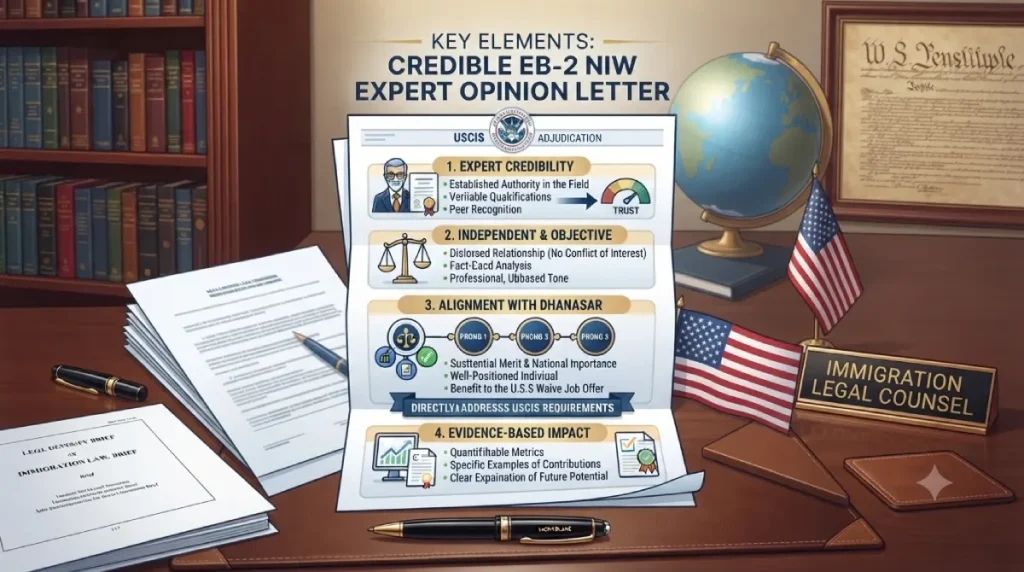
An EB-2 NIW expert opinion letter can provide valuable independent professional analysis in an employment-based immigration petition. It can explain the significance of an applicant’s achievements, evaluate a proposed endeavor, and help establish why specialized work may have broader importance to the United States. However, simply obtaining a letter from a professor, researcher, or experienced industry professional does not automatically make it persuasive evidence.
What makes an expert opinion letter credible to USCIS is the quality of the expert’s qualifications, the relevance of their professional experience, the evidence they review, and the depth of their independent analysis. A well-prepared letter should explain specific facts, connect professional achievements to the proposed endeavor, and provide meaningful insight into the three-prong framework established in Matter of Dhanasar.
At AAE Evaluations, we prepare customized EB-2 NIW expert opinion letters through field-matched experts, with analysis structured around the applicant’s individual background, supporting evidence, and proposed endeavor.
This guide explains the factors that influence the credibility of an EB-2 NIW expert opinion letter, common weaknesses that can reduce its evidentiary value, and what applicants should look for when obtaining independent expert documentation.
What Is an EB-2 NIW Expert Opinion Letter?
An EB-2 NIW expert opinion letter is a professional evaluation prepared by a qualified individual with relevant expertise in the applicant’s field or proposed endeavor.
The expert reviews information about the applicant’s education, professional background, achievements, research, industry contributions, and proposed future work. Based on the available documentation, the expert provides an independent assessment of relevant professional and technical issues.
For example:
- An artificial intelligence researcher may need an expert to explain the significance of their machine learning research and its potential applications.
- A civil engineer may need an assessment of infrastructure innovations and their potential broader impact.
- A healthcare researcher may benefit from an expert evaluation of research contributions and their relevance to healthcare challenges.
- An entrepreneur may need professional analysis of an innovative business endeavor and its potential economic or industry impact.
The purpose is not simply to praise the applicant. It is to help explain specialized professional evidence in a way that an immigration adjudicator can understand and evaluate.
An expert opinion letter is supporting evidence, not a substitute for the applicant’s legal arguments or the other documentation required for an EB-2 NIW petition.
For a more detailed explanation, see our guide to EB-2 NIW expert opinion letter requirements.
Does USCIS Consider Expert Opinion Letters Credible Evidence?
Yes. Expert opinion letters may be submitted as supporting evidence in an EB-2 NIW petition. However, their evidentiary weight depends on their relevance, reliability, and overall probative value.
In Matter of Caron International, 19 I&N Dec. 791, 795 (Comm’r 1988), the decision recognized that USCIS may use statements from universities, professional organizations, or other sources as advisory opinions or expert testimony.
However, an expert’s opinion does not automatically establish eligibility. USCIS remains responsible for making the final determination.
AAO decisions have also illustrated that letters may receive limited weight when they offer broad statements about an applicant’s qualifications or the importance of an industry without adequately analyzing the specific proposed endeavor.
This distinction is important.
For example, an expert letter stating that artificial intelligence is important to the United States does not, by itself, demonstrate why a particular applicant’s proposed AI endeavor has national importance.
A more useful assessment would explain:
- What the applicant is specifically proposing to accomplish.
- Which professional achievements demonstrate relevant expertise.
- What problem or opportunity the proposed work addresses.
- How the endeavor may produce broader implications.
- Which supporting documents substantiate the expert’s conclusions.
The credibility of a letter therefore depends on more than the expert’s professional title. The actual analysis matters.
For an official legal reference, see Matter of Dhanasar, 26 I&N Dec. 884 (AAO 2016).
10 Factors That Make an EB-2 NIW Expert Opinion Letter Credible to USCIS
A persuasive expert opinion letter should demonstrate professional credibility and provide specific, evidence-based analysis. The following ten factors are particularly important when evaluating the quality of a letter.
1. The Expert Has Relevant Academic or Professional Qualifications
The expert’s qualifications are one of the first things an applicant should evaluate.
A person may have an impressive academic title or extensive professional experience, but that does not necessarily mean they are qualified to assess every type of proposed endeavor.
The expert’s background should be relevant to the subject being evaluated.
For example:
| Applicant’s Field | Potentially Relevant Expert Background |
|---|---|
| Artificial intelligence | AI research, machine learning, computer science |
| Software engineering | Software architecture, computer science, technology |
| Healthcare | Public health, medical research, healthcare systems |
| Civil engineering | Infrastructure, structural engineering, transportation |
| Biotechnology | Molecular biology, biotechnology, life sciences |
| Cybersecurity | Information security, network security, cyber research |
| Entrepreneurship | Business innovation, industry development, relevant sector expertise |
| Environmental science | Environmental research, sustainability, climate science |
The expert’s credentials should be clearly presented in the letter.
Relevant information may include:
- Academic degrees and institutions.
- Professional titles and current positions.
- Research or teaching experience.
- Publications and scholarly contributions.
- Industry experience.
- Professional certifications, where relevant.
- Specialized knowledge related to the proposed endeavor.
Applicants should also be able to verify the expert’s professional background through appropriate sources.
How AAE Evaluations approaches expert qualifications
AAE Evaluations works with field-matched experts, including PhD-level, postdoctoral, academic, research, and industry professionals across multiple disciplines.
The objective is to identify an expert whose professional background is relevant to the applicant’s work and the issues being evaluated.
A relevant expert is more important than an impressive title that has little connection to the proposed endeavor.
2. The Expert Clearly Establishes Their Basis of Knowledge
A credible letter should explain why the expert is qualified to evaluate the applicant’s professional achievements and proposed endeavor.
It should establish the expert’s professional background and identify the basis for the opinions expressed.
For example, consider the difference between these two statements:
Weak statement:
“I am an experienced researcher, and I believe the applicant is an outstanding professional.”
Stronger approach:
“I have worked in computational biology for more than 15 years, including research involving genomic data analysis and machine learning applications in biomedical science. Based on my professional experience and my review of the applicant’s documented research contributions, I can assess the technical significance and potential applications of this work.”
The second approach gives the reader a clearer understanding of the expert’s relevant experience and the basis for the assessment.
A letter should not rely on credentials alone. It should connect those credentials to the subject of the opinion.
3. The Letter Provides Specific, Evidence-Based Analysis
One of the biggest weaknesses in poorly prepared expert opinion letters is excessive general praise.
Statements such as the following provide limited analytical value:
- The applicant is highly talented.
- The applicant is an exceptional researcher.
- The applicant has made important contributions.
- The applicant will benefit the United States.
These statements may express an opinion, but they do not explain the evidence behind it.
A credible expert opinion letter should identify specific achievements and explain their significance.
For example, an expert evaluating a machine learning researcher might discuss:
- The research problem addressed.
- The applicant’s specific contribution.
- The technical approach used.
- The significance of the findings.
- Relevant publications and citation evidence.
- Demonstrated industry or research applications.
- The connection between past achievements and the proposed endeavor.
Where appropriate, the expert may reference independently verifiable information, such as publication records, patents, research findings, industry reports, or government data.
Consider the following comparison:
| Generic assessment | Evidence-based assessment |
|---|---|
| The applicant is a talented researcher. | The expert identifies specific research contributions and explains their technical significance. |
| The applicant’s work is important. | The expert explains which documented problem the work addresses and why it matters. |
| The applicant has strong experience. | The expert connects specific projects and achievements to the proposed endeavor. |
| The proposed work will help the United States. | The expert explains the potential broader implications using relevant evidence. |
The goal is to help USCIS understand why the applicant’s actual work matters, rather than asking the adjudicator to accept unsupported praise.
4. The Expert Opinion Letter Addresses the Matter of Dhanasar Framework
For an EB-2 NIW petition, a useful expert opinion letter should be organized around the relevant considerations of the three-prong framework established in Matter of Dhanasar.
The framework requires the petitioner to demonstrate:
- The proposed endeavor has substantial merit and national importance.
- The petitioner is well positioned to advance the proposed endeavor.
- On balance, it would benefit the United States to waive the job offer and labor certification requirements.
A letter that discusses professional qualifications without explaining their relevance to these criteria may offer limited assistance.
Prong 1: Substantial Merit and National Importance
The expert should understand the applicant’s specific proposed endeavor and evaluate its significance.
For example, a healthcare researcher may propose developing a technology-assisted approach to improve early disease detection.
A useful expert assessment could explain:
- The healthcare challenge being addressed.
- The proposed technical or research contribution.
- Relevant evidence supporting the importance of the problem.
- Potential implications beyond the applicant’s immediate workplace or individual employer.
It is important to distinguish the importance of an entire industry from the national importance of the specific proposed endeavor.
The fact that healthcare, cybersecurity, AI, or renewable energy is important does not automatically establish that every project within that field has national importance.
Prong 2: Well Positioned to Advance the Proposed Endeavor
This prong focuses on the applicant’s ability to advance the proposed work.
An expert may evaluate relevant evidence such as:
- Education and specialized training.
- Professional experience.
- Publications and citations.
- Patents and intellectual property.
- Previous successful projects.
- Research contributions.
- Awards and recognition.
- Leadership experience.
- Evidence of implementation or industry adoption.
- Progress toward the proposed endeavor.
A strong analysis should explain why these accomplishments are relevant to the future endeavor.
For example, an applicant with experience developing cybersecurity systems may have documented projects, research, and implementation experience. The expert can explain how that background relates to the applicant’s plans to advance cybersecurity solutions.
Simply repeating the applicant’s CV is not enough.
Prong 3: Whether Waiving the Job Offer and Labor Certification Requirements Would Benefit the United States
The third prong examines the overall balancing consideration.
An expert may provide relevant professional insight into the nature of the proposed work, its potential benefits, and why the applicant’s circumstances may be significant in the context of the proposed endeavor.
For example, an entrepreneur developing a specialized technology may pursue collaborations with multiple organizations rather than working for a single employer.
An expert could explain the professional or technical context of that endeavor and the potential benefits of allowing it to progress.
However, the legal balancing determination belongs to USCIS. The expert should provide professional analysis rather than present an unsupported legal conclusion.
The three-prong framework comes from the published precedent decision Matter of Dhanasar. Applicants can also explore our EB-2 NIW expert opinion letter sample and format guide to understand how these elements can be organized in a supporting document.
5. The Expert Is Independent or Clearly Discloses Any Prior Relationship
Independence can strengthen the credibility of an expert opinion letter, particularly when the expert has no personal or professional relationship with the applicant.
An independent expert may evaluate the applicant’s documentation without the perspective of a former supervisor, research collaborator, or colleague.
This can provide a useful outside assessment of the applicant’s achievements.
However, a prior relationship does not automatically make an expert opinion letter invalid or unusable. The nature of the relationship, the expert’s qualifications, and the basis of the opinion all matter.
For example:
An independent expert may have no previous professional interaction with the applicant but may evaluate their publications, patents, and professional achievements.
A dependent or personally connected expert may have worked with the applicant, supervised their research, or collaborated on projects.
Both may provide relevant information, but they serve different evidentiary purposes.
A letter should not misrepresent the expert’s relationship with the applicant. Any relevant relationship should be disclosed accurately.
Applicants should ask providers:
- Is the expert independent of my professional work?
- Has the expert previously collaborated with me?
- Does the expert have any relevant personal or professional relationship?
- Will the nature of the relationship be accurately explained?
The important point is that credibility comes from transparency, relevant qualifications, and the quality of the expert’s reasoning.
6. The Expert Reviews the Applicant’s Actual Supporting Documents
A credible expert opinion letter should be based on a meaningful review of the applicant’s professional record.
A letter prepared without examining relevant supporting documents may contain general statements that are difficult to substantiate.
Depending on the applicant’s background, the expert may review:
| Document | Why It May Matter |
|---|---|
| Current CV or résumé | Establishes professional background |
| Academic transcripts and degrees | Documents educational qualifications |
| Research publications | Demonstrates scholarly contributions |
| Citation information | Provides evidence of research influence |
| Patents | Documents intellectual property contributions |
| Awards | Establishes professional recognition |
| Employment history | Provides context for professional experience |
| Project documentation | Demonstrates practical contributions |
| Business plans | Explains entrepreneurial endeavors |
| Proposed endeavor statement | Establishes the future work being evaluated |
| Contracts or implementation records | May demonstrate practical adoption or progress |
| RFE notice | Identifies specific issues requiring additional analysis |
Not every document is necessary for every case.
The expert should review materials that are relevant to the proposed endeavor and the subject of the evaluation.
For example, a software engineer may provide project documentation and technical implementation evidence, while a biomedical researcher may submit publications, research findings, and patent records.
The expert’s conclusions should be traceable to the information actually reviewed.
At AAE Evaluations, the preparation process includes case review, document assessment, field-matched expert selection, customized letter preparation, and expert review and signature.
7. The Letter Explains the Proposed Endeavor Clearly
An EB-2 NIW petition is not simply an assessment of how successful an applicant has been in their profession.
The proposed endeavor is a central part of the Dhanasar framework.
A credible expert opinion letter should explain what the applicant intends to accomplish in the United States and why the proposed work is significant.
For example:
Too general:
“The applicant intends to work as a software engineer in the United States.”
More specific:
“The applicant proposes to develop and implement cybersecurity solutions designed to improve the protection of critical digital infrastructure, drawing on documented experience in network security, threat detection, and enterprise-level security systems.”
The second description gives the reader more context about the actual endeavor.
The expert should then assess the proposed work using relevant professional knowledge and supporting evidence.
This is particularly important for applicants whose proposed work involves research, entrepreneurship, innovation, or specialized technical projects.
The letter should avoid confusing an ordinary job title with a clearly defined proposed endeavor.
8. The Expert Uses Reliable Sources and Verifiable Information
A professional opinion becomes more useful when its conclusions are supported by reliable information.
Depending on the case, an expert may reference:
- Peer-reviewed research.
- Academic publications.
- Government reports.
- Industry research.
- Scientific findings.
- Patent databases.
- Relevant professional standards.
- Published statistics.
- Documented project outcomes.
For example, an expert evaluating an environmental technology endeavor might reference reliable information about the environmental problem being addressed, relevant technical developments, and the applicant’s documented contributions.
A cybersecurity expert may discuss recognized cybersecurity challenges and connect them to the applicant’s documented research or implementation experience.
However, sources should be selected because they genuinely support the analysis. Adding unrelated statistics simply to make a letter appear research-heavy does not improve its credibility.
The letter should also distinguish between established facts, the expert’s professional interpretation, and projections about future impact.
Any quantitative claim should have a clear source and appropriate context.
9. The Letter Is Consistent With the Rest of the Petition
An expert opinion letter should complement the applicant’s petition, not create contradictions.
USCIS reviews the petition as a whole. If the proposed endeavor, professional achievements, and supporting evidence are described differently across documents, those inconsistencies may create questions.
For example, consider an applicant who describes their proposed endeavor as developing AI solutions for healthcare in the petition but whose expert letter focuses entirely on unrelated financial technology projects.
Even if the expert is highly qualified, the letter may not effectively support the stated endeavor.
Before submitting an expert opinion letter, check:
- Does it describe the same proposed endeavor as the petition?
- Are the applicant’s qualifications consistent with the CV?
- Are publication and citation details accurate?
- Are patents and achievements correctly identified?
- Are project descriptions consistent with the supporting documents?
- Does the analysis address the issues identified by the attorney?
- Are conclusions supported by the submitted evidence?
The immigration attorney should review the final letter as part of the complete petition strategy.
AAE Evaluations can consider relevant attorney instructions when preparing an expert opinion letter so that the professional assessment is aligned with the intended purpose of the document.
10. The Letter Is Clear, Structured, and Professionally Presented
Presentation is not a substitute for substance, but a well-organized letter makes the expert’s reasoning easier to understand.
A useful expert opinion letter generally includes:
- Expert identification and professional credentials.
- Purpose of the evaluation.
- Description of the expert’s relevant experience.
- Relationship or independence disclosure, where appropriate.
- Materials reviewed.
- Applicant’s professional background.
- Description of the proposed endeavor.
- Evidence-based professional analysis.
- Discussion of relevant Dhanasar considerations.
- Expert’s professional conclusions.
- Signature and appropriate contact information.
The letter should use clear language and explain technical terms where necessary.
For example, a letter about advanced machine learning should not assume that every reader understands specialized algorithms or research terminology.
The expert should explain the technical contribution, its significance, and the relevance of the supporting evidence in accessible language.
There is no universal USCIS-mandated page count or template for an EB-2 NIW expert opinion letter. The appropriate length depends on the complexity of the case and the scope of the professional analysis.
A concise, well-supported assessment can be more useful than a lengthy document filled with repeated praise.
Weak vs. Credible EB-2 NIW Expert Opinion Letters: Practical Comparison
The following examples illustrate the difference between general statements and more meaningful expert analysis.
| Area | Weak letter | More credible approach |
|---|---|---|
| Expert credentials | Lists only a professional title | Explains relevant qualifications and experience |
| Independence | Does not explain the relationship | Discloses the relationship accurately |
| Applicant achievements | Repeats the CV | Evaluates specific contributions |
| National importance | Says the industry is important | Explains the significance of the specific endeavor |
| Research impact | Uses general praise | References documented findings and relevant evidence |
| Proposed endeavor | Describes only a job title | Explains the actual future work |
| Dhanasar analysis | Mentions the three prongs briefly | Provides relevant, evidence-based analysis |
| Supporting documents | Does not identify reviewed materials | Explains the evidence considered |
| Conclusions | Makes unsupported predictions | Distinguishes professional opinions from established facts |
| Consistency | Uses different descriptions of the endeavor | Aligns with the petition and supporting documents |
This comparison is useful when reviewing a draft or discussing requirements with an expert opinion letter provider.
What Can Make an EB-2 NIW Expert Opinion Letter Less Persuasive?
Even when an expert has strong qualifications, certain weaknesses can reduce the usefulness of a letter.
Generic Praise Without Supporting Evidence
Statements describing an applicant as exceptional or highly talented are not sufficient by themselves.
The expert should explain the basis of those opinions and identify the relevant professional contributions.
An Expert Whose Background Does Not Match the Proposed Endeavor
A well-known professor in one discipline may not be the most appropriate person to evaluate specialized work in another discipline.
Field relevance should be a central consideration.
No Meaningful Discussion of the Proposed Endeavor
A letter that focuses only on past achievements may fail to explain how those achievements relate to the applicant’s future plans.
Unsupported Claims About National Importance
The importance of a general industry does not automatically demonstrate the national importance of an individual endeavor.
The expert should discuss the specific proposed work and its potential broader implications.
Inaccurate or Unverifiable Information
Incorrect publication details, unsupported statistics, inaccurate professional credentials, or exaggerated achievements can undermine confidence in the letter.
Contradictions With the Petition
A letter that describes a different proposed endeavor or makes claims inconsistent with the supporting documents can complicate the overall case.
Promises of Guaranteed USCIS Approval
No expert opinion letter provider can guarantee that USCIS will approve an EB-2 NIW petition. Any such promise should be treated cautiously.
For further guidance, see our article on EB-2 NIW expert opinion letter requirements.
Can an Independent Expert Opinion Letter Help With an EB-2 NIW RFE?
An independent expert opinion letter may provide useful additional analysis when USCIS raises concerns about an applicant’s proposed endeavor, professional achievements, or supporting evidence.
However, an RFE response should be developed around the specific concerns identified in the notice.
For example, if USCIS questions whether the proposed endeavor has national importance, an expert may provide additional professional context about the specific work, its potential broader implications, and the evidence supporting those conclusions.
If USCIS questions whether the applicant is well positioned, an expert may evaluate the relevance of the applicant’s documented research, experience, technical contributions, or previous accomplishments.
The letter should not simply repeat the original petition’s claims.
It should provide additional analysis that addresses the actual evidentiary gap, where appropriate.
An expert opinion letter should also complement the attorney’s response rather than replace the legal explanation.
Read our detailed guide: EB-2 NIW Expert Opinion Letter for RFE.
How to Evaluate an EB-2 NIW Expert Opinion Letter Before Submission
Before including an expert opinion letter in your petition, review it carefully.
The following checklist can help applicants and their attorneys identify common quality issues.
Expert credentials and independence
-
The expert’s name, position, and qualifications are clearly stated.
-
The expert has relevant subject-matter expertise.
-
Academic and professional credentials can be verified.
-
Any relevant relationship with the applicant is disclosed.
-
The expert’s basis of knowledge is explained.
Evidence and analysis
-
The materials reviewed are identified.
-
The applicant’s actual achievements are discussed.
-
The proposed endeavor is described accurately.
-
Conclusions are supported by relevant evidence.
-
Sources and quantitative information are verifiable.
-
The expert provides independent professional analysis.
Dhanasar framework
-
Prong 1 is addressed through analysis of the specific proposed endeavor.
-
Prong 2 connects the applicant’s achievements to their ability to advance the endeavor.
-
Prong 3 receives relevant professional consideration.
-
The letter does not rely solely on broad statements about the industry.
Final review
-
The letter is consistent with the petition and supporting exhibits.
-
Technical information is understandable.
-
There are no unsupported claims or guarantees.
-
The final letter is reviewed and signed by the identified expert.
-
The attorney has had an opportunity to review the document.
This checklist is a practical quality-control tool, not an official USCIS checklist or a guarantee of approval.
How AAE Evaluations Prepares EB-2 NIW Expert Opinion Letters
At AAE Evaluations, the focus is on preparing customized expert opinion letters that reflect the applicant’s actual professional background, proposed endeavor, and supporting documentation.
The service is designed for applicants who need an independent professional assessment as part of an initial EB-2 NIW petition or an RFE-related response.
1. Case and Document Review
The process begins with reviewing the applicant’s professional background and relevant documentation.
Depending on the case, materials may include a CV, educational credentials, publications, citation information, patents, awards, employment history, proposed endeavor statement, business plans, and other supporting evidence.
2. Field-Matched Expert Selection
AAE Evaluations works with experts across multiple disciplines, including:
- Artificial intelligence and machine learning.
- Computer science and software engineering.
- Mechanical, electrical, and civil engineering.
- Healthcare and medical research.
- Biotechnology and life sciences.
- Business and entrepreneurship.
- Supply chain and telecommunications.
- Education and academic research.
- Other specialized professional fields.
The goal is to match the applicant with an expert whose background is relevant to the subject being evaluated.
3. Customized Expert Opinion Letter Preparation
The letter is prepared around the applicant’s specific professional record and proposed endeavor.
Rather than relying on generic praise, the assessment focuses on explaining relevant qualifications, achievements, technical contributions, and the significance of the proposed work.
4. Dhanasar-Focused Analysis
The expert opinion letter is structured around the three-prong Matter of Dhanasar framework.
The exact analysis depends on the applicant’s circumstances and the evidence available.
5. Expert Review, Signature, and Delivery
The final document undergoes expert review and signature before delivery.
Applicants working with an immigration attorney can provide relevant instructions to help coordinate the scope of the professional assessment.
AAE Evaluations EB-2 NIW Service Details
| Service Detail | Current Offering |
|---|---|
| Provider | AAE Evaluations |
| Service | EB-2 NIW Expert Opinion Letter |
| Price | $675 per letter |
| Standard turnaround | 6 business days |
| Expert selection | Field-matched |
| Preparation | Customized and case-specific |
| Framework | Matter of Dhanasar |
| Expert review and signature | Included |
| RFE support | Available |
| Rush processing | Available when applicable |
The current listed price is $675, with a six-business-day standard turnaround after receipt of the required information and documentation. Confirm the current scope, pricing, and availability before ordering.
To understand the service in more detail, visit the AAE Evaluations EB-2 NIW Expert Opinion Letter service page.
Frequently Asked Questions About Credible EB-2 NIW Expert Opinion Letters
1. What makes an EB-2 NIW expert opinion letter credible to USCIS?
A credible letter generally comes from a qualified expert whose professional background is relevant to the applicant’s proposed endeavor. It should explain the expert’s basis of knowledge, identify the materials reviewed, provide specific evidence-based analysis, address relevant Dhanasar considerations, and remain consistent with the rest of the petition.
2. Does USCIS give more weight to independent expert opinion letters?
Independence can strengthen the value of an expert’s assessment because it may provide an outside professional perspective. However, independence alone does not guarantee greater evidentiary weight. USCIS may consider the expert’s qualifications, relevance, reliability, supporting evidence, and overall probative value.
3. Does an EB-2 NIW expert need to be a professor?
No. An expert does not necessarily need to hold a university professorship. Depending on the subject being evaluated, an appropriately qualified researcher, scientist, engineer, physician, technology professional, or experienced industry specialist may be suitable.
4. Should an expert opinion letter address all three Dhanasar prongs?
A comprehensive EB-2 NIW expert opinion letter may address all three prongs when relevant to the expert’s assignment and the applicant’s circumstances. The analysis should explain the proposed endeavor’s significance, the applicant’s ability to advance it, and relevant professional considerations concerning the waiver. The legal arguments remain the responsibility of the petitioner’s legal strategy.
5. Can a generic expert opinion letter hurt an EB-2 NIW petition?
A generic letter may offer limited evidentiary value if it repeats the applicant’s CV, provides unsupported praise, or fails to explain the significance of the proposed endeavor. It may also create inconsistencies if it does not align with the petition and supporting documentation.
6. How many expert opinion letters should an EB-2 NIW applicant submit?
There is no universal USCIS requirement specifying a minimum number of expert opinion letters. The appropriate number depends on the applicant’s evidence, proposed endeavor, and overall petition strategy. Quality, relevance, and distinct analytical value are more important than simply increasing the number of letters.
7. Can an expert opinion letter establish national importance?
An expert may explain the professional, technical, scientific, or industry significance of a specific proposed endeavor and provide relevant supporting analysis. However, USCIS makes the final determination. A letter that only describes the general importance of an industry may not adequately address the national importance of the applicant’s particular endeavor.
8. Can an expert opinion letter help with an EB-2 NIW RFE?
Yes. A targeted expert opinion letter may provide additional professional analysis addressing concerns raised in an RFE. Its usefulness depends on whether it responds to the actual issues identified by USCIS and is supported by relevant documentation.
9. Is an EB-2 NIW expert opinion letter mandatory?
No. USCIS does not require every EB-2 NIW applicant to submit an expert opinion letter. Applicants must establish eligibility through the totality of the evidence. An expert letter is one potential form of supporting documentation.
10. How much does an EB-2 NIW expert opinion letter cost at AAE Evaluations?
AAE Evaluations currently lists its EB-2 NIW expert opinion letter service at $675 per letter. The standard turnaround is six business days after receiving the required documentation. Visit the AAE Evaluations pricing page for current service information.
11. What documents should I provide to prepare a credible expert opinion letter?
Depending on the case, relevant documents may include a CV, academic records, publications, citation information, patents, awards, project records, professional achievements, a proposed endeavor statement, and other supporting evidence. If the letter is intended for an RFE response, the complete RFE notice and relevant petition documents may also be needed.
12. Does a credible expert opinion letter guarantee EB-2 NIW approval?
No. Even a detailed letter from a highly qualified expert cannot guarantee approval. USCIS evaluates the entire petition, including the applicant’s qualifications, proposed endeavor, supporting evidence, and applicable legal requirements.
Final Thoughts: Credibility Comes From Evidence, Expertise, and Independent Analysis
A credible EB-2 NIW expert opinion letter should do more than describe an applicant as an accomplished professional. It should explain why the expert is qualified to provide the assessment, what evidence was reviewed, and how the applicant’s achievements relate to the proposed endeavor.
The most important considerations are relevant expert qualifications, transparent independence disclosures, specific evidence-based analysis, a clear understanding of the Dhanasar framework, and consistency with the overall petition.
For applicants considering an independent expert evaluation, AAE Evaluations provides customized EB-2 NIW expert opinion letters prepared by field-matched experts, with a focus on professional credibility and case-specific analysis.
If you are preparing an initial EB-2 NIW petition or responding to an RFE, explore the service details to determine whether an expert opinion letter is appropriate for your documentation needs.
Explore EB-2 NIW Expert Opinion Letter Services at AAE Evaluations:
https://aaeevaluations.com/services/eb-2-niw-expert-opinion-letters/
Disclaimer: AAE Evaluations provides professional expert evaluation and document preparation services, not legal advice. Expert opinion letters are supporting evidence and do not guarantee USCIS approval or any particular immigration outcome. Consult a qualified immigration attorney regarding your individual petition.