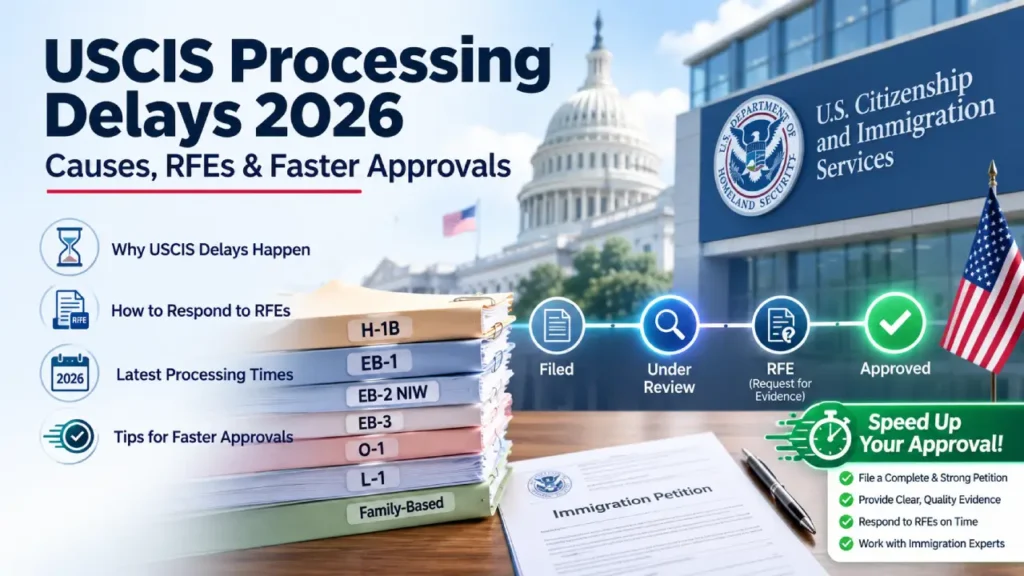
Quick Note: USCIS is currently managing a record backlog of over 11 million pending cases as of early 2026. Processing delays stem from five core causes: incomplete documentation, seasonal case surges, security and background checks, complex visa categories, and shifting adjudication policies. The most controllable factor — and the one most applicants overlook — is documentation quality. RFEs can add 60–90 days or more to any case, but professionally prepared, decision-ready filings significantly reduce that risk.
Key Takeaways:
- USCIS completions dropped 18% in Q2 FY2025 year-over-year, deepening existing backlogs
- Premium processing for I-129 and I-140 petitions now costs $2,965 (as of March 1, 2026) and guarantees a 15-calendar-day response — but not approval
- RFEs are the single biggest controllable delay factor; responding with legal representation leads to approval 85% of the time vs. 62% for self-filed responses
- Employment-based cases (H-1B, EB-2, EB-3, O-1, L-1) are most vulnerable to documentation-triggered delays
- Filing a complete, evidence-backed petition from day one is the most effective strategy to reduce wait time
If you’ve been watching your USCIS case status page refresh with the same “Case Was Received” message for months, you’re not alone — and you’re not imagining it. The U.S. immigration system in 2026 is under more pressure than it’s faced in decades.
But here’s what most guides won’t tell you: not all delays are equal, and not all of them are out of your control. While no one can force USCIS to move faster, the difference between a case that sails through adjudication and one that stalls for six extra months almost always comes down to what was in the petition when it landed on an officer’s desk.
At AAE Evaluations, we’ve worked through more than 1,500 cases since 2018, helping applicants and immigration attorneys build credential evaluation packages that hold up under USCIS scrutiny. This guide breaks down what’s actually causing delays right now, which causes you can influence, and what a decision-ready filing looks like in practice.
Why USCIS Processing Is Slower Than Ever in 2026
Before we get into what you can do, it helps to understand the scale of what USCIS is dealing with. The agency processes roughly 10 million applications, petitions, and requests each year. Right now, that volume is overwhelming the system.
As of early 2026, USCIS is managing a backlog exceeding 11 million pending cases — a 170% increase over the past decade. Case completions dropped 18% in Q2 FY2025 compared to the same period in 2024. With new filings arriving faster than the agency can process them, the queue keeps growing.
What makes this particularly challenging is that USCIS is approximately 96% fee-funded. When fee changes create intake disruptions — and the March 2026 premium processing fee increase to $2,965 caused exactly that — a wave of rejected submissions creates a secondary backlog on top of the existing one.
Understanding this context matters because it reframes how you should think about your application strategy. You cannot make USCIS move faster. But you can make sure your case doesn’t get stuck in preventable loops.
The 5 Root Causes of USCIS Processing Delays
Not every delay comes from the same source. Identifying which cause is most relevant to your case type is the first step toward doing something about it.
1. Incomplete or Inconsistent Documentation
This is the most common delay trigger — and the most preventable. When an adjudicating officer can’t clearly verify an applicant’s education, work history, or eligibility without requesting additional information, the case stops moving.
The problem isn’t always a missing document. Often it’s a mismatch: a degree title that doesn’t obviously align with a job duty description, a work experience letter that uses vague language, or a credential evaluation that covers education but doesn’t address how it maps to U.S. degree equivalencies. USCIS officers are trained to adjudicate efficiently when everything is clear — but when something needs interpretation, they issue a Request for Evidence (RFE) and wait.
For employment-based cases — H-1B, EB-2, EB-3, L-1 — the documentation requirements are especially specific. USCIS needs to see that the foreign applicant’s qualifications actually meet the standard for the offered position under U.S. immigration law. Gaps, ambiguities, or anything that requires an officer to make assumptions are delay triggers.
The practical implication: every document in your petition should be self-explanatory to someone unfamiliar with your industry, your country’s education system, and your career history. That level of clarity rarely happens without professional preparation.
📋 Not sure what your petition is missing? Get a free case review from AAE Evaluations — we’ll identify documentation gaps before you file.
2. Case Volume Surges and Seasonal Backlogs
USCIS doesn’t operate at a steady pace year-round. Filing volume spikes sharply during the H-1B cap season (April), F-1/OPT renewal cycles, and EB-2 NIW self-petition periods. These surges create processing bottlenecks that affect even complete, well-prepared cases.
During peak periods, service centers can see petition intake volumes that outpace adjudicator capacity by significant margins. Vermont Service Center and California Service Center, for example, currently show processing time differences of 25–30% on comparable petition types — purely because of workload distribution.
The critical nuance here: seasonal backlogs slow cases universally, but they hit incomplete cases hardest. When a case gets stuck in an RFE cycle during a peak period, the response review adds to an already-stressed queue. A case that might have resolved in three months during a lighter period can take seven or eight months if it gets caught in a volume surge while awaiting an RFE response.
Filing outside peak windows — May, August, or December — can meaningfully reduce queue depth exposure. But that’s only effective if the underlying documentation is strong enough to avoid RFEs regardless of when you file.
3. Security Checks and Background Verification
USCIS conducts security background checks on all applicants, and for foreign nationals with international education and multi-country employment histories, this process can involve additional verification layers.
When credential history spans multiple countries, USCIS may need to cross-reference records that aren’t easily accessible through standard databases. Foreign degree records, employment history from countries with limited data-sharing agreements, and names that appear differently across transliteration systems can all trigger extended review periods.
Professional education evaluation for USCIS addresses a specific slice of this problem: when a qualified evaluator has already translated, analyzed, and certified a foreign credential against U.S. educational standards, the officer doesn’t have to figure it out themselves. That pre-done work reduces the likelihood that a credential question becomes a delay trigger.
This is one of the most underappreciated functions of a credential evaluation. It’s not just about proving equivalency — it’s about removing a potential question mark from the officer’s review process before it has a chance to become an RFE.
4. Complex Visa Categories With Higher Scrutiny
Some visa categories are inherently more documentation-intensive, and USCIS adjudicates them accordingly. H-1B specialty occupation petitions, EB-2 National Interest Waiver self-petitions, O-1 extraordinary ability cases, and L-1 specialized knowledge petitions all require applicants to meet a higher evidentiary bar — and USCIS officers reviewing them apply correspondingly closer scrutiny.
The O-1 category illustrates this well. In FY2025, nearly 1 in 5 completed O-category petitions received an RFE — a 19.7% RFE rate. After receiving an RFE, only 70.9% of those cases were approved. That means approximately 30% of O-category cases that generated RFEs ended in denial — a significant risk that could largely be mitigated by stronger initial evidence.
For EB-2 NIW expert opinion letters specifically, the Dhanasar framework (the three-prong standard established by Matter of Dhanasar, 26 I&N Dec. 884 (AAO 2016)) requires petitioners to demonstrate: (1) the proposed endeavor has substantial merit and national importance, (2) they are well-positioned to advance it, and (3) it would be beneficial to waive the job offer and labor certification requirements. Missing any prong — or addressing them superficially — is a near-certain path to an RFE.
EB-1 expert opinion letters for extraordinary ability require satisfying at least three of ten evidentiary criteria. The quality of how those criteria are documented in supporting letters from independent experts matters enormously to how the officer reads the petition.
5. Policy Shifts and Evolving Adjudication Standards
U.S. immigration policy has undergone significant changes since January 2025. The current administration has placed greater emphasis on enforcement, national security vetting, and U.S. worker protections — all of which have filtered into how USCIS officers review employment-based petitions.
RFE rates have increased across multiple visa categories. Adjudication standards for specialty occupation cases have tightened. A January 2026 policy memo paused certain cases from 39 countries for naturalization processing. Premium processing fees increased on March 1, 2026 — and cases filed with the old fee were rejected at intake, creating an additional delay layer for affected petitioners.
Applications prepared under older policy assumptions — or that don’t anticipate heightened scrutiny — are running into these changes at adjudication. The fix isn’t to guess at what officers want to see; it’s to build petitions that are evidence-dense enough to hold up under the strictest possible reading of current standards.
What Actually Speeds Up a USCIS Case: 5 Practical Strategies
Now the more useful half of this conversation. None of these strategies eliminate USCIS processing time — but they significantly reduce your exposure to the delays that are actually preventable.
1. File a Decision-Ready Petition From Day One
The phrase “decision-ready” sounds simple, but most petitions aren’t. A decision-ready filing is one where a USCIS officer can read the petition, review the supporting evidence, and make a determination without needing to ask a single follow-up question.
That requires more than just including all required forms. It means:
- Every eligibility claim is supported by specific documentary evidence (not general statements)
- Education credentials are professionally evaluated and mapped to U.S. equivalencies
- Work experience is documented in letters that clearly describe duties, technologies, and scope — not boilerplate HR language
- Job duties in employer support letters align precisely with the visa category’s specialty occupation or eligibility requirements
- Expert opinion letters address the specific legal standards USCIS uses to evaluate the petition
At AAE Evaluations, our work experience evaluations are built around this standard. We don’t just confirm that someone worked somewhere — we analyze their documented duties and translate them into the evidentiary language USCIS expects to see, whether that’s for H-1B specialty occupation evidence or EB-2 degree equivalency.
⚡ One team. All documents. AAE Evaluations coordinates education evaluations, expert opinion letters, and business plans as a single engagement — so your attorney files a consistent, complete petition the first time. See how it works.
2. Eliminate RFE Risk Before You File
RFEs are expensive in every sense: they add 60–90 days minimum to your timeline, require attorney time to respond to, and introduce uncertainty even for well-qualified applicants. The goal isn’t to respond well to an RFE — it’s to never receive one.
The most common RFE triggers in employment-based cases are:
- Foreign degree not clearly equivalent to a U.S. Bachelor’s or higher — addressed by a formal academic credential evaluation
- Specialty occupation not established — addressed by an H-1B expert opinion letter from a qualified expert in the field
- Job duties don’t clearly require the degree — addressed by a combination of detailed employer support letters and expert analysis
- Work experience claimed as degree equivalent lacks sufficient documentation — addressed by a properly structured work experience evaluation
- EB-2 NIW Dhanasar prongs not adequately demonstrated — addressed by a comprehensive NIW expert opinion letter
When represented by legal counsel, RFE responses succeed at an 85% approval rate. Self-represented applicants succeed at 62%. But if you can keep your case out of the RFE cycle entirely, you’ve saved two to three months of waiting time regardless of which number you’re in.
The H-1B expert opinion letters we write at AAE Evaluations are specifically structured to anticipate specialty occupation scrutiny — we know what questions adjudicators ask because we’ve seen what generates RFEs and what doesn’t.
3. Use Professional Credential Evaluations for All Employment-Based Cases
Foreign education credentials don’t automatically translate to U.S. equivalencies in the eyes of USCIS. An officer reading a degree from a foreign institution needs to understand what it means in terms of U.S. educational standards — and that determination shouldn’t be left to interpretation.
A professional course-by-course evaluation does two things: it confirms the degree level equivalency and provides subject-by-subject analysis of what was studied. For visa categories where the field of study must match the offered position — particularly H-1B — the course-by-course detail often makes the difference between a clean approval and an RFE questioning whether the degree is in a “directly related” specialty.
For applicants who don’t hold a traditional four-year degree, work experience evaluations can establish the equivalent of a U.S. Bachelor’s degree for USCIS purposes — typically through documented professional experience in lieu of formal education. Our position-by-position evaluation service is specifically designed for these situations, analyzing each role held to establish progressive specialization and cumulative equivalency.
Here’s the table comparing what each evaluation type accomplishes:
| Evaluation Type | Best For | What It Establishes |
|---|---|---|
| Academic Credential Evaluation | All employment-based visas | Degree level equivalency to U.S. standards |
| Course-by-Course Evaluation | H-1B, EB-2, EB-3 with field-of-study questions | Subject-by-subject analysis + major equivalency |
| Work Experience Evaluation | Applicants without U.S.-equivalent degrees | Professional experience as degree equivalent |
| Position-by-Position Evaluation | Progressive specialization cases | Career trajectory and cumulative expertise |
| Expert Opinion Letter | H-1B, EB-1, EB-2 NIW, O-1, L-1 | Independent expert analysis of qualifications and eligibility |
4. Request Expedited Processing When You Qualify
USCIS allows applicants to request expedited processing outside of premium processing in specific circumstances. Qualifying reasons include severe financial loss to a company or individual, urgent humanitarian or medical needs, and cases that serve a clear U.S. national interest.
Expedite requests aren’t guaranteed — USCIS makes a discretionary determination. But when they’re granted, they can move a case significantly faster than standard queue processing.
The critical qualifier: expedite requests need supporting documentation just like the underlying petition. A request that says “our project will suffer” without specific financial evidence or project timelines rarely succeeds. A request that includes an expert analysis of the project’s scope, the financial impact of delay, and the beneficiary’s unique qualifications — and ties them directly to the qualifying criteria — stands a much better chance.
If you’re pursuing an expedite request, it’s worth having your credential documentation already in order. Expedited cases that then generate RFEs don’t move particularly fast.
5. Use Premium Processing Strategically
Premium processing for eligible I-129 and I-140 petitions guarantees a USCIS response within 15 calendar days — as of March 1, 2026, the fee is $2,965. It’s currently the most reliable way to accelerate an employment-based case.
The strategic point most people miss: premium processing accelerates the review timeline, not the documentation quality. If you file a premium-processed petition that generates an RFE, you’ll get the RFE within 15 days — but then you’re in an 84-day response window, followed by a 15-day post-response review. Premium-processed cases with RFEs can still take four to five months total.
This is why the documentation work comes first. Premium processing is most powerful when combined with a petition that’s genuinely decision-ready — the 15-day guarantee actually results in a 15-day decision, not a 15-day RFE.
Also worth knowing: if USCIS fails to act on a premium-processed case within 15 calendar days, the fee is refunded and the case remains in the queue. The clock starts only after USCIS accepts the petition as complete, which means rejected filings don’t trigger the premium processing window at all. Filing with outdated fees — especially post-March 1, 2026 — can cost you both time and money.
🔍 Is premium processing right for your case? Contact AAE Evaluations to discuss whether your documentation package is ready to make the most of it.
How AAE Evaluations Builds Faster, Stronger Petitions
Most USCIS delays in employment-based cases come down to one of two things: documentation that’s absent, or documentation that’s present but not persuasive. AAE Evaluations addresses both.
We’ve been working with applicants and immigration attorneys since 2018 across more than 1,500 cases spanning 43 nationalities. In that time, we’ve developed a clear picture of what USCIS officers look for in specific visa categories — and what consistently generates RFEs.
What makes our approach different from coordinating between multiple vendors is that your education evaluation, expert opinion letter, and business plan (where applicable) all come from a single team that knows your full case. That means no inconsistencies between documents, no gaps in how your qualifications are presented, and no attorney having to reconcile conflicting language across different providers’ reports.
Our expert opinion letters are written by credentialed experts in the relevant field — not generic templates. For H-1B cases, our letters address specialty occupation under the relevant SOC code and DOL wage data. For EB-2 NIW cases, we structure letters around all three Dhanasar prongs. For EB-1A extraordinary ability cases, we identify the three strongest evidentiary criteria from the ten available and document them with specificity.
For attorneys managing high-volume employment-based practices, we also coordinate directly on case strategy — particularly for complex EB-1, EB-2 NIW, and RFE response situations where the evaluation needs to address specific USCIS concerns rather than general credential verification.
| Service | What It Does for Your Case |
|---|---|
| Education Evaluation | Confirms degree equivalency under U.S. standards for USCIS adjudicators |
| Work Experience Evaluation | Establishes professional experience as academic equivalency for non-traditional credential holders |
| H-1B Expert Opinion Letter | Supports specialty occupation classification with field-expert analysis |
| EB-2 NIW Expert Opinion Letter | Addresses all three Dhanasar prongs for self-petitioners and RFE responses |
| EB-1 Expert Opinion Letter | Supports extraordinary ability, outstanding researcher, and multinational executive petitions |
| Course-by-Course Evaluation | Provides subject-level analysis where USCIS requires field-of-study alignment |
| Position-by-Position Evaluation | Documents progressive specialization for applicants building degree equivalency through experience |
Frequently Asked Questions About USCIS Processing Delays
Why is my USCIS case pending beyond the published processing time?
USCIS publishes median processing times based on the time it took to complete 80% of adjudicated cases in the previous six months — not a guaranteed timeline for your case. Factors that can push your case beyond the published timeframe include service center workload at the time your petition was received, background check complexity, RFE cycles, and any policy changes that affect your visa category. If your case exceeds the published timeframe, you can submit an e-Request through the USCIS website, contact the USCIS Ombudsman, or consult an immigration attorney about a Writ of Mandamus for prolonged inaction.
Can a credential evaluation actually speed up my USCIS case?
Not directly — credential evaluations don’t shorten USCIS queue times. What they do is remove a question mark from the adjudicator’s review. When USCIS doesn’t have to independently verify or interpret your foreign credentials, one of the most common RFE triggers is eliminated. Since RFEs add 60–90 days or more to any case, avoiding them has a real impact on how long your case takes from filing to decision. Our education evaluation services are designed specifically to give USCIS officers the clear credential analysis they need to make a decision without additional requests.
What happens if I receive an RFE on my H-1B or EB-2 case?
An RFE isn’t a denial — but it’s a serious signal that the officer couldn’t complete adjudication based on what was filed. You’ll typically have 84 days to respond (87 days in some categories). The response must directly address the specific concerns raised by USCIS. RFE responses succeed at an 85% approval rate when handled by experienced legal representation. Applicants who respond without representation succeed at a 62% rate. If you’ve received an RFE, AAE Evaluations can prepare RFE response letters that specifically address the USCIS concerns raised — this is one of our most frequently requested services.
Does premium processing guarantee that my petition will be approved?
No. Premium processing guarantees a USCIS action — approval, denial, or RFE — within 15 calendar days of accepting your petition. It does not guarantee that action will be an approval. If your documentation has gaps that would generate an RFE under standard processing, those same gaps will generate an RFE under premium processing — just faster. The fee as of March 1, 2026 is $2,965. Premium processing is most effective when combined with a complete, well-documented petition.
What is an expert opinion letter and when does my case need one?
An expert opinion letter is an independent, analytical document written by a credentialed authority in your field — a professor, researcher, or senior industry practitioner — that evaluates your qualifications or the merits of your case against specific USCIS standards. They’re typically required or strongly advisable for H-1B specialty occupation cases, EB-1A extraordinary ability petitions, EB-2 NIW self-petitions, O-1 cases, and L-1 specialized knowledge situations. The key distinction from a recommendation letter: expert opinion letters are independent and analytical; they’re written by someone who doesn’t necessarily know you personally, but who can speak authoritatively about your field and your qualifications within it.
How long does USCIS take to process an RFE response?
After you submit an RFE response, USCIS typically takes approximately 60 days to issue a final decision. If you’re in premium processing and your petition received an RFE, USCIS has 15 days after receiving your response to issue a final decision — but only if premium processing remains active for your case. This means a premium-processed case with an RFE could still take 15 days (initial review) + up to 84 days (response period) + 15 days (post-response review) = 114 days from filing to final decision. That’s why RFE prevention is a more effective strategy than relying on premium processing to compensate for documentation gaps.
Can AAE Evaluations work directly with my immigration attorney?
Yes. We coordinate directly with immigration attorneys on case strategy — particularly for complex EB-1, EB-2 NIW, and RFE response situations. Many attorneys work with us on an ongoing basis because having a single team handle credential evaluations, expert opinion letters, and business plans eliminates the inconsistency risk that comes from coordinating multiple vendors. If your attorney has specific documentation requirements or is building toward a particular evidentiary strategy, we can structure our reports accordingly.
The Bottom Line on USCIS Processing Delays
USCIS delays in 2026 are real, significant, and unlikely to resolve quickly. The agency’s 11-million-case backlog, combined with declining completion rates and rising RFE volumes across employment-based categories, means that average processing times for many visa types have stretched well beyond what applicants planned for.
But here’s the honest assessment: the majority of avoidable delays — the ones that add months to cases that should have been straightforward — trace back to documentation that wasn’t decision-ready when it was filed. RFEs that could have been prevented, credential gaps that should have been addressed, expert evidence that should have been stronger.
You don’t control how fast USCIS moves. You do control what you file.
A petition that gives an officer everything they need to say yes — without requiring additional clarification — moves through the system as efficiently as that system allows. That’s the practical standard to aim for, and it’s achievable with the right preparation.
Get a free case review from AAE Evaluations — we’ll identify what your petition needs and which of our services will address it. No obligation, no generic advice. Just a direct assessment of your specific situation.
Trusted nationwide since 2018. 1,500+ cases processed. 43 nationalities served.
⚠️ Note: Processing times and fees cited in this article reflect data available as of July 2026. USCIS updates published processing times quarterly. Verify current times using the official USCIS processing times tool before making filing decisions. This article is for informational purposes only and does not constitute legal advice.