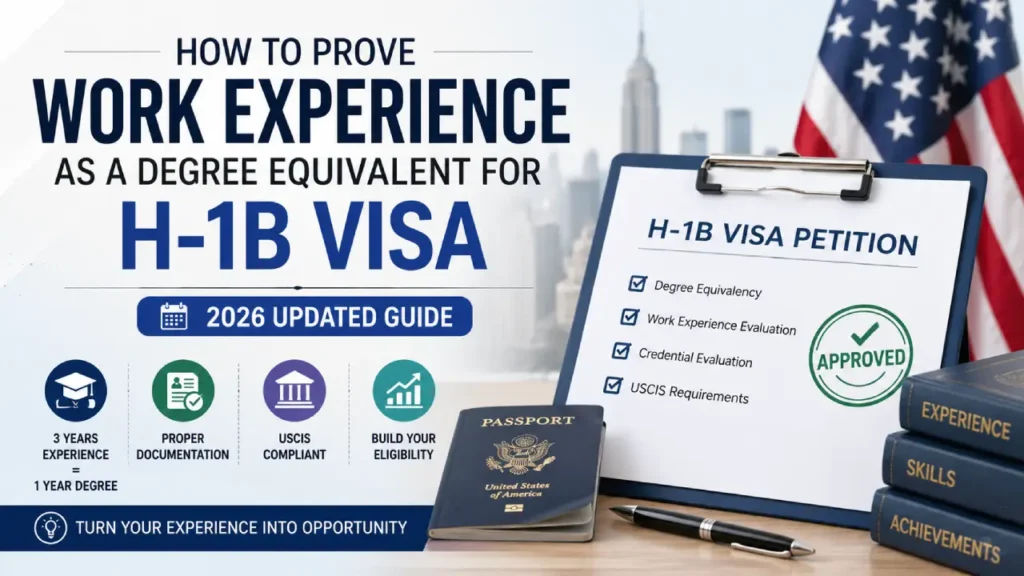
Quick Answer: Under 8 CFR § 214.2(h)(4)(iii)(D), USCIS allows three years of progressive, specialized work experience to substitute for each year of missing college education — meaning 12 years of qualifying experience can equal a four-year U.S. bachelor’s degree. This work experience evaluation for H-1B must be documented through detailed employer letters, a credential evaluation from a NACES- or AICE-accredited service, and evidence of progressively responsible roles. Foreign degrees must also undergo an education evaluation for H1B to confirm U.S. equivalency. The process is complex, but thousands of professionals qualify every year through this pathway.
Key Takeaways:
- The “three-for-one rule” under 8 CFR § 214.2(h)(4)(iii)(D) allows 3 years of specialized experience to replace 1 year of college — 12 years total for a bachelor’s equivalent
- A professional work experience evaluation from a NACES- or AICE-accredited service is the most accepted form of documentation with USCIS
- Foreign degree holders must complete an education evaluation for H1B to establish U.S. equivalency — this is a separate, mandatory step
- USCIS approved 97.9% of H-1B petitions in FY 2025, but RFE rates climbed to ~23% — weak experience documentation is a leading trigger
- A new weighted lottery system effective February 27, 2026 favors higher wage levels, making strong qualification evidence more critical than ever
- Professionals without any degree can qualify — but they need 12 years of progressive experience, not just 12 years in any job
You don’t have a U.S. bachelor’s degree. Maybe you earned a 3-year diploma abroad, climbed the ranks through hands-on work, or built an entire career before ever stepping into a college classroom. Now your employer wants to sponsor you for an H-1B, and the first question your immigration attorney asks is: “How are we going to prove degree equivalency?”
This is exactly where a proper work experience evaluation for H-1B becomes the difference between approval and an RFE that derails your entire timeline.
The good news: U.S. immigration law has always recognized that expertise isn’t earned exclusively in classrooms. The legal framework at 8 CFR § 214.2(h)(4)(iii)(C) explicitly allows professionals to qualify for H-1B classification through equivalent combinations of education, specialized training, and progressively responsible work experience. What USCIS wants isn’t a diploma — it’s proof that you’ve achieved the same level of knowledge, competence, and practice as someone who holds a bachelor’s degree in the specialty.
This guide covers everything you need to know in 2026: what USCIS actually looks for, how the three-for-one rule really works, the five officially accepted methods to prove equivalency, what your documentation must include, and the biggest mistakes that trigger RFEs even in strong cases.
What Are H-1B Specialty Occupation Degree Requirements?
Before you can prove equivalency, you need to understand what you’re proving equivalency to. The H-1B visa exists for specialty occupations — positions that require the theoretical and practical application of a body of highly specialized knowledge, and that normally require a bachelor’s degree (or higher) in a directly related specific specialty as a minimum for entry.
That phrase “directly related” is doing a lot of heavy lifting. USCIS defines it as “a logical connection between the required degree, or its equivalent, and the duties of the position.” A Computer Science degree aligns with a software developer role. A Business Administration degree does not automatically align with a data engineering role — USCIS has been increasingly skeptical of those connections since 2024.
The Four Criteria That Define a Specialty Occupation
Under USCIS regulations, a position qualifies as a specialty occupation if it meets at least one of these four criteria:
- A baccalaureate or higher degree in a specific specialty is the normal minimum requirement for entry into the position
- The degree requirement is common to similar positions across the industry
- The employer normally requires a degree or equivalent for this role
- The duties are so specialized and complex that the knowledge required is usually associated with a bachelor’s degree or higher
A strong H-1B petition proves both sides: that the job qualifies as a specialty occupation AND that you meet the degree or equivalent experience requirement. This is precisely why an H-1B expert opinion letter from a credentialed specialist is so valuable — it addresses the four-part specialty occupation test directly in USCIS-accepted language.
What “Education Evaluation for H1B” Actually Means
The phrase education evaluation for H1B covers two different scenarios, and most guides conflate them — which causes real confusion.
Scenario 1 — You have a foreign degree: Your degree needs to be evaluated and compared to U.S. standards. A NACES-accredited credential evaluation agency reviews your transcripts, diplomas, and academic records and produces a report confirming whether your degree is equivalent to a U.S. bachelor’s degree (or higher). This is called a foreign degree evaluation for H1B or credential evaluation for H1B.
Scenario 2 — You lack a full four-year degree: You need a work experience evaluation for H1B that demonstrates how your combined education, training, and professional experience equals a U.S. bachelor’s degree in the specialty. This is more complex — and more likely to attract USCIS scrutiny.
Both types of evaluations are required to be submitted with Form I-129. Skipping either is one of the most common reasons USCIS issues an RFE related to beneficiary qualifications. You can review all AAE Evaluations services to understand which evaluation type applies to your situation.
The Legal Foundation: 8 CFR § 214.2(h)(4)(iii)(D) Explained
If there’s one regulation you should know before any H-1B petition meeting, it’s this one. Section 8 CFR § 214.2(h)(4)(iii)(D) defines what “equivalence” actually means for someone without a traditional four-year degree. It states that a candidate must demonstrate “achievement of a level of knowledge, competence, and practice in the specialty occupation that equals that of an individual who has a baccalaureate or higher degree in the specialty.”
That definition is precise for a reason: it’s not about years on the job — it’s about demonstrable mastery of specialized knowledge.
The regulation then lists five specific methods to prove this equivalency. Any one of them, properly documented, can satisfy USCIS.
The Five Officially Accepted Equivalency Methods
1. Credential evaluation from a reliable credentials evaluation service — This is the most common path. A professional evaluation agency (ideally accredited by NACES or AICE) reviews your complete professional and academic background and issues a formal opinion stating that your credentials are equivalent to a U.S. bachelor’s degree in a specific field. USCIS adjudicators view these evaluations most favorably when they’re “credible, logical, and well-documented” — which means the evaluator should clearly explain how your experience maps to specific academic credit equivalencies, not just assert that it does.
2. Evaluation by an accredited college official — An academic official at a U.S. college or university with the authority to grant credit for training and experience can provide a written evaluation. This approach works well if you’ve worked closely with academic institutions or if a university professional can genuinely speak to your specialty-level knowledge.
3. College-level equivalency examination results — Programs like CLEP (College Level Examination Program) test specific academic knowledge areas. If your experience has given you deep knowledge of subjects tested by these exams, passing scores serve as evidence of college-level equivalency.
4. Certification from a professional association — If you hold a recognized certification or registration from a well-established professional body with strict membership standards, that documentation can support your equivalency claim.
5. Recognition of expertise through progressively responsible positions — USCIS itself may determine that your career trajectory demonstrates equivalent degree acquisition. This is proven through your employment history, employer verification letters, peer acknowledgments, industry recognition, publications, or professional memberships.
Most successful petitions for candidates without degrees combine methods 1 and 5 — a professional work experience evaluation plus strong employer documentation of progressive responsibility. In complex cases, pairing the evaluation with an H-1B expert opinion letter further strengthens the beneficiary qualification argument before USCIS.
The Three-for-One Rule: What It Actually Requires
The “three-for-one rule” is frequently misunderstood, and that misunderstanding leads to avoidable RFEs. Let’s get this precisely right.
The basic math: Three years of specialized training or work experience = one year of college education. To fully substitute a four-year U.S. bachelor’s degree, you need 12 years of qualifying experience.
But here’s what most guides skip: if you have some formal education, the math changes. A person with a two-year diploma needs six additional years of qualifying experience. Someone with a three-year foreign degree (common in India, the UK, and many Commonwealth countries) needs three years of qualifying experience. And someone who attended two years of college but didn’t graduate needs six qualifying years.
This matters because foreign credential evaluation for H1B often establishes partial credit — meaning your foreign education reduces the experience requirement proportionally.
What Counts as “Specialized” Experience
Not every job that happens to be in your field counts toward the three-for-one calculation. USCIS looks for experience that combines theoretical knowledge with practical application in the specialty occupation. Routine tasks that don’t involve the application of specialized concepts typically don’t qualify.
The USCIS regulation specifically requires that your experience come from work in a professional environment — among peers, supervisors, or subordinates who themselves hold degrees in the specialty. This is the “professional environment” test, and it’s often overlooked. Ten years running a small business in your industry may not satisfy it if you were working independently without that professional framework around you.
Your experience also needs to conclude in professional-level employment. This doesn’t mean every year had to be at the professional level — it means your career arc must have arrived there. USCIS explicitly acknowledges that professionals often start below the professional level and build up. What matters is where you ended up, not where you started.
Progressive Responsibility: The Most Critical Documentation Requirement
“Progressive responsibility” is the concept that trips up the most applications. USCIS doesn’t just want a list of jobs you held — it wants to see that your responsibilities, complexity of work, and level of decision-making increased over time.
Think of it this way: twelve years doing the same entry-level job is not equivalent to a degree. Twelve years of advancement from entry-level to professional-level specialist, with increasing autonomy, complexity, and expertise — that’s what the regulation is describing.
Your employer letters must tell this story explicitly. They can’t simply list job duties and employment dates. They need to articulate how your role evolved, what new responsibilities you took on, how your work became more complex or independent over time, and what level of expertise you demonstrated by the end of your tenure.
How to Document Work Experience for H-1B: A Step-by-Step Guide
Documentation is where most experience-based petitions succeed or fail. USCIS adjudicators can’t see your expertise — they can only see what’s on paper. Here’s how to make sure the paper tells the right story.
Step 1: Map Your Experience Against the Degree Requirement
Before you gather a single document, sit down with your attorney and map your professional history against the specific knowledge domains of a bachelor’s degree in your specialty. If your field is computer science, what are the core subject areas a CS degree covers — algorithms, data structures, systems design, software engineering? Which parts of your work history demonstrate experience in each area?
This mapping exercise accomplishes two things: it helps you identify gaps, and it gives your credential evaluator the framework they need to write a compelling, USCIS-approved opinion.
Step 2: Secure Experience Letters That Actually Work
Each employer letter should be on company letterhead and include all of the following:
- Your full name and job title(s) held
- Exact employment dates (month and year — not just years)
- Whether employment was full-time or part-time, and if part-time, the number of weekly hours
- A detailed description of your duties, emphasizing specialized knowledge applied
- Explicit language about how your responsibilities became more complex or advanced over time
- The educational background or equivalent of colleagues and supervisors in your department
- A statement confirming that your experience “concluded in professional-level employment”
The supervisor or HR representative who writes the letter must have direct personal knowledge of your work. Generic letters that describe a job category rather than your actual work are a leading cause of RFEs.
If a former employer no longer exists, your former supervisor can write the letter on their current employer’s letterhead, explaining their relationship to you during the relevant period.
Step 3: Choose the Right Credential Evaluation Service
For your education evaluation for H1B, choose a service accredited by NACES (National Association of Credential Evaluation Services) or AICE (Association of International Credential Evaluators). USCIS adjudicators are familiar with these bodies and view their evaluations as credible.
Your evaluator will need all academic diplomas, transcripts, and certificates (with certified English translations for any non-English documents), a detailed employment history, any professional licenses or certifications, and the specific job description for the H-1B petition.
The evaluation should explicitly state that your combined education and experience is equivalent to a U.S. bachelor’s degree in a specific field — not just “equivalent to a bachelor’s degree” generically. The field must match the specialty occupation claimed in the petition. See AAE Evaluations’ pricing page for a breakdown of evaluation types and turnaround options.
Step 4: Gather Supporting Evidence of Expertise Recognition
USCIS regulations specifically reference “recognition of expertise” as a required element when experience substitutes for a degree. This recognition can be demonstrated through professional organization memberships, industry certifications, published articles, awards, patents, and expert opinion or recommendation letters from recognized authorities in your specialty.
This is the part that separates strong petitions from mediocre ones. Anyone can document twelve years of employment. Fewer people can document twelve years of employment and demonstrate that their industry peers recognize them as having expert-level knowledge. A position-by-position evaluation can help build this case by formally analyzing the seniority and complexity of each role you’ve held.
2026 Update: What’s Changed and Why It Matters
Several significant policy changes since mid-2025 affect how you approach an experience-based H-1B petition in 2026.
The weighted lottery system (effective February 27, 2026): USCIS implemented a new selection rule that assigns additional lottery entries to petitions with higher DOL wage levels. While this primarily affects lottery selection, it has a secondary effect: employers sponsoring higher-skill workers are under more pressure to ensure the petition documents specialty occupation clearly.
Rising RFE rates: After hitting a low of 15.2% in FY 2023, RFE rates climbed to 19.7% in FY 2024 and approximately 23% in FY 2025. For petitions that rely on experience equivalency — which already face higher scrutiny — expect rates to be even higher. The good news: the approval rate after RFE improved to 85.4% in FY 2025, meaning a well-prepared response still wins most cases.
Degree-mismatch denials: Analysis of USCIS data from 2024–2026 shows that degree-mismatch issues account for roughly 22% of H-1B rejections — including cases where applicants had advanced degrees, but from fields USCIS deemed insufficiently related to the position. For experience-based petitions, the threshold is at least as high. Your credential evaluation must establish equivalency in the specific field of the specialty occupation.
The $100,000 supplemental fee: A 2025 Presidential Proclamation introduced a $100,000 supplemental fee for certain new H-1B petitions — primarily those involving individuals outside the U.S. This has raised the financial stakes for employers, which in turn raises the expectation that petitions will be maximally defensible before filing.
Common Mistakes That Trigger H-1B RFEs on Experience-Based Petitions
| Mistake | Why It Triggers an RFE | How to Avoid It |
|---|---|---|
| Experience letters with vague job descriptions | USCIS can’t assess specialty-level knowledge from generic duty summaries | Letters must describe specific specialized tasks and how they required advanced knowledge |
| No mention of progressive responsibility | Doesn’t satisfy the regulatory requirement | Each letter should explicitly describe how the role evolved over time |
| Credential evaluation doesn’t specify a field | Generic “bachelor’s equivalent” is insufficient | Evaluation must name the specific specialty (e.g., “equivalent to a U.S. bachelor’s degree in Computer Science”) |
| Non-English documents without certified translations | USCIS cannot review untranslated documents | All foreign-language documents must include certified English translations |
| Evaluator lacks NACES/AICE accreditation | USCIS may dismiss or discount the evaluation | Use only NACES- or AICE-accredited services |
| Experience overlaps not counted correctly | Concurrent roles may not be additive | Clarify full-time equivalency in every letter |
| Missing evidence of professional environment | Fails the “professional peers” requirement | Include information about colleagues’ and supervisors’ educational backgrounds |
Frequently Asked Questions
Can I qualify for an H-1B without any degree at all?
Yes — but the documentation burden is significant. If you have no formal post-secondary education, you need to demonstrate 12 years of qualifying progressive work experience in the specialty occupation. You’ll also need a professional work experience evaluation for H-1B from an accredited evaluation service to document it properly for USCIS.
What is an education evaluation for H1B and who needs one?
An educational evaluation for H1B is a formal assessment of your academic or professional credentials against U.S. standards, produced by an accredited credential evaluation agency. If you have a foreign degree, you need one to confirm your degree’s U.S. equivalency. If you’re substituting work experience for a degree, you need an experience-based evaluation that maps your professional history to the equivalent academic credit. See AAE Evaluations’ Education Evaluation for H1B for a full overview of what’s included.
Does a 3-year foreign degree qualify as a U.S. bachelor’s degree equivalent?
Not automatically. A three-year degree from countries like India, the UK, or Australia is typically evaluated as equivalent to a three-year U.S. degree — one year short of a four-year bachelor’s. In this case, you need to supplement your foreign degree with at least three years of qualifying specialized work experience. A proper foreign degree evaluation for H1B will clarify the specific equivalency. You can also use a course-by-course evaluation to establish precise GPA and credit-level equivalency for USCIS.
What does “progressive responsibility” mean in practice?
Progressive responsibility means your career shows a measurable upward trajectory — not just time logged in a field. Examples include: promotions with increased decision-making authority, expanding team or project leadership, transition from supervised to independent work, development of specialized techniques or methods, and being called upon to train or mentor others. Your employer letters must articulate this progression explicitly — USCIS won’t infer it from job titles alone.
Can I use part-time experience toward the three-for-one calculation?
Yes, but it’s calculated on a full-time-equivalent basis. If you worked 20 hours per week at a qualifying job, USCIS will credit you with half the calendar duration. Your employer letters must specify weekly hours for every part-time position.
What is an H1B professional evaluation and how is it different from an academic evaluation?
An H1B professional evaluation (also called a work experience evaluation) focuses specifically on your employment history and professional expertise, rather than academic credentials. An academic evaluation for H1B focuses on your foreign educational credentials and establishes their U.S. equivalency. Many candidates need both. AAE Evaluations offers both through a single engagement — visit the services page to see what’s needed for your case.
Is it possible to get an H-1B with only a diploma or associate-level credential?
Yes, with the right documentation. If you hold a two-year diploma or associate’s degree, USCIS would typically credit that as two years of the four-year bachelor’s requirement, meaning you need six additional years of qualifying specialized work experience. A credential evaluation service will assess your diploma and determine the exact U.S. credit equivalency.
My previous employer closed down. How do I get an experience letter?
Your former supervisor can write the letter on their current employer’s letterhead, explaining their supervisory relationship to you at the previous company, confirming the dates and nature of your employment, and providing current contact information for USCIS verification.
What is educational evaluation for H1B visa when I have no degree at all?
When you have no formal degree, the educational evaluation process focuses entirely on your work history. The evaluator reviews your employment letters, certifications, professional memberships, and any relevant training to build the case that your experience — totaling 12 qualifying years — constitutes the equivalent of a bachelor’s degree in your specialty. Get in touch with AAE Evaluations to discuss your specific history before starting the process.
What Happens If USCIS Issues an RFE on Your Equivalency Claim?
An RFE is not a denial — it’s a formal request for additional evidence. But it is a warning, and how you respond determines everything.
RFE rates on H-1B petitions hit approximately 23% in FY 2025, and experience-based petitions tend to attract higher-than-average scrutiny. If you receive an RFE related to beneficiary qualifications or degree equivalency, USCIS is almost certainly asking for one of these:
- A more detailed or accredited credential evaluation
- Stronger employer letters with more specific duty descriptions and progressive responsibility language
- Evidence of professional environment (colleagues’ and supervisors’ educational backgrounds)
- An H-1B expert opinion letter providing an independent credentialed analysis of your specialty occupation qualification — starting at $475 with a 5–6 business day turnaround
You have 87 calendar days to respond. Use them — but don’t wait. The most successful RFE responses are comprehensive packages, not point-by-point replies.
The H-1B RFE response process for education challenges is covered in detail in our guide — if you’ve already received an RFE, that’s your next read.
Final Thoughts on Proving Work Experience as a Degree Equivalent in 2026
The three-for-one rule has been part of U.S. immigration law for decades, and it remains a legitimate, well-established path to H-1B qualification. But the 2026 environment is more rigorous than it was even three years ago — RFE rates are climbing, USCIS adjudicators are applying stricter scrutiny to experience equivalency claims, and the new weighted lottery system has raised the stakes for every petition.
What this means practically: experience-equivalent H-1B petitions aren’t just possible in 2026 — they’re regularly approved. But they require more thorough documentation, more carefully worded employer letters, and more precise credential evaluations than many applicants expect.
Start the documentation process early. Give your former employers enough time to write thorough, accurate letters. And make sure your credential evaluator understands that USCIS needs to see field-specific equivalency spelled out explicitly — not just a generic “bachelor’s equivalent” stamp.
If you’re ready to start the education evaluation for H1B process, or if you need a work experience evaluation for H-1B that’s built to withstand USCIS scrutiny, AAE Evaluations works with immigration attorneys and petitioners at every stage — from initial evaluation through RFE response. You can also explore our expert opinion letter services if your case needs independent credentialed analysis of your specialty occupation status.
Ready to get started? Contact our team or call (+1) 813-816-3969 to discuss your specific situation. View our pricing for a full breakdown of evaluation types and turnaround times.