How to Qualify for an EB-2 National Interest Waiver (NIW)
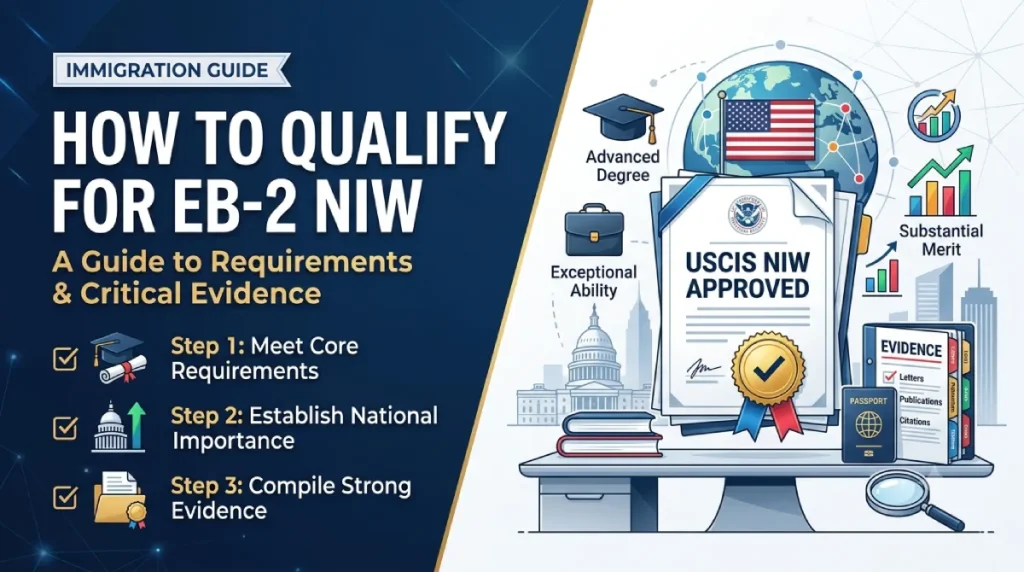
To qualify for an EB-2 National Interest Waiver (NIW), you generally need to clear two separate stages. Do not mix them up.
Stage 1 – EB-2 eligibility. You must show either an advanced degree (or the equivalent) or exceptional ability in the sciences, arts or business.
Stage 2 – the waiver. You must show, under the three-prong framework in Matter of Dhanasar, that waiving the job offer and labor certification is in the national interest. USCIS decides this in its discretion.
- Prong 1: your proposed endeavor has substantial merit and national importance.
- Prong 2: you are well positioned to advance the endeavor.
- Prong 3: on balance, it would benefit the United States to waive the job offer and labor certification.
Meeting a checklist does not guarantee approval. The sections below explain each stage and what evidence typically supports it.
What the EB-2 NIW is and who can self-petition
EB-2 is an employment-based second-preference immigrant category. Most EB-2 cases need a U.S. employer offer and a Department of Labor labor certification (PERM). The NIW lets USCIS waive both when doing so is in the national interest. As USCIS explains, people seeking the waiver can self-petition using Form I-140.
That is why the NIW is built around you and your proposed endeavor rather than a specific employer’s job description. It is also why a strong petition explains a concrete plan of work, not just a resume.
Step 1: Meet the EB-2 eligibility requirement
USCIS’s Policy Manual says NIW petitioners must first establish EB-2 eligibility as a threshold matter. There are two routes.
Route A: Advanced degree or equivalent
- A U.S. master’s degree or higher, or a foreign equivalent degree.
- Or a U.S. bachelor’s degree (or foreign equivalent) plus at least five years of progressive post-baccalaureate experience in the specialty.
- Typical evidence: official academic records and, for the experience route, letters from current or former employers.
Foreign degrees often need a U.S. equivalency opinion. AAE Evaluations offers education evaluations for USCIS and work experience evaluations that can document degree equivalency and experience.
Route B: Exceptional ability
Exceptional ability means a degree of expertise significantly above what is ordinarily encountered in the field. Under the regulation at 8 CFR 204.5(k), you generally provide evidence for at least three of these six types, and USCIS then weighs everything together (a final merits determination):
- An official academic record showing a degree, diploma or certificate related to your area of exceptional ability.
- Letters from current or former employers showing at least ten years of full-time experience.
- A license or certification to practice your profession.
- Salary or other remuneration that demonstrates exceptional ability.
- Membership in professional associations.
- Recognition for achievements and significant contributions from peers, governmental entities, or professional or business organizations.
Comparable evidence may be submitted if these criteria do not readily apply to your occupation. Per USCIS’s January 2025 update, for people relying on exceptional ability, that ability must relate to the proposed endeavor.
Step 2: The Matter of Dhanasar three-prong test
Matter of Dhanasar, 26 I&N Dec. 884 (AAO 2016), is the framework USCIS uses for the waiver. USCIS says a petitioner must meet all three prongs, and that granting a waiver is a discretionary decision.
Prong 1: Substantial merit and national importance
Substantial merit can be shown in many fields, including business, science, technology, health, education and culture. National importance is about the prospective impact of your specific endeavor, not the importance of your field in general. The 2025 Policy Manual update expanded USCIS’s guidance on how it views national importance arguments, so describe a specific problem, your approach, and who benefits beyond one employer or client.
Prong 2: Well positioned to advance the endeavor
Dhanasar lists factors USCIS may consider:
- Your education, skills, knowledge and record of success in related or similar efforts.
- A model or plan for future activities.
- Progress toward achieving the proposed endeavor.
- Interest from potential customers, users, investors or other relevant entities.
The endeavor and your background need a clear connection. Independent corroboration usually carries more weight than self-description.
Prong 3: Beneficial to waive the job offer and labor certification
USCIS balances the benefit of your contributions against the protections labor certification normally provides. Factors under Dhanasar include whether labor certification is impractical for your situation, whether the national interest in your contributions outweighs the usual process even if qualified U.S. workers exist, and whether there is urgency. Explain why the standard process does not fit your endeavor.
How to define your proposed endeavor
The proposed endeavor is the work you plan to do in the United States. Vague descriptions are a common weakness. A useful draft answers five questions:
- What specific problem or need will you address?
- What will you do, and what is your method or product?
- Who benefits, and at what scale (a region, an industry, a public-interest area)?
- What have you already done that shows you can carry it out?
- What are the next steps, and what support or interest already exists?
Compare: “I am a software engineer” tells USCIS little. A scoped description of a particular tool, its intended users and its expected impact gives an officer something to evaluate. Keep the endeavor consistent across your petition, letters and any business plan. For founders, an EB-2 NIW business plan can help document the plan, though USCIS says it evaluates such evidence in the context of the whole record.
Evidence checklist by prong
Evidence varies by field. Use this as a starting list, not a guarantee that any item will be enough.
EB-2 threshold
- Degree certificates and transcripts
- Credential evaluation for foreign degrees
- Employer letters documenting years of experience
- For exceptional ability: licenses, memberships, salary evidence, peer recognition
Prong 1 and 2
- Detailed endeavor statement
- Publications, citations, patents or products
- Independent letters from people in the field
- Evidence of progress: prototypes, data, pilots, contracts
- Letters of interest from prospective users, investors or collaborators
Prong 3
- Explanation of why a job offer or labor certification is impractical
- Evidence of urgency, where it truly exists
- Support showing the benefit to the U.S. outweighs the usual process
- Consistent narrative across all documents
Letters, evaluations and business plans: what each one does
Applicants often confuse supporting documents. They serve different purposes:
- Credential evaluation: documents U.S. equivalency of foreign education. Helps with the EB-2 threshold. (https://aaeevaluations.com/services/education-evaluation/)
- Recommendation letters: written by people who know your work, such as collaborators or users. Describe your contributions and their impact. (https://aaeevaluations.com/services/recommendation-letters-for-eb-2-niw-visa-petitions/)
- Expert opinion letter: an independent expert’s analysis of your work and the Dhanasar factors. Read AAE’s guides on cost, sample format and USCIS requirements. (https://aaeevaluations.com/services/eb-2-niw-expert-opinion-letters/)
- Immigration business plan: lays out the venture and plan for entrepreneurs and independent professionals. (https://aaeevaluations.com/eb-2-niw-business-plan/)
None of these replaces strong underlying evidence such as publications, results, contracts or documented progress. USCIS says it evaluates letters and plans for their content and credibility, so generic or exaggerated letters can hurt more than help.
Want help organizing supporting documents?
AAE Evaluations prepares credential evaluations, expert opinion letters, recommendation letters and business plans. We do not provide legal advice or guarantee approval.
Explore EB-2 NIW Expert Opinion Letters
Illustrative examples by profession
Hypothetical examples. These are simplified scenarios to show how to think about the prongs, not real cases or predictions.
Researcher
A researcher developing a method to detect a specific crop disease might support Prong 1 with evidence of the disease’s U.S. agricultural impact, Prong 2 with publications and independent expert letters, and Prong 3 with an explanation of why research on this project does not fit a single employer’s job posting.
Software or AI engineer
Writing “AI helps the economy” is too broad. A narrower endeavor, such as a specific security tool for a defined group of U.S. users, with evidence of prototypes, adoption or user interest, is easier to evaluate.
Entrepreneur
USCIS’s updated guidance says not every entrepreneur qualifies and that broad claims about economic benefit or job creation alone are not enough. Entrepreneurs should document the specific business, the problem it solves, their role, progress and supporting evidence.
Physician
Physicians serving in shortage areas or at certain VA facilities may have a separate NIW pathway under 8 CFR 204.12, which has its own requirements. Check the regulation and USCIS guidance, or ask an attorney, before choosing a route.
Common reasons NIW petitions struggle
- Describing a job or field instead of a specific proposed endeavor.
- Claiming national importance without explaining the scale or mechanism of impact.
- Letters that repeat the petition’s claims without independent detail.
- Relying on experience that does not relate to the proposed endeavor.
- Inconsistencies between the resume, endeavor statement, letters and business plan.
- Skipping the Prong 3 explanation, or treating it as automatic.
- Using a foreign degree without a proper evaluation when one is needed.
A Request for Evidence (RFE) is not a denial. It is a request for more information, and a careful, evidence-based response matters. AAE can review an RFE and prepare documentation, coordinated with your attorney where one is involved, without promising any outcome.
Filing process overview
- Confirm EB-2 eligibility (degree route or exceptional ability).
- Draft and refine your proposed endeavor.
- Collect evidence for each Dhanasar prong.
- Obtain credential evaluations, recommendation or expert letters, and any business plan where appropriate.
- File Form I-140 with the required fees and evidence, following current USCIS instructions.
- After I-140 approval, the next step depends on visa availability and your circumstances (adjustment of status or consular processing).
Processing times, fees and visa availability change. Check the USCIS Form I-140 page and the State Department’s Visa Bulletin for current information.
Self-assessment checklist
If you can answer “yes” to most of these, your case may be ready for detailed preparation. If not, you may need to build evidence first.
- I can document an advanced degree or equivalent, or at least three exceptional-ability criteria.
- I can describe my proposed endeavor in a few specific sentences.
- I can explain who benefits beyond one employer.
- I have independent evidence of my record of success.
- I can show progress or interest supporting the plan.
- I can explain why a job offer and labor certification do not fit my endeavor.
- My documents tell one consistent story.
Frequently asked questions
Is the EB-2 NIW the same as EB-2?
No. EB-2 is the category; the NIW is a waiver of the job offer and labor certification within it. You must first qualify for EB-2, then satisfy the waiver framework.
Do I need a job offer?
Not for the NIW. USCIS says people seeking the waiver may self-petition on Form I-140. You still need to show a specific proposed endeavor.
Is the Dhanasar test the same as EB-2 eligibility?
No. EB-2 eligibility concerns your degree or exceptional ability. The three Dhanasar prongs concern your endeavor, your position to advance it, and the balance of waiving the usual requirements.
Do I need an expert opinion letter?
It is not a formal requirement. Some petitioners use one to explain technical significance. USCIS evaluates the content and credibility of any letter, so it should supplement, not replace, strong evidence.
What is the difference between a recommendation letter and an expert opinion letter?
A recommendation letter usually comes from someone familiar with your work. An expert opinion letter is an independent expert’s analysis of your work and its significance.
Can early-career professionals qualify?
Possibly. There is no fixed years-of-experience threshold under Dhanasar, but your record must show you are well positioned to advance the endeavor.
How long does it take?
It varies by processing times and visa availability, which change. Check USCIS and the Visa Bulletin for current figures.
Does AAE Evaluations guarantee approval?
No. AAE prepares supporting documentation and does not provide legal advice. No provider can legitimately guarantee USCIS approval.
Official sources
- USCIS Policy Manual, Vol. 6, Part F, Ch. 5 (Advanced Degree or Exceptional Ability) (https://www.uscis.gov/policy-manual/volume-6-part-f-chapter-5)
- USCIS policy alert PA-2025-03 (January 15, 2025) (https://uscis.gov/sites/default/files/document/policy-manual-updates/20250115-Employment-BasedNationalInterestWaivers.pdf)
- USCIS alert: Updates Guidance on National Interest Waivers (https://uscis.gov/newsroom/alerts/uscis-updates-guidance-on-national-interest-waivers)
- USCIS Form I-140, Immigrant Petition for Alien Workers (https://www.uscis.gov/i-140)
- Matter of Dhanasar, 26 I&N Dec. 884 (AAO 2016) – available through the DOJ EOIR and USCIS precedent decision pages.
- 8 CFR 204.5(k) (advanced degree and exceptional ability) and 8 CFR 204.12 (physicians in shortage areas).
Ready to organize your EB-2 NIW supporting documents?
Tell AAE Evaluations about your petition and we will explain which documentation may apply and what to expect next. We do not provide legal advice or guarantee outcomes.