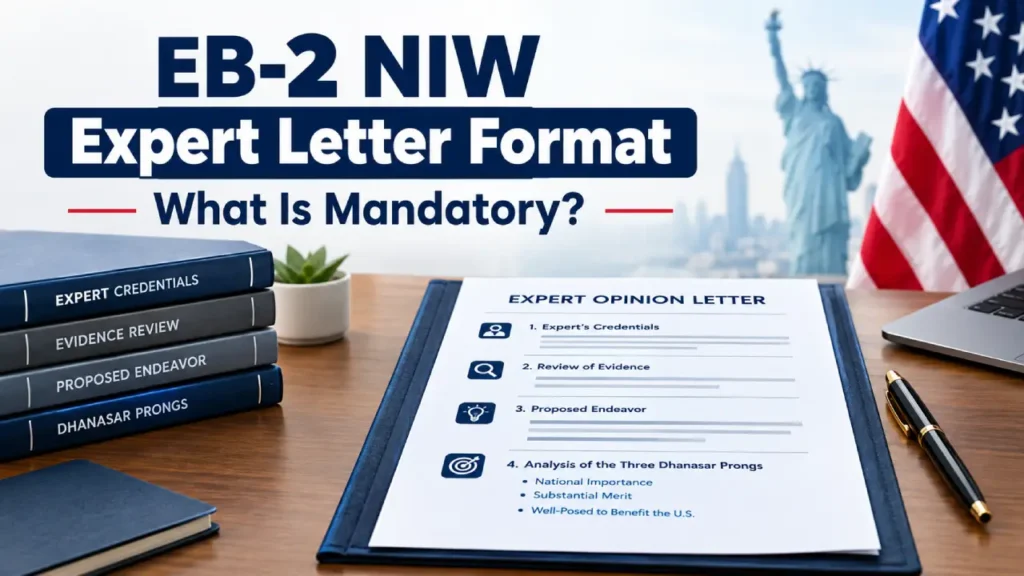
Quick Answer: USCIS does not publish a rigid, line-by-line template for EB-2 NIW expert opinion letters. However, every letter that survives adjudication follows the same structural logic: it opens with the expert’s credentials, defines the petitioner’s proposed endeavor, addresses all three prongs of the Matter of Dhanasar framework with specific evidence, and closes with an unambiguous professional conclusion. Skipping any of these components — or treating them superficially — is the most common trigger for a Request for Evidence (RFE).
If you’ve spent any time researching the EB-2 National Interest Waiver process, you’ve probably heard that expert opinion letters are critical. What you may not have heard is that the format of those letters matters just as much as their content. A letter from a highly credentialed expert that’s structured like a generic job recommendation will carry almost no weight with a USCIS adjudicator. Conversely, a well-structured letter from a credible independent expert — one that directly addresses the legal framework USCIS uses to evaluate NIW petitions — can be the single most persuasive document in your I-140 package.
This guide breaks down exactly what that structure looks like, section by section, and explains what USCIS is actually evaluating when it reads each part.
Does USCIS Require a Specific Expert Letter Template?
Let’s clear up the most common misconception first. USCIS does not publish or mandate a specific template for EB-2 NIW expert opinion letters. There’s no official government form you fill out, and there’s no mandatory word count or page length specified in the regulations.
What USCIS does require — by way of the Matter of Dhanasar precedent decision — is that expert letters address three specific legal prongs:
- The petitioner’s proposed endeavor has substantial merit and national importance
- The petitioner is well positioned to advance that endeavor
- On balance, it would benefit the United States to waive the normal job offer and labor certification requirements
A letter can be formatted in any number of ways and still satisfy these requirements. But across thousands of approved petitions, a consistent structural approach has emerged that USCIS adjudicators recognize and respond to. Deviating from that structure doesn’t make your letter more creative — it makes it harder for the officer to find the legal arguments they need to approve your case.
AAE Evaluations Note: Every EB-2 NIW expert opinion letter we prepare is custom-built around your specific proposed endeavor and structured explicitly around all three Dhanasar prongs. Learn more about our EB-2 NIW Expert Opinion Letter service.
The Standard Format: Section-by-Section Breakdown
Here’s how a USCIS-compliant EB-2 NIW expert opinion letter is structured in practice, along with what each section needs to accomplish.
Section 1: Letterhead, Date, and Formal Salutation
This is straightforward but matters more than people assume. The letter must be printed on the expert’s official institutional or professional letterhead. This alone signals to the adjudicator that the letter is a formal professional document, not a personal note.
- Letterhead: Expert’s institution, company, or independent practice
- Date: Current date at time of signing
- Salutation: Addressed to USCIS (“To Whom It May Concern” or “Dear USCIS Officer” are both acceptable)
A letter without letterhead — even from a highly credentialed expert — will immediately be treated as less authoritative. This is one of the first visual signals of credibility that an officer encounters.
Section 2: The Expert’s Credentials and Qualifications
This is where the letter earns its credibility, and it’s where most self-drafted or cheaply produced letters fall short. The expert doesn’t just need to be qualified — they need to demonstrate their qualifications in specific, verifiable terms.
What this section must include:
- The expert’s full name, title, and current professional affiliation
- Their academic degrees and the institutions that awarded them
- Specific leadership positions held in their field
- Publications, citation counts, H-index, or other measurable indicators of scholarly recognition (for academic experts)
- Patents, awards, professional honors, or media recognition
- Why this expert is specifically qualified to evaluate this petitioner’s work in this field
The last point is often skipped, and it’s a critical mistake. An immigration officer isn’t automatically impressed by a long CV — they need to understand why this particular expert’s opinion should carry weight on this particular topic. If your expert is a biomedical engineer writing about your AI-based drug discovery platform, the letter needs to explicitly connect those dots.
Simply stating “I am a leading expert in the field” is not enough. Persuasive letters cite specific examples: named awards, publication counts, citation numbers, named leadership positions, media appearances. Make it concrete.
It is also best practice to attach the expert’s full curriculum vitae (CV) to the letter as a supporting document.
Section 3: How the Expert Knows the Petitioner
Before the expert can credibly evaluate your work, the letter needs to establish the basis of their knowledge of you. This section answers a simple but important question: why is this expert writing about you?
Common and persuasive ways experts come to know petitioners include:
- Having encountered the petitioner’s published research and relied on it in their own work
- Having attended presentations or conference talks by the petitioner
- Having used or licensed technology, software, or methodologies developed by the petitioner
- Having collaborated at arm’s length (not as a direct supervisor, which carries less independent weight)
- Being referred to the petitioner’s work through peer networks in the field
Critically: Letters from independent experts — those with no direct supervisory or financial relationship with the petitioner — carry significantly more weight than letters from current or former employers. USCIS needs to establish that the petitioner has earned a reputation in the field beyond their immediate professional circle. Independent letters are strong evidence of exactly that.
This doesn’t mean supervisor letters are useless. They serve a different purpose: confirming technical skills and role. But they shouldn’t be your primary source of credibility evidence, and they should never replace independent expert letters.
Section 4: Description of the Proposed Endeavor
This is often the section that separates good expert letters from exceptional ones. The proposed endeavor is the work the petitioner plans to continue doing in the United States — and the expert needs to explain it clearly, in non-technical language, in a way that a USCIS adjudicator (who is an immigration specialist, not a scientist or engineer) can actually understand.
What this section must accomplish:
- Define the petitioner’s field and the specific problem or opportunity their work addresses
- Explain the proposed endeavor in plain, accessible terms — no unexplained acronyms, no jargon without definition
- Describe why this particular approach or methodology matters
- Establish the context: what was the state of the field before this petitioner’s work?
This section is not a resume recitation. It’s a professional explanation of why the work matters — written by someone with the standing to make that argument credibly.
One practical tip: the expert should avoid describing the endeavor as “the applicant’s work” in purely abstract terms. Concrete descriptions — naming the technology, the methodology, the specific problem being solved — are far more persuasive to an adjudicator reviewing hundreds of similar petitions.
Section 5: Dhanasar Prong One — Substantial Merit and National Importance
This is where the letter gets into the legal analysis, and it’s where many otherwise qualified letters fail. Prong One requires demonstrating two things simultaneously: that the endeavor has substantial merit (it’s genuinely important within the relevant field) and national importance (it matters beyond the petitioner’s immediate clients, partners, or institution).
Substantial merit is usually the easier of the two to establish. The expert explains the significance of the petitioner’s work within the field, cites the problem or gap it addresses, and places it in the context of existing approaches or technologies.
National importance is trickier. The letter must connect the work to a broader U.S. benefit — economic competitiveness, public health, national security, energy independence, educational advancement, or another recognized area of national interest. Generic statements like “this work benefits the United States” won’t survive scrutiny.
Effective strategies for establishing national importance include:
- Quantifying economic impact: job creation projections, revenue potential, tax contribution estimates
- Citing the work’s connection to a recognized national priority (STEM workforce, clean energy, healthcare infrastructure, cybersecurity)
- Referencing government reports, federal agency priorities, or congressional findings that identify the problem the petitioner’s work addresses
- Demonstrating how the work improves existing practices across the industry, not just within one organization
Important update: The January 2025 USCIS policy guidance clarified that adjudicators now expect greater specificity on this prong. Generic endorsements and boilerplate statements about national importance carry significantly less weight than they did even two years ago. The expert must make a specific, supported argument — not a general assertion.
Section 6: Dhanasar Prong Two — Well Positioned to Advance the Endeavor
Prong Two asks: of all the people who could pursue this type of work, why is this petitioner the right person to do it in the United States? This requires the expert to evaluate the petitioner’s track record, not just describe it.
This section should include what immigration practitioners call “mini-case studies” — specific examples of the petitioner’s prior projects and their demonstrated impact on the field. Each example should:
- Name the specific project, technology, paper, patent, or initiative
- Describe what the petitioner did and how it differed from existing approaches
- Quantify the results wherever possible (citations, downloads, users, revenue, adoption by other organizations)
- Explain what positive interest the work generated among other industry actors
Avoid conclusory language like “the petitioner has significantly advanced the field.” USCIS adjudicators see that language constantly, and it gives them nothing to evaluate. Instead: “The petitioner’s 2022 paper on [specific topic], published in [named journal], has since been cited 47 times by researchers at institutions including [names], and the methodology was incorporated into the [named software or protocol] used by organizations including [names].”
Other evidence that supports the “well positioned” argument:
- Patents granted or pending
- Contracts, licensing agreements, or letters of intent from U.S. organizations
- Speaking invitations at recognized professional conferences
- Media coverage in industry publications
- High salary relative to peers in the same field and geography (supported by labor data)
- Grants or competitive funding received
The expert doesn’t need to recite your entire CV here. They need to select the most compelling evidence of past success and connect it explicitly to your capacity to advance the proposed endeavor going forward.
Section 7: Dhanasar Prong Three — Benefit to the United States to Waive Labor Certification
The third prong is sometimes treated as an afterthought, but it’s a distinct legal requirement and should be addressed explicitly rather than implied. The expert must make the affirmative case that it serves the national interest to grant the petitioner an NIW — that is, to exempt them from the usual requirement of a job offer and labor market test.
The core argument here is that the value the petitioner brings to the United States is not contingent on a single employer relationship. Their work has broader societal benefit, and requiring a specific job offer would undermine the petitioner’s ability to pursue work that benefits the country.
This can be argued through several angles:
- The petitioner’s work fills a gap that the domestic labor market alone cannot fill
- The petitioner’s unique expertise, background, or methodology cannot easily be replicated
- The petitioner’s work serves a national interest that transcends any individual employer
- Any delay in allowing the petitioner to work in the U.S. would cost the country competitively
The expert shouldn’t simply state that the petitioner “deserves” a waiver. They need to articulate specifically why the national interest is better served by granting a waiver than by requiring the petitioner to go through the standard labor certification process.
Section 8: Conclusion — Clear Professional Judgment
This is one of the most overlooked structural elements of an expert opinion letter. The conclusion must do more than summarize the preceding sections. It must deliver an unambiguous, professionally stated judgment from the expert.
An effective conclusion states clearly:
- That the expert’s opinion, based on their professional knowledge and experience, is that the petitioner’s work meets the national interest standard
- That granting the NIW is, in the expert’s professional judgment, in the interest of the United States
- Optionally: a final statement of the expert’s willingness to provide additional information or clarification if needed
Weak conclusions — those that trail off into general praise without a clear professional opinion — leave adjudicators without the anchor they need. The conclusion should read like an expert witness statement, not a letter of encouragement.
Section 9: Signature Block
The letter must be signed in ink (wet signature) or with a verifiable electronic signature by the named expert. The signature block should include:
- Expert’s full name (printed)
- Title and position
- Institutional affiliation
- Contact information (email and/or phone)
- Date of signature
The signature block is not cosmetic. It ties the credentialing claims at the top of the letter to a real, accountable person. Letters without a proper signature block or that are unsigned are routinely discounted by adjudicators.
Formatting Standards: Length, Language, and Presentation
Beyond the structural sections, there are practical formatting considerations that affect how the letter is received.
Length
Most approved EB-2 NIW expert opinion letters run between 4 and 8 pages. Letters shorter than 4 pages typically can’t address all three Dhanasar prongs with sufficient depth. Letters significantly longer than 8 pages risk losing the adjudicator’s attention on the key legal arguments.
For complex technical fields — advanced AI research, novel biotechnology, cutting-edge engineering — a longer letter that explains the field adequately before making the legal argument is often more appropriate. The goal is thoroughness, not brevity for its own sake.
Language and Tone
Expert opinion letters should be written in clear, professional English. This matters particularly in technical fields: a letter full of unexplained discipline-specific acronyms and jargon will fail to persuade an immigration officer who is not a subject-matter expert. The expert’s credibility is better demonstrated through clear explanation than through technical density.
At the same time, the language should be confident and direct. Hedging language (“it may be argued that,” “one could suggest that”) weakens the expert’s professional opinion. USCIS wants to hear what the expert actually thinks — not what might be speculated.
Avoid Generic Boilerplate
Perhaps the most common mistake in expert letter drafting — and one of the most frequently cited causes of RFEs — is the use of generic, boilerplate language that could apply to virtually any professional in the field. USCIS adjudicators review hundreds of NIW petitions and can immediately recognize a letter that hasn’t been written specifically for the individual petitioner.
Every substantive claim in the letter should be specific to this petitioner, this proposed endeavor, and this field. If the expert’s letter could be sent on behalf of any researcher, engineer, or professional in the same discipline with minimal editing, it’s not specific enough.
How Many Expert Letters Do You Need?
While there’s no regulatory minimum, the general practice for well-prepared EB-2 NIW petitions is to include 4 to 6 expert opinion letters. Here’s how to think about the mix:
- 2 letters from independent experts who came to know the petitioner through the petitioner’s work or reputation — these carry the most weight because they demonstrate impact beyond the petitioner’s immediate professional circle
- 2 letters from former supervisors or close collaborators — these confirm technical skills, role, and specific contributions, but are given less independent weight than truly independent letters
- 1–2 additional letters from experts who can address specific aspects of the petitioner’s qualifications — for example, one expert who can speak to research significance, another who can speak to practical applications, and a third who can address international recognition
It can also be strategically valuable to include at least one letter from a U.S.-based expert and one from an internationally recognized expert in the same field, as this demonstrates the petitioner’s global impact and cross-border recognition.
The letters should collectively address all three Dhanasar prongs from multiple credentialed perspectives — not simply repeat the same claims in different language.
Common Expert Letter Mistakes That Trigger RFEs
Understanding what USCIS flags is just as important as knowing what to include. These are the most common structural and substantive problems that lead to RFEs on expert letter quality:
1. Letters that are too short to address all three prongs with any depth. A two-page letter cannot meaningfully establish substantial merit, national importance, the petitioner’s track record, and the case for waiving labor certification. Don’t mistake brevity for professionalism.
2. Vague praise without supporting evidence. “Dr. [Name] is one of the leading researchers in the field” is a conclusory statement. “Dr. [Name]’s 2023 paper in Nature Biotechnology has been cited 89 times and has been incorporated into clinical trial protocols at three U.S. hospital systems” is evidence.
3. Generic letters that could apply to anyone. If the specific petitioner’s name were removed and replaced with another name, and the letter still made sense, it’s too generic.
4. Letters that address only one or two of the three Dhanasar prongs. All three must be addressed explicitly. Missing Prong Three — the case for the waiver itself — is a common omission.
5. Letters from non-independent sources only. If every letter in the package comes from current or former supervisors or direct collaborators, USCIS will question whether the petitioner has earned recognition beyond their immediate professional circle.
6. Technical language without explanation. An adjudicator who can’t understand what the petitioner actually does can’t evaluate whether it meets the national interest standard.
7. Unsigned letters or letters without proper letterhead. These are basic but critical credibility signals. Don’t skip them.
Expert Letters vs. Credential Evaluations: Understanding the Difference
Many EB-2 NIW applicants — particularly those with foreign degrees — need both an expert opinion letter and a credential evaluation. These are two distinct documents that serve different purposes, and they shouldn’t be confused.
A credential evaluation (also called an academic equivalency evaluation) establishes that the petitioner holds the U.S. equivalent of an advanced degree. It answers the baseline EB-2 eligibility question: does this person have the educational foundation to qualify for the second preference employment-based category?
An expert opinion letter addresses the NIW waiver question: does this person’s proposed endeavor meet the national interest standard, and should USCIS waive the normal job offer and labor certification requirements?
Both may be needed in the same petition, but neither substitutes for the other. A credential evaluation doesn’t address Dhanasar. An expert opinion letter doesn’t establish degree equivalency. The credential evaluation comes from a professional credential evaluation service; the expert opinion letter comes from a credentialed subject-matter expert in the petitioner’s field.
AAE Evaluations provides both credential evaluations and EB-2 NIW expert opinion letters — so you can get both documents from a single, USCIS-accepted provider.
What About RFE Response Letters?
Receiving a Request for Evidence on your EB-2 NIW petition is common — and receiving one doesn’t mean your case is heading toward denial. In many cases, an RFE is USCIS indicating that specific evidence was insufficient or unclear, not that the underlying qualifications don’t exist.
When an RFE targets expert letter quality, the response typically requires one of the following:
- A new or supplemental expert opinion letter that directly addresses the specific concerns USCIS raised
- An updated letter from the original expert that adds the missing specificity
- Additional letters from different experts that reinforce the weaknesses identified in the RFE
The RFE response letter should be structured in the same way as an initial expert letter, with the additional requirement of explicitly addressing the USCIS concerns point by point. This is not the time for general advocacy — it’s the time for targeted, specific responses to each deficiency the officer identified.
AAE Evaluations prepares RFE response letters specifically structured around the concerns raised in your RFE, with different subcategory variations depending on what USCIS has questioned.
A Note on the January 2025 USCIS Policy Update
The January 2025 USCIS policy guidance introduced meaningful changes to how NIW petitions are evaluated, with particular implications for expert letters. Key changes affecting expert letter format and content include:
- Adjudicators now expect greater specificity and direct relevance when evaluating national importance claims — broad assertions about benefiting the U.S. economy or scientific community are being scrutinized more rigorously
- Generic endorsements that read as professional courtesy rather than independent expert analysis are weighted lower than they previously were
- The January 2025 guidance also clarified a pathway for entrepreneurs, with expert letters playing a specific role in documenting the national importance of business-oriented endeavors and the petitioner’s unique positioning to advance them
If you’re preparing an NIW petition in 2025 or 2026, letters drafted prior to 2025 that haven’t been reviewed and updated for the current adjudication standards may not reflect what USCIS currently expects. This is particularly true for letters that rely on pre-Dhanasar frameworks or that were drafted as general recommendation letters rather than structured legal arguments.
Frequently Asked Questions
Does USCIS have an official format for EB-2 NIW expert letters?
No. USCIS does not publish a mandatory template. However, every approvable letter must address the three prongs of the Matter of Dhanasar framework: substantial merit and national importance of the proposed endeavor, the petitioner’s positioning to advance it, and the national benefit of waiving the job offer requirement. The structural format described in this article reflects what consistently meets that standard.
How long should an EB-2 NIW expert opinion letter be?
Most effective letters run 4 to 8 pages. The appropriate length depends on the technical complexity of the field and how much context is needed to explain the proposed endeavor to a non-specialist adjudicator. Letters shorter than 4 pages rarely address all three prongs with sufficient depth. Letters should never be padded for length — every section must serve a substantive purpose.
Can the expert write their own letter, or does it need to be professionally drafted?
Technically, the expert can write the letter themselves. In practice, most immigration practitioners recommend that the petitioner or a professional letter writing service provide a draft that the expert then reviews, revises, and signs. Experts are typically highly qualified in their own field, not in the legal specifics of the Matter of Dhanasar framework. A letter drafted by someone who understands both the expert’s credentials and the legal standard USCIS applies tends to be more effective than a letter written by the expert alone without guidance on what USCIS needs to see.
Can I use letters written for a previous visa category (O-1 or EB-1A) in my NIW petition?
Generally, no — or at least not without significant revision. Letters written for O-1 or EB-1A petitions focus on different legal standards (extraordinary ability, rather than the Dhanasar three-prong test). While some of the underlying evidence may overlap, the legal arguments, framing, and conclusions need to be revised to directly address the NIW criteria. Using the same letters across categories risks misaligning your evidence with the specific standard USCIS is applying.
What if my field is highly technical and hard to explain to a non-expert adjudicator?
This is exactly the challenge expert opinion letters are designed to address. The expert’s job is to explain complex, specialized work in terms that an intelligent non-specialist can understand and evaluate. Avoid unexplained jargon, define acronyms, and use analogies where they help. If USCIS can’t understand what you do, they can’t approve the waiver — no matter how impressive your credentials are.
How many expert letters should I include in my EB-2 NIW petition?
Most well-prepared petitions include 4 to 6 expert opinion letters. The mix should include at least 2 letters from genuinely independent experts (those with no direct supervisory or financial relationship with you) and 2 letters from former supervisors or collaborators who can confirm specific technical contributions. Letters from different experts can address different aspects of your qualifications — research significance, practical applications, international recognition — to create a comprehensive evidentiary picture.
What’s the difference between an expert opinion letter and a credential evaluation for EB-2 NIW? These are distinct documents that serve different purposes. A credential evaluation establishes that you hold the U.S. equivalent of an advanced degree — satisfying the baseline EB-2 eligibility requirement. An expert opinion letter addresses the NIW waiver criteria — arguing that your proposed endeavor meets the Matter of Dhanasar standard. Many foreign nationals need both. Neither document substitutes for the other.
What happens if my expert letter triggers an RFE?
An RFE related to expert letter quality typically asks for additional evidence, greater specificity, or clarification of specific claims. The response should include a new or supplemented expert letter that directly addresses each USCIS concern point by point — not a general resubmission of the same content. RFE responses need to be precise, targeted, and responsive to the specific deficiencies the officer identified.
Conclusion
The format of an EB-2 NIW expert opinion letter isn’t arbitrary — it’s a response to the specific legal framework USCIS uses to evaluate every NIW petition. A letter that opens with strong expert credentials, explains the proposed endeavor clearly, addresses all three Matter of Dhanasar prongs with specific and measurable evidence, and closes with an unambiguous professional judgment is structurally aligned with how officers are trained to evaluate these cases.
The inverse is equally true. A letter that’s generic, vague, or missing key structural components doesn’t just fail to help your case — it can actively raise questions about whether your qualifications are as strong as your other evidence suggests.
Getting expert letters right matters. If you’re filing for the first time, responding to an RFE, or reviewing letters drafted before the January 2025 policy update, now is the right time to ensure every letter in your package is structured to meet the current standard.
Ready to get started? AAE Evaluations prepares USCIS-compliant EB-2 NIW expert opinion letters written by credentialed, independent experts in your field — custom-researched, built around your specific proposed endeavor, and structured around all three Dhanasar prongs. Request your expert opinion letter today, or contact us with any questions about your petition.
This article is for informational purposes only and does not constitute legal advice. Immigration law is complex and fact-specific. Consult a qualified immigration attorney before filing any USCIS petition.