What Is the Format and USCIS Structure for an EB-2 NIW Expert Opinion Letter?
Quick Answer: USCIS does not prescribe a mandatory template, fixed page count, or specific layout for an EB-2 National Interest Waiver (NIW) expert opinion letter. A well-prepared letter typically identifies the expert’s qualifications, explains the petitioner’s proposed endeavor, evaluates relevant evidence, and provides a reasoned professional opinion addressing the three criteria established in Matter of Dhanasar. The strongest letters use specific examples, explain the significance of documented achievements, and connect the expert’s analysis to the petitioner’s proposed work in the United States.
If you are preparing an EB-2 NIW petition, understanding the proper expert opinion letter format can help you present your professional achievements and proposed endeavor more clearly. The purpose is not simply to make the document look formal. It is to help USCIS understand the nature of your work, the significance of your contributions, and the evidence supporting your case.
This guide explains the recommended EB-2 NIW expert opinion letter structure, the information each section should contain, how to connect your evidence to the national interest waiver criteria, and the common formatting and writing mistakes to avoid.

What Makes an EB-2 NIW Expert Opinion Letter Well Structured?
A strong expert opinion letter follows a logical progression. It establishes the expert’s credibility, identifies the materials reviewed, explains the petitioner’s proposed endeavor, evaluates the relevant evidence, and provides a clear professional conclusion.
The following elements are commonly useful:
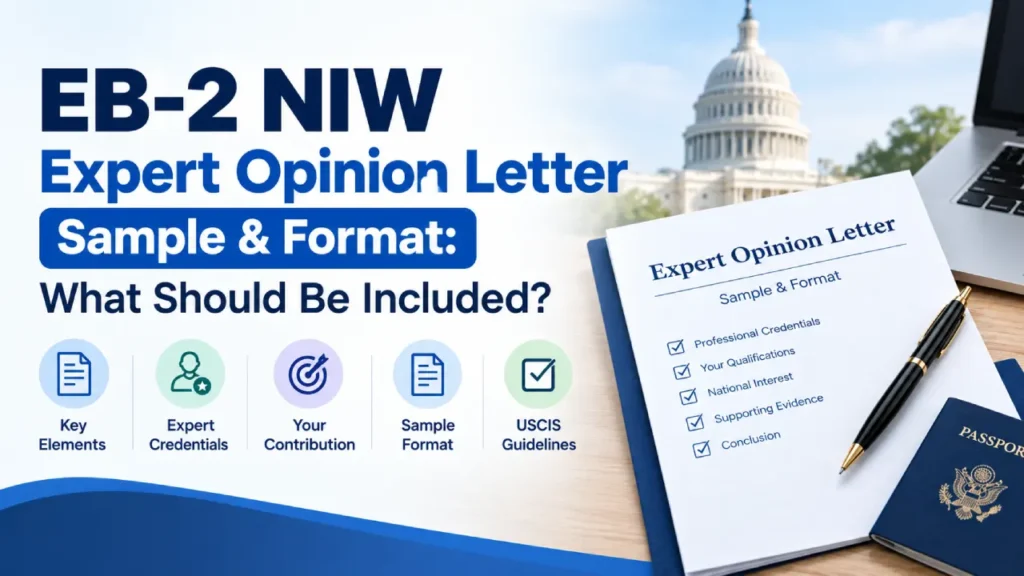
- Professional header: The expert’s name, title, affiliation, contact information, and date.
- Expert credentials: Qualifications and experience relevant to the petitioner’s field.
- Relationship disclosure: An accurate explanation of the expert’s relationship with the petitioner, if any.
- Purpose and scope: The questions the expert is evaluating.
- Materials reviewed: The records and supporting evidence considered.
- Petitioner overview: Relevant education, experience, achievements, and specialized skills.
- Proposed endeavor: A clear explanation of the work the petitioner intends to pursue.
- Professional analysis: An evidence-based assessment of the petitioner’s contributions and future work.
- Dhanasar analysis: Reasoning relevant to substantial merit and national importance, the petitioner’s positioning, and the waiver balancing analysis.
- Conclusion and signature: The expert’s findings, signature, professional title, and contact information.
These are recommended elements, not an official USCIS checklist. The appropriate structure depends on the case, the expert’s scope of review, and the purpose of the letter.
For an overview of the supporting evidence and expert qualifications, see our guide to EB-2 NIW expert opinion letter requirements.
Does USCIS Require a Specific Expert Opinion Letter Format?
No. USCIS does not provide a mandatory EB-2 NIW expert opinion letter template or require a particular number of pages.
The legal framework for the National Interest Waiver comes from Matter of Dhanasar, 26 I&N Dec. 884 (AAO 2016). The decision establishes three criteria that must be satisfied for the waiver:
- The proposed endeavor has substantial merit and national importance.
- The petitioner is well positioned to advance the proposed endeavor.
- On balance, it would benefit the United States to waive the job offer and labor certification requirements.
An expert opinion letter may provide relevant professional analysis supporting these criteria. However, USCIS evaluates the petition and its supporting evidence as a whole, and a letter does not independently guarantee eligibility or approval.
A document can use different headings or section orders and still be useful. What matters most is whether the expert explains the evidence clearly, provides credible reasoning, and addresses the issues relevant to the petition.
For the official policy framework, consult the USCIS Policy Manual, Volume 6, Part F, Chapter 5.
Standard EB-2 NIW Expert Opinion Letter Format: Section-by-Section Guide
The following structure provides a practical way to organize an expert opinion letter. Each section has a distinct purpose, and the amount of detail should reflect the complexity of the case.
1. Professional Header and Date
Begin with a professional heading that identifies the person providing the opinion.
Include the following information where applicable:
- Expert’s full name.
- Professional title and current affiliation.
- Institutional or professional letterhead, if available.
- Professional contact information.
- Date of the letter.
- Subject line identifying the petitioner and purpose of the letter.
A clear heading helps the reader identify the author and the document’s purpose. Letterhead can be appropriate when the expert has an institutional or professional affiliation, but the document should not imply an affiliation that does not exist.
2. Expert Introduction and Credentials
The opening should establish why the expert is qualified to evaluate the petitioner’s work.
Relevant details may include academic qualifications, professional experience, research contributions, publications, patents, leadership roles, industry expertise, awards, or other accomplishments.
The credentials should be relevant to the subject being evaluated. A distinguished professional title alone does not establish that an expert is qualified to assess every type of endeavor.
For example, a researcher evaluating a biomedical innovation should explain their experience in the relevant scientific or technical discipline. An expert assessing a business endeavor should demonstrate appropriate knowledge of the industry, commercialization, or business activity involved.
The letter should also explain how the expert’s background relates to the specific issues discussed in the opinion.
3. Relationship Disclosure and Basis of Knowledge
The letter should accurately explain whether the expert has worked with the petitioner, supervised them, collaborated with them, or evaluated their work independently.
An independent expert may form an opinion by reviewing publications, patents, project records, technical documentation, or other professional evidence. An expert who has worked directly with the petitioner may offer useful firsthand observations.
Neither type of relationship should be misrepresented. The important considerations are the expert’s relevant qualifications, the basis of their knowledge, and the reasoning supporting their conclusions.
Where appropriate, the letter can explain:
- How the expert became familiar with the petitioner’s work.
- Whether the expert has collaborated with or supervised the petitioner.
- Which materials informed the opinion.
- Why the expert is qualified to evaluate the work in question.
A transparent explanation helps the reader assess the context and credibility of the opinion.
4. Purpose of the Letter and Materials Reviewed
Explain what the expert has been asked to evaluate and identify the principal documents considered.
Depending on the case, the materials may include:
- The petitioner’s curriculum vitae or résumé.
- Academic and professional records.
- Publications and citation information.
- Patent documentation.
- Research findings or project reports.
- Evidence of professional recognition.
- A proposed endeavor statement.
- Business plans or implementation documentation.
- Records of industry adoption or measurable outcomes.
- Relevant attorney instructions or USCIS correspondence.
The letter should accurately describe the materials reviewed. It should not suggest that the expert independently verified information unless that verification actually occurred.
A list of documents is useful, but the expert should also explain how the most relevant materials support the conclusions reached.
5. Petitioner Overview and Professional Achievements
Provide a concise summary of the petitioner’s relevant background.
This section may discuss education, specialized skills, professional experience, research contributions, technical projects, leadership responsibilities, patents, or other accomplishments.
The goal is not to reproduce the petitioner’s entire résumé. It is to identify the qualifications that help explain their ability to pursue the proposed endeavor.
For example, a software engineer’s experience developing a particular cybersecurity system may be more relevant than a lengthy list of unrelated job responsibilities. A researcher’s contribution to a specific methodology may be more useful than a general statement that they have published numerous papers.
Each highlighted achievement should contribute to the expert’s analysis.
6. Proposed Endeavor and Its Significance
The proposed endeavor is central to the NIW analysis. The letter should explain what the petitioner intends to do in the United States, what problem or opportunity the work addresses, and why the proposed activities matter.
Avoid describing the endeavor solely through a broad occupational title.
For instance, “working as a data scientist” does not explain the scope or significance of a proposed endeavor. A more informative description might explain how the petitioner intends to develop and implement data-analysis methods to address a defined challenge in healthcare, infrastructure, manufacturing, or another field.
The description should be understandable to a reader without specialized knowledge of the technical subject.
Where appropriate, explain:
- The specific problem the endeavor addresses.
- The proposed approach or methodology.
- The intended scope of the work.
- The professional or technical context.
- The potential applications or broader implications.
- How the endeavor relates to the petitioner’s previous experience.
The proposed endeavor should remain consistent with the petitioner’s statement and the other evidence submitted with the case.
7. Dhanasar Prong One: Substantial Merit and National Importance
The first prong evaluates the proposed endeavor’s substantial merit and national importance.
The expert should explain why the specific endeavor matters, rather than relying solely on the general importance of the petitioner’s industry.
Relevant considerations may include scientific advancement, public health, infrastructure, energy, cybersecurity, education, economic development, or other areas supported by the facts of the case.
For example, a letter concerning a cybersecurity endeavor might explain the specific security problem the petitioner intends to address, the proposed solution, and the potential implications for organizations or systems beyond a single employer.
Evidence could include technical documentation, research, industry data, government publications, or other credible sources relevant to the proposed work.
National importance should not simply be assumed because an industry is prominent or economically significant. The letter should explain the connection between the petitioner’s specific endeavor and its potential broader implications.
8. Dhanasar Prong Two: The Petitioner Is Well Positioned to Advance the Endeavor
The second prong examines whether the petitioner is well positioned to advance the proposed endeavor.
The expert should evaluate relevant evidence of the petitioner’s knowledge, experience, accomplishments, progress, and ability to pursue the proposed work.
Potentially relevant evidence includes:
- Publications, citations, and research findings.
- Patents and technical innovations.
- Completed projects and implementation records.
- Awards and professional recognition.
- Leadership and specialized experience.
- Grants, funding, or documented support.
- Partnerships, contracts, or evidence of interest from relevant organizations.
- Progress already made toward the proposed endeavor.
The letter should explain why these records matter. Simply repeating the petitioner’s qualifications does not provide the same value as interpreting the evidence in the context of the proposed work.
For example, if a petitioner developed a technical method that was subsequently adopted by other organizations, the expert could explain the method’s significance, the petitioner’s role in its development, and the documented evidence of adoption.
Not every petitioner will have patents, high citation counts, or commercial revenue. The relevant evidence depends on the field, the nature of the endeavor, and the petitioner’s professional record.
9. Dhanasar Prong Three: Why Waiving the Job Offer and Labor Certification Requirements Would Benefit the United States
The third prong considers whether, on balance, it would benefit the United States to waive the job offer and labor certification requirements.
The expert can provide professional context concerning the petitioner’s specialized capabilities, the nature of the proposed endeavor, and the potential benefits of allowing the work to proceed under the requested waiver.
The analysis should address the circumstances of the particular case. It should not assume that every skilled professional automatically qualifies for a waiver or that labor certification is unsuitable for every occupation.
Relevant considerations may include the nature of the proposed work, the petitioner’s particular expertise, the potential benefits of the endeavor, and other facts supported by the evidence.
The expert’s analysis can complement the attorney’s legal arguments, but it should not substitute for a complete legal assessment of the petition.
10. Evidence-Based Impact and Measurable Results
A persuasive expert opinion letter explains the significance of achievements through concrete evidence wherever available.
Depending on the field, relevant indicators may include:
| Field | Examples of potentially relevant evidence |
|---|---|
| Research and academia | Publications, citations, grants, research findings, and documented influence on later work |
| Engineering and technology | Patents, technical performance, implementation, adoption, or improvements to existing systems |
| Business and entrepreneurship | Revenue, partnerships, commercialization, product deployment, or documented business outcomes |
| Healthcare and life sciences | Research results, clinical or public-health contributions, and documented applications |
| Education and public policy | Program outcomes, adoption of methods, institutional improvements, or documented public benefits |
Numerical evidence can be useful when it is relevant and verifiable. However, not every contribution can be reduced to a number.
If the expert describes a projected benefit, the letter should distinguish projections from demonstrated results and explain the basis for the estimate.
The objective is to provide a clear and credible explanation of the evidence, not to inflate achievements or claim that every accomplishment has a measurable national impact.
11. Future Contributions and Potential
An NIW petition concerns a proposed endeavor, so the letter should connect the petitioner’s previous experience to the work they intend to pursue.
The expert may discuss the petitioner’s plans, the skills those plans require, the relevance of previous achievements, and any documented progress toward the endeavor.
Depending on the case, relevant information may include:
- A defined research or development plan.
- A proposed implementation strategy.
- Business or commercialization plans.
- Existing partnerships or professional relationships.
- Resources or support available for the work.
- Evidence that the petitioner has already begun pursuing the endeavor.
The letter should distinguish between established facts and future expectations. Predictions about economic growth, job creation, scientific breakthroughs, or other outcomes should be supported by credible reasoning and available evidence.
A strong analysis explains why the petitioner’s experience and current position are relevant to the proposed work without treating future success as guaranteed.
12. Clear Connection to the National Interest
The expert should bring the analysis together by explaining how the proposed endeavor relates to the national interest considerations relevant to the petition.
This is not a separate fourth Dhanasar prong. It is a way to make the reasoning across the three prongs clear and coherent.
The connection might involve scientific advancement, healthcare, technology, infrastructure, environmental sustainability, economic activity, or another area relevant to the specific endeavor.
The letter should not rely on broad statements such as “the petitioner will benefit America.” It should explain the particular benefit, identify the supporting evidence, and clarify the limits of what can reasonably be concluded.
The most useful analysis is specific to the petitioner’s work and consistent with the rest of the petition.
13. Professional Conclusion and Recommendation
The conclusion should summarize the expert’s principal findings and state their professional opinion clearly.
A well-supported conclusion may address:
- The significance of the proposed endeavor.
- The relevance of the petitioner’s documented achievements.
- The petitioner’s ability to advance the proposed work.
- The professional reasoning relevant to the NIW analysis.
The expert may express a clear professional view, but should not claim to control the USCIS decision or guarantee the petition’s approval.
The conclusion should follow naturally from the analysis rather than introduce unsupported claims.
14. Signature and Contact Information
The final section should identify the expert and provide an appropriate means of verifying their professional identity.
Include the expert’s printed name, title, affiliation where applicable, contact information, date, and signature.
The signature method should be genuine and consistent with the document’s intended use. A curriculum vitae or other relevant credential documentation may also be included when appropriate.
These details support the document’s professional presentation and help establish who is responsible for the opinion.
What Is the Best Length for an EB-2 NIW Expert Opinion Letter?
There is no universally required page count for an EB-2 NIW expert opinion letter.
The appropriate length depends on the complexity of the endeavor, the expert’s scope of review, the evidence available, and how much explanation is needed to make the analysis understandable.
A short letter may be appropriate for a focused evaluation. A complex technical endeavor may require more space to explain the field, the petitioner’s contributions, and the reasoning supporting the conclusions.
Rather than targeting a fixed number of pages, ask whether the letter provides enough detail to:
- Establish the expert’s relevant qualifications.
- Explain the proposed endeavor clearly.
- Evaluate the petitioner’s relevant achievements.
- Discuss the three Dhanasar prongs where appropriate to the letter’s purpose.
- Connect conclusions to identifiable evidence.
- Present a coherent professional opinion without unnecessary repetition.
A longer letter is not automatically more persuasive. A shorter letter is not automatically inadequate. Substance and relevance should determine the length.
What Writing Style Should an Expert Opinion Letter Use?
The tone should be professional, clear, objective, and appropriate for a formal immigration petition.
Use specific language. Explain the actual work, the evidence, and the reasons a contribution matters.
Explain technical terms. Define specialized acronyms and concepts when a non-specialist reader may not recognize them.
Avoid unsupported praise. Claims about exceptional ability or significant impact should be explained through relevant accomplishments and evidence.
Separate facts from opinions. Identify documented results and distinguish them from professional interpretations or future projections.
Avoid repetition. Each section should serve a distinct purpose. Repeating the same achievements under every prong without further analysis adds little value.
Maintain consistency. The expert’s statements should align with the petitioner’s records, proposed endeavor, and other supporting documents.
Clear writing helps the reader understand the substance of the opinion without having to interpret unnecessary jargon or promotional language.
Main Elements That Make an Expert Opinion Letter More Useful
| Element | Why it matters |
|---|---|
| Relevant expert credentials | Establishes the basis for the expert’s professional assessment |
| Transparent relationship disclosure | Clarifies how the expert knows the work and the petitioner |
| Specific proposed endeavor | Identifies the work being evaluated rather than relying on a broad job title |
| Evidence-based examples | Helps distinguish documented achievements from generalized claims |
| Clear Dhanasar analysis | Organizes the opinion around the relevant NIW framework |
| Measurable or verifiable impact | Supports conclusions where suitable evidence exists |
| Future-work analysis | Connects previous experience to the proposed endeavor |
| Consistent professional conclusion | Summarizes the expert’s reasoning without unsupported guarantees |
No single element guarantees that USCIS will give the letter a particular weight. The usefulness of the letter depends on its relevance, credibility, reasoning, and consistency with the full evidentiary record.
Common Mistakes to Avoid in an EB-2 NIW Expert Opinion Letter
1. Using a Generic Template Without Individualized Analysis
A consistent structure can help organize a letter, but the substance should reflect the petitioner’s actual experience, evidence, and proposed endeavor.
If the letter could be used for almost any professional in the same industry simply by changing the name, it likely needs more specific analysis.
2. Confusing the Importance of an Industry With the Importance of the Endeavor
A field such as artificial intelligence, healthcare, or clean energy may be important. That fact alone does not establish the national importance of every proposed endeavor in that field.
The expert should explain how the petitioner’s particular work relates to the broader implications being claimed.
3. Repeating the Résumé Instead of Evaluating It
Listing degrees, job titles, publications, and awards is not the same as explaining why the achievements matter.
The expert should identify the most relevant evidence and interpret it in the context of the proposed endeavor.
4. Making Unsupported Claims About Impact
Avoid claims of national significance, economic benefits, or future success that lack a credible evidentiary basis.
Where numerical information is available, explain its source and relevance. Where the evidence supports only a qualitative assessment, describe the reasoning accurately.
5. Ignoring the Third Dhanasar Prong
A letter focused only on the importance of the field and the petitioner’s qualifications may not fully address the waiver analysis.
Where the letter is intended to support the overall NIW case, it can be useful to explain the professional considerations relevant to the third prong as well.
6. Choosing an Expert Whose Background Does Not Match the Work
A professional’s senior title or general reputation does not automatically make them the best person to evaluate a specialized endeavor.
The expert’s background should be relevant to the particular subject of the opinion, and the letter should explain that connection.
7. Treating Independence as a Substitute for Evidence
An independent expert may offer a valuable outside perspective, but independence alone does not make an opinion persuasive.
The analysis still needs a clear basis of knowledge, relevant credentials, and reasoning supported by the materials reviewed.
8. Making Guarantees About USCIS Approval
An expert opinion letter is supporting evidence, not a guarantee of an immigration outcome. Avoid claims that a particular format automatically meets USCIS requirements or ensures approval.
9. Inconsistent or Incomplete Presentation
Check that names, dates, project descriptions, figures, and other factual details agree with the supporting records. Confirm that the document identifies the expert and includes an appropriate signature and contact details.
A final consistency review can help prevent avoidable confusion.
Expert Opinion Letter vs. Recommendation Letter: What Is the Difference?
Although the documents can overlap in some respects, an expert opinion letter and a recommendation letter generally serve different purposes.
An expert opinion letter offers a professional evaluation of the petitioner’s work, achievements, proposed endeavor, and its significance. A recommendation letter typically emphasizes the writer’s endorsement and firsthand knowledge of the petitioner’s abilities or contributions.
| Feature | Expert opinion letter | Recommendation letter |
|---|---|---|
| Main purpose | Professional evaluation and analysis | Endorsement and description of achievements |
| Basis of opinion | Relevant expertise and materials reviewed | Often the writer’s direct experience with the petitioner |
| Proposed endeavor | Can provide detailed analysis | May discuss it, but often focuses on past work |
| NIW framework | Can address issues relevant to the Dhanasar prongs | May provide supporting evidence of achievements |
| Relationship | May be independent or based on a professional relationship | Often written by a colleague, supervisor, or collaborator |
The documents are not interchangeable, and neither is automatically required in every case. Their usefulness depends on the petitioner’s evidence and the overall legal strategy.
Read our detailed guide on the difference between EB-2 NIW expert opinion letters and recommendation letters.
Illustrative EB-2 NIW Expert Opinion Letter Format
The following fictional example illustrates how the sections can work together. It is not an official USCIS template or a complete letter to copy into a petition.
Subject: Expert Opinion Letter in Support of an EB-2 National Interest Waiver Petition
Expert qualifications and purpose
I am [expert’s name], [professional title], with experience in [relevant field]. My professional background includes [relevant qualifications and accomplishments]. I am providing this opinion to evaluate the petitioner’s proposed endeavor and the significance of the documented work relevant to my area of expertise.
Materials reviewed
For this evaluation, I reviewed [identify the actual documents reviewed], including materials describing the petitioner’s professional background, previous contributions, and proposed endeavor in the United States.
Proposed endeavor and professional assessment
The petitioner’s proposed endeavor involves [describe the specific work and objective]. This work addresses [identify the problem or opportunity] through [explain the proposed approach].
The petitioner’s previous work on [specific project or contribution] demonstrates experience relevant to this endeavor. The supporting documentation identifies [specific evidence or results], which I have evaluated in the context of my professional experience in [relevant discipline].
Analysis of significance and ability to advance the work
The significance of the proposed endeavor arises from [case-specific explanation]. Its broader relevance is supported by [identify relevant evidence or context], rather than solely by the general importance of the industry.
The petitioner’s documented experience in [specific area] is relevant because [explain the connection to the proposed endeavor]. Based on the materials reviewed, [state a reasoned professional conclusion that the evidence supports].
Conclusion
Based on my professional experience and the materials identified in this letter, my opinion is that [provide the actual, evidence-supported conclusion]. This assessment reflects the scope of my expertise and the evidence reviewed.
[Expert’s full name, professional title, affiliation where applicable, signature, date, and contact information]
Important: An actual expert opinion letter must reflect the expert’s genuine qualifications, the documents reviewed, and their independent professional conclusions. The language and analysis should be developed for the specific case.
For a more detailed example and discussion of the sample structure, see our EB-2 NIW expert opinion letter sample and format guide.
Frequently Asked Questions About EB-2 NIW Expert Opinion Letter Format
Does USCIS require an expert opinion letter for an EB-2 NIW petition?
No. An expert opinion letter is not mandatory for every EB-2 NIW petition. Whether it is useful depends on the evidence, the proposed endeavor, and the issues that require professional explanation.
Does USCIS provide an official expert opinion letter template?
No. USCIS does not prescribe a specific template, fixed page count, or mandatory section order for EB-2 NIW expert opinion letters.
What is the best format for an EB-2 NIW expert opinion letter?
A useful structure includes the expert’s credentials, relationship disclosure where relevant, purpose and scope, materials reviewed, petitioner background, proposed endeavor, evidence-based analysis, relevant Dhanasar considerations, conclusion, and signature information.
How long should an EB-2 NIW expert opinion letter be?
There is no universally required length. The letter should be long enough to explain the relevant evidence and professional reasoning without unnecessary repetition. The complexity of the endeavor and the scope of the evaluation should determine the level of detail.
Can I use the same format for multiple expert opinion letters?
A similar organizational structure can be used, but each letter should reflect the individual expert’s qualifications, basis of knowledge, and actual assessment. Letters that merely repeat the same arguments without adding distinct analysis may provide limited additional value.
Are independent expert opinion letters more credible?
An independent expert can provide a useful outside assessment, particularly when the opinion is based on relevant expertise and a review of the petitioner’s work. However, independence alone does not determine evidentiary weight. The expert’s qualifications, basis of knowledge, reasoning, and supporting evidence also matter.
Should an expert opinion letter include measurable results?
Where meaningful and available, documented results can help explain the significance of a contribution. These may include research citations, patent applications or grants, implementation outcomes, documented adoption, or other field-appropriate indicators. Not every contribution can be quantified, and projections should be distinguished from demonstrated results.
Can an expert opinion letter help with a Request for Evidence (RFE)?
A targeted expert opinion letter may provide additional analysis when USCIS raises questions involving the petitioner’s specialized work, proposed endeavor, qualifications, or supporting evidence. The letter should address the specific issues raised rather than simply repeat the original arguments.
Does a well-formatted letter guarantee NIW approval?
No. Formatting can improve clarity and organization, but USCIS evaluates the entire petition under the applicable legal standards. No particular letter format or expert opinion guarantees approval.
How much does an EB-2 NIW expert opinion letter cost?
AAE Evaluations lists its EB-2 NIW expert opinion letter service at $675 per letter, with a standard turnaround of six business days after the required information and documentation are received. Rush processing may be available depending on the circumstances. Check the AAE Evaluations pricing page for current details.
Get an EB-2 NIW Expert Opinion Letter From AAE Evaluations
A well-prepared expert opinion letter should do more than describe a petitioner’s qualifications. It should explain the proposed endeavor, evaluate relevant achievements, and provide credible professional analysis that helps the reader understand the evidence in the context of the National Interest Waiver framework.
AAE Evaluations prepares customized EB-2 NIW expert opinion letters using field-matched expertise, case-specific information, and supporting documentation. Our service is designed to provide an independent professional assessment that complements the petitioner’s evidence and legal strategy.
The process begins with reviewing your background, proposed endeavor, and supporting materials to identify the appropriate scope of the evaluation.
Explore your options:
If you are working with an immigration attorney, the expert opinion letter can be coordinated with the legal strategy and the evidence in your petition.
Disclaimer: This article provides general information and is not legal advice. An expert opinion letter is supporting evidence and does not guarantee approval. Consult a qualified immigration attorney regarding your individual circumstances.