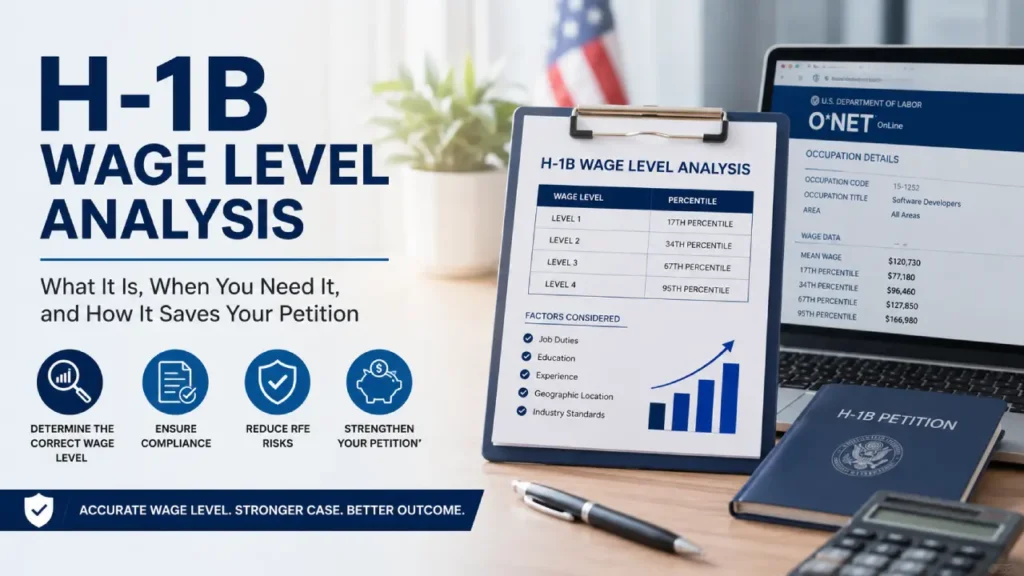
Direct: An H-1B wage level analysis is an expert-authored document that explains why the DOL wage level assigned to a position is appropriate and does not contradict a specialty occupation determination. It is most commonly needed when USCIS issues an RFE challenging whether a Level 1 or Level 2 wage is consistent with a specialty occupation claim — and it is prepared as a targeted add-on to an H-1B expert opinion letter.
What Is H-1B Wage Level Analysis?
When an employer files a Labor Condition Application (LCA) with the Department of Labor for an H-1B or E-3 specialty occupation position, one of the required disclosures is the prevailing wage level assigned to the role. The DOL divides prevailing wages for every specialty occupation into four levels:
| Wage Level | What It Reflects |
|---|---|
| Level 1 | Entry-level position; employee works under close supervision and exercises limited independent judgment |
| Level 2 | Position requiring the employee to exercise more independent judgment; semi-routine duties |
| Level 3 | Experienced position requiring a significant range of professional judgment; advanced skills |
| Level 4 | Fully competent professional demonstrating mastery of the occupation; high degree of independence |
Per DOL guidelines, the wage level assigned to a position should be commensurate with the complexity of tasks, the degree of independent judgment required, and the amount of supervision the employee receives.
Here is where the problem arises: USCIS has increasingly taken the position that a Level 1 wage designation — and sometimes a Level 2 designation — signals that the position is not sufficiently complex to require a bachelor’s degree in a specific specialty field. In the USCIS officer’s reasoning: if a position is truly a specialty occupation, it cannot be entry-level.
This reasoning is legally incorrect — but it is generating RFEs at a high rate.
A wage level analysis is the expert-prepared document that directly refutes this reasoning. It explains, with professional authority, why the wage level designated at the time of filing is appropriate for the position’s actual duties and why that designation does not undermine or contradict the specialty occupation determination.
Why USCIS’s Level 1 = Not a Specialty Occupation Equation Is Wrong
The critical legal point that a wage level analysis makes explicit:
Wage level and specialty occupation status are determined by two different agencies using two different criteria — and one does not govern the other.
- DOL determines wage levels. Its methodology under the Occupational Employment and Wage Statistics (OEWS) survey assigns wage percentiles across an entire occupation group — including workers who may or may not hold bachelor’s degrees. A Level 1 wage simply reflects the entry-tier compensation for that SOC code in that geographic area. It says nothing about the educational requirements of the specific position.
- USCIS determines specialty occupation status. Under 8 CFR §214.2(h)(4)(ii), USCIS evaluates whether the position requires the theoretical and practical application of a body of highly specialized knowledge and a bachelor’s degree or higher in a specific specialty as the standard minimum entry requirement.
These are parallel frameworks. Entry-level positions in specialty occupations — a first-year software engineer, an entry-level biomedical researcher, a newly licensed architect — can legitimately be compensated at Level 1 wages while still requiring a bachelor’s degree in a specific field. The DOL’s wage level guidelines explicitly acknowledge that Level 1 wages are appropriate for entry-level specialty occupation positions.
A wage level analysis explains this distinction in an authoritative, expert-authored format that USCIS adjudicators can rely on.
The Four H-1B DOL Wage Levels Explained in Full
Understanding what each level actually means — and how the DOL determines which level applies — is essential for building a defensible LCA and responding to RFEs.
Level 1 — Entry Level
Positions appropriate for Level 1 are those where the employee:
- Performs routine tasks requiring limited judgment
- Works under close supervision with specific instructions
- Is developing an understanding of the occupation’s professional norms
- Has minimal or no prior experience in the specific role
Example occupations legitimately filed at Level 1: Entry-level software developers performing code development under senior supervision; entry-level engineers conducting defined testing procedures; clinical researchers following established protocols under PI supervision.
Critical point: Level 1 does not mean the position lacks complexity or does not require a degree. A newly graduated software engineer performing Java development under senior architect oversight is performing a specialty occupation task — they simply have not yet accumulated the experience to operate independently.
Level 2 — Qualified Position
Level 2 applies when:
- The employee applies their knowledge to perform specific tasks requiring some judgment
- The employee adapts established methods to new situations within defined parameters
- Some independent decision-making is exercised within understood boundaries
Level 2 RFEs are increasing. USCIS is expanding its scrutiny beyond Level 1 to challenge Level 2 designations where the petition describes complex duties inconsistent with a semi-routine role.
Level 3 — Experienced Position
Level 3 reflects experienced practitioners who:
- Exercise significant independent judgment
- Handle complex problems and develop novel solutions
- May supervise or guide junior staff
Level 4 — Fully Competent / Expert
Level 4 applies to workers who:
- Demonstrate full mastery of the occupation
- Exercise near-complete autonomy and independent judgment
- Represent the top tier of compensation for the occupation group in the geographic area
When Does USCIS Challenge Wage Level as a Specialty Occupation Issue?
USCIS RFEs challenging wage level and specialty occupation simultaneously are most common in the following scenarios:
Consulting and staffing firm placements. Third-party placement arrangements already attract heightened USCIS scrutiny on the employer-employee relationship. A Level 1 wage in this context compounds the scrutiny, triggering combined RFEs questioning both the specialty occupation and the wage level’s consistency with it.
Positions with generic job titles. Business Analyst, Operations Specialist, Marketing Manager, IT Consultant — titles that don’t immediately signal a degree requirement are frequently paired with Level 1 or Level 2 wages, creating RFE risk on both the specialty occupation and the wage level simultaneously.
Petitions with inconsistent duty descriptions. When the LCA describes a Level 1 entry-level role but the petition’s support letter describes complex, independent technical work — there is an internal inconsistency. USCIS will flag it.
Beneficiaries using work experience for degree equivalency. A beneficiary establishing equivalency through the 3-for-1 rule while the employer simultaneously classifies the role at Level 1 creates a factual tension. If the position only requires entry-level skills, why does the beneficiary need equivalent work experience? A wage level analysis resolves this tension explicitly.
DOL’s proposed 2026 wage rule increasing Level I floors. The DOL’s March 2026 proposed rule would raise Level I from approximately the 17th wage percentile to the 34th percentile. This proposal — designed to exclude from the Level I floor workers who lack specialty occupation qualifications — will likely increase USCIS officers’ reliance on wage level as an indicator of specialty occupation status, making wage level analysis documentation increasingly important.
What a Wage Level Analysis Expert Opinion Addresses
A professional wage level analysis, prepared as part of or in combination with an H-1B specialty occupation expert opinion letter, must address:
1. The Correct Regulatory Framework
The analysis opens by establishing the legal separation between DOL wage level determinations and USCIS specialty occupation determinations. It cites the applicable DOL prevailing wage guidance, the four-level wage framework, and the specific standard for Level 1 wage designations. It makes clear — citing regulatory authority — that wage level is outside USCIS’s adjudicative purview for specialty occupation determinations.
2. Why the Assigned Wage Level Is Appropriate for This Position
The expert analyzes the specific position’s duties, supervision structure, and required judgment against the DOL criteria for the assigned wage level. For a Level 1 position, this means explaining:
- How the described duties fit the entry-level characterization
- What type of supervision the employee receives
- Why the employee exercises limited versus extensive independent judgment
This must be consistent with the duty description in the petition support letter. If the support letter describes highly complex, independent work — that inconsistency needs to be addressed in the analysis, not papered over.
3. Why the Wage Level Does Not Contradict Specialty Occupation Status
This is the analytical core of the wage level analysis. The expert must explain, with industry authority, that:
- Entry-level positions in specialty occupation fields routinely require a bachelor’s degree as the minimum qualification
- The DOL Level 1 wage designation reflects compensation tier, not the position’s degree requirements
- Comparable positions at similar organizations in the same industry are filled by degree-holding candidates, even at entry-level compensation
This argument is supported by occupational data (O*NET, BLS Occupational Outlook Handbook), industry surveys, and the expert’s professional knowledge of hiring norms in the relevant field.
4. The Expert’s Authoritative Conclusion
The analysis closes with a direct expert determination: the wage level designated in the LCA is appropriate for the position’s duties, and this designation does not contradict the position’s status as a specialty occupation requiring a bachelor’s degree or higher in a specific field.
How Wage Level Analysis Works with an H-1B Expert Opinion Letter
A wage level analysis is most effective — and most defensible — when it is prepared as a coordinated add-on to a specialty occupation expert opinion letter, not as a standalone document.
Here’s why: the specialty occupation letter already establishes the analytical foundation — it explains what the position requires, what industry norms dictate, and why the role meets the specialty occupation standard under 8 CFR §214.2(h)(4)(ii). The wage level analysis then builds on that foundation to address USCIS’s secondary argument: that the wage level designation undermines the specialty occupation claim.
When both components come from the same expert author, they are internally consistent. The same job duty analysis, the same industry context, the same expert credentials — presented in a unified evidentiary package that USCIS can rely on from a single authoritative source.
At AAE Evaluations, our H-1B expert opinion letters are designed to work together with wage level analysis add-ons, ensuring that every relevant argument is addressed, coordinated, and consistent within a single filing package.
H-1B Wage Level RFE Response: What You Need
When USCIS issues an RFE challenging specialty occupation status and citing wage level as a supporting reason, the response must be direct and targeted. A generic specialty occupation letter — even a good one — is insufficient if it does not specifically address the wage level challenge.
Your RFE response package for a wage level challenge should include:
- A targeted specialty occupation expert opinion letter that analyzes the position’s duties against the four-part specialty occupation test under 8 CFR §214.2(h)(4)(ii)
- A wage level analysis section that explains the regulatory separation between DOL wage determination and USCIS specialty occupation determination, defends the assigned wage level, and directly refutes USCIS’s conflation of the two
- A revised or supplemented position support letter from the employer that clearly articulates the supervision structure, duty complexity, and degree requirement — with language that is internally consistent with the wage level designation
- Industry documentation showing that comparable employers in the same industry fill similar entry-level positions with degree holders, even at Level 1 compensation
- DOL regulatory guidance on wage level assignment, including the relevant portions of DOL’s prevailing wage guidance clarifying that wage levels reflect compensation tier, not specialty occupation status
Our team reads every H-1B RFE in full before preparing the response letter. When the RFE cites wage level as part of the specialty occupation challenge, we address it directly and specifically — not as a generic addendum, but as a targeted component of the response argument.
Common Mistakes Petitioners Make with Wage Level RFEs
Using the previous specialty occupation letter without updating it. An existing specialty occupation letter that does not address the wage level argument provides no additional value to the USCIS adjudicator. The RFE exists because the original letter was insufficient. A new, targeted letter is required.
Submitting only regulatory arguments without expert analysis.
Citing the regulatory separation between DOL and USCIS is necessary — but insufficient. USCIS adjudicators need expert authority supporting the position’s entry-level classification, not just legal argument.
Inconsistent duty descriptions.
If the original petition describes complex, independent duties but the wage level analysis argues the position is entry-level with close supervision — the internal inconsistency undermines both arguments. The duty description and the wage level justification must be aligned.
Upgrading the LCA wage level without explanation.
Simply filing a new LCA at a higher wage level does not resolve the specialty occupation challenge — it may simply create a new factual record without addressing the underlying question. If a wage level amendment is appropriate, it should be accompanied by a revised position support letter and updated expert analysis.
Documents Required for Wage Level Analysis
To prepare a wage level analysis in combination with an H-1B specialty occupation expert opinion letter, our team requires:
- Copy of the LCA (Labor Condition Application) — showing the SOC code, geographic area, wage level, and offered wage
- Petition support letter / Letter of Support — the full employer narrative of the position, duties, and qualification requirements
- Detailed job duty breakdown — with percentage allocation if available
- RFE notice — required for RFE response engagements; the RFE’s exact language determines how the wage level argument is structured
- Any previous expert opinion letters submitted in the case
- Beneficiary credentials — degrees, transcripts, and experience letters in PDF format
- Latest resume in Word format
Submit all documents in PDF to Contact@aaeevaluations.com. Original documents are not required.
Pricing and Turnaround at AAE Evaluations
| Service | Fee | Turnaround |
|---|---|---|
| H-1B Specialty Occupation Expert Opinion Letter | $475 | 5–6 business days |
| Wage Level Analysis (add-on to specialty occupation letter) | Contact for quote | 5–6 business days |
| H-1B RFE Response Package (specialty occupation + wage level) | Contact for quote | 5–6 business days |
| Rush Service | Additional fee | Contact for availability |
View Full Pricing → | Contact Us →
Why Choose AAE Evaluations for H-1B Wage Level Analysis
Coordinated expert authorship. Our wage level analysis is prepared by the same credentialed expert who authors the specialty occupation letter — ensuring internal consistency and a unified evidentiary package for USCIS.
RFE-specific drafting. We read every RFE before drafting. When USCIS cites wage level specifically, we build the response around that argument directly — not a generic update to an existing letter.
Legal framework accuracy. Our analyses correctly establish the regulatory boundaries between DOL wage level authority and USCIS specialty occupation adjudication — the foundational legal argument that supports every wage level analysis.
Complete H-1B documentation support. Pair your wage level analysis with our H-1B expert opinion letter, academic credential evaluation, and work experience evaluation for a complete, coordinated petition package.
Transparent pricing, fast turnaround. No hidden fees. Standard 5–6 business day turnaround. Rush options available.
Related Services
- H-1B Expert Opinion Letter — Specialty occupation and degree equivalency letters for H-1B petitions and RFE responses
- Education Evaluation for H-1B — USCIS-compliant academic credential evaluations supporting degree equivalency claims
- Work Experience Evaluation — Professional experience evaluations supporting the 3-for-1 degree equivalency rule
- Position-by-Position Evaluation — Evaluations assessing whether a beneficiary’s experience aligns with the offered specialty occupation role
- EB-2 NIW Expert Opinion Letters — National Interest Waiver letters addressing all three Dhanasar prongs
- L-1 Expert Opinion Letters — Specialized knowledge and managerial authority letters for L-1A and L-1B petitions
Frequently Asked Questions
What is H-1B wage level analysis?
H-1B wage level analysis is an expert-authored document that explains why the DOL wage level designation on an LCA is appropriate for the offered position and why that designation does not undermine or contradict the position’s specialty occupation status. It is most commonly prepared in response to USCIS RFEs that cite wage level as evidence that a position may not be a specialty occupation.
Does a Level 1 wage mean the position is not a specialty occupation?
No. A Level 1 wage reflects the entry-tier compensation for an occupation in a geographic area, determined by DOL using the OEWS wage survey methodology. It does not indicate whether the position requires a bachelor’s degree in a specific specialty field. Entry-level positions in specialty occupation fields can legitimately be compensated at Level 1 wages while still meeting the specialty occupation standard under 8 CFR §214.2(h)(4)(ii). USCIS’s equation of Level 1 wages with non-specialty-occupation status is a legally incorrect position — and the purpose of a wage level analysis is to establish this through expert authority.
Can USCIS use wage level to deny a specialty occupation claim?
USCIS has been using wage level as a factor in specialty occupation RFEs and denials, but this remains a legally contested position. Wage level determination is the exclusive jurisdiction of the DOL, not USCIS. Petitioners responding to such RFEs should argue — with expert support and regulatory authority — that USCIS’s reliance on wage level for specialty occupation determination exceeds its adjudicative authority. A targeted wage level analysis makes this argument in an expert-authored format USCIS can weigh alongside the specialty occupation letter.
Is wage level analysis needed for every H-1B petition?
Not for every petition. It is most commonly needed when: (1) the position is filed at Level 1 or Level 2 and the duties could be characterized as complex; (2) USCIS has issued an RFE citing wage level as a specialty occupation concern; (3) the petition involves a consulting or staffing firm placement; or (4) the position has a generic title where the specialty occupation connection is not immediately apparent. For petitions at Level 3 or Level 4 with clearly complex duty descriptions, a standalone wage level analysis is less commonly needed.
How is wage level analysis different from a specialty occupation letter?
A specialty occupation letter establishes that the offered position qualifies as a specialty occupation — analyzing the duties, degree requirements, and industry norms under the USCIS four-part test. A wage level analysis addresses a separate, secondary argument: that the wage level designation on the LCA is appropriate for the position and does not contradict the specialty occupation determination. Both documents are most effective when prepared together, by the same expert, as a coordinated package.
What is the DOL’s proposed 2026 wage level rule and how does it affect this?
In March 2026, the DOL proposed increasing prevailing wage floors across all four H-1B wage levels. The most significant change is to Level I, which would increase from approximately the 17th wage percentile to the 34th. The DOL’s stated rationale is that the current Level I floor is set too low because it includes wage data for workers who would not qualify for specialty occupations. If finalized, this change means that fewer positions will qualify for Level 1 wages — and the DOL itself is implicitly acknowledging that Level 1 positions should still be specialty occupations by workers who meet the degree requirement. This regulatory context actually reinforces the legal argument in a wage level analysis: even DOL’s own proposed methodology treats Level I wages as appropriate for entry-level specialty occupation workers.
Can AAE Evaluations help with an H-1B wage level RFE response?
Yes. H-1B RFE responses involving wage level challenges are among the services we handle most frequently. We read the RFE in full, identify the specific arguments USCIS raised regarding wage level and specialty occupation, and prepare a coordinated response package that includes a targeted specialty occupation letter and wage level analysis — structured to address USCIS’s stated concerns directly. Contact us to get started.