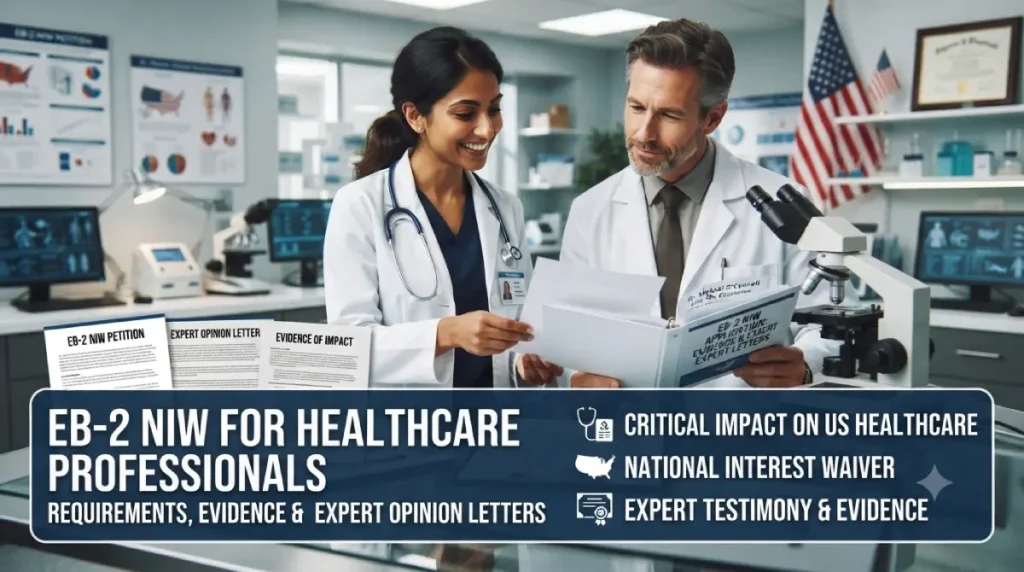
Healthcare professionals contribute to some of the most important areas of public welfare, including medical research, disease prevention, patient safety, healthcare technology, and access to medical services. For qualified professionals seeking to continue or expand their work in the United States, the EB-2 National Interest Waiver (NIW) offers an employment-based immigration pathway that can waive the traditional job offer and labor certification requirements.
However, working in an important healthcare field does not automatically establish eligibility for an EB-2 NIW. Applicants must qualify for the underlying EB-2 classification and demonstrate that their specific proposed endeavor satisfies the national interest waiver requirements.
Physicians, medical researchers, nurses, public health specialists, healthcare administrators, and medical technology professionals may have different ways of presenting their qualifications and professional contributions.
Understanding these differences is essential when preparing an evidence-based petition. An independent expert opinion letter may also help explain specialized medical knowledge, research contributions, and the potential significance of a proposed healthcare endeavor.
This guide covers EB-2 NIW requirements for healthcare professionals, professional eligibility, proposed endeavor examples, supporting evidence, and the role of independent expert opinion letters.
Can Healthcare Professionals Qualify for EB-2 NIW?
Yes. Healthcare professionals may qualify for the EB-2 National Interest Waiver if they satisfy the underlying EB-2 classification requirements and demonstrate that their proposed endeavor meets the national interest waiver criteria.
The EB-2 classification generally provides two qualification pathways:
- Advanced Degree Professional: Applicants who hold an advanced degree or an equivalent qualification. A U.S. bachelor’s degree or foreign equivalent followed by at least five years of progressive post-baccalaureate experience in the specialty may qualify as the equivalent of a master’s degree.
- Exceptional Ability: Applicants who demonstrate expertise significantly above that ordinarily encountered in the sciences, arts, or business and satisfy the applicable regulatory requirements.
For a national interest waiver, USCIS evaluates the applicant’s qualifications and proposed endeavor on a case-by-case basis.
Healthcare professionals may pursue different types of endeavors depending on their experience and objectives, including:
- Advancing medical and clinical research.
- Developing innovative medical technologies.
- Improving healthcare delivery and patient safety.
- Addressing specific public health challenges.
- Expanding access to specialized healthcare services.
- Developing healthcare artificial intelligence applications.
- Improving disease prevention and diagnostic methods.
The important consideration is how the applicant’s specific professional work relates to the proposed endeavor and its potential broader impact.
Which Healthcare Professionals May Qualify for EB-2 NIW?
EB-2 NIW is not restricted to physicians or medical researchers. Professionals working in several healthcare-related disciplines may consider this immigration pathway, provided they meet the applicable requirements.
1. Physicians and Medical Specialists
Physicians may pursue research, medical innovation, specialized treatment initiatives, public health programs, and other healthcare-related endeavors.
Relevant professional backgrounds may include:
- Internal medicine specialists.
- Cardiologists.
- Neurologists.
- Oncologists.
- Surgeons.
- Pediatricians.
- Radiologists.
- Psychiatrists.
- Other medical specialists.
A physician’s qualifications, clinical experience, research contributions, and proposed future activities may provide relevant supporting evidence.
For example, a physician developing an initiative to improve early detection of cardiovascular disease in underserved populations may have a proposed endeavor involving more than routine clinical practice.
The petition should explain the specific activities, intended outcomes, and evidence supporting the broader significance of that work.
Physicians should also understand the separate physician-specific national interest waiver pathway, which has its own clinical service requirements.
2. Nurses and Advanced Nursing Professionals
Nursing professionals may also explore EB-2 NIW eligibility, although their cases require careful consideration of the underlying EB-2 classification.
Potential professional backgrounds include:
- Nurse practitioners.
- Clinical nurse specialists.
- Nurse researchers.
- Nursing educators.
- Nursing administrators.
- Healthcare quality specialists.
Registered nurses should not assume that professional experience or a nursing qualification automatically establishes eligibility under the advanced-degree pathway.
USCIS has specifically discussed the distinction between ordinary registered nursing positions and advanced nursing roles that generally require graduate-level qualifications.
For example, a nurse researcher developing evidence-based approaches to improve patient safety across multiple healthcare settings may have a different proposed endeavor from a nurse whose activities involve routine patient care.
Nursing professionals should carefully evaluate their education, intended occupation, proposed endeavor, and supporting achievements.
3. Medical and Clinical Researchers
Medical researchers may demonstrate their professional contributions through research publications, clinical studies, scientific presentations, and collaborative projects.
Relevant areas include:
- Biomedical research.
- Clinical trials.
- Pharmaceutical research.
- Cancer research.
- Neuroscience.
- Infectious disease research.
- Genetics and molecular biology.
- Medical device development.
An applicant’s research history may help establish their preparation for the proposed endeavor.
However, publication counts alone do not establish eligibility. The petition should explain the relevance of the research, the applicant’s individual contributions, and how previous work connects to future objectives.
4. Public Health Professionals
Public health professionals may pursue endeavors involving disease prevention, healthcare access, epidemiological research, community health initiatives, and health policy.
Examples include:
- Developing disease surveillance methods.
- Improving vaccination program delivery.
- Studying public health risks.
- Addressing preventable diseases.
- Improving maternal and child health outcomes.
- Developing strategies for underserved populations.
A public health applicant should explain the specific problem being addressed, the proposed activities, and the potential benefits supported by relevant evidence.
5. Healthcare Administrators and Medical Management Professionals
Healthcare administrators and executives may have relevant professional backgrounds in hospital operations, healthcare management, patient safety, and healthcare system improvement.
Potential endeavors may include:
- Improving hospital operational efficiency.
- Developing healthcare quality management systems.
- Reducing avoidable administrative delays.
- Improving patient care coordination.
- Developing scalable healthcare delivery models.
- Implementing evidence-based patient safety programs.
The applicant should distinguish between routine managerial responsibilities and a specific endeavor with potential implications beyond an individual employer.
6. Healthcare Technology and Medical AI Professionals
Healthcare technology is another area where specialized expertise may be relevant to an EB-2 NIW petition.
Professionals may work in:
- Medical artificial intelligence.
- Health informatics.
- Medical imaging technology.
- Digital health platforms.
- Healthcare cybersecurity.
- Clinical decision-support systems.
- Medical device engineering.
- Remote patient monitoring.
For example, a professional developing machine-learning methods to improve the interpretation of medical imaging may have a proposed endeavor involving research, testing, validation, and implementation.
The petition should explain the technical contribution and its potential applications using appropriate supporting documentation.
What Are the EB-2 NIW Requirements for Healthcare Professionals?
Healthcare professionals must satisfy the underlying EB-2 classification requirements before USCIS considers the national interest waiver request.
Once the applicant establishes the relevant EB-2 qualification, the petition must address the three-prong framework established in Matter of Dhanasar, 26 I&N Dec. 884 (AAO 2016).
Prong 1: The Proposed Endeavor Must Have Substantial Merit and National Importance
The first prong focuses on the applicant’s specific proposed endeavor.
Healthcare is an important field, but the general importance of medicine or public health does not automatically establish that an individual’s proposed work has national importance.
Applicants should explain:
- What specific work they intend to undertake.
- Which healthcare problem or opportunity the work addresses.
- Why the proposed activities have substantial merit.
- How the endeavor could have broader implications.
- What evidence supports its potential impact.
For example, a physician proposing to develop and evaluate a specialized screening program for a particular disease should explain the health problem, the proposed methodology, the intended population, and the potential broader applications.
Relevant evidence may include government health reports, published research, clinical findings, and documented professional projects.
The objective is to demonstrate the importance of the actual endeavor rather than rely on the general importance of the healthcare profession.
Prong 2: The Applicant Must Be Well Positioned to Advance the Proposed Endeavor
The second prong evaluates the applicant’s qualifications, previous achievements, relevant expertise, and ability to make progress toward the proposed work.
Healthcare professionals may provide evidence such as:
- Academic qualifications.
- Medical or professional certifications.
- Research publications.
- Citation records.
- Clinical research experience.
- Patents and medical innovations.
- Awards and professional recognition.
- Leadership responsibilities.
- Documented project outcomes.
- Research grants and institutional collaborations.
For example, a medical researcher proposing to develop a new diagnostic method may demonstrate relevant preparation through previous research, published findings, technical expertise, and documented progress toward the proposed project.
The applicant should explain how these achievements relate to the future endeavor.
A long résumé or extensive professional experience may be useful, but the evidence should demonstrate a meaningful connection between the applicant’s background and the proposed work.
Prong 3: On Balance, It Would Benefit the United States to Waive the Job Offer and Labor Certification Requirements
The third prong considers whether, on balance, the United States would benefit from waiving the job offer and permanent labor certification requirements.
Healthcare professionals should explain why their particular contributions support granting the waiver.
Depending on the circumstances, relevant considerations may include:
- The nature of the proposed healthcare initiative.
- The applicant’s specialized qualifications.
- The potential benefits of their professional contributions.
- The importance or urgency of the proposed work.
- Why the endeavor may be advanced without being limited to a traditional employer-sponsored position.
For example, a healthcare technology researcher developing a specialized medical diagnostic platform may explain how the proposed work could benefit healthcare providers, research institutions, or broader patient populations.
The third prong is not satisfied merely because a profession is in demand or an applicant has specialized skills. The explanation must relate to the individual circumstances and the proposed endeavor.
For a more detailed understanding of the supporting documentation, review the EB-2 NIW requirements.
EB-2 NIW Proposed Endeavor Examples for Healthcare Professionals
A proposed endeavor should describe specific future activities rather than simply identify a profession or job title.
Below are illustrative examples of how healthcare professionals may describe their intended work.
1. Improving Healthcare Access in Underserved Communities
Illustrative proposed endeavor: Developing and implementing healthcare delivery initiatives that improve access to preventive and primary care services in underserved communities.
Potential supporting evidence may include:
- Previous community healthcare projects.
- Public health research.
- Documented healthcare access challenges.
- Institutional partnerships.
- Program implementation records.
- A detailed plan describing future activities.
An expert with relevant public health or healthcare delivery experience may help explain the problem being addressed and the potential significance of the proposed initiative.
2. Advancing Medical Research and Disease Prevention
Illustrative proposed endeavor: Conducting research to improve early identification and prevention strategies for a specific chronic disease.
Relevant evidence could include:
- Peer-reviewed research publications.
- Clinical study participation.
- Research findings.
- Scientific presentations.
- Grant records.
- Previous research collaborations.
- A documented future research plan.
An expert in the relevant medical or scientific discipline may evaluate the research methodology, previous findings, and potential contribution to the field.
3. Developing Artificial Intelligence for Medical Diagnosis
Illustrative proposed endeavor: Developing and validating AI-based diagnostic tools to assist healthcare professionals in identifying specific medical conditions through clinical imaging.
Potential evidence may include:
- Technical research papers.
- Software development records.
- Clinical validation studies.
- Medical imaging research.
- Patent documentation.
- Institutional research collaborations.
- Testing and performance results.
An expert in medical AI, biomedical engineering, or the relevant clinical discipline may explain the technical significance of the proposed work.
4. Improving Patient Safety and Hospital Quality
Illustrative proposed endeavor: Developing evidence-based methods to reduce preventable patient safety incidents and improve quality management across healthcare facilities.
Supporting documentation may include:
- Hospital quality improvement projects.
- Patient safety research.
- Documented implementation results.
- Professional certifications.
- Clinical management experience.
- Quality assessment reports.
The petition should explain how the proposed activities could have broader implications rather than focusing exclusively on responsibilities at one hospital.
5. Advancing Biomedical and Pharmaceutical Research
Illustrative proposed endeavor: Conducting biomedical research to improve the development and evaluation of treatments for a particular disease.
Potential evidence may include:
- Laboratory research.
- Peer-reviewed publications.
- Clinical trial records.
- Research collaborations.
- Patents.
- Scientific presentations.
- Documented research outcomes.
A qualified biomedical or pharmaceutical expert may help explain the technical context, significance of previous findings, and potential contribution of the future research.
6. Developing Digital Healthcare and Remote Monitoring Solutions
Illustrative proposed endeavor: Developing digital health technologies that improve the monitoring and management of patients with chronic conditions.
Supporting documentation may include:
- Technology development records.
- Clinical pilot projects.
- Research publications.
- User testing.
- Healthcare partnerships.
- Implementation plans.
- Evidence of previous professional contributions.
The applicant should clearly explain how the proposed technology addresses a documented healthcare challenge and what evidence supports its potential applications.
These examples are illustrative, not pre-approved endeavors. Each applicant must establish eligibility based on their own professional background, proposed activities, and supporting evidence.
For additional examples across different professional fields, see EB-2 NIW proposed endeavor examples.
What Evidence Do Healthcare Professionals Need for an EB-2 NIW Petition?
Supporting evidence is an important part of an EB-2 NIW petition. Healthcare professionals should organize documents that establish their qualifications, professional achievements, proposed activities, and potential contributions.
The appropriate evidence depends on the applicant’s background and the nature of the proposed endeavor.
1. Educational Qualifications and Professional Credentials
Applicants may provide:
- Bachelor’s, master’s, and doctoral degree certificates.
- Academic transcripts.
- Foreign education credential evaluations, where appropriate.
- Medical qualifications.
- Professional certifications.
- Relevant specialist training.
- Professional licenses, where applicable.
For applicants with foreign educational qualifications, an appropriate credential evaluation may help explain the U.S. equivalency of their academic credentials.
Where the applicant needs to demonstrate the relationship between education and professional experience, a work experience evaluation may also be relevant, depending on the applicable immigration requirements.
Clinical licensing requirements are separate from immigration eligibility. An immigration petition does not itself authorize a healthcare professional to practice medicine or another licensed profession in the United States.
2. Research Publications and Scientific Contributions
Medical researchers and academic professionals may submit:
- Peer-reviewed journal articles.
- Conference papers.
- Research reports.
- Citation records.
- Published research findings.
- Editorial or peer-review activities.
- Research collaboration documentation.
Applicants should identify their individual contributions to research projects rather than rely exclusively on the number of publications.
Where relevant, evidence may explain how the research has been used, cited, adopted, or developed by other professionals.
3. Clinical Experience and Professional Achievements
Physicians and other healthcare professionals may provide:
- Employment verification letters.
- Clinical experience records.
- Hospital appointment documents.
- Professional responsibilities.
- Leadership records.
- Specialized training certificates.
- Evidence of clinical research participation.
- Documented healthcare improvement projects.
The applicant should explain how these achievements relate to the proposed endeavor.
4. Patents, Innovations, and Medical Technology
Professionals involved in healthcare innovation may submit:
- Patent certificates or applications.
- Medical device development records.
- Software documentation.
- Technical reports.
- Research prototypes.
- Clinical testing results.
- Evidence of product implementation.
The documentation should identify the applicant’s actual contribution and explain its relevance to the proposed work.
5. Awards, Grants, and Professional Recognition
Relevant supporting documents may include:
- Academic awards.
- Research grants.
- Professional association recognition.
- Competitive fellowships.
- Invitations to speak at professional conferences.
- Institutional recognition.
- Research funding records.
The significance of an award or grant should be explained where it is not self-evident.
6. Evidence Supporting the Proposed Endeavor
Applicants should also provide documents explaining what they intend to accomplish in the United States.
Depending on the endeavor, this may include:
- Research proposals.
- Clinical research plans.
- Business plans.
- Project development documents.
- Letters of intent.
- Institutional collaboration records.
- Funding commitments.
- Partnership agreements.
- Implementation plans.
- Relevant government or scientific reports.
A detailed proposed endeavor statement should connect the applicant’s intended activities with the supporting evidence.
The goal is to create a consistent record showing both the importance of the proposed work and the applicant’s preparation to advance it.
How Can an Independent Expert Opinion Letter Support a Healthcare Professional’s EB-2 NIW Petition?
Healthcare professionals often work in highly specialized areas where the significance of their contributions may not be immediately clear to someone outside the discipline.
An EB-2 NIW expert opinion letter can provide professional analysis of the applicant’s work, qualifications, and proposed endeavor.
For example, a biomedical researcher may have developed a specialized research methodology, while a healthcare technology professional may have contributed to a medical diagnostic system. A qualified expert in the relevant field may explain the technical significance of these contributions and their potential applications.
An effective expert opinion letter should be based on the applicant’s actual professional record and the expert’s independent assessment.
Selecting an Expert With Relevant Healthcare Expertise
The expert should have qualifications relevant to the subject being evaluated.
Depending on the proposed endeavor, an appropriate expert might have experience in:
- Clinical medicine.
- Biomedical research.
- Public health.
- Pharmaceutical sciences.
- Medical technology.
- Healthcare administration.
- Medical AI and health informatics.
The expert’s academic qualifications, professional experience, research background, and relevant specialization should be clearly established.
A general healthcare background may not be sufficient when the applicant’s work involves a highly specialized medical or technical subject.
Explaining the Significance of Medical and Research Contributions
An expert may explain the importance of a particular clinical project, research finding, medical technology, or professional contribution.
For example, instead of simply stating that an applicant has published several medical research papers, an expert may explain what the research investigated, what the applicant contributed, and why the findings are relevant to the particular field.
Such analysis should refer to specific documents and avoid unsupported claims.
Connecting Professional Achievements With the Proposed Endeavor
An applicant’s previous achievements and future objectives should form a coherent professional narrative.
An expert may explain how previous research, clinical projects, technical development, or leadership experience demonstrates relevant preparation for the proposed endeavor.
This can help clarify the relationship between the applicant’s established expertise and future professional activities.
Providing Context for the Three Dhanasar Prongs
An expert opinion letter may address relevant aspects of the three-prong framework by providing professional analysis of:
- The substantial merit and potential national importance of the proposed healthcare endeavor.
- The applicant’s qualifications and documented record of relevant achievements.
- The potential value of allowing the applicant to advance the proposed work without the traditional job offer and labor certification requirements.
The expert should remain within their professional competence. An expert opinion does not replace the legal analysis that an immigration attorney may provide.
Maintaining Independence and Evidence-Based Analysis
An independent expert opinion should explain the expert’s qualifications, the materials reviewed, and the basis for the conclusions reached.
The letter should not simply repeat the applicant’s résumé or provide generic praise.
USCIS evaluates supporting evidence in the context of the complete petition. An expert opinion letter can contribute to the record, but it does not guarantee approval or replace other required documentation.
For a detailed explanation of the EB-2 NIW expert opinion letter requirements, including expert qualifications and supporting evidence, review our dedicated article.
You can also review an EB-2 NIW expert opinion letter sample to understand the structure and information commonly included in a professional evaluation.
EB-2 NIW for Physicians: Understanding the Separate Physician National Interest Waiver
Physicians should understand that immigration regulations provide a separate physician-specific national interest waiver pathway in addition to the general EB-2 NIW framework.
Under the physician-specific provision, qualifying physicians must satisfy particular clinical service requirements.
Generally, the physician must:
- Be a doctor of medicine (MD) or doctor of osteopathy (DO).
- Agree to work full-time, meaning 40 hours per week, in clinical practice for an aggregate of five years.
- Provide services in a qualifying medically underserved area or designated health professional shortage area, within the scope of the applicable designation, or at a qualifying Department of Veterans Affairs facility.
- Obtain the required prior determination from a federal agency or state public health department that the physician’s work is in the public interest.
These requirements are established under 8 CFR § 204.12.
This pathway is different from the general EB-2 NIW framework under Matter of Dhanasar. Physicians should not assume that the two routes have identical requirements.
The appropriate pathway depends on the physician’s qualifications, proposed work, and immigration circumstances. An immigration attorney can assess which route may apply.
The physician-specific national interest waiver should not be confused with the general EB-2 NIW pathway available to qualifying professionals in healthcare-related fields. Nurses and other healthcare professionals do not automatically qualify for the physician-specific provision.
EB-2 NIW for Nurses: Important Eligibility Considerations
Nurses considering an EB-2 NIW petition should pay particular attention to their underlying EB-2 classification.
A nursing qualification or years of clinical experience alone do not establish eligibility.
USCIS has noted that many ordinary registered nursing positions do not generally require an advanced degree, while certain advanced nursing positions, including nurse practitioner and clinical nurse specialist roles, may have different educational requirements.
Depending on the applicant’s circumstances, the analysis may involve:
- Whether the intended occupation qualifies as a profession.
- Whether the applicant meets the advanced-degree requirements.
- Whether the applicant can establish exceptional ability.
- Whether the proposed endeavor is sufficiently specific.
- Whether the evidence demonstrates all three Dhanasar prongs.
For example, a nurse researcher proposing to develop evidence-based patient safety programs across multiple healthcare systems may present a different case from a registered nurse whose proposed work consists solely of continuing routine clinical duties.
Nursing professionals should evaluate their actual qualifications and proposed activities rather than rely on the general demand for healthcare workers.
Common EB-2 NIW Challenges for Healthcare Professionals
Even highly experienced healthcare professionals may face challenges when presenting their immigration petitions.
Understanding these issues can help applicants prepare more relevant and consistent documentation.
1. Relying Only on the Importance of Healthcare
Healthcare is essential to public welfare, but that does not establish the national importance of every healthcare-related occupation or project.
Applicants should explain the specific significance of their proposed endeavor.
2. Describing Routine Clinical Responsibilities as a Proposed Endeavor
Simply stating an intention to work as a physician, nurse, or healthcare administrator may not adequately describe the proposed endeavor.
Applicants should identify the particular work they intend to undertake and its potential broader implications.
3. Providing Research Publications Without Explaining Their Significance
A publication list may demonstrate research activity, but it does not necessarily establish the applicant’s individual contributions or the significance of their work.
Relevant evidence should explain the applicant’s role and the relationship between previous research and future objectives.
4. Failing to Connect Past Achievements With Future Plans
The applicant’s professional history should support the proposed endeavor.
If the applicant has extensive experience in one area but proposes to pursue an unrelated project, the petition should explain the connection and provide appropriate supporting evidence.
5. Making Unsupported Claims About Healthcare Impact
Claims concerning reduced mortality, improved patient outcomes, healthcare savings, or national-scale benefits should be supported by credible evidence.
Projected outcomes should be identified as projections rather than presented as established results.
6. Relying on Generic Expert Recommendation Letters
An expert opinion letter should provide substantive professional analysis.
A general recommendation describing the applicant as talented, hardworking, or respected may not adequately explain the proposed endeavor or the significance of the applicant’s contributions.
EB-2 NIW Documentation Checklist for Healthcare Professionals
Before preparing an expert opinion letter or organizing an immigration petition, healthcare professionals can use the following general checklist.
Educational and professional documents
- Academic degree certificates.
- Academic transcripts.
- Foreign credential evaluations, where appropriate.
- Medical or professional licenses, where applicable.
- Relevant specialist certifications.
- Professional training records.
Professional experience
- Updated CV or résumé.
- Employment verification letters.
- Clinical experience documentation.
- Research and project records.
- Leadership and administrative experience.
- Evidence of professional responsibilities.
Research and achievements
- Published research papers.
- Citation records.
- Conference presentations.
- Research grants.
- Patents and innovations.
- Awards and professional recognition.
- Evidence of previous project outcomes.
Proposed endeavor
- Detailed proposed endeavor statement.
- Research or project plans.
- Clinical development plans.
- Business plans, where relevant.
- Institutional collaborations.
- Letters of intent.
- Funding or partnership evidence.
- Relevant supporting industry or government research.
Expert opinion letter preparation
- Updated CV.
- Proposed endeavor statement.
- Relevant educational and professional documents.
- Research publications and technical reports.
- Evidence of individual contributions.
- Supporting project documentation.
- Existing petition materials, if available.
- Any USCIS Request for Evidence, if applicable.
Not every applicant needs every document. The appropriate evidence depends on the professional background, proposed endeavor, and individual immigration circumstances.
Frequently Asked Questions About EB-2 NIW for Healthcare Professionals
Can doctors apply for EB-2 NIW?
Yes. Physicians may qualify through the general EB-2 NIW framework if they meet the underlying EB-2 classification and all three Dhanasar prongs. Certain physicians may also qualify for the separate physician-specific national interest waiver based on qualifying clinical service.
Can nurses qualify for EB-2 NIW?
Some nursing professionals may qualify, depending on their education, intended occupation, professional achievements, and proposed endeavor. However, ordinary registered nursing positions may present additional challenges under the advanced-degree professional classification. Eligibility must be evaluated individually.
Can medical researchers apply for an EB-2 National Interest Waiver?
Yes. Medical researchers may pursue EB-2 NIW if they satisfy the relevant EB-2 classification and demonstrate that their proposed research endeavor meets the three-prong framework. Publications, research contributions, grants, and documented project progress may provide relevant evidence.
Do healthcare professionals need a PhD for EB-2 NIW?
No. A PhD is not universally required. Applicants may qualify through the advanced-degree pathway using an eligible master’s degree or a qualifying bachelor’s degree with five years of progressive post-baccalaureate experience in the specialty. The exceptional ability pathway may also be available to qualifying applicants.
Are research publications mandatory for EB-2 NIW healthcare professionals?
No. USCIS does not require every EB-2 NIW applicant to have published research papers. Publications may be useful evidence for researchers and academics, but other relevant achievements, professional contributions, project outcomes, and supporting documents may also demonstrate an applicant’s qualifications.
Is an expert opinion letter mandatory for an EB-2 NIW petition?
No. USCIS does not require every EB-2 NIW petitioner to submit an expert opinion letter. However, a relevant, independent, evidence-based opinion may help explain specialized professional contributions and the significance of a proposed endeavor.
Can an expert opinion letter help physicians and medical researchers?
Yes. A qualified expert may provide an independent assessment of clinical research, medical innovations, specialized knowledge, and relevant professional achievements. The value of the letter depends on the expert’s qualifications, the evidence reviewed, and the quality of the analysis.
Can a healthcare professional qualify for EB-2 NIW without a job offer?
Yes. The national interest waiver can waive the job offer and permanent labor certification requirements for applicants who qualify for the underlying EB-2 classification and satisfy the applicable NIW criteria. The physician-specific pathway has its own clinical service requirements.
Can a healthcare professional use an expert opinion letter for an RFE response?
An expert opinion letter may be useful when an RFE raises questions that require specialized professional analysis. The letter should address the relevant concerns, rely on appropriate supporting evidence, and remain consistent with the rest of the petition.
Learn more about an EB-2 NIW expert opinion letter for RFE and how independent expert analysis may contribute to an evidence-based response.
Does an EB-2 NIW expert opinion letter guarantee approval?
No. An expert opinion letter is supporting evidence, not a guarantee of approval. USCIS evaluates the complete petition, including the applicant’s EB-2 eligibility, proposed endeavor, qualifications, and supporting documentation.
Get an Independent Expert Opinion Letter for Your EB-2 NIW Petition
Healthcare professionals with specialized experience, research achievements, and important professional contributions may need to explain their work in a way that clearly communicates its technical significance and potential broader impact.
An independent expert opinion letter can help provide that explanation through qualified professional analysis based on the applicant’s background, proposed endeavor, and supporting documentation.
AAE Evaluations provides independent expert opinion letters for EB-2 NIW petitions, with an emphasis on relevant professional expertise, case-specific assessment, and evidence-based analysis.
Whether you work in clinical medicine, biomedical research, public health, healthcare administration, or medical technology, the evaluation should reflect your actual professional contributions and proposed activities.
Explore our EB-2 NIW expert opinion letter service to learn more about the evaluation process and request an initial case review.
You can also review the EB-2 NIW expert opinion letter cost to understand the service and associated costs.
AAE Evaluations helps healthcare professionals present their qualifications and professional contributions through clear, independent, and evidence-based expert analysis.
Disclaimer: This article is for general informational purposes only and does not constitute legal advice. Immigration eligibility depends on individual circumstances and applicable law. An expert opinion letter does not guarantee USCIS approval or replace advice from a qualified immigration attorney.