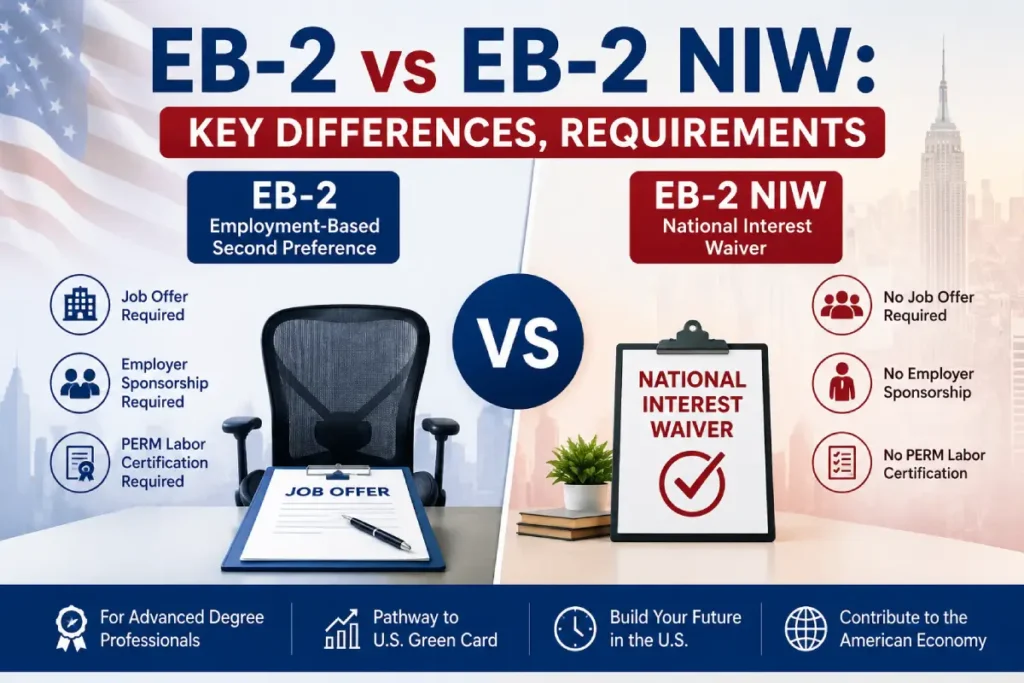
Quick Answer: EB-2 and EB-2 NIW are both employment-based second-preference green card categories for professionals with advanced degrees or exceptional ability. The core difference: standard EB-2 requires an employer sponsor and a PERM labor certification that can take 2+ years. EB-2 NIW (National Interest Waiver) lets you self-petition without any employer — if you can show your work benefits the United States at a national level under the Dhanasar framework.
Key Takeaways:
- Both EB-2 and EB-2 NIW lead to a U.S. green card under the same employment-based second-preference category — they share the same visa quota and Visa Bulletin backlog.
- Standard EB-2 requires employer sponsorship and PERM labor certification (currently averaging ~496 days at DOL); EB-2 NIW skips both.
- EB-2 NIW applicants self-petition using Form I-140, but must satisfy the three-pronged Dhanasar standard to prove national importance.
- USCIS approval rates for EB-2 NIW tightened in 2024–2025; documentation strength — including expert opinion letters and credential evaluations — is now more critical than ever.
- Neither pathway removes the EB-2 visa backlog for high-demand countries like India and China; both face identical priority date waits.
Choosing between EB-2 and EB-2 NIW might look like a technicality on paper. It isn’t. The path you choose determines whether you’re dependent on an employer for your immigration future, how quickly you can file, and how much documentation burden falls on your shoulders versus your company’s HR department.
If you’ve been searching for a clear breakdown, you’ve probably run into articles that either oversimplify (“NIW is better because no employer!”) or go so deep into legalese that you leave more confused than when you started. This guide cuts through both problems.
We’ll walk through what actually separates these two pathways, which professionals are strongest candidates for each, and how the right supporting documentation — from credential evaluations to expert opinion letters — can be the difference between approval and an RFE.
What Is the EB-2 Visa? Understanding the Foundation
Before comparing the two paths, it helps to understand that EB-2 is a category, not a single visa. The National Interest Waiver is one route within that category — not a separate visa altogether. That distinction matters because both paths draw from the same pool of visa numbers and face the same priority date constraints.
EB-2 Eligibility: Who Qualifies?
To enter the EB-2 category through either path, you must meet one of two criteria:
Advanced Degree (EB-2A): A U.S. master’s degree or higher (or the foreign equivalent), OR a U.S. bachelor’s degree plus at least five years of progressive work experience in your field. Foreign degrees must be evaluated for U.S. equivalency by a qualified credential evaluator — this is often the first document USCIS wants to see.
Exceptional Ability (EB-2B): Demonstrated ability significantly above the norm in your field — science, arts, or business. This requires at least three of six criteria: an academic degree related to the field, at least ten years of full-time experience, a professional license or certification, a salary reflecting exceptional ability, membership in professional associations, or recognition from peers, government entities, or professional organizations.
Most applicants qualify under the advanced degree route. But here’s something competitors rarely mention: if your foreign degree isn’t evaluated properly or your work experience isn’t documented to U.S. equivalency standards, USCIS will issue a Request for Evidence (RFE) before adjudicating anything else. That’s a delay that’s entirely avoidable.
💡 Want to make sure your credentials are properly documented from the start? Get a credential evaluation from AAE Evaluations — our team works with EB-2 and NIW petitioners across 43+ nationalities.
Standard EB-2 (With PERM): How Employer Sponsorship Works
The standard EB-2 path is employer-driven from start to finish. Your U.S. employer must obtain a PERM labor certification from the Department of Labor — a process designed to prove that no qualified U.S. workers were available for the position before hiring you.
The PERM Process: What It Actually Involves
PERM isn’t just filing a form. Your employer must conduct a formal recruitment campaign — job postings, newspaper ads, internal postings — document all applicants considered, and demonstrate why none were qualified. Only after that process is complete can the employer file the PERM application with the DOL.
Current DOL processing times for PERM are running approximately 496 days (as of late 2025 data). That’s over 16 months just for the labor certification stage, before your employer even files Form I-140 with USCIS.
After PERM approval, the employer files I-140 on your behalf. Standard I-140 processing currently averages around 8 months for EB-2 (premium processing can accelerate this to 15 business days for an additional $2,965 fee).
Add it up: you’re looking at roughly 2–3 years before you reach adjustment of status — and that’s before any visa backlog delays for your country of birth.
The Real Risk of Employer-Tied Sponsorship
The number most EB-2 articles skip: your immigration case is entirely in your employer’s hands under the standard path. If the company is acquired, if you’re laid off, if you switch jobs — your petition may fall apart. This isn’t a hypothetical risk; it’s a regular occurrence for H-1B holders pursuing employer-sponsored EB-2 petitions.
You also have no control over how thoroughly your employer documents your job duties, your degree requirements, or the recruitment process. A sloppily completed PERM application can result in DOL audits, denials, or the need to restart the entire process.
That said, the standard EB-2 path has real advantages for the right candidate. If your employer is committed, has strong immigration counsel, and you’re not in a hurry to change roles, the employer-backed route is structurally predictable. The burden of proof is shared.
📋 Need a work experience evaluation for your EB-2 petition? AAE Evaluations’ work experience evaluations are prepared by PhD-level evaluators and accepted for USCIS petitions.
EB-2 NIW: The National Interest Waiver Explained
The NIW is exactly what it sounds like: a waiver of the usual EB-2 requirements — specifically, the job offer and the PERM labor certification. Congress gave USCIS the authority to grant this waiver when it’s in the national interest to do so.
The Dhanasar Standard: How USCIS Evaluates NIW Petitions
Since the landmark 2016 decision in Matter of Dhanasar, USCIS evaluates EB-2 NIW petitions under a three-prong framework. You must demonstrate all three:
Prong 1 — Substantial Merit and National Importance: Your proposed endeavor must have real significance — not just to your employer or your city, but to the United States broadly. USCIS has approved NIW petitions in fields including AI research, healthcare access, clean energy, cybersecurity infrastructure, food security, and STEM education. The key word is national — your work needs a nexus to U.S. interests that goes beyond a single organization.
Prong 2 — Well-Positioned to Advance the Endeavor: This is where your credentials, track record, and documented expertise become central. USCIS wants to see publications, patents, funded research, professional recognition, or demonstrated impact. You must show not just that the work matters, but that you specifically are the right person to do it.
Prong 3 — Balance of Benefit: The waiver itself must make sense — meaning it would be beneficial to the U.S. to exempt you from the standard requirements. This prong acknowledges that requiring employer sponsorship for your work might actually slow down or impede contributions the country wants to see happen.
Notice what USCIS doesn’t require under the Dhanasar standard: extraordinary achievements at the level of EB-1A, Nobel Prizes, or international headlines. The bar is high but reachable for professionals with documented impact in fields the U.S. considers strategically important.
Who Files EB-2 NIW? Real Profiles That Work
EB-2 NIW isn’t one-size-fits-all. It tends to work well for:
- Researchers and academics with publications, citations, or federally funded work
- Physicians committing to underserved areas or public health programs
- STEM professionals in AI, machine learning, biotech, or clean energy
- Entrepreneurs and startup founders whose companies create U.S. jobs or advance technology
- Education professionals improving access to quality schooling at scale
- Engineers working on infrastructure, defense, or critical systems
What these profiles have in common: they can point to impact beyond a paycheck. The USCIS adjudicator reviewing your I-140 needs to understand, in clear terms, why the United States benefits from letting you skip the employer-sponsorship requirement. That case is built through documentation — and the quality of that documentation is where cases are won or lost.
This is where an EB-2 NIW expert opinion letter from a qualified PhD evaluator can significantly strengthen your petition. Expert letters contextualize your work within the national interest framework and speak to Prongs 2 and 3 in language USCIS adjudicators recognize.
EB-2 vs EB-2 NIW: Side-by-Side Comparison
Here’s a direct comparison across the factors that matter most for your filing decision:
| Factor | Standard EB-2 (PERM) | EB-2 NIW |
|---|---|---|
| Employer Required? | Yes — must sponsor throughout | No — you self-petition |
| PERM Labor Certification? | Yes — avg. ~496 days (DOL) | No — waived entirely |
| Who Files I-140? | Your employer | You |
| Self-Petition Allowed? | No | Yes |
| Standard of Proof | Advanced degree or exceptional ability + employer sponsor | Advanced degree or exceptional ability + Dhanasar 3-prong test |
| Time to File I-140 | After PERM approval (~16+ months) | Immediately upon readiness |
| I-140 Processing Time | ~8 months (standard); 15 biz days (premium) | ~20 months (standard); 45 cal. days (premium) |
| Total Pre-Backlog Timeline | 2–3+ years | 8–20 months depending on premium |
| EB-2 Visa Backlog? | Yes — same for both | Yes — same for both |
| Job Change Risk | High — case may collapse | Low — you’re the petitioner |
| Documentation Burden | Shared with employer | Falls entirely on you |
| Best For | Stable employer committed to full PERM cycle | Researchers, physicians, entrepreneurs, STEM experts |
| Approval Rate (2025) | Higher structural predictability | ~62% (down from prior years; tightening scrutiny) |
Both paths use the same Form I-140. Both draw from the same EB-2 visa numbers. Neither eliminates the Visa Bulletin backlog — which, for India-born applicants, currently stretches over 12 years in the EB-2 category.
Processing Times and Priority Dates: The Part Everyone Underestimates
This is where even well-researched professionals get tripped up. Choosing between EB-2 and EB-2 NIW affects how quickly you can file and how much control you have — but it doesn’t change how long you wait once filed.
The PERM Bottleneck
The single biggest time difference between these two paths is PERM. For standard EB-2, your employer can’t even file I-140 until PERM is approved by DOL. With processing times currently at ~496 days and DOL audits adding additional months, you could easily spend 2 years just getting to the I-140 stage.
EB-2 NIW skips that entirely. You file I-140 the day your petition package is ready.
NIW I-140 Takes Longer — But Still Wins on Total Time
Here’s the nuance competitors miss: NIW I-140 processing is actually slower than standard EB-2 I-140. Without premium processing, NIW petitions currently average ~20 months at USCIS, compared to ~8 months for employer-sponsored I-140 petitions.
But because NIW starts immediately (no PERM wait), the total time from “decision to file” to “I-140 approval” is still typically shorter for NIW applicants — even with the longer USCIS adjudication window.
Premium processing dramatically changes the calculus. For standard EB-2, premium processing brings I-140 to 15 business days. For NIW, it brings the decision within 45 calendar days. If timeline is critical, premium processing on either path is worth the $2,965 fee.
Priority Dates and the Visa Bulletin
Once your I-140 is approved, both EB-2 and EB-2 NIW applicants wait in the same line. The USCIS Visa Bulletin publishes monthly cutoff dates by category and country of birth. As of early 2026, EB-2 Final Action dates for India-born applicants remain over a decade behind.
This reality means that for many applicants — particularly those born in India or China — the choice between EB-2 and NIW matters less for total green card timeline and more for quality of life and career flexibility during the wait. Being self-petitioned under NIW means you can change employers without risking your petition, which is a significant practical advantage during a 10+ year wait.
The Documentation Difference: Why NIW Cases Live or Die on Evidence
When an employer sponsors your EB-2 through PERM, they carry a significant part of the evidentiary burden. The labor certification itself documents that your role exists, that your qualifications match, and that no U.S. worker was available.
Under NIW, you carry all of that weight yourself. USCIS expects your petition to build a compelling, self-contained case for why the national interest standard is met. That means assembling:
Core NIW Documentation Checklist
- I-140 petition form with a detailed cover letter building the Dhanasar argument
- Advanced degree proof or exceptional ability evidence (this is where a credential evaluation becomes essential — especially for foreign degrees)
- Expert opinion letter(s) from qualified third-party evaluators establishing your field standing
- Recommendation letters from peers, supervisors, or institutional leaders who can speak to your national-level impact (see: EB-2 NIW recommendation letters)
- Publications, citations, patents, or funded project records demonstrating documented impact
- Evidence of field recognition: awards, conference invitations, media coverage, peer review activity
- National importance support: evidence that your specific endeavor — not just your field — benefits the U.S.
- Feasibility evidence: documentation that you have the skills, resources, and track record to actually advance your proposed work
Why Expert Opinion Letters Matter More Than Ever
USCIS has increased scrutiny on NIW petitions since 2024. The denial rate reached approximately 37% in Q1 FY2025 — a meaningful jump from historical averages. The cases that get denied most often share a pattern: thin Prong 1 arguments (generic claims about a field rather than specific national importance), weak Prong 2 evidence, and recommendation letters that read like generic endorsements rather than substantive assessments.
A strong EB-2 NIW expert opinion letter written by a PhD-credentialed evaluator who understands the Dhanasar framework addresses all three prongs directly. It doesn’t just say “this person is excellent” — it explains why their specific work matters to U.S. national interests and why they are positioned to advance it.
At AAE Evaluations, our expert opinion letters for NIW petitions are authored by PhD-level professionals with direct experience in USCIS evidentiary standards across more than 43 nationalities. If you’re filing NIW, this is not the place to cut corners.
📞 Ready to strengthen your EB-2 NIW petition? Get a free consultation with AAE Evaluations — our evaluators work specifically with EB-2 NIW petitioners on credential evaluations and expert opinion letters.
EB-2 NIW Business Plans: An Often-Overlooked Component
For entrepreneurs, startup founders, and self-employed professionals, the NIW petition may also benefit from a formal business plan that demonstrates the national importance and feasibility of your proposed endeavor.
An EB-2 NIW business plan isn’t the same as a general business plan you’d pitch to investors. It’s structured specifically to address Dhanasar Prongs 1 and 3 — showing that your business serves national interests beyond private commercial gain, and that the U.S. benefits from waiving the employer-sponsorship requirement for you.
This is particularly relevant for:
- Entrepreneurs whose companies are creating U.S. jobs in underserved communities
- Researchers commercializing federally funded technology
- Founders building AI, clean energy, or healthcare access infrastructure
- Professionals whose work advances an industry with national security implications
If your case has a business component, integrating a properly structured business plan into your I-140 package significantly reinforces Prong 3.
Common Mistakes That Cause EB-2 NIW Denials
Based on patterns in USCIS RFEs and denials, here are the most avoidable mistakes NIW petitioners make — and what to do instead:
Mistake 1: Treating “National Importance” as a Field, Not an Endeavor Saying “I work in AI, which is nationally important” is not enough. USCIS wants to know what specific contribution you are making. Be concrete: your project, your methodology, your measurable expected impact.
Mistake 2: Using Generic Recommendation Letters A letter that says “Dr. X is a talented researcher with strong credentials” fails Prong 2. Letters should speak specifically to the applicant’s unique contributions, their standing relative to peers, and — ideally — why their work serves U.S. interests that others in the field don’t. NIW recommendation letters need to be substantive, not ceremonial.
Mistake 3: Undervaluing the Credential Evaluation If your foreign degree isn’t properly evaluated to U.S. equivalency standards, USCIS may question whether you even meet the EB-2 threshold. A course-by-course evaluation from a qualified evaluator provides the degree-equivalency documentation USCIS expects.
Mistake 4: Self-Filing Without Understanding the Three Prongs The Dhanasar standard is specific. Many self-filers write petition cover letters that are compelling personally but don’t map clearly to the three legal criteria. If your I-140 cover letter doesn’t explicitly address all three prongs with evidence citations, expect an RFE.
Mistake 5: Ignoring the EB-2 Backlog When Planning Filing EB-2 NIW doesn’t mean you’ll have a green card in 2 years. If you’re from India or China, the priority date backlog could push final action dates a decade or more out. Plan accordingly — especially regarding what happens to your work authorization and travel documents during that window.
Frequently Asked Questions
Can I apply for EB-2 NIW without a job offer?
Yes. The entire point of the National Interest Waiver is that it waives the job offer requirement. You file Form I-140 as a self-petitioner, without any employer involvement. You do still need to demonstrate that you meet EB-2 eligibility criteria (advanced degree or exceptional ability) and satisfy the Dhanasar three-prong standard.
Is EB-2 NIW harder to get than standard EB-2?
In terms of approval rates, yes — EB-2 NIW currently has a higher denial rate (~37% as of Q1 FY2025) compared to employer-sponsored EB-2 petitions, which tend to be more structurally predictable when the employer completes PERM properly. However, NIW offers significant advantages in timeline, flexibility, and independence from employer risk that make it worth pursuing for strong candidates.
Do I need a credential evaluation for EB-2 or EB-2 NIW?
If your degree was earned outside the United States, yes. USCIS expects documentation confirming that your foreign credential is equivalent to a U.S. master’s degree or higher. An academic credential evaluation from a qualified evaluator satisfies this requirement and is typically one of the first exhibits in your I-140 package.
How long does EB-2 NIW take compared to standard EB-2?
Without premium processing: NIW I-140 takes roughly 20 months, but since there’s no PERM wait, total time is still usually shorter than standard EB-2 (which requires 16+ months for PERM plus 8 months for I-140). With premium processing: NIW decisions come in 45 calendar days; standard EB-2 I-140 can be decided in 15 business days. Neither path eliminates the Visa Bulletin backlog after I-140 approval.
Can I switch jobs after filing EB-2 NIW?
Yes, with more flexibility than employer-sponsored EB-2. Since you’re the petitioner in NIW, your petition doesn’t collapse if you change employers. However, you should continue working in the field of national importance you described in your petition. Significant career pivots could theoretically raise questions during consular processing or adjustment of status.
What is the EB-2 NIW filing fee?
The Form I-140 filing fee is $715 for both standard EB-2 and EB-2 NIW. NIW self-petitioners also pay a $300 Asylum Program Fee. Optional premium processing adds $2,965, bringing the I-140 stage total to approximately $3,980 with premium. These are government fees only — professional service fees for credential evaluations, expert opinion letters, and legal representation are separate.
Can physicians qualify for EB-2 NIW?
Yes, and this is one of the most well-established NIW pathways. Physicians who commit to work in a medically underserved area (MUA) or Veterans Affairs facility may qualify under a special NIW track with favorable treatment for the national importance prong. This track has its own specific documentation requirements. A position evaluation can help document how your specific role qualifies.
What’s the difference between EB-2 NIW and EB-1A?
EB-1A is for individuals with extraordinary ability — the “top 1%” of their field with sustained national or international acclaim. EB-2 NIW is for professionals with advanced degrees or exceptional ability whose work serves national interests. The EB-1A bar is higher, but EB-1A has no backlog for most countries and historically faster processing. As of 2025, the EB-1A denial rate (~25%) is actually lower than EB-2 NIW (~37%), making EB-1A worth considering for candidates with genuinely strong profiles.
Which Path Is Right for You? A Practical Framework
Rather than giving you a generic flowchart, here’s a decision framework based on the factors that actually matter:
Choose Standard EB-2 (PERM) if:
- You have a stable U.S. employer committed to sponsoring you through the full PERM cycle
- Your employer has experienced immigration counsel to manage the PERM process correctly
- You don’t plan to change jobs in the next 3–4 years
- Your field or role doesn’t naturally lend itself to a national importance argument
- You prefer to share the documentation burden with your employer
Choose EB-2 NIW if:
- You’re a researcher, physician, entrepreneur, or STEM professional with documented impact
- You’re concerned about career flexibility or employer stability over a multi-year process
- Your proposed work clearly serves U.S. national interests in a specific, demonstrable way
- You want to control your own immigration timeline without depending on an employer’s HR department
- You’re willing to invest in strong documentation — credential evaluations, expert letters, and a well-crafted petition cover letter
Consider both simultaneously if:
- Your employer is willing to run PERM while you also self-petition NIW — a dual-track strategy that establishes an earlier priority date under PERM while preserving the flexibility of NIW.
Conclusion
The difference between EB-2 and EB-2 NIW comes down to one fundamental question: who controls your immigration case?
With standard EB-2, your employer does — and you’re trusting them to complete PERM correctly, stay committed throughout a 2–3 year process, and keep you employed. With NIW, you do — and the trade-off is a higher evidentiary burden that requires you to build a compelling case for national importance entirely on your own.
Both paths lead to the same destination. The right choice depends on your field, your employer relationship, your documentation strength, and how much independence you want in your immigration journey.
What remains true for both: the quality of your supporting documentation — your credential evaluation, your expert opinion letters, your recommendation letters — directly affects your odds of approval. USCIS scrutiny has increased. The cases that succeed are the ones built on specific, well-documented evidence, not general assertions.
If you’re preparing an EB-2 NIW petition and want to make sure your documentation package is complete and compelling, contact AAE Evaluations today. Our PhD-credentialed evaluators prepare credential evaluations and expert opinion letters specifically for EB-2 NIW petitioners — trusted by clients across 43+ nationalities.
See our full range of immigration evaluation services — from academic evaluations to EB-1 and NIW expert opinion letters, all prepared by domain experts who understand what USCIS is looking for.
Disclaimer: This article is for informational purposes only and does not constitute legal advice. Immigration law is complex and fact-specific. Consult a qualified immigration attorney for guidance on your individual case.