EB2 vs EB1: Eligibility, Timelines, and Choosing the Right Green Card (2026)
When professionals research eb2 vs eb1, they are usually asking one practical question: which employment-based green card gives me the fastest, most realistic path to U.S. permanent residence given my qualifications? The short answer is that EB1 is faster and harder to qualify for, while EB2 is more accessible but often slower, especially for applicants born in India and China. The right choice depends on your achievements, your field, your country of birth, and whether you can self-petition.
This guide breaks down every difference that actually affects your decision, using current 2026 data from the U.S. Department of State Visa Bulletin and USCIS processing reports. By the end, you will know exactly which category fits your profile, what evidence you need, and where most petitions go wrong.

Key takeaways:
- EB1 is the first-preference employment-based green card for people with extraordinary ability, outstanding research records, or multinational executive experience. It usually skips PERM labor certification and moves faster.
- EB2 is the second-preference category for professionals with an advanced degree or exceptional ability. It normally requires PERM, unless you qualify for the National Interest Waiver (NIW).
- The two self-petition routes, EB1A and EB2 NIW, are the most compared pathways because neither requires an employer sponsor.
- As of the June 2026 Visa Bulletin, EB1 and EB2 are current for most countries, but both have retrogressed sharply for India.
- A well-prepared evidentiary package, including independent expert opinion letters, is often what separates an approval from a Request for Evidence (RFE).
EB2 vs EB1 at a Glance: Side-by-Side Comparison
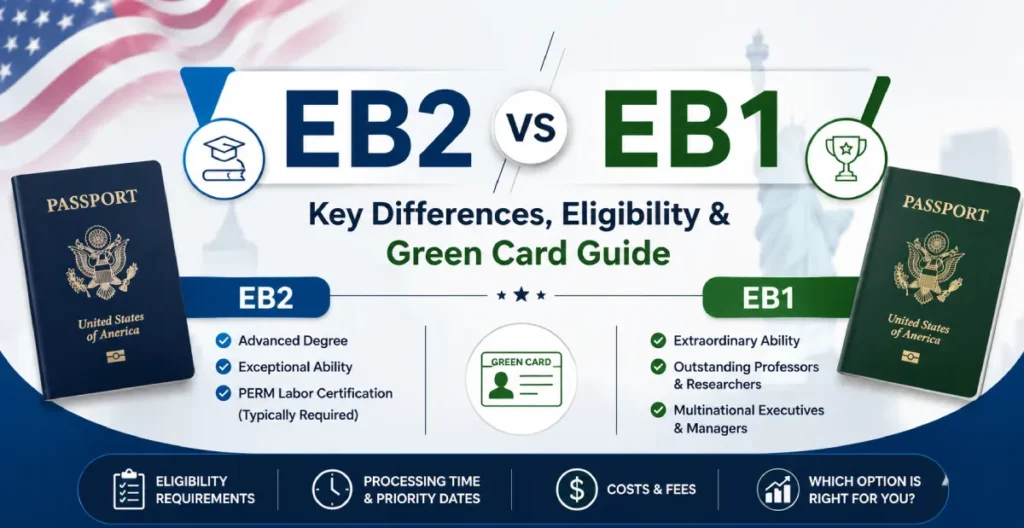
Here is the fastest way to see how the two categories differ. Both are employment-based immigrant visa categories that lead to a green card, but they target different professionals and follow different rules.
| Factor | EB1 (First Preference) | EB2 (Second Preference) |
|---|---|---|
| Who it is for | Top of the field: extraordinary ability, outstanding researchers, multinational executives | Professionals with an advanced degree or exceptional ability |
| Subcategories | EB1A, EB1B, EB1C | EB2 advanced degree, EB2 exceptional ability, EB2 NIW |
| Self-petition allowed? | Yes (EB1A only) | Yes (EB2 NIW only) |
| Job offer required? | No for EB1A; yes for EB1B and EB1C | Yes, unless filing EB2 NIW |
| PERM labor certification | Not required | Required, unless filing EB2 NIW |
| Evidence standard | Very high (sustained national or international acclaim) | Moderate (degree, experience, or exceptional ability) |
| Priority dates (most countries, June 2026) | Current | Current |
| Priority dates (India/China, June 2026) | Backlogged and retrogressed | Heavily backlogged |
| Typical I-140 processing | Faster, no PERM step | Slower overall, PERM adds time |
| Premium processing | 15 business days (EB1A, EB1B); 45 business days (EB1C) | 15 business days (PERM EB2); 45 business days (EB2 NIW) |
The single biggest divide is the PERM labor certification requirement, which sits in front of most EB2 cases but never applies to EB1. The second biggest divide is the evidence bar: EB1 demands proof that you sit at the very top of your profession, while EB2 asks you to prove advanced qualifications or national-interest impact.
What Is the EB1 Green Card?
The EB1 green card is the first-preference employment-based immigrant visa, reserved for foreign nationals who have reached the top of their field. It is one of the most desirable U.S. immigration pathways because it usually carries no PERM requirement, offers a faster route to permanent residence, and (in the case of EB1A) allows you to file without an employer.
USCIS divides the EB1 category into three subcategories, each with its own evidentiary criteria and documentation strategy.
EB1A: Extraordinary Ability (Self-Petition)
EB1A is for individuals with extraordinary ability in the sciences, arts, education, business, or athletics. You must demonstrate sustained national or international acclaim, which in practice means meeting at least 3 of the 10 regulatory criteria under 8 CFR 204.5(h)(3), and then passing a final merits determination that confirms you are among the small percentage at the very top of your field.
EB1A is the only EB1 subcategory that permits a self-petition green card filing. You do not need a job offer or a U.S. employer to sponsor you, although you must intend to continue working in your area of expertise. Because the bar is so high, EB1A petitions frequently turn on the quality of supporting documentation, including independent EB-1A recommendation letters and analytical EB-1 expert opinion letters that map each achievement to the regulatory criteria.
EB1B: Outstanding Professors and Researchers
EB1B is for academics and researchers with international recognition for outstanding achievements in their field. You need at least three years of teaching or research experience and a permanent or tenure-track job offer from a U.S. university, research institution, or qualifying private employer.
Unlike EB1A, EB1B requires employer sponsorship. The evidentiary focus is narrower and academic: publications, citation records, peer recognition, and standing within the scholarly community. Letters from senior academics at institutions other than your own carry particular weight here.
EB1C: Multinational Managers and Executives
EB1C is for managers and executives transferred to the United States by a qualifying multinational organization. You must have worked abroad in a managerial or executive capacity for at least one of the three years before filing, and you must be entering the U.S. to continue in a similar role for the same company, a parent, an affiliate, or a subsidiary.
EB1C requires a job offer and tends to draw heavier scrutiny than EB1A or EB1B, because USCIS evaluates both the multinational corporate structure and whether the role is truly executive or managerial rather than operational.
EB1 Eligibility Requirements at a Glance
To summarize the EB1 eligibility and EB1 requirements across subcategories:
- EB1A: sustained acclaim, at least 3 of 10 criteria met, no job offer needed, self-petition allowed.
- EB1B: international recognition, 3+ years of research or teaching, permanent job offer required.
- EB1C: 1 year of qualifying foreign managerial or executive employment in the prior 3 years, U.S. job offer required.
What Is the EB2 Green Card?
The EB2 green card is the second-preference employment-based immigrant visa for professionals who hold an advanced degree or who demonstrate exceptional ability in their field. It is more accessible than EB1, which is exactly why it is the more common filing among highly qualified professionals.
EB2 splits into three practical pathways: the advanced degree route, the exceptional ability route, and the National Interest Waiver.
EB2 Advanced Degree Pathway
This is the most common EB2 route. You qualify if you hold a U.S. master’s degree or higher, or a foreign equivalent. You can also qualify with a U.S. bachelor’s degree (or foreign equivalent) plus at least five years of progressive, post-baccalaureate experience in your specialty, which USCIS treats as equivalent to a master’s degree.
For applicants with foreign degrees, proving that advanced degree equivalency is a documentation step, not an assumption. USCIS does not accept foreign transcripts at face value, so many petitioners obtain an academic credential evaluation to establish U.S. equivalency, and a work experience evaluation when years of experience are being used to bridge the gap to an advanced degree.
EB2 Exceptional Ability Pathway
The exceptional ability route is for individuals with a degree of expertise significantly above the ordinary in the sciences, arts, or business. You must meet at least 3 of 6 regulatory criteria, such as professional licenses, evidence of a high salary, membership in professional associations, or recognition for achievements and contributions. This pathway is often paired with a clear demonstration of how your skills benefit U.S. employers or, in NIW cases, the national interest.
EB2 NIW and the Matter of Dhanasar Framework
The EB2 NIW (National Interest Waiver) is the second-preference category’s self-petition option. It lets you skip both the employer sponsor and the PERM labor certification if you can show your work serves the U.S. National Interest Waiver (NIW) standard.
To win an NIW, you first establish that you hold an advanced degree or exceptional ability, then satisfy the three-prong test from the AAO precedent decision Matter of Dhanasar:
- Your proposed endeavor has both substantial merit and national importance.
- You are well-positioned to advance that endeavor.
- On balance, it benefits the United States to waive the job offer and labor certification requirement.
Because the NIW turns on a legal argument rather than a credential alone, petitions are strengthened significantly by independent EB-2 NIW expert opinion letters that address each Dhanasar prong with evidence, supported by EB-2 NIW recommendation letters from collaborators.
EB2 Eligibility Requirements at a Glance
The core EB2 eligibility and EB2 requirements:
- Advanced degree route: master’s or higher, or bachelor’s plus 5 years of progressive experience; job offer and PERM normally required.
- Exceptional ability route: meet 3 of 6 criteria; job offer and PERM normally required.
- EB2 NIW route: advanced degree or exceptional ability, plus the three Dhanasar prongs; no job offer, no PERM.
EB1 vs EB2 Eligibility: The Differences That Decide Your Case
When you compare eb1 vs eb2 eligibility directly, seven differences do most of the work in pointing you toward one category.
- Bar of achievement. EB1 demands proof you are at the top of your field. EB2 asks you to prove advanced qualifications or national-interest impact.
- Job offer. EB1A and EB2 NIW need no job offer. EB1B, EB1C, and standard EB2 do.
- PERM. EB1 never requires PERM. EB2 requires it unless you file NIW.
- Self-petition. Only EB1A and EB2 NIW allow you to petition without an employer.
- Evidence type. EB1 leans on acclaim, awards, and recognition. EB2 leans on degrees, experience, and (for NIW) the importance of your work.
- Speed. EB1 typically moves faster because it skips PERM and has shorter queues for most countries.
- Country of birth. For India and China, both categories face backlogs, but the gap between them changes month to month.
EB1A vs EB2 NIW: Which Self-Petition Path Is Right for You?
For most self-petitioners, the real comparison is not EB1 vs EB2 broadly but EB1A vs EB2 NIW specifically, because these are the two routes that let you file without an employer. They share the self-petition advantage but differ in what you must prove.
| Factor | EB1A (Extraordinary Ability) | EB2 NIW (National Interest Waiver) |
|---|---|---|
| Core question | Are you among the very top of your field? | Does your work serve the U.S. national interest? |
| Legal standard | 3 of 10 criteria + final merits determination | Three Dhanasar prongs |
| Evidence bar | Higher; sustained acclaim required | Moderate; focus on the proposed endeavor |
| Priority dates | Often current for most countries | Often current for most countries |
| Best for | Award winners, highly cited researchers, recognized leaders | Researchers, founders, physicians, engineers, public-interest professionals |
| Premium processing | 15 business days | 45 business days |
A practical rule of thumb: if you can clearly document elite, recognized achievement, EB1A is the stronger and faster filing. If your work is important and impactful but you are still building national acclaim, EB2 NIW is usually the more realistic self-petition. Many professionals who do not yet meet the EB1A bar are strong NIW candidates, and some file both. For a deeper breakdown of how the two evidence packages differ, see our guide to the EB-1A expert opinion letter and our comparison of expert opinion letters versus recommendation letters.
PERM Labor Certification: The Dividing Line Between EB1 and EB2
The clearest structural difference in the eb2 vs eb1 comparison is the PERM labor certification. PERM is a Department of Labor process in which a U.S. employer tests the labor market to prove no qualified U.S. worker is available for the role at the prevailing wage.
- EB1 never requires PERM. That removes a step that can add roughly a year or more before the I-140 is even filed.
- Standard EB2 requires PERM, including recruitment, a prevailing wage determination, and potential audit delays.
- EB2 NIW waives PERM entirely, which is the central reason the NIW is so attractive to self-petitioners.
If avoiding PERM is your priority and you can self-petition, your decision narrows quickly to EB1A or EB2 NIW.
EB1 Priority Date vs EB2 Priority Date (June 2026 Visa Bulletin)
Your priority date is your place in line for a green card. It is set when your I-140 (or PERM, where applicable) is filed, and a visa becomes available only when your priority date is earlier than the Final Action Date listed for your category and country in the monthly Visa Bulletin.
The gap between the EB1 priority date and the EB2 priority date is where country of birth matters most. Here are the Final Action Dates from the June 2026 Visa Bulletin published by the U.S. Department of State:
| Country | EB1 Final Action Date | EB2 Final Action Date |
|---|---|---|
| All other countries (incl. Mexico, Philippines) | Current | Current |
| China | April 1, 2023 | September 1, 2021 |
| India | December 15, 2022 | September 1, 2013 |
Two points are worth flagging for 2026. First, both EB1 and EB2 for India retrogressed in the June 2026 bulletin, and the State Department warned that further retrogression, or an “unavailable” designation, may be necessary before the fiscal year ends on September 30, 2026. Second, the annual EB2 limit for India was reached in May 2026, meaning India EB2 applicants may continue filing if current, but were not expected to receive immigrant visas for the remainder of that fiscal year. For applicants from most other countries, both categories remained current, allowing eligible applicants to file Form I-485 concurrently.
Always check the current month’s Visa Bulletin before you file, because these dates move, sometimes sharply, from one month to the next.
EB1 Processing Time vs EB2 Processing Time
The EB1 processing time is generally faster than the EB2 processing time, for two reasons: EB1 skips PERM, and EB1 priority dates are current for most countries. EB2 carries the PERM step (except NIW) and longer backlogs for high-demand countries.
Here is how the timelines compare across the I-140 petition stage in 2026, including premium processing options. Note that the premium processing fee rose to $2,965 effective March 1, 2026.
| Stage | EB1 | EB2 |
|---|---|---|
| PERM labor certification | Not required | Several months to a year-plus (not required for NIW) |
| Standard I-140 processing | Roughly 5 to 12 months, varies by service center | Roughly 8 to 20+ months; NIW often longer at the I-140 stage |
| Premium processing (Form I-907) | 15 business days (EB1A, EB1B); 45 business days (EB1C) | 15 business days (PERM EB2); 45 business days (EB2 NIW) |
| I-485 adjustment of status (if current) | Roughly 6 to 14 months | Roughly 6 to 14 months |
A few practical notes. Premium processing only speeds up USCIS review of the I-140; it does not change your priority date or visa availability, so it offers limited benefit to backlogged India and China applicants. RFE rates have also risen across employment-based categories following a 2025 USCIS policy update, and an RFE can add several months because you typically have around 87 days to respond before USCIS resumes adjudication. A strong, complete petition at filing is the most reliable way to keep your timeline short.
EB1 vs EB2: Cost Comparison
The filing fees for the I-140 and for premium processing are the same regardless of whether you choose EB1 or EB2. The real cost difference comes from two places:
- PERM recruitment costs apply to standard EB2 (advertising, prevailing wage, attorney time) but never to EB1 or EB2 NIW.
- Evidence preparation for self-petitions (EB1A and EB2 NIW) often includes credential evaluations and expert opinion letters, which are investments in approval odds rather than government fees.
You can review typical evaluation and letter packages on our pricing page.
How Expert Opinion Letters Strengthen Both EB1 and EB2 Petitions
USCIS adjudicators are generalists who review petitions across dozens of fields. That is precisely why independent expert opinion letters carry so much weight in both EB1 and EB2 filings: they translate your technical contributions into an evidence-based argument that maps directly to the legal standard.
In our experience preparing letters for both categories, the strongest petitions share three traits:
- Independence. Letters from experts with no prior working relationship to the petitioner are treated as more objective, and therefore carry more evidentiary weight than letters from supervisors or co-authors alone.
- Specificity. Generic praise is a leading cause of RFEs. Letters that tie each achievement to a named regulatory criterion (for EB1A) or to a specific Dhanasar prong (for EB2 NIW) are far more persuasive.
- Completeness. A balanced package pairs analytical expert letters with personal recommendation letters, plus properly evaluated credentials.
If your degrees were earned outside the United States, a USCIS-compliant academic evaluation establishes the advanced-degree equivalency that EB2 requires. Professionals on other visa types who are weighing a switch may also want to compare these with an H-1B specialty occupation letter, an O-1 expert advisory letter, or an L-1 expert opinion letter, depending on their current status and long-term goals.
Can You Apply for Both EB1 and EB2 at the Same Time?
Yes. You can file petitions in both the EB1 and EB2 categories simultaneously, and there is no limit on how many I-140 petitions you may submit. This is a common hedging strategy: if USCIS denies one, the other may still be approved, and if both are approved, you choose whichever serves you best.
You will pay the full I-140 filing fee for each petition. If you are filing concurrently with an I-485, you can generally file multiple I-140 petitions but only one I-485, then transfer the I-485 to whichever I-140 is approved.
Can You Move From EB2 to EB1? Understanding Porting
If your career advances after you file an EB2 petition, you may later qualify for EB1. There is no mechanism to convert an existing petition, but you can file a new EB1 petition and, in many cases, retain the earlier priority date from your approved EB2 I-140. This is known as priority date retention, and for backlogged applicants from India or China it can be valuable, because it preserves your place in line while you move to a faster-moving category.
EB2 vs EB1: Which Should You Choose?
There is no universally “better” category in the eb2 vs eb1 debate. The right answer depends on your profile. Use these guidelines as a starting point, then confirm with a qualified immigration attorney.
- Choose EB1A if you have documented, recognized achievements: major awards, high citation counts, leading roles, press coverage, or comparable acclaim. It is the fastest self-petition route for most countries.
- Choose EB1B if you are an academic or researcher with international recognition and a permanent U.S. research or teaching offer.
- Choose EB1C if you are a multinational manager or executive transferring to a U.S. office of your organization.
- Choose EB2 NIW if your work is impactful and important to the United States but you are still building toward elite acclaim, and you want to self-petition without PERM.
- Choose standard EB2 if you have an advanced degree (or bachelor’s plus five years) and a sponsoring employer willing to complete PERM, and you do not qualify for NIW.
For applicants from India and China, factor the current Visa Bulletin into the decision. A faster I-140 means little if your priority date sits years away from current, so the strategic choice often weighs queue position alongside qualification.
Common Mistakes That Trigger RFEs in EB1 and EB2 Petitions
Many otherwise-qualified petitions stumble on avoidable issues. The most frequent in both categories:
- Generic expert letters that praise the petitioner without connecting achievements to specific criteria or Dhanasar prongs.
- Unevaluated foreign credentials, leaving USCIS unable to confirm an advanced degree without a proper equivalency evaluation.
- Weak national-importance arguments in NIW cases, where the work is shown to matter locally but not at a national scale.
- Reusing the original letter for an RFE response, instead of writing a new, targeted document that answers USCIS by name.
- Over-reliance on affiliated sources, with too few independent experts in the package.
Building anticipatory evidence on every weak point before filing is the single most effective way to reduce RFE risk and keep your timeline on track.
Frequently Asked Questions
What is the main difference between EB2 and EB1?
The main difference in the eb2 vs eb1 comparison is the level of achievement required and the role of PERM. EB1 is for people at the top of their field and skips labor certification, making it faster. EB2 is for professionals with an advanced degree or exceptional ability and normally requires PERM, unless you file under the National Interest Waiver.
Is EB1 faster than EB2?
Yes, EB1 is usually faster than EB2. EB1 skips the PERM labor certification step and its priority dates are current for most countries, so applicants typically only wait for the I-140 to be adjudicated. EB2 adds PERM (except for NIW) and faces longer backlogs, especially for India and China.
Can I self-petition for EB1 or EB2 without an employer?
Yes, but only through two specific routes. EB1A (extraordinary ability) allows a self-petition green card filing with no job offer, and EB2 NIW (National Interest Waiver) also permits self-petition. EB1B, EB1C, and standard EB2 all require an employer to sponsor the petition.
What is the difference between EB1A and EB2 NIW?
Both EB1A vs EB2 NIW are self-petition options, but they prove different things. EB1A requires sustained national or international acclaim and meeting at least 3 of 10 criteria, then a final merits determination. EB2 NIW requires an advanced degree or exceptional ability plus the three Dhanasar prongs showing your work serves the U.S. national interest. EB1A sets a higher bar but moves faster.
What are the EB1 and EB2 priority dates in 2026?
As of the June 2026 Visa Bulletin, EB1 and EB2 are current for most countries. For China, the EB1 Final Action Date is April 1, 2023 and EB2 is September 1, 2021. For India, EB1 is December 15, 2022 and EB2 is September 1, 2013, after both categories retrogressed. Always verify the current month’s bulletin before filing.
How long does EB2 NIW processing take?
In 2026, the standard EB2 processing time at the I-140 stage for NIW commonly runs from about 8 to 20 months, depending on the service center. Premium processing guarantees USCIS action within 45 business days for NIW, though it does not change your priority date or visa availability.
Do EB1 and EB2 require PERM labor certification?
EB1 never requires PERM labor certification. EB2 requires PERM for the advanced degree and exceptional ability routes, but the EB2 NIW waives it entirely. PERM is the most significant procedural difference between the two categories.
Can I apply for EB1 and EB2 at the same time?
Yes. You can file petitions in both categories simultaneously, and there is no limit on the number of I-140 petitions you can submit. Each I-140 carries its own filing fee. Filing both can increase your overall chances of approval and gives you flexibility if one is denied.
Is an expert opinion letter required for EB1 or EB2?
An expert opinion letter is not legally mandated by USCIS, but it is included in the vast majority of successful EB1A and EB2 NIW petitions. It provides independent, third-party analysis that connects your achievements to the legal criteria, which strengthens the petition and reduces RFE risk.
How do I prove an advanced degree earned outside the U.S. for EB2?
USCIS does not accept foreign transcripts directly. You establish advanced degree equivalency with a USCIS-compliant credential evaluation, and you can use a work experience evaluation when years of progressive experience are being counted toward the advanced-degree threshold (a bachelor’s plus five years).
What is the EB1 processing time with premium processing?
With premium processing, USCIS guarantees action on the I-140 within 15 business days for EB1A and EB1B, and within 45 business days for EB1C. The premium processing fee is $2,965 as of March 1, 2026. Premium processing speeds up adjudication only, not your priority date or visa availability.
Can I move from EB2 to EB1 later?
Yes. While you cannot convert an existing petition, you can file a new EB1 petition if your qualifications improve, and you may retain the priority date from your approved EB2 I-140. This porting strategy preserves your place in line, which is especially useful for backlogged applicants from India and China.
Which has a higher approval rate, EB1 or EB2?
In recent USCIS fiscal-year data, EB2 I-140 petitions have generally shown higher approval rates than EB1A, reflecting EB1A’s higher evidentiary bar. NIW petitions face particularly close scrutiny, and RFE rates across all employment-based categories rose after a 2025 USCIS policy update, so petition quality matters more than ever.
Is EB1 or EB2 better for applicants from India?
For India-born applicants, both EB1 and EB2 face backlogs, and both retrogressed in 2026. EB1 typically has a more favorable priority date than EB2 for India, so qualifying for EB1A can meaningfully shorten the wait. Because the gap shifts monthly, the decision should weigh both your qualifications and the current Visa Bulletin.
Does EB2 NIW or EB1A need a stronger expert letter package?
EB1A generally requires a stronger, larger package, often 5 to 7 letters, because you must prove elite standing against 10 criteria and the final merits determination. EB2 NIW typically uses 3 to 5 letters focused on the three Dhanasar prongs. In both cases, independent, specific, evidence-anchored letters outperform a larger volume of generic ones.
Final Verdict: Choosing Between EB2 and EB1
The eb2 vs eb1 decision comes down to a simple trade-off: EB1 is faster and more prestigious but harder to qualify for, while EB2 is more accessible but slower, especially with PERM and country-specific backlogs. If you can document elite, recognized achievement, EB1A is usually the stronger filing. If your work is important but you are still building acclaim, EB2 NIW offers a self-petition route without PERM. And if you have an advanced degree and a sponsoring employer, standard EB2 remains a dependable path.
Whichever category fits, the outcome depends heavily on the strength of your evidence. Properly evaluated credentials and rigorously prepared, independent expert opinion letters are often what move a petition from borderline to approved.
AAE Evaluations prepares USCIS-compliant credential evaluations and expert opinion letters for EB1, EB2 NIW, and related petitions. Explore all our services or contact our team to discuss the right strategy for your case.
This article is for general informational purposes only and is not legal advice. For guidance on your specific situation, consult a licensed immigration attorney.