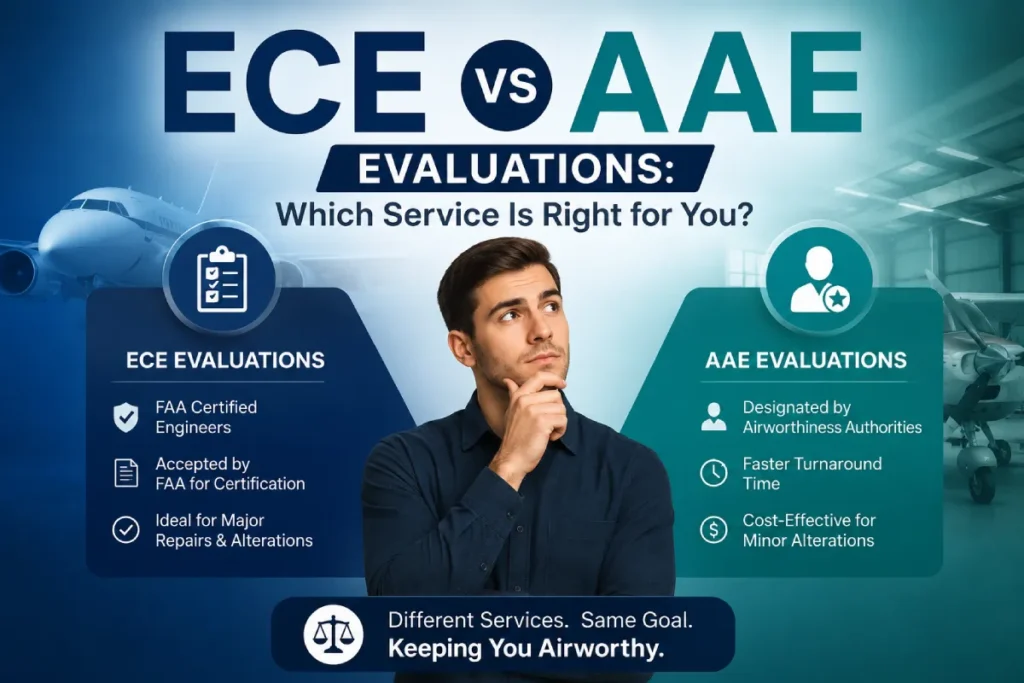
Quick Answer: ECE (Educational Credential Evaluators) is a well-respected NACES member that handles academic credential evaluations for university admissions, employment, and general immigration use. AAE Evaluations goes significantly further — offering not only credential evaluations but also immigration-specific expert opinion letters, work experience evaluations, and position evaluations for visa petitions including EB-1, EB-2 NIW, H-1B, O-1, and L-1. If your goal involves a USCIS visa petition, AAE Evaluations is the more complete solution.
Choosing the wrong credential evaluation service can cost you weeks of delays, a USCIS Request for Evidence (RFE), or worse — a denied petition. Yet the differences between services like ECE and AAE Evaluations aren’t always obvious from the outside.
Both organizations evaluate foreign academic credentials. Both are trusted names in the industry. But they serve meaningfully different purposes, and understanding those differences before you order is the decision that actually matters.
This guide breaks down everything you need to know: what each service offers, where each one falls short, how they compare on processing time and pricing, and — most importantly — which one is right for your specific situation.
What Is ECE (Educational Credential Evaluators)?
Educational Credential Evaluators (ECE) is a nonprofit organization founded in 1976 and headquartered in Milwaukee, Wisconsin. It is one of the most recognized foreign credential evaluation agencies in the United States and has been a charter member of NACES (National Association of Credential Evaluation Services) since that body’s founding in 1987.
ECE has assisted more than 800,000 individuals in obtaining degree equivalency recognition, and its evaluations are widely accepted by U.S. universities, professional licensing boards, and employers. The organization holds an A+ rating from the Better Business Bureau and was awarded the BBB Torch Award for Ethics.
What ECE Does Well
ECE’s core competency is academic credential evaluation — determining the U.S. equivalent of a foreign degree for purposes of university admissions, professional licensing, and general employment. Their most popular product, the Course-by-Course evaluation, is ordered by roughly 69% of ECE applicants and provides detailed course-level equivalency.
ECE typically processes evaluations in approximately five business days from receipt of all required documents, which is a genuine strength for students and professionals with straightforward academic backgrounds.
The Important Limitation to Know
ECE does not provide immigration-specific expert opinion letters. This is not a criticism — it reflects ECE’s purposeful scope. But it is an important distinction for anyone pursuing an employment-based visa. A credential evaluation from ECE establishes your degree equivalency; it does not address the additional evidentiary requirements that USCIS imposes for H-1B specialty occupation determinations, EB-2 NIW National Interest Waiver petitions, or EB-1 extraordinary ability petitions.
ECE also does not evaluate work experience. If your qualifications include a combination of education and professional experience — as is common in many H-1B and EB-2 NIW cases — ECE cannot document that component for USCIS.
What Is AAE Evaluations?
AAE Evaluations is a U.S.-based credential evaluation and expert opinion letter service specializing in immigration documentation. Based in Delaware and serving clients across 43+ nationalities, AAE Evaluations offers a coordinated suite of services designed to support the full documentation stack required for employment-based visa petitions.
Where ECE focuses exclusively on academic credentials, AAE Evaluations operates at the intersection of credential evaluation and immigration documentation — a positioning that reflects how most real-world USCIS petitions actually work. In the majority of employment-based immigration cases, a credential evaluation alone is not sufficient. USCIS requires supporting documentation that addresses visa-specific criteria, and that’s where AAE Evaluations fills a gap that academic-only evaluators cannot.
What AAE Evaluations Offers
- Academic credential evaluations — foreign degree equivalency for USCIS and employer use
- Work experience evaluations — converting professional experience to academic equivalency
- Course-by-course evaluations — detailed course-level analysis
- Position evaluations — role-by-role equivalency documentation
- EB-1 expert opinion letters — for extraordinary ability petitions
- EB-1A recommendation letters — supporting EB-1A petition packages
- EB-2 NIW expert opinion letters — addressing the Matter of Dhanasar three-prong test
- EB-2 NIW recommendation letters — for National Interest Waiver petitions
- H-1B expert opinion letters — specialty occupation documentation
- L-1 expert opinion letters and business plans
- O-1 expert and advisory letters
- Certified translations
The practical difference: When you work with AAE Evaluations, you can commission your credential evaluation, expert opinion letter, and work experience evaluation from a single provider — ensuring consistency across every document in your USCIS petition package. That consistency matters: conflicting details between separately sourced documents are a common trigger for Requests for Evidence.
ECE vs AAE Evaluations: Side-by-Side Comparison
| Feature | ECE | AAE Evaluations |
|---|---|---|
| Founded | 1976 | 2016 |
| Organization type | Nonprofit | Private |
| NACES member | Yes (charter member) | No |
| Academic credential evaluation | ✅ Yes | ✅ Yes |
| Course-by-course evaluation | ✅ Yes | ✅ Yes |
| Work experience evaluation | ❌ No | ✅ Yes |
| Position/role evaluation | ❌ No | ✅ Yes |
| Expert opinion letters (EB-1) | ❌ No | ✅ Yes |
| Expert opinion letters (EB-2 NIW) | ❌ No | ✅ Yes |
| Expert opinion letters (H-1B) | ❌ No | ✅ Yes |
| Expert opinion letters (O-1) | ❌ No | ✅ Yes |
| Expert opinion letters (L-1) | ❌ No | ✅ Yes |
| Recommendation letters | ❌ No | ✅ Yes |
| RFE response support | ❌ No | ✅ Yes |
| Certified translations | ❌ No | ✅ Yes |
| Standard processing time | ~5 business days | Varies by service |
| Best for | University admissions, licensing | Immigration visa petitions |
| Immigration-specific expertise | General use | Specialized (H-1B, EB-1, EB-2 NIW, O-1, L-1) |
| Report validity | 5 years | No expiry |
Credential Evaluation Services: What Each Provider Offers
Both ECE and AAE Evaluations provide core academic credential evaluations — but their approach and intended audience differ.
ECE’s Credential Evaluation Products
ECE offers three primary report types for U.S. applicants:
- General Report: Confirms the authenticity of academic documents, recognizes the status of the institution, and establishes the U.S. equivalency of the program of study.
- General with Grade Average: Adds a cumulative GPA calculation to the General Report.
- Course-by-Course Report: The most comprehensive option. Provides U.S. equivalent course titles, grades, and credits for all individual coursework. This is ECE’s most-ordered report and is typically required for graduate school admission and professional licensing.
ECE’s documentation requirements can be strict. For some countries and educational systems, ECE requires original documents. Applicants in countries where institutions are unable or unwilling to issue official documents directly face particular challenges — a well-documented limitation with ECE’s process that prospective applicants should factor into their timeline.
AAE Evaluations’ Credential Evaluation Products
AAE Evaluations offers equivalent academic evaluation types — document-by-document, course-by-course, and general evaluations — with the same USCIS compliance standards. Critically, AAE also offers two evaluation types that ECE does not:
Work Experience Evaluations: USCIS permits foreign nationals who lack a qualifying U.S. bachelor’s degree to demonstrate equivalency through a combination of education and professional experience (typically three years of experience in the field for each year of education short of a four-year degree). A work experience evaluation from AAE documents this equivalency in a format USCIS accepts for H-1B and EB-2 petitions.
Position Evaluations: Position-by-position evaluations document the complexity, specialization, and academic requirements of specific roles — an important tool for H-1B specialty occupation cases and employer-sponsored green card applications.
Why this matters for immigration applicants: If your degree is from outside the U.S. and you’re pursuing an H-1B, EB-2, or EB-1 petition, you almost certainly need both a credential evaluation and at least one additional document (an expert opinion letter, a work experience evaluation, or both). ECE can only supply one piece of that puzzle. AAE Evaluations can supply the complete set.
Expert Opinion Letters: The Critical Difference
This is the area where ECE and AAE Evaluations diverge most significantly — and where the stakes are highest for immigration applicants.
What an Expert Opinion Letter Is
An expert opinion letter (sometimes called an expert evaluation letter or expert reference letter) is a formal document written by a credentialed expert in the applicant’s field. It provides USCIS with an authoritative, independent evaluation of the applicant’s qualifications, the significance of their work, and how their credentials align with the specific standards of the visa category being sought.
USCIS adjudicators are immigration specialists — not engineers, researchers, physicians, or business executives. When evaluating a petition from a software architect, an oncology researcher, or a supply chain specialist, an adjudicator depends on expert opinion letters to understand what the work actually means, why it matters, and whether it meets the visa criteria.
Why ECE Doesn’t Provide Expert Opinion Letters
ECE’s mandate is academic credential equivalency. The organization assesses whether a foreign university degree is equivalent to a U.S. bachelor’s or master’s degree. That is a well-defined, standardized function. Expert opinion letters, by contrast, require field-specific expertise that varies by discipline and visa category — a structurally different service that falls outside ECE’s scope by design.
This creates a practical gap for immigration applicants: an ECE credential evaluation tells USCIS that your degree is equivalent to a U.S. master’s. An expert opinion letter tells USCIS that your work in computational fluid dynamics is of national importance to the U.S. aerospace industry. Both documents are typically needed. Only one provider in this comparison can supply both.
AAE Evaluations’ Expert Opinion Letter Services
AAE Evaluations provides expert opinion letters written by PhD-credentialed professionals across relevant disciplines. Their letters are designed to address the specific evidentiary standards USCIS applies to each visa category:
For EB-2 NIW: EB-2 NIW expert opinion letters from AAE address the three-prong Matter of Dhanasar framework — substantial merit, national importance, and the applicant’s ability to advance the proposed endeavor. Without this analysis, an EB-2 NIW petition is structurally incomplete and virtually certain to receive an RFE.
For EB-1: EB-1 expert opinion letters address the extraordinary ability criteria — explaining how the applicant’s achievements map to the EB-1A or EB-1B standards and providing the kind of independent expert perspective that USCIS weighs heavily in these highly competitive categories.
For H-1B: H-1B specialty occupation expert opinion letters establish that the position in question qualifies as a specialty occupation and that the beneficiary meets the theoretical and practical application requirements of an H-1B classification. These letters are particularly important when USCIS questions whether the role’s specific duties require a specialized degree.
For O-1: O-1 expert and advisory letters support extraordinary ability or extraordinary achievement claims for artists, athletes, researchers, and business professionals.
For L-1: L-1 expert opinion letters and business plans support intracompany transferee petitions — documenting executive or managerial capacity and the legitimacy of the proposed business operations.
Important note for EB-2 NIW applicants: In addition to expert opinion letters, strong NIW petitions typically include recommendation letters from independent industry experts. AAE Evaluations provides both: EB-2 NIW recommendation letters in addition to formal expert opinion letters. See their expert opinion letter services overview for a complete breakdown.
Work Experience Evaluations {#work-experience-evaluations}
One of the most commonly overlooked documents in employment-based immigration petitions is the work experience evaluation.
USCIS recognizes a “three-for-one” equivalency rule: three years of specialized work experience in a field can substitute for one year of formal education. For applicants whose highest academic credential is a bachelor’s degree and who are seeking to demonstrate a master’s-level equivalency for EB-2 purposes, or for H-1B applicants whose formal education doesn’t precisely match the required specialty, a work experience evaluation can be the difference between an approvable petition and an RFE.
ECE does not offer work experience evaluations. Their scope is limited to academic credentials.
AAE Evaluations’ work experience evaluation service documents the applicant’s professional background, the academic level at which that work was performed, and the resulting U.S. educational equivalency — in a format calibrated to USCIS standards. This is especially important for:
- H-1B applicants who do not hold a bachelor’s degree in the specific specialty the position requires
- EB-2 applicants who hold a bachelor’s degree but need to demonstrate equivalency to an advanced degree
- Applicants in fields where formal education and professional practice diverge significantly
Processing Times Compared
Processing time is a genuine concern for immigration applicants, particularly those managing USCIS deadlines or responding to RFEs.
ECE Processing Times
ECE advertises an average turnaround of approximately five business days from receipt of all required documentation. In practice, total processing time depends heavily on how quickly the applicant can gather and submit the required documents — which for some countries requires original transcripts sent directly from the issuing institution. Total elapsed time often ranges from two to six weeks when document collection is factored in.
ECE’s evaluation reports have a validity period of five years.
AAE Evaluations Processing Times
AAE Evaluations offers flexible processing timelines calibrated to the urgency of the case. For rush situations — including RFE responses with tight deadlines — expedited turnaround is available. Contact AAE Evaluations directly to discuss timeline requirements for your specific situation.
Importantly, AAE Evaluations credential evaluation reports do not expire. Your earned credentials are permanent, and the equivalency determination reflects that.
For RFE situations: If you’ve received a Request for Evidence, you are working against a hard deadline. AAE Evaluations’ ability to provide coordinated expert opinion letters and credential evaluations in a single engagement significantly reduces the coordination complexity you’d otherwise face by sourcing documents from multiple providers — which is a common and avoidable source of delays.
Pricing Comparison {#pricing}
Pricing in the credential evaluation industry varies by report type and service level. Direct price comparisons between ECE and AAE Evaluations are difficult to make cleanly because the two organizations offer fundamentally different service sets.
ECE Pricing (Approximate)
- General report: ~$100–$135
- Course-by-course report: ~$160–$200
- Rush/expedited processing: additional fee
- Canadian institution reports: separate pricing
AAE Evaluations Pricing
AAE Evaluations’ pricing reflects the breadth of services offered and is structured around the immigration use case. For complete and current pricing — including credential evaluations, expert opinion letters, and bundled engagement options — see AAE Evaluations’ pricing page.
The real cost calculation: When comparing pricing, factor in the complete documentation you need, not just the credential evaluation in isolation. An applicant who orders an ECE academic evaluation and then separately sources an expert opinion letter from a third provider often pays more in total — and introduces the risk of inconsistent documentation — than an applicant who sources both from AAE Evaluations in a single coordinated engagement.
Immigration Use Cases: Which Service Do You Actually Need? {#immigration-use-cases}
The right service depends entirely on what you’re trying to accomplish. Here’s a practical breakdown:
You Need ECE If:
- You’re applying to a U.S. university or graduate program that specifically requires an ECE evaluation
- You’re pursuing professional licensure with a board that requires a NACES-member evaluation and specifies ECE
- You need a credential evaluation for general employment purposes and your employer accepts ECE
You Need AAE Evaluations If:
- You’re filing an H-1B petition and need both a credential evaluation and a specialty occupation expert opinion letter
- You’re self-petitioning for an EB-2 NIW green card and need the full documentation package
- You’re applying for an EB-1A, EB-1B, or EB-1C green card and need expert opinion letters addressing extraordinary ability or outstanding researcher criteria
- You’re applying for an O-1 or L-1 visa
- Your qualifications include work experience that needs to be documented for educational equivalency purposes
- You’ve received an RFE and need a coordinated response package
- You want all immigration documents to be consistent and sourced from a single provider
You May Need Both — But Understand Why
Some applicants use ECE for an academic evaluation (because a specific institution requires it) and AAE Evaluations for expert opinion letters and work experience documentation (because ECE doesn’t offer those services). This is a legitimate approach but adds coordination complexity. If your primary driver is USCIS compliance rather than institutional requirement, working with AAE Evaluations exclusively tends to produce a more coherent documentation package.
ECE vs AAE Evaluations for Specific Visa Categories
H-1B Visa
Documents typically required: Credential evaluation + specialty occupation expert opinion letter (and potentially a work experience evaluation if the degree doesn’t precisely match the specialty)
ECE can provide: Credential evaluation only AAE Evaluations can provide: Credential evaluation + H-1B expert opinion letter + work experience evaluation
Verdict: AAE Evaluations is the more practical choice for H-1B petitioners who need a complete documentation package.
EB-2 NIW (National Interest Waiver)
Documents typically required: Credential evaluation + expert opinion letters addressing the Dhanasar three-prong test + recommendation letters from independent experts
ECE can provide: Credential evaluation only AAE Evaluations can provide: Credential evaluation + EB-2 NIW expert opinion letters + EB-2 NIW recommendation letters
Verdict: For EB-2 NIW, AAE Evaluations is the only viable choice between the two. An ECE evaluation alone cannot support an NIW petition.
EB-1A (Extraordinary Ability)
Documents typically required: Expert opinion letters addressing extraordinary ability + recommendation letters from recognized authorities + evidence of sustained national or international acclaim
ECE can provide: N/A (credential evaluation, but EB-1A petitions turn primarily on extraordinary ability evidence, not degree equivalency) AAE Evaluations can provide: EB-1 expert opinion letters + EB-1A recommendation letters + credential evaluation if needed
Verdict: AAE Evaluations is the relevant provider for EB-1A documentation.
EB-1B (Outstanding Researcher or Professor)
Documents typically required: Evidence of at least two of the recognized criteria for outstanding researchers + employer offer from a qualifying institution
ECE can provide: Credential evaluation (limited applicability for EB-1B, which is primarily evidence-based) AAE Evaluations can provide: EB-1 expert opinion letters + credential evaluation
Verdict: AAE Evaluations for expert documentation; ECE may be acceptable for the credential evaluation component if required.
O-1 Visa (Extraordinary Ability or Achievement)
Documents typically required: Advisory opinion from a peer group or expert + evidence of extraordinary ability
ECE can provide: N/A AAE Evaluations can provide: O-1 expert and advisory letters + O-1 recommendation letters
Verdict: AAE Evaluations is the applicable provider for O-1 documentation.
L-1 Visa (Intracompany Transferee)
Documents typically required: Evidence of managerial/executive capacity + documentation of qualifying relationship between entities
ECE can provide: N/A AAE Evaluations can provide: L-1 expert opinion letters and business plans + L-1A and L-1B expert opinion letters
Verdict: AAE Evaluations is the applicable provider for L-1 documentation.
NACES Membership and Accreditation
One of the first things prospective credential evaluation customers encounter is the question of NACES membership. ECE is a charter member of NACES; AAE Evaluations is not. What does this actually mean in practice?
NACES (National Association of Credential Evaluation Services) is a nonprofit association that sets ethical and professional standards for credential evaluation organizations in the United States. Membership signals that an organization has met NACES’s standards for evaluator qualifications, methodology, and business practices. The U.S. Department of State recognizes NACES as one of two associations (along with AICE) whose member evaluations carry established credibility.
For university admissions and professional licensing, NACES membership is frequently a hard requirement — institutions specify that evaluations must come from a NACES member, and there is no workaround.
For USCIS immigration petitions, the requirement is different. USCIS does not mandate that credential evaluations come exclusively from NACES members. What USCIS requires is that the evaluator is qualified — typically holding credentials equivalent to a U.S. bachelor’s degree or higher in the relevant field, with experience evaluating foreign credentials. Many immigration evaluations accepted by USCIS come from non-NACES organizations, provided the evaluator’s qualifications are documented.
Bottom line on NACES: If a specific university, licensing board, or employer requires a NACES-member evaluation, ECE is the right choice. If your evaluation is destined for a USCIS immigration petition, the NACES status of your credential evaluator matters less than the expertise, completeness, and USCIS-alignment of your full documentation package.
Who Should Choose ECE?
ECE is the stronger choice when:
- Your institution specifies ECE. Some universities, nursing boards, and licensing organizations explicitly require ECE evaluations and will not accept substitutes. Always verify before ordering.
- Your purpose is university admissions in the U.S. or Canada. ECE’s course-by-course reports are specifically designed for this use case and are widely accepted.
- Your purpose is professional licensure. ECE has established relationships with licensing boards across healthcare, engineering, and education fields.
- You need a simple, NACES-certified academic equivalency document. For straightforward situations where institutional name recognition is the primary concern, ECE’s track record and NACES membership carry weight.
Who Should Choose AAE Evaluations?
AAE Evaluations is the stronger choice when:
- You are filing a USCIS visa petition and need a complete documentation package — credential evaluation, expert opinion letters, and/or work experience evaluation from a single coordinated source.
- You are self-petitioning for EB-2 NIW or EB-1A and need expert opinion letters that address the specific evidentiary standards for those categories.
- You received an RFE and need a responsive, coordinated package of documents quickly.
- Your qualifications include significant work experience that needs to be documented for educational equivalency purposes under USCIS standards.
- You are applying for H-1B, O-1, or L-1 and need specialty occupation or extraordinary ability documentation.
- You value consistency across your immigration documents — having a single provider responsible for credential evaluation, expert letters, and recommendation letters eliminates the risk of conflicting details that can trigger scrutiny.
- You want no expiry on your evaluation. Unlike ECE’s five-year validity window, AAE Evaluations’ credential evaluation reports do not expire.
Ready to get started? Contact AAE Evaluations to discuss your specific visa situation, or view pricing for available services. You can also pay online once your service is confirmed.
Frequently Asked Questions
Is ECE accepted by USCIS for immigration purposes?
ECE credential evaluations are generally accepted by USCIS to establish the U.S. equivalency of a foreign academic degree. However, ECE does not provide the expert opinion letters, work experience evaluations, or visa-specific documentation that USCIS also requires for most employment-based visa petitions. A credential evaluation from ECE is one piece of your immigration documentation — not a complete solution.
Does AAE Evaluations have NACES membership?
AAE Evaluations is not a NACES member. For USCIS immigration petitions, NACES membership is not a mandatory requirement — USCIS evaluates the qualifications of the evaluator and the completeness of the documentation. For university admissions or professional licensing boards that specifically require a NACES-member evaluation, ECE is the appropriate choice.
Can I use both ECE and AAE Evaluations?
Yes. Some applicants use an ECE credential evaluation because a university or licensing board requires it, and separately order expert opinion letters and work experience evaluations from AAE Evaluations for their USCIS petition. This approach works but adds coordination complexity and the potential for inconsistencies between documents.
What’s the difference between a credential evaluation and an expert opinion letter?
A credential evaluation establishes that your foreign degree is equivalent to a specified U.S. degree level — for example, that your foreign bachelor’s is equivalent to a U.S. bachelor’s. An expert opinion letter provides a qualified expert’s assessment of your professional qualifications, the significance of your work, and how your experience meets the specific criteria of a visa category (such as specialty occupation for H-1B or national importance for EB-2 NIW). Both documents are typically needed for employment-based visa petitions.
How long does an ECE evaluation take?
ECE averages approximately five business days from receipt of all required documents. However, collecting the required documents — particularly for countries where ECE requires original transcripts sent directly from the issuing institution — can add two to six weeks to the total elapsed time.
Does AAE Evaluations offer rush processing?
Yes. AAE Evaluations accommodates rush timelines, including RFE responses with tight USCIS deadlines. Contact AAE Evaluations directly to discuss your timeline.
Do AAE Evaluations credential reports expire?
No. AAE Evaluations’ credential evaluation reports do not have an expiration date. ECE’s reports are valid for five years.
What is a work experience evaluation and do I need one?
A work experience evaluation documents your professional experience and converts it to an academic equivalency under USCIS standards. You typically need one if: (a) your formal education doesn’t reach the degree level required for your visa category, or (b) your degree doesn’t precisely match the specialty required by an H-1B position. ECE does not offer work experience evaluations. AAE Evaluations does — see their work experience evaluation service.
Can a credential evaluation alone support an EB-2 NIW petition?
No. An EB-2 NIW petition requires substantially more documentation than a credential evaluation. The core of an NIW petition is demonstrating the three Dhanasar prongs — substantial merit, national importance, and the petitioner’s ability to advance the proposed endeavor — which requires expert opinion letters and/or recommendation letters from qualified independent experts. See AAE Evaluations’ EB-2 NIW expert opinion letters and EB-2 NIW recommendation letters for the relevant services.
Which credential evaluator is better for H-1B?
For H-1B, the credential evaluation is only one component of the required documentation. AAE Evaluations is the stronger choice for H-1B petitioners because it provides both the credential evaluation and the H-1B specialty occupation expert opinion letter — and potentially a work experience evaluation — in a coordinated single engagement.
Are credential evaluations the same as certified translations?
No. A credential evaluation assesses the U.S. equivalency of a foreign academic degree or professional experience. A certified translation converts foreign-language documents into English in a format accepted by USCIS, universities, and other institutions. AAE Evaluations provides both services. ECE provides evaluations but does not provide translation services.
Conclusion
ECE and AAE Evaluations are not competing services in the way that, say, WES and ECE compete. They occupy different positions in the credential evaluation landscape, and the right choice depends almost entirely on what you’re actually trying to accomplish.
If your destination is a U.S. university, a nursing license, or an employer that requires a NACES-member evaluation, ECE’s 45+ years of institutional relationships, charter NACES membership, and established reputation make it a reliable choice for that specific purpose.
If your destination is a USCIS petition — H-1B, EB-1, EB-2 NIW, O-1, or L-1 — AAE Evaluations is the more practical and complete solution. Not because ECE falls short, but because USCIS immigration petitions require a fundamentally different and broader set of documents than academic admissions do. A credential evaluation is one piece of a petition. Expert opinion letters, work experience evaluations, and recommendation letters are the others. AAE Evaluations provides all of them.
The cost of choosing the wrong service isn’t just a matter of reordering a document. In immigration, the wrong documentation means an RFE — which costs time, money, and sometimes the ability to maintain status while you wait. Getting the documentation right from the start is always less expensive than fixing it afterward.
Contact AAE Evaluations to discuss your specific situation with their team, or explore their full service menu to identify exactly what your petition requires.
This article is for informational purposes only and does not constitute legal advice. For guidance specific to your immigration case, consult a qualified U.S. immigration attorney.