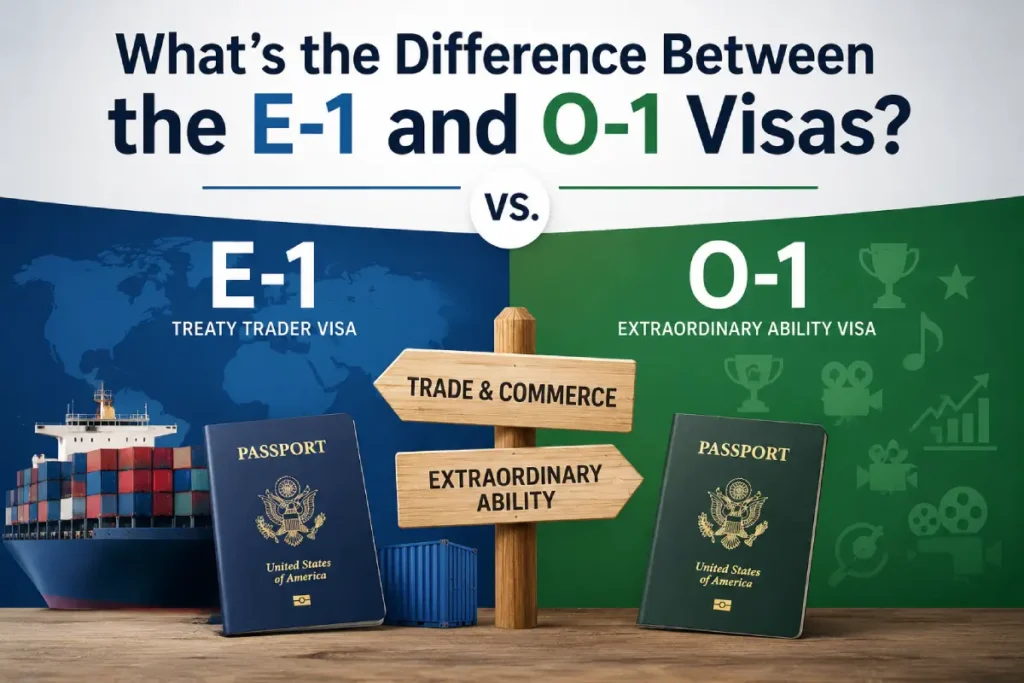
The E-1 and O-1 visas are both U.S. nonimmigrant work visas, but they exist for completely different reasons. The E-1 visa is for nationals of treaty countries who carry on substantial trade between the U.S. and their home country. The O-1 visa is for individuals with extraordinary ability in the sciences, arts, education, business, athletics, or the motion picture and television industry. One is built around trade and nationality; the other is built around talent and acclaim.
If you qualify for both, the right choice depends on your nationality, your business activity, your level of recognition in your field, and your long-term green card plans. This guide breaks down every meaningful difference so you can decide which path fits — and what documentation each one demands.
Quick answer: Choose the E-1 if you’re a treaty-country national running ongoing trade with the U.S. Choose the O-1 if you have national or international recognition in your field and want a flexible, talent-based visa with a strong bridge to a green card.
E-1 Visa at a Glance (Treaty Trader)
The E-1 classification lets a citizen of a treaty country enter the U.S. to engage in substantial, ongoing international trade between the United States and that treaty country.
Who it’s for
- Owners, executives, supervisors, or essential-skills employees of a trading firm
- Nationals of a country that has a qualifying Treaty of Commerce and Navigation (or equivalent agreement) with the U.S.
Core requirements
- You must be a national of an E-1 treaty country.
- The trading firm must hold the nationality of the treaty country (at least 50% owned by treaty-country nationals).
- The trade must be substantial — a continuous, sizable flow of goods, services, or technology, not a single deal.
- More than 50% of the firm’s total international trade must be between the U.S. and the treaty country.
- You must work in an executive, supervisory, or essential-skills role.
Duration
- Granted in increments of up to two years, with unlimited renewals as long as the trade and your status continue. The visa stamp itself may be valid for up to five years depending on your country’s reciprocity schedule.
Family
- Spouse and unmarried children under 21 can accompany you. Spouses are work-authorized incident to status (more on this important update below).
There is no annual cap or lottery for the E-1, unlike the H-1B.
O-1 Visa at a Glance (Extraordinary Ability)
The O-1 classification is for individuals who have risen to the top of their field through sustained national or international acclaim, and who are coming to the U.S. to continue working in that area.
The O category is split into sub-types that most comparisons skip — but they matter:
| Sub-classification | For whom |
|---|---|
| O-1A | Extraordinary ability in science, education, business, or athletics |
| O-1B (Arts) | Extraordinary ability (distinction) in the arts |
| O-1B (MPTV) | Extraordinary achievement in the motion picture or television industry |
| O-2 | Support personnel essential to an O-1’s performance |
| O-3 | Spouse and children of O-1 and O-2 holders |
Core requirements
- Demonstrate sustained national or international acclaim.
- For O-1A, you qualify either through a one-time major internationally recognized award (think Nobel Prize, Olympic medal) or by satisfying at least 3 of 8 regulatory criteria. For O-1B (Arts), the threshold is 3 of 6 criteria.
- A U.S. employer or agent must file the petition — self-sponsorship isn’t allowed, though a separate legal entity that you own can petition on your behalf.
- A written advisory opinion from a relevant peer group, labor organization, or management organization is mandatory.
Duration
- Initially granted for up to three years, then extended in one-year increments to continue the same activity. There is no overall limit on total time in O-1 status.
Family
- Spouse and children under 21 enter on O-3 visas. O-3 dependents cannot work but can study.
The O-1 has no annual cap, and approval rates have historically sat around 93–95% for well-prepared petitions.
E-1 vs O-1: Side-by-Side Comparison
| Factor | E-1 (Treaty Trader) | O-1 (Extraordinary Ability) |
|---|---|---|
| Core purpose | Substantial trade between U.S. and treaty country | Continue work in a field of extraordinary ability/achievement |
| Nationality requirement | Must be a treaty-country national | None — any nationality |
| Sponsor needed | No separate USCIS petition required when applying abroad; tied to the trading firm | U.S. employer or agent must file Form I-129 |
| Self-employment | Allowed (you can own the trading business) | No direct self-petition; an entity you own may petition |
| Key evidence | Treaty nationality + proof of substantial, ongoing trade | Awards or 3 of 8 (O-1A) / 3 of 6 (O-1B Arts) criteria + advisory opinion |
| Initial duration | Up to 2 years | Up to 3 years |
| Extensions | 2-year increments, unlimited | 1-year increments, unlimited |
| Annual cap / lottery | None | None |
| Spouse work rights | Yes — authorized incident to status (no EAD needed) | No — O-3 spouse cannot work |
| Employment flexibility | Tied to the trading firm | Can work for multiple petitioners/engagements if listed in the petition |
| Green card bridge | Indirect (often EB-1C, EB-2 NIW, EB-5) | Strong (EB-1A, EB-2 NIW share much of the same evidence) |
| Filing form (in U.S.) | Form I-129 (change of status) | Form I-129 (employer/agent) |
| Filing (abroad) | DS-160 + DS-156E at consulate | Consular interview after I-129 approval |
The Differences That Actually Affect Your Decision
A table tells you what differs. Here’s why each difference can make or break your strategy.
1. Nationality vs. Talent
This is the dividing line. The E-1 is gated by your passport — if your country doesn’t hold a qualifying treaty with the U.S., the E-1 is simply off the table, no matter how strong your business is. The O-1 ignores nationality entirely; it’s gated by your achievements. A founder from a non-treaty country who can document acclaim may have no E-1 option but a clear O-1 path.
2. Business Activity vs. Personal Recognition
The E-1 measures your company’s trade: volume, frequency, continuity, and the 50%-plus requirement between the U.S. and the treaty country. The O-1 measures you — your awards, published work, press, judging roles, original contributions, high remuneration, and leading roles. Two very different evidence files.
3. Spouse Work Authorization (Where Older Guides Get It Wrong)
This is one of the most important practical differences, and many comparisons still publish outdated information.
Featured answer: As of January 30, 2022, spouses of E-1 treaty traders are employment-authorized incident to status. They receive an I-94 with the E-1S code and do not need a separate work permit (EAD) to work in the U.S. An O-3 spouse, by contrast, cannot work at all.
If both spouses intend to work, the E-1 has a real edge here. (Two narrow exceptions exist for TECRO/TECO-affiliated spouses, who must still obtain an EAD.)
4. Employment Flexibility
An E-1 holder works for the specific trading firm tied to the visa — there’s no freelancing outside it. An O-1 holder can work across multiple employers, agents, or engagements, as long as each is included in the petition and falls within the area of extraordinary ability. For artists, consultants, and project-based professionals, that flexibility is significant.
5. The Advisory Opinion Requirement
The O-1 has a step the E-1 doesn’t: a mandatory advisory opinion (also called a consultation) from a peer group, union, or management organization confirming the nature of the work and your qualifications. It’s advisory, not binding on USCIS, and can occasionally be waived if no appropriate organization exists — but for most petitions, it’s required. Building this into your timeline matters.
6. The Path to a Green Card
The E-1, like other treaty visas, has no built-in path to permanent residency. Many holders transition later through categories like EB-1C (multinational manager), EB-2 NIW, or EB-5.
The O-1 is different in a quietly powerful way: it’s generally treated as dual-intent-friendly, and the evidence that wins an O-1 overlaps heavily with the EB-1A (Extraordinary Ability) green card and the EB-2 National Interest Waiver. Many professionals use the O-1 as a deliberate stepping stone — the documentation you assemble for one strengthens the other. If permanent residency is the goal, this overlap is a major reason high-achievers favor the O-1.
How Are the E-1 and O-1 Visas Similar?
Despite their different purposes, the two share several features:
- Both are nonimmigrant visas intended for temporary (not permanent) stays.
- Both authorize U.S. work tied to the visa’s purpose.
- Both allow dependents — spouse and unmarried children under 21.
- Both can be extended indefinitely as long as you keep meeting the requirements (E-1 in 2-year blocks, O-1 in 1-year blocks).
- Neither is subject to an annual cap or lottery, which makes both attractive alternatives to the H-1B.
Which Visa Is Right for You?
Featured answer: Pick the E-1 if you’re a treaty-country national whose business carries on substantial, continuous trade with the U.S. Pick the O-1 if you have demonstrable national or international acclaim in your field and want maximum flexibility plus a strong bridge toward a green card.
Use this quick decision guide:
The E-1 is likely your best fit if:
- You hold citizenship in a U.S. treaty country.
- Your firm already trades — or will trade — heavily with the U.S.
- You want your spouse to work without an EAD.
- You’re comfortable being tied to one trading business.
The O-1 is likely your best fit if:
- Your country has no qualifying treaty (so the E-1 is unavailable).
- You can document awards, publications, media, or other markers of acclaim.
- You want to work across multiple projects, clients, or employers.
- You plan to pursue an EB-1A or EB-2 NIW green card down the road.
It’s worth talking to a professional if:
- You qualify for both and want to optimize for permanent residency.
- You’re a startup founder weighing trade-based versus talent-based positioning.
- Your evidence is borderline and needs strategic framing.
What Each Visa Requires From Your Evidence File
The strength of your petition usually comes down to documentation. This is where many otherwise-qualified applicants fall short.
E-1 evidence typically includes:
- Proof of treaty-country nationality and firm ownership
- Trade records: contracts, invoices, bills of lading, ledgers
- Evidence that trade is substantial and principally U.S.–treaty country
- Documentation of your executive, supervisory, or essential role
- A clear business plan showing the trade is real, ongoing, and viable
O-1 evidence typically includes:
- Awards or evidence meeting at least 3 of 8 (O-1A) or 3 of 6 (O-1B Arts) criteria
- A mandatory advisory opinion from a peer or industry body
- Expert opinion and recommendation letters establishing your standing
- Credential and work-experience evaluations that translate foreign degrees and experience into U.S. equivalency
- Contracts, an itinerary of engagements, and proof of sustained acclaim
This is where we come in. At AAE Evaluations, we prepare the documentation that strengthens O-1 petitions: O-1 expert and advisory letters authored by qualified PhD-level professionals, O-1 visa recommendation letters that articulate your acclaim in USCIS-aligned language, and an O-1 visa business plan for founders and self-petitioning entities. When your record depends on foreign qualifications, our academic credential evaluations, work experience evaluations, and course-by-course evaluations establish the U.S. equivalency adjudicators expect to see.
Processing, Forms, and Timelines
E-1 process
- From abroad: File Form DS-160 and the business registration Form DS-156E, then attend a consular interview. (Note: as of September 2, 2025, the interview exemption for children under 14 was lifted, so plan for in-person appointments for all applicants.)
- From inside the U.S.: File Form I-129 to request a change of status. You cannot request E-1 classification on Form I-129 while physically outside the U.S.
O-1 process
- Your petitioner files Form I-129 with the advisory opinion, support letter, and evidence.
- Premium processing is available for a 15-day USCIS adjudication response.
- If you’re abroad after approval, you attend a consular interview; if you’re in the U.S. in valid status, you may request a change of status.
Both visas reward preparation. The O-1’s advisory opinion and evidence assembly, and the E-1’s trade documentation, are the steps most likely to cause delays if rushed.
From O-1 Toward a Green Card
Because the O-1 and the EB-1A extraordinary-ability green card use overlapping evidence, the O-1 is often the smartest temporary visa for anyone with permanent-residency ambitions. If that’s your trajectory, the letters and evaluations you build now do double duty later.
We support that longer arc too — from EB-2 NIW expert opinion letters to EB-1A visa business plans — so your documentation strategy stays consistent from your first O-1 petition through your green card. You can review our full range on the services page or explore our expert opinion letter offerings directly.
Ready to strengthen your petition? Contact us for a fast, accurate assessment, or view transparent pricing to get started today.
Frequently Asked Questions
Is the O-1 visa harder to get than the E-1?
They’re hard in different ways. The O-1 demands proof that you’re among the top of your field — awards, publications, press, and an advisory opinion — which not everyone can document. The E-1 demands the right nationality and proof of substantial, ongoing trade. Neither is “easier” universally; the harder one is whichever matches your weaker qualification.
Can my spouse work on an E-1 or O-1 visa?
On the E-1, yes — spouses are work-authorized incident to status and don’t need a separate EAD (their I-94 carries the E-1S code). On the O-1, no — O-3 spouses cannot work, though they can study and live in the U.S.
Does the E-1 or O-1 lead to a green card?
Neither grants permanent residency directly. The E-1 has no built-in path; holders often transition through EB-1C, EB-2 NIW, or EB-5. The O-1 pairs naturally with EB-1A and EB-2 NIW because the evidence overlaps, making it a popular stepping stone toward a green card.
Do I need a sponsor for the E-1 or O-1?
The O-1 requires a U.S. employer or agent to file the petition; you cannot self-petition (though an entity you own can file for you). The E-1 doesn’t require a separate USCIS petition when applying abroad — it’s tied to the qualifying trading firm, which you may own.
Which visa is better for entrepreneurs and startup founders?
It depends on the foundation of your business. A treaty-country founder running real cross-border trade may fit the E-1 cleanly. A founder with strong personal recognition — but from a non-treaty country, or wanting a green card bridge — usually favors the O-1, filed through an owned entity.
Is there an annual cap or lottery for either visa?
No. Both the E-1 and O-1 are exempt from the numerical caps and lottery that constrain the H-1B, so you can apply at any point in the year.
How long can I stay on each visa?
The E-1 is granted in increments of up to two years with unlimited renewals. The O-1 starts at up to three years and extends in one-year increments, with no overall limit on total time in status — as long as you keep meeting the requirements.
The Bottom Line
The E-1 rewards trade and nationality; the O-1 rewards talent and acclaim. The E-1 offers spousal work authorization and indefinite two-year renewals tied to your trading business. The O-1 offers flexibility across employers, no nationality barrier, and a powerful bridge toward an EB-1A or EB-2 NIW green card. Match the visa to your strongest qualification, then build the evidence file that proves it.
When your case turns on documentation — expert opinion letters, recommendation letters, advisory opinions, or credential evaluations — that’s exactly what we do. Get in touch with AAE Evaluations to make your petition as strong as it can be.
This article is for general informational purposes and is not legal advice. Visa rules change; always confirm details with a licensed immigration attorney and official sources such as USCIS and the U.S. Department of State before acting.