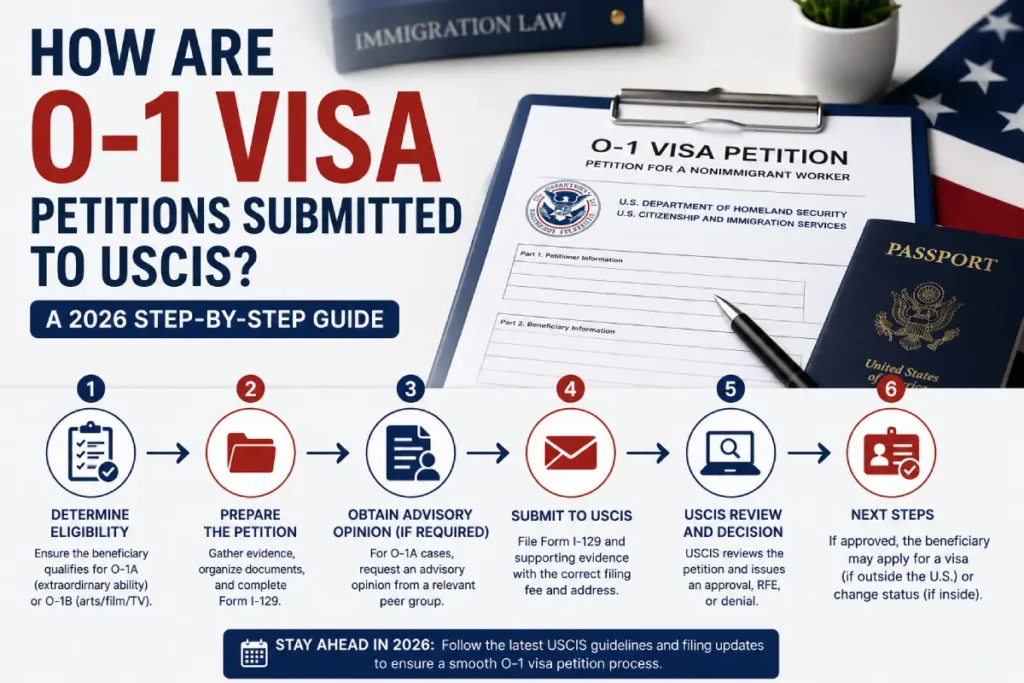
Quick answer: An O-1 visa petition is submitted to USCIS by a U.S. employer or a U.S. agent (not the beneficiary) on Form I-129, Petition for a Nonimmigrant Worker, with the O and P Classifications Supplement. The petitioner assembles the form, the required advisory opinion, the employment contract, an itinerary, and the evidence of extraordinary ability into one package, pays the filing fees, and submits it either online through a USCIS account or by mail to the correct direct filing address. USCIS then issues a receipt notice (Form I-797C) and begins adjudication.
The hardest part of an O-1 case is rarely the submission itself. It is getting every piece of the package right before it goes to USCIS, because a single missing component can trigger a Request for Evidence or an outright rejection. This guide walks through exactly how an O-1 petition is filed in 2026, who can file it, what goes inside the package, the current fees, and the supporting evidence that gives a petition the best chance of a clean approval.
Who Submits the O-1 Petition (You Cannot File for Yourself)
The single most important rule of O-1 filing is that the beneficiary cannot self-petition. USCIS only accepts an O-1 petition from one of three petitioner types:
- A U.S. employer who is hiring the individual for a specific role or project.
- A U.S. agent, who can file on behalf of a beneficiary who works for multiple employers, is self-employed, or is sponsored by a foreign employer.
- A foreign employer through a U.S. agent, where the agent acts as the petitioner and the liaison with USCIS.
The petitioner is legally responsible for the filing. That means the petitioner signs Form I-129, pays the fees, and receives the official correspondence from USCIS. If you are an extraordinary-ability professional planning your own move to the United States, your first practical step is identifying who your petitioner will be, because nothing can be submitted without one.
Featured-snippet answer: Can you file your own O-1 petition? No. O-1 petitions must be filed by a U.S. employer or a U.S. agent. The beneficiary cannot petition on their own behalf, although a U.S. agent can file for a self-employed or multi-employer beneficiary.
What Goes Inside an O-1 Petition Package (Submission Checklist)
A complete O-1 petition is a single, organized package. Before anything reaches USCIS, the petitioner gathers and assembles the following:
- Form I-129 with the O and P Classifications Supplement, fully completed and signed.
- A written advisory opinion (consultation) from an appropriate peer group, labor organization, or management organization. If the consultation document carries a watermark or other authenticity mark, the version with that mark must be submitted, because copies without it can raise doubts and slow processing.
- A copy of the contract between the petitioner and the beneficiary, or a written summary of the terms of an oral agreement.
- An itinerary with the dates and locations of the events or activities, if the work will take place in more than one location.
- Evidence of extraordinary ability or achievement, organized around the regulatory criteria for the beneficiary’s classification (O-1A for sciences, education, business, or athletics; O-1B for the arts or the motion picture and television industry).
- Supporting and recommendation letters from recognized experts, which interpret the evidence and confirm the beneficiary’s standing in the field.
- A clear table of contents and exhibit tabs, so the adjudicating officer can navigate the package without hunting for documents.
The quality of this package is what decides the case. USCIS evaluates O-1 petitions on the totality of the evidence, meaning officers weigh everything together rather than checking criteria off a list. A package that is complete, well-organized, and supported by credible expert opinion is far less likely to draw an RFE.
Want your evidence to do the heavy lifting? Our O-1 expert and advisory letters and O-1 visa recommendation letters are written by qualified PhD professionals who translate your achievements into the language USCIS officers look for.
Step by Step: How an O-1 Petition Is Submitted to USCIS
Here is the full submission sequence, from preparation to receipt notice.
Step 1: Confirm Eligibility and Gather Evidence
Before filing, the petitioner confirms the beneficiary qualifies under at least three of the regulatory criteria (or holds a single major internationally recognized award). This is also when supporting documents, publications, media coverage, membership records, and expert letters are collected. For many applicants this is the longest stage, sometimes taking months.
Step 2: Secure the Advisory Opinion (Consultation)
The petitioner requests the written consultation from the relevant peer group, union, or management organization. If no appropriate peer group exists, the petitioner submits evidence of that, and USCIS bases its decision on the rest of the record. Build in time here, as third-party organizations set their own turnaround.
Step 3: Prepare Form I-129 and the O and P Supplement
The petitioner completes Form I-129 and the O and P Classifications Supplement. Every page must be from the same form edition, with the edition date and page numbers visible, or USCIS may reject the filing.
Step 4: Assemble the Evidence Package
All forms, the consultation, the contract, the itinerary, and the evidentiary exhibits are organized into one logical package with a cover letter and an index. Strong organization is not cosmetic; it directly affects how an officer reads the case.
Step 5: Choose the Submission Method
The petitioner decides between online filing through a USCIS online account and paper filing by mail. Online filing is available for many I-129 classifications and records the submission date electronically. Paper filing goes to a specific address (see the next section).
Step 6: Pay the Correct Fees
The petitioner pays the base Form I-129 fee plus the Asylum Program Fee, with each fee paid as a separate remittance when filing by paper. Incorrect fees are one of the most common reasons a package is returned. (Full 2026 fee breakdown below.)
Step 7: Add Premium Processing if Speed Matters (Optional)
If the timeline is tight, the petitioner files Form I-907, Request for Premium Processing Service, with the additional fee. This can be filed together with the I-129 or added later while the petition is pending.
Step 8: Submit to USCIS
For paper filings, the package is mailed to the direct filing address listed on the USCIS Form I-129 page for the O classification. For online filings, the petitioner uploads and submits through the USCIS account. The correct location matters: a standalone premium-processing request mailed to the wrong place will be rejected.
Step 9: Receive the Receipt Notice (Form I-797C)
Once USCIS accepts the package, it issues Form I-797C, Notice of Action, confirming receipt and providing a case number to track the petition. From here the case is officially pending.
Featured-snippet answer: How long before the start date should an O-1 petition be filed? USCIS recommends filing Form I-129 at least 45 days before the employment start date, and a petition cannot be filed more than one year before the services are actually needed.
Online Filing vs. Paper Filing: Which Submission Method?
Both methods are valid. The right choice depends on the petitioner’s preference and case type.
| Factor | Online Filing | Paper Filing (Mail) |
|---|---|---|
| Where it goes | USCIS online account | Direct filing address on the I-129 page |
| Submission date | Recorded electronically | Tied to the postmark or shipping-label date |
| Fee discount | $50 discount on many forms | No online discount |
| Best for | Petitioners who want digital tracking and confirmation | Large evidence packages and certain case types |
| Premium processing | Form I-907 can be filed online where available | Form I-907 mailed to the correct address |
A practical note for paper filers: USCIS no longer accepts personal checks, business checks, or money orders for most paper filings. Payment is made by credit or debit card using Form G-1450 or directly from a U.S. bank account using Form G-1650.
O-1 Petition Filing Fees in 2026
Fees are split into the base petition fee, the mandatory Asylum Program Fee, and the optional premium-processing fee. The figures below reflect the O classification as of 2026.
| Fee | Standard Petitioner | Small Employer (25 or fewer FTE) | Nonprofit |
|---|---|---|---|
| Form I-129 base fee (O classification) | $1,055 | $510 | $510 |
| Asylum Program Fee | $600 | $300 | $0 (exempt) |
| Typical total before premium | $1,655 | $810 | $510 |
| Premium processing (Form I-907, optional) | $2,965 | $2,965 | $2,965 |
A few details that catch petitioners off guard:
- The Asylum Program Fee is separate and, on paper filings, must be paid as its own remittance.
- The premium processing fee rose to $2,965 for O-1 petitions effective March 1, 2026. A request postmarked on or after that date with the old amount will be rejected.
- Online filing of certain forms includes a $50 discount.
Always confirm current amounts on the USCIS fee schedule (Form G-1055) before filing, because USCIS adjusts these periodically.
What Happens After You Submit the Petition to USCIS
Submission is the beginning of adjudication, not the end of the process.
- Receipt notice (Form I-797C). USCIS confirms it has the petition and assigns a case number.
- Adjudication. An officer reviews the package. Standard processing for an O-1 commonly runs a few months; premium processing guarantees a response within 15 business days.
- Possible Request for Evidence (RFE). If the officer needs more, USCIS issues an RFE. Under premium processing, an RFE pauses the 15-business-day clock, which restarts when the response is received.
- Decision. USCIS approves or denies the petition.
- Approval notice (Form I-797). On approval, USCIS sends the petitioner Form I-797 confirming the petition is approved.
It is worth stressing what premium processing does and does not do. It guarantees a faster adjudicative action, not a faster approval. USCIS may still approve, deny, or issue an RFE within the 15-business-day window.
Petition vs. Visa: Why Submission Is Only Half the Journey
Many applicants assume an approved petition means they can fly to the United States. It does not. The O-1 petition establishes eligibility and secures USCIS approval. The O-1 visa is the entry document, and how you get it depends on where you are:
- If you are abroad, after approval you complete Form DS-160 and attend a visa interview at a U.S. embassy or consulate, presenting the approval notice. Once the visa is issued, you can travel and present it at the port of entry.
- If you are already in the United States in valid nonimmigrant status, the petition can request a change of status to O-1 without leaving the country. You would still need the visa stamp for future re-entry after international travel.
The initial O-1 period of stay is up to three years, with extensions granted in increments of up to one year and no fixed limit on the number of extensions for the same activity.
Common Mistakes That Get O-1 Petitions Rejected or Delayed
Most O-1 problems are avoidable. The ones we see most often:
- Filing without a petitioner. A beneficiary cannot submit the petition; an employer or agent must.
- Missing or weak advisory opinion. Submitting a copy without the required watermark, or skipping the consultation entirely.
- Incomplete itinerary or unsigned contracts. Among the most frequent RFE triggers for agent-filed petitions.
- Wrong or combined fee payments. Paying multiple forms with one combined payment can cause USCIS to reject the entire package.
- Mixed form editions. Pages from different editions of Form I-129 can lead to rejection.
- Thin evidence with no expert interpretation. Documents alone rarely tell the full story; officers rely on credible expert letters to understand the significance of the record.
How Strong Supporting Evidence Improves Your Submission
This is where the petition is won or lost, and it is where we help. At AAE Evaluations, we do not file petitions, but we produce the supporting evidence that makes a petition persuasive on the totality-of-evidence standard USCIS applies.
- O-1 expert opinion letters: independent, field-specific letters from qualified PhD experts that explain why your achievements meet the O-1 standard.
- O-1 recommendation letters: professionally drafted letters that establish your national or international acclaim in clear, credible terms.
- Credential and education evaluations: reports that establish U.S. equivalency for foreign degrees, often essential where formal qualifications support your claim.
- Work experience evaluations: documentation that converts professional experience into recognized equivalency.
- Course-by-course evaluations: detailed academic breakdowns when a granular review of coursework strengthens the record.
- O-1 visa business plans: for self-employed and agent-filed petitions where the work plan needs to be documented clearly.
A petition supported by independent expert opinion reads very differently to an adjudicating officer than a stack of raw documents. If you are preparing an O-1 filing, the supporting evidence is the part most within your control, and the part most worth getting right.
Ready to strengthen your O-1 submission? Explore our expert opinion letter services, check current pricing, or contact our team to discuss your case.
Frequently Asked Questions
Who files an O-1 petition with USCIS?
A U.S. employer or a U.S. agent files the petition on Form I-129. The beneficiary cannot self-petition, although a U.S. agent can file for someone who is self-employed or works for multiple employers.
What form is used to submit an O-1 petition?
Form I-129, Petition for a Nonimmigrant Worker, together with the O and P Classifications Supplement. Premium processing, if requested, is filed on Form I-907.
Can an O-1 petition be filed online?
Yes, online filing is available for many I-129 classifications through a USCIS online account, and it records the submission date electronically. Paper filing by mail to the correct direct filing address is also accepted. Check the USCIS Form I-129 page to confirm online availability for your case.
How much does it cost to submit an O-1 petition in 2026?
For most petitioners, the base Form I-129 fee is $1,055 plus a $600 Asylum Program Fee, totaling $1,655. Small employers and nonprofits pay reduced amounts. Optional premium processing is $2,965 as of March 1, 2026.
How long does USCIS take to process an O-1 petition?
Standard processing commonly takes a few months. Premium processing guarantees an adjudicative response within 15 business days, though that response may be an approval, a denial, or a Request for Evidence.
What is the advisory opinion in an O-1 petition?
It is a written consultation from a peer group, labor organization, or management organization in the beneficiary’s field. It is a required part of the package, and if it carries a watermark, the watermarked version must be submitted.
Does an approved O-1 petition let me enter the United States?
Not by itself. The approved petition establishes eligibility. If you are abroad, you still need to obtain the O-1 visa at a U.S. embassy or consulate before traveling. If you are already in the U.S. in valid status, the petition can request a change of status.
What is the difference between the O-1 petition and the O-1 visa?
The petition is the filing submitted to USCIS to establish eligibility and obtain approval. The visa is the entry document issued by a U.S. consulate that allows admission to the United States.
This guide is for general informational purposes and reflects USCIS procedures and fees as of 2026. Immigration rules and fees change, so always confirm current requirements on USCIS.gov and consult a qualified immigration attorney for legal advice on your specific case.
Read more: