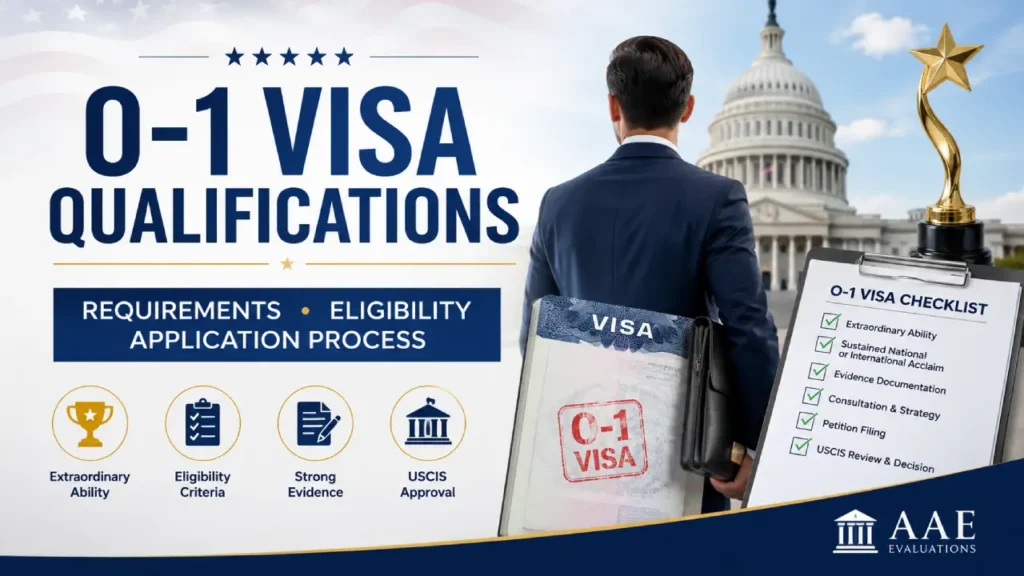
Quick: The O-1 visa is a nonimmigrant visa for individuals with extraordinary ability in science, education, business, athletics (O-1A), or the arts and entertainment (O-1B). To qualify, you either hold a major one-time award (Nobel Prize, Academy Award, Olympic Gold) or meet at least 3 of 8 USCIS criteria — such as high salary, published work, media coverage, or judging peers. A U.S. employer or agent must file Form I-129 on your behalf. Total costs range from $8,000–$20,000+, with premium processing available for 15-day adjudication at $2,965 extra.
Key Takeaways:
- No annual cap or lottery — you can apply any time of year
- O-1A covers STEM, business, and sports; O-1B covers arts and entertainment
- You need 3 of 8 USCIS criteria if you don’t have a major one-time award
- Premium processing cuts wait time from 12+ months to 15 business days
- Strong expert opinion letters and advisory opinions significantly improve approval odds
- O-1 holders can later transition to EB-1A green cards using the same evidence
Most visa guides treat the O-1 as some exotic category reserved for Nobel laureates and Oscar winners. That’s not how USCIS actually looks at it — and it’s not how successful petitions get built.
The reality? Many working scientists, tech founders, physicians, artists, and athletes qualify without a single famous award to their name. What wins cases is how well you document a pattern of sustained accomplishment, not how many headlines you’ve generated.
If you’re trying to understand whether the O-1 visa is within reach — and how to build a petition that survives USCIS scrutiny — this guide gives you the complete picture. We cover O-1 visa qualifications and eligibility criteria, the full document checklist, a step-by-step walkthrough of the application process, and real cost breakdowns. We also look at how an O-1 expert opinion letter from a credentialed specialist can make the difference between an approval and an RFE.
Let’s get into it.
What Is an O-1 Visa? Types, Duration, and Who It’s For
The O-1 is a nonimmigrant visa authorized under INA § 101(a)(15)(O). It allows individuals who have risen to the very top of their profession to live and work in the United States temporarily — usually tied to a specific project, employer, or agent.
There are two main categories:
O-1A is for individuals with extraordinary ability in science, education, business, or athletics. This is the category most STEM professionals, researchers, entrepreneurs, and athletes pursue.
O-1B is for those with extraordinary ability in the arts, or extraordinary achievement in the motion picture or television industry. Painters, musicians, actors, directors, cinematographers, and other creative professionals fall here.
An important distinction: “extraordinary ability” under O-1A is defined as being in the top tier of the field — someone recognized nationally or internationally. “Extraordinary achievement” under O-1B (specifically for film and television) is a slightly different standard that emphasizes a distinguished reputation and critical roles in major productions.
O-2 and O-3: Supporting Visas in the O Category
If you hold an O-1 visa, essential support personnel who accompany you and have critical skills specific to your work may qualify for O-2 status. Think: a film director’s longtime cinematographer, or an athlete’s specialized coach.
Spouses and unmarried children under 21 can accompany O-1 holders on O-3 visas. O-3 holders may study in the U.S. but cannot work. There’s no blanket work authorization for O-3 spouses — any exception to this would require specific legal circumstances, so don’t plan around it without consulting an immigration attorney first.
How Long Does an O-1 Visa Last?
The O-1 is initially granted for up to 3 years. After that, you can extend in one-year increments with no hard cap on extensions — as long as you continue working in your field of extraordinary ability and maintain qualifying engagements. This makes the O-1 one of the most flexible nonimmigrant work visas available.
O-1 Visa Qualifications: The Full Eligibility Breakdown
Here’s where most guides lose people. They list the 8 criteria and move on. We’re going to explain how USCIS actually evaluates each one — and which combinations tend to carry the most weight.
The “One-Time Achievement” Shortcut
The fastest path to O-1 eligibility is proof of a single, major internationally recognized award:
- Nobel Prize
- Academy Award (Oscar)
- Olympic Gold Medal
- Grammy Award
- Pulitzer Prize
If you have one of these, USCIS doesn’t require you to meet the 3-of-8 criteria. The award itself establishes extraordinary ability. In practice, this shortcut applies to a tiny fraction of applicants — most petitions are built on the multi-criteria route below.
The 3-of-8 Criteria for O-1A Applicants
If you don’t have a defining one-time award, you need to satisfy at least 3 of these 8 criteria. Meeting 4 or 5 strengthens your case considerably — especially given the recent increase in RFEs.
1. Nationally or internationally recognized prizes or awards for excellence
This doesn’t require a Nobel Prize. Competitive grants (NSF, NIH, industry-specific fellowships), startup competition wins, Forbes 30 Under 30, academic honors, and patent awards can qualify — provided they’re recognized beyond a local or regional level. Hackathon wins and bug bounty rankings have increasingly been accepted for tech professionals in 2026 USCIS adjudications.
2. Membership in associations requiring outstanding achievement
The key word is requiring — your membership must be judged by peers, not simply paid for. Professional societies that admit only credentialed or peer-selected members (IEEE Fellows, National Academy of Sciences, etc.) qualify. Generic industry associations generally don’t.
3. Published materials about you in major media
This means coverage about you, not articles you wrote. News features, profiles, interviews, and case studies in recognized trade publications, newspapers, or broadcast media count. USCIS now accepts digital media — podcasts where you’re the subject, YouTube features about your work, and tech news coverage — but you’ll need to document traffic and credibility metrics.
4. Original contributions of major significance
This is the most powerful criterion — and the hardest to prove. You need to show that your work has actually influenced your field: citations, adoption of your method or technology by others, patents that generated commercial value, or documented changes in industry practice that trace back to your contribution. Vague statements about “impact” won’t move USCIS officers; concrete downstream evidence will.
5. Authorship of scholarly articles
Academic papers in peer-reviewed journals, book chapters, technical reports cited by others, or published research in professional publications all count. The quantity matters less than the quality — a high-citation paper outweighs ten minor publications.
6. Critical or essential role for a distinguished organization
Two sub-paths here: (a) you held a key leadership role or were indispensable to a prominent, reputable organization, or (b) you received a high salary or compensation significantly above industry norms for your position and geography. Salary data from BLS reports, competing offers, or industry surveys can be used as supporting evidence.
7. Performance in a critical role for organizations with distinguished reputations
Similar to above, but focuses on the organization’s reputation rather than your compensation. Evidence includes the company’s press coverage, awards, funding rounds, market position, and documentation of your specific role within it.
8. High salary relative to peers
Your compensation must be substantially above what others in equivalent positions earn in the same geographic area. Contracts, offer letters, W-2s, and third-party salary surveys from credible sources (Levels.fyi, Glassdoor data, Radford, etc.) all support this criterion.
Important 2026 update: USCIS has signaled in recent adjudications that “sustained acclaim” matters — not just a single high point in your career. When building your petition, show growth and consistency over time. One award from five years ago with no follow-up activity is a weaker case than steady recognition across a three-to-four-year window.
The 3-of-6 Criteria for O-1B Applicants (Arts)
Artists and performers work from a parallel but slightly shorter list:
- Lead or starring role in productions with distinguished reputations
- National or international recognition via critical reviews, press coverage, or endorsements
- Lead role for organizations with distinguished reputations
- Major commercial or critically acclaimed success (box office data, album charts, streaming numbers)
- Significant recognition from peers, critics, or recognized experts
- High salary or substantial remuneration compared to others in the field
For motion picture and TV (O-1B MPTV), the evidence standards emphasize industry credits, role prominence, and reception more than academic-style contributions.
Complete O-1 Visa Document Checklist
A disorganized or incomplete petition package is the single most avoidable cause of delays and RFEs. Here’s what needs to go into a well-built O-1 petition — and what USCIS officers are actually looking for in each element.
Filed by the Petitioner (Employer or Agent)
| Document | Notes |
|---|---|
| Form I-129 (Petition for Nonimmigrant Worker) | The foundational filing — includes the O Supplement |
| Cover letter / legal brief | Explains the basis for eligibility; organized by criterion |
| Employment contract or offer letter | Must specify role, salary, duration, and terms |
| Itinerary | Describes all work activities planned, including locations, dates, and project names — at least 10 events or ongoing work |
| Advisory opinion | Letter from a relevant peer group, union, or labor management organization (can be waived in certain cases) |
Evidence of Extraordinary Ability
This is the heart of the petition. You need 3–5 strong, detailed expert opinion letters from independent authorities in your field. These aren’t character references — they’re substantive evaluations explaining why your contributions matter and how they compare to peers.
Other evidence includes:
- Awards documentation (certificates, announcements, organization descriptions)
- Media coverage (printed or digital — include traffic data for digital sources)
- Citation records for academic or technical publications
- Salary documentation and industry comparisons
- Membership documentation with proof of selection criteria
- Patents with commercialization records
- Evidence of judging (invitations, decisions issued, panel memberships)
- Organizational charts or declarations establishing your critical role
A common mistake: Submitting evidence without connecting it to the specific USCIS criterion it’s meant to satisfy. Every document needs a clear narrative explaining why it qualifies. This is where a well-structured expert opinion letter for O-1 visa becomes critical — it does the interpretive work that loose evidence alone can’t.
Filed by the Applicant (After I-129 Approval)
| Document | Notes |
|---|---|
| Valid passport | Must be valid at least 6 months beyond intended stay |
| DS-160 (Online nonimmigrant visa application) | Completed via the consulate’s online portal |
| Photo | Per current consulate specifications |
| I-797 approval notice | From USCIS, required for the consular interview |
| Visa fee payment receipt | $190 MRV fee |
O-1 Visa Application Process: Step by Step
The O-1 application has two distinct phases: the USCIS petition (filed by your employer or agent) and the consular processing phase (handled by you at a U.S. embassy or consulate abroad). Confusing these two phases is a common source of timeline errors.
Step 1: Identify Your Petitioner and Assess Eligibility
Before anything else, you need a U.S. employer, U.S.-based agent, or — increasingly common — your own U.S. entity to file on your behalf.
If you’re a freelancer, consultant, or entrepreneur without a traditional employer, a U.S. agent can file the I-129 on your behalf. Agents are often used when you have multiple clients or engagements. Some immigration attorneys serve in this capacity, and there are specialist agent services designed specifically for artists, athletes, and independent professionals.
One important 2026 development: founders can use their own U.S. C-corporation as the petitioning entity — but the corporation must be structured to be genuinely separate from you in a legal sense, and you cannot directly self-petition. The agent route remains the more common path for solo founders.
This is also when you should begin gathering your evidence portfolio and identify which criteria you’ll be arguing. The earlier you start this assessment, the better — don’t leave it until you’re about to file.
Step 2: Gather Evidence and Obtain Expert Opinion Letters
Give yourself at least 60–90 days for this phase. Expert opinion letters need to come from credentialed, independent specialists — not colleagues you know personally. The letters need to:
- Establish the expert’s own qualifications in your field
- Articulate your specific achievements in concrete terms
- Explain how those achievements compare to others in the field
- Connect your work to one or more USCIS criteria explicitly
An advisory opinion from a relevant peer group or union (e.g., SAG-AFTRA for performers, or relevant professional societies) is also typically required for O-1B petitions and strongly recommended for O-1A.
If you need support building this documentation, AAE Evaluations’ O-1 expert and advisory letter service works with credentialed specialists in your field to produce USCIS-standard letters that directly address the criteria framework.
Step 3: File Form I-129 with USCIS
Your petitioner submits the completed I-129 package to USCIS. Filing fees as of 2026:
- Base I-129 filing fee: $460–$1,055 (depending on employer size; employers with 26+ FTEs pay $1,055)
- Premium processing: $2,965 additional (15 business days)
- Standard processing: Up to 12+ months
Unless cost is a serious constraint, premium processing is almost always worth it. The time value of getting your approval 10–11 months earlier typically far exceeds the $2,965 fee.
After filing, USCIS may issue a Request for Evidence (RFE) — particularly if the evidence is seen as insufficient for any of the claimed criteria, or if the itinerary is vague. You’ll have 87 days to respond to an RFE. A non-response or a weak response leads to denial. If you receive an RFE, working with specialists experienced in RFE responses for O-1 petitions can significantly improve your outcome.
Step 4: Consular Processing (DS-160 and Visa Interview)
Once the I-129 is approved, you receive an I-797 approval notice. If you’re outside the U.S., you now apply for the actual O-1 visa stamp at a U.S. embassy or consulate:
- Complete the DS-160 online nonimmigrant visa application
- Pay the $190 MRV (machine-readable visa) fee
- Schedule your visa interview at the nearest U.S. embassy
- Attend the interview with your I-797, passport, DS-160 confirmation, fee receipt, and supporting evidence
Most O-1 visa interviews are brief if the petition was well-prepared — the consular officer is largely verifying your identity and confirming your approved status.
Step 5: Enter the U.S. and Begin Work
Once your visa is stamped, you can enter the U.S. up to 10 days before your authorized employment start date. You cannot begin working until that official start date.
At port of entry, U.S. Customs and Border Protection (CBP) will inspect your documents and formally admit you in O-1 status. Keep your I-797 approval notice and your employment contract accessible — CBP officers may review them.
O-1 Visa Cost Breakdown: What to Actually Budget
Most guides quote a wide range without explaining what drives the variation. Here’s an honest breakdown:
| Cost Item | Amount | Notes |
|---|---|---|
| Form I-129 base filing fee | $460–$1,055 | Higher fee for larger employers |
| Premium processing (optional but recommended) | $2,965 | 15 business days; regular can take 12+ months |
| DS-160 / MRV visa fee | $190 | Per applicant |
| Immigration attorney fees | $5,000–$15,000 | Varies widely by firm and case complexity |
| Expert opinion letters | $1,500–$5,000 | Depends on number of letters and specialty |
| Document preparation and shipping | $500–$2,000 | Translations, notarizations, couriers |
| Total range | $10,000–$25,000+ | Simpler cases near the low end; complex or RFE cases higher |
Where do cases get expensive? RFEs. If USCIS requests additional evidence and you need attorney time to respond, you can easily add $3,000–$8,000 to your total. This is the strongest argument for investing in a strong initial petition — the savings from avoiding a single RFE can pay for better expert opinion letters several times over.
O-1 vs. H-1B vs. EB-1A: Which Visa Is Right for You?
The O-1 is often compared to the H-1B and EB-1A. They serve different purposes, but understanding the trade-offs helps you decide which to pursue — or whether to stack them strategically.
| Feature | O-1 Visa | H-1B Visa | EB-1A Green Card |
|---|---|---|---|
| Annual cap / lottery | None | 85,000/year (lottery-based) | None |
| Eligibility bar | Extraordinary ability | Specialty occupation + degree | Extraordinary ability |
| Initial duration | 3 years | 3 years | Permanent residency |
| Extensions | Unlimited (1-year increments) | Up to 6 years total | N/A |
| Employer required | Yes (or U.S. agent) | Yes | No (self-petition) |
| Path to green card | Via EB-1A or EB-2 NIW | Possible, but capped | Direct |
| Spouse work authorization | No (O-3 status) | Yes (H-4 EAD eligible) | Yes |
| Processing time (premium) | 15 business days | 15 business days | Longer (no premium) |
The O-1 is the smart bridge for high-achievers who can’t afford to gamble on the H-1B lottery or aren’t ready to commit to the green card process. And because O-1 and EB-1A share nearly identical evidentiary standards, building a strong O-1 petition is essentially building the foundation for a future green card application.
Extensions, Family, and the Path to a Green Card
Extending Your O-1 Status
To extend, your petitioner files a new I-129 before your current status expires. There’s no limit to the number of extensions, but each renewal requires showing that you’re still actively working in your field of extraordinary ability. The extension petition should document ongoing projects, new achievements, and continued recognition since the last filing.
Don’t let your status expire while waiting — if you continue working past your authorized period, it triggers unlawful presence, which can have serious long-term immigration consequences.
From O-1 to EB-1A: The Natural Pathway
The EB-1A extraordinary ability green card uses nearly the same 10-criterion framework as the O-1A (8 criteria). Many O-1 holders apply for EB-1A while maintaining their O-1 status — the evidence packages overlap significantly. No job offer is required for EB-1A, which makes it one of the most direct paths to permanent residency for elite professionals.
In 2026, under current immigration policy priorities, high-skill workers holding O-1 status have been flagged for potential fast-track EB-1A adjudication. This isn’t a formal policy change yet, but it’s worth discussing with an immigration attorney if you’re planning your long-term path.
Alternative: EB-2 NIW
If your work has national importance — especially in STEM, healthcare, or research — the EB-2 NIW (National Interest Waiver) allows you to self-petition for a green card without an employer sponsor. Many O-1 holders pursue EB-2 NIW simultaneously or as an alternative to EB-1A, especially when the national importance argument is clearer than the extraordinary ability standard.
Common Mistakes That Get O-1 Petitions Denied or RFEd
USCIS has been issuing more RFEs in recent adjudication cycles — particularly for O-1 petitions that rely on digital or non-traditional evidence. Here’s what to avoid:
Vague itinerary.
A one-line description of “ongoing consulting work” won’t satisfy USCIS. You need specific projects, locations, dates, and a clear description of your role. The itinerary tells USCIS that there’s real, qualifying U.S. work to be done.
Generic expert letters.
Letters that describe you as “talented” or “accomplished” without connecting your work to specific USCIS criteria are nearly worthless. Each letter must make a fact-based argument tied to the legal standard. This is exactly what separates a professional expert opinion letter from a personal recommendation.
Treating criteria as checkboxes without evidence depth.
Meeting 3 criteria on paper isn’t enough if the evidence for each is thin. USCIS applies a totality-of-evidence standard — they look at everything together. Strong documentation on 3 criteria beats weak documentation on 6.
Using your degree as the centerpiece.
Academic credentials don’t satisfy O-1 criteria. Your accomplishments and recognition do. Don’t open your petition with your education history.
Inconsistent timelines.
Media coverage from 2019, an award from 2021, and a salary comp from 2024 with nothing in between raises questions about sustained acclaim. Build a chronological narrative that shows consistent, growing recognition.
Ignoring digital evidence requirements.
For tech professionals using GitHub stats, podcast appearances, or viral content as evidence, you need to document reach and credibility. A GitHub repo with 50 stars isn’t the same as one with 5,000. Include traffic data, engagement metrics, and third-party recognition of the platform.
Expert Opinion Letters for O-1 Visa: Why They Matter More Than You Think
Let’s talk about this directly, because most guides either gloss over it or treat expert letters as a checkbox item.
USCIS adjudicators aren’t experts in your field. They’re reviewing petitions across dozens of specialties every day. An expert opinion letter bridges that gap — it provides a credentialed, independent voice explaining why your work is significant, why your achievements are exceptional relative to peers, and how you satisfy specific USCIS criteria.
A poorly written expert letter — one that’s vague, that reads like a personal endorsement, or that doesn’t engage with the legal standard — can actually hurt your case by signaling that the petitioner couldn’t find credible support.
A well-written letter, by contrast, does several things:
- Establishes the expert’s authority in the field
- Contextualizes your work against industry norms
- Explains why your contribution has had major significance
- Maps your achievements to specific USCIS criteria by name
- Uses language calibrated to USCIS evidentiary standards
At AAE Evaluations, our O-1 expert and advisory letter service connects applicants with credentialed specialists in their specific field — not generic evaluators — and produces letters that are built around the USCIS extraordinary ability framework. If you’re preparing a petition or responding to an RFE, this is one of the highest-leverage investments you can make.
Ready to strengthen your O-1 petition with professionally crafted expert opinion letters? Get started with AAE Evaluations — our specialists work directly in your field and are experienced with USCIS O-1 adjudication standards.
Frequently Asked Questions
Do I need a famous award to qualify for the O-1 visa?
No — and this is one of the most common misconceptions. While a Nobel Prize, Oscar, or Olympic Gold Medal creates an automatic presumption of eligibility, the vast majority of successful O-1 applicants qualify by meeting 3 of the 8 USCIS criteria instead. High salary, media coverage, original contributions, and peer judging experience are all qualifying paths — no household-name award required.
Can I sponsor my own O-1 petition?
Not directly. A U.S. employer or U.S.-based agent must file the I-129 petition on your behalf. However, if you’ve established a U.S. C-corporation, that entity can serve as the petitioner — provided it’s structured to be legally distinct from you as an individual. Many founders use a U.S. agent as an alternative, which is especially common for freelancers and independent professionals.
What’s the difference between an advisory opinion and an expert opinion letter?
An advisory opinion is a letter from a relevant peer group, union, or labor-management organization commenting on whether the petitioner has the required extraordinary ability. It’s typically required (or at least strongly recommended) for O-1 petitions. An expert opinion letter, by contrast, is written by an individual credentialed expert in the applicant’s specific field and goes into substantive detail about the applicant’s achievements relative to peers and USCIS criteria.
How important is the itinerary for O-1 approval?
Extremely. USCIS requires proof that there’s specific U.S. work requiring extraordinary ability — a vague statement about future plans won’t satisfy this. Your itinerary should list specific engagements, project names, locations, dates, and your role. For ongoing or consulting work, describe the scope of engagements in concrete terms rather than general descriptions.
Can an O-1 visa lead to a green card?
Yes. O-1 holders commonly transition to the EB-1A green card (extraordinary ability) using much of the same evidence from their O-1 petition. The EB-2 NIW is another pathway, particularly for researchers and STEM professionals whose work serves the national interest. Many applicants maintain O-1 status while pursuing these immigrant petitions in parallel.
What happens if I receive an RFE on my O-1 petition?
An RFE is not a denial — it’s a request for more or clarified evidence. You have 87 days to respond. A strong RFE response typically involves addressing each USCIS concern with additional documentation, more detailed expert letters, and sometimes a legal brief explaining why the existing evidence satisfies the standard. Working with experienced specialists for your RFE response significantly improves outcomes.
Can early-career professionals qualify for an O-1?
Yes, with the right evidence. There’s no minimum years-of-experience requirement — what USCIS looks for is recognition and achievement relative to peers, not tenure. A researcher with two high-citation publications, an editorial fellowship, and a competitive grant could qualify even at an early career stage. The key is showing that your recognition is disproportionately high for your experience level, not just your absolute achievement.
How does the O-1 compare to the H-1B for skilled professionals?
The O-1 has no annual cap or lottery — you can apply any time and don’t risk random exclusion. The H-1B is subject to an 85,000-per-year cap and wage-based lottery selection, making it increasingly unreliable for high earners. The O-1 does require a higher evidentiary threshold (extraordinary ability vs. specialty occupation), but for professionals who can document their achievements well, it’s a more reliable and potentially faster path.
Conclusion: Building an O-1 Petition That Actually Works
The O-1 visa isn’t reserved for once-in-a-generation talent. It’s designed for the top tier of any field — and with careful evidence building, many working professionals qualify without realizing it.
What separates approved petitions from RFEs and denials isn’t usually the underlying achievements — it’s how those achievements are documented, framed, and connected to USCIS criteria. A strong itinerary, deep expert letters, and a logically organized I-129 package can turn a borderline case into a clean approval.
If you’re assessing your eligibility, the O-1 visa qualifications framework we’ve outlined above is your starting point. Work through each of the 8 criteria and honestly assess whether you have compelling evidence for at least 3.
If you need help with expert opinion letters, advisory letters, or a credential evaluation to support your petition, AAE Evaluations works with specialists across STEM, business, arts, and athletics — and our documents are built to USCIS standards, not generic templates. You can also review our pricing for O-1 evaluation services to understand what’s involved before you commit.
Your extraordinary ability got you this far. Make sure your petition documents it properly.