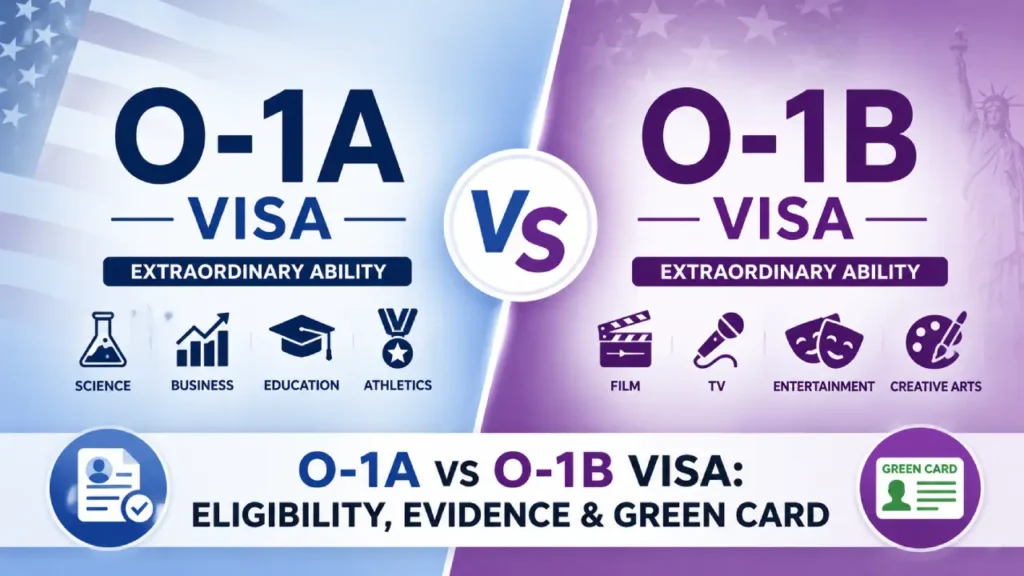
Quick Answer: The O-1A visa is for people with extraordinary ability in science, business, education, or athletics, proven mostly through objective, measurable evidence like awards, publications, and original contributions. The O-1B visa is for extraordinary achievement in the arts (or the higher motion picture/television standard), proven through recognition-based evidence like press coverage, credits, and critical reviews. You file one or the other based on your field and the type of proof you actually have — not personal preference.
Key Takeaways:
- O-1A covers science, business, education, and athletics; O-1B covers the arts, with a tougher bar for motion picture and television work
- Both require 3 of 8 (O-1A) or 3 of 6 (O-1B) regulatory criteria — unless you hold a major, internationally recognized award
- O-1A leans on data — citations, patents, salary, judging; O-1B leans on reputation — press, reviews, lead roles
- Both need a mandatory advisory opinion from a peer group, union, or industry organization before USCIS will approve the petition
- Choosing wrong doesn’t just slow you down — it usually means an RFE or denial, because your evidence won’t map to the criteria USCIS is checking
If you’ve been told you’re “extraordinary” enough for an O-1 but nobody’s explained which flavor of extraordinary you are, you’re not alone. I’ve reviewed petitions where a strong candidate almost filed under the wrong category simply because their attorney or HR team defaulted to whichever one sounded more prestigious. That mistake costs months — USCIS doesn’t let you swap categories mid-review, and a poorly matched evidence packet is one of the most common reasons an O-1 visa expert opinion letter ends up patching holes that should never have existed.
This guide breaks down exactly how O-1A and O-1B differ — in eligibility, evidence, advisory letters, validity, and the path to a green card — so you (or your legal team) can pick the right lane before you start building the case.
What O-1A and O-1B Actually Cover
Both are nonimmigrant work visas for people at the top of their field, and neither has an annual cap or lottery — that part’s identical. Where they split is what kind of top you need to be.
O-1A is built for people whose excellence shows up in outcomes: a biotech founder whose research gets cited, a data scientist whose model becomes an industry benchmark, an Olympic-level athlete, a university researcher with a patent portfolio. USCIS wants to see sustained, measurable impact.
O-1B is built for people whose excellence shows up in recognition: a film composer scoring major releases, a fashion designer covered by trade press, a stage director with a string of acclaimed productions. Here, the case is made through critical acclaim and industry validation rather than metrics.
| Aspect | O-1A | O-1B |
|---|---|---|
| Standard | Extraordinary ability | Extraordinary achievement (distinction) |
| Core fields | Science, education, business, athletics | Arts, motion picture, television |
| Degree required | No | No |
| Annual cap | None | None |
| Evidence style | Objective, data-driven | Reputation and recognition-driven |
O-1A: Who It’s Really For
Researchers, founders, executives, engineers, and physicians fall here most often. The through-line isn’t job title — it’s whether your work produced something USCIS can point to and measure: a publication cited by peers, a company you scaled, an award juried by experts in your field.
O-1B: Who It’s Really For
Actors, musicians, designers, directors, and performers. If your work lives in the arts and your case rests on who noticed you rather than what you produced numerically, you’re almost certainly O-1B. Motion picture and television work sits inside O-1B but is judged against a stricter standard than other arts.
The Legal Standard Each Category Has to Meet
This is where a lot of confusion starts, because both sound similarly impressive on paper.
USCIS evaluates O-1A against whether you’re among the small percentage who have risen to the very top of your field, sustained over time. It’s an analytical read — reviewers are checking whether your evidence adds up to continuous, provable impact.
O-1B asks whether you have distinction: a level of skill and recognition significantly above what’s normal, but the read is more subjective. Two officers can reasonably weigh press coverage differently, which is exactly why the advisory opinion and expert letters matter so much for this category — they anchor a subjective judgment in credible, third-party language.
In my experience, this is the single biggest misunderstanding I see: O-1B isn’t “the easier one.” It’s differently evidenced, not less rigorous.
Eligibility Criteria: 3 of 8 vs 3 of 6
Both categories require satisfying at least three regulatory criteria — unless you hold a major, internationally recognized award (a Nobel Prize, an Oscar, an Olympic medal), which can stand in for meeting the criteria list entirely.
| Criteria Category | O-1A (need 3 of 8) | O-1B (need 3 of 6) |
|---|---|---|
| Awards | Nationally/internationally recognized prizes | Recognition for excellence in the field |
| Membership | Associations requiring outstanding achievement | Rarely a primary criterion |
| Published material about you | Major trade or professional publications | Major publications, critical reviews |
| Judging others’ work | Individually or on a panel | Occasionally, as a peer reviewer |
| Original contributions | Scientific, scholarly, or business contributions of major significance | Less emphasized, but usable |
| Scholarly articles | Authored articles in professional journals | Not a standard criterion |
| Critical/essential role | For a distinguished organization | Lead or starring role for a distinguished organization/production |
| High remuneration | Salary well above peers | Salary or contract terms well above peers |
A founder building an O-1A case might realistically hit judging, original contributions, high remuneration, and critical role — four solid criteria from running and scaling a company. A working actor might hit lead roles, critical reviews, and high remuneration from a single well-reviewed production and its press cycle. The evidence looks completely different, but the bar — three satisfied criteria — is structurally the same.
Evidence Style: Objective Data vs. Reputation
This is the part that trips people up most, because it determines how you build your exhibit binder, not just what you claim.
| Evidence Type | O-1A | O-1B |
|---|---|---|
| Primary proof | Metrics, citations, patents, funding raised | Press, reviews, credits, festival selections |
| Letters of recommendation | From experts who can speak to technical impact | From industry leaders, critics, collaborators |
| Contracts and engagements | Helpful, secondary | Often central to the case |
| Media coverage | Optional but strengthening | Frequently essential |
I’ve seen O-1A petitions get flagged not because the applicant lacked achievement, but because the evidence was framed as reputation (“well respected in the field”) instead of data (“cited 340 times, cross-referenced in three independent research papers”). USCIS officers reviewing O-1A cases are trained to look for numbers. If your strongest proof is qualitative, you may actually have an O-1B case hiding inside what you thought was an O-1A profile — which is exactly the kind of misdiagnosis a proper work experience evaluation or credential review can catch early, before a petition is filed.
The Advisory Opinion: A Requirement Both Categories Share
Neither category gets approved without a written advisory opinion — sometimes called a consultation letter — from a relevant peer group, labor organization, or (for O-1B) union or management organization in the field. This isn’t optional paperwork; USCIS treats a missing or generic advisory opinion as a near-automatic problem.
- O-1A advisory opinions typically come from a professional association or peer body confirming your standing and the legitimacy of your extraordinary ability claim.
- O-1B advisory opinions usually come from an entertainment union or guild, and motion picture/television cases may need input from a management organization too.
A well-written O-1 recommendation letter works alongside — not instead of — this advisory opinion. The advisory opinion confirms your standing to USCIS as a structural requirement; expert letters build the substantive case for why that standing exists.
Where Petitions Actually Fail: Common Mistakes and RFEs
Most O-1A denials or Requests for Evidence trace back to one issue: general, descriptive documentation instead of evidence tied directly to a specific criterion. Saying someone is “a leader in their field” means nothing to an adjudicator; showing the original contribution, the citation count, and an independent expert connecting the two does.
Most O-1B problems trace back to thin press or reputation evidence — a few local reviews instead of recognized trade publications, or credits that don’t clearly establish a lead/critical role.
A pattern I’ve watched repeat across cases:
- Weak O-1A cases bury their strongest data point in a long narrative instead of leading with it under the exact criterion it satisfies
- Weak O-1B cases confuse popularity with distinction — a large social following isn’t the same as critical or industry recognition
- Both frequently underuse the original contribution / critical role criteria because applicants don’t realize founder or leadership work qualifies
If USCIS issues an RFE, it’s asking you to fix exactly one of these gaps — not restart the case. That’s a fixable moment, not a dead end, especially with RFE solutions built to respond directly to the cited deficiency.
Validity, Extensions, and Changing Employers
| Feature | O-1A | O-1B |
|---|---|---|
| Initial validity | Up to 3 years | Up to 3 years |
| Extensions | 1 year at a time, no cap, tied to continued qualifying work | 1 year at a time, no cap |
| Changing employers | New or amended petition required | New or amended petition required |
| Support staff | O-2 (no independent work authorization) | O-2 (no independent work authorization) |
| Dependents | O-3 — may study, cannot work | O-3 — may study, cannot work |
Neither category is officially “dual intent” the way an H-1B is, but pursuing permanent residence alongside an O-1 is common practice and generally tolerated in adjudication.
Cost to Expect in 2026
Filing costs for either category run through Form I-129. As of March 1, 2026, USCIS raised the premium processing fee for O-1 petitions to $2,965 for 15-day expedited adjudication, on top of the standard I-129 base filing fee. Attorney and evidence-preparation costs vary widely by case complexity, but a fully built O-1 petition — including advisory opinion coordination and expert opinion letters — commonly runs several thousand dollars beyond filing fees. Budgeting for a strong evidence packet upfront is almost always cheaper than paying to respond to an RFE later.
O-1 to Green Card: EB-1A and EB-2 NIW
Both categories can lead to permanent residence, but the alignment isn’t identical.
- O-1A holders often transition cleanly into EB-1A (Extraordinary Ability green card), since the underlying evidence — citations, original contributions, judging, high remuneration — overlaps heavily with EB-1A criteria. EB-2 NIW is also a common route for researchers and professionals whose work serves a broader national interest.
- O-1B holders can pursue EB-1A too, but it’s a harder fit unless the artistic distinction is exceptionally well documented; EB-2 NIW applies less often outside specific fields like public-interest arts education or cultural preservation work.
If a green card is the end goal, it’s worth building your O-1 evidence with that transition in mind from day one — an EB-1A recommendation letter or EB-2 NIW expert opinion letter reuses much of the same underlying documentation, so there’s real efficiency in planning both stages together rather than starting from scratch later.
Worked Examples: Two Real-World Profiles
Profile 1 — The Founder (O-1A).
A software engineer who founded a company now generating measurable revenue, holds two patents, and has been invited to judge a regional startup competition. Their case leans on original contributions, judging, and high remuneration — three criteria built almost entirely from business outcomes, no press required.
Profile 2 — The Composer (O-1B).
A film composer with scoring credits on two festival-selected films and reviews in two recognized trade outlets. Their case leans on critical role, published material, and industry recognition — built from reputation and credits rather than metrics.
Neither profile is “more extraordinary” than the other. They’re differently evidenced, and that’s the entire point of choosing correctly before you file.
Which Is Better: O-1A or O-1B?
| Situation | Better Fit |
|---|---|
| Your proof is data, leadership, or research output | O-1A |
| Your proof is press, credits, and industry recognition | O-1B |
| You have strong publications and peer standing | O-1A |
| You have strong reviews and artistic reputation | O-1B |
| Your profile spans both (e.g., a scientist with major media coverage) | Whichever category matches your primary intended U.S. work |
Frequently Asked Questions
Do I need a degree for O-1A or O-1B?
No. Neither category requires a degree. USCIS evaluates accomplishments, awards, and demonstrated expertise — not formal education. That said, a foreign degree or coursework can still support your case as supplementary evidence, which is where a formal academic evaluation becomes useful for establishing U.S. equivalency.
Can I qualify for both O-1A and O-1B at the same time?
No. You file under the category that matches your intended U.S. employment. If your primary role is scientific or business-based, file O-1A; if it’s artistic or entertainment-based, file O-1B. Achievements in an unrelated field can still support the petition as context, but the classification has to match your primary occupation.
How many criteria do I need to satisfy?
O-1A requires 3 of 8 regulatory criteria; O-1B requires 3 of 6 — unless you hold a major, internationally recognized award, which can substitute for the criteria review entirely.
Is media coverage required for either category?
For O-1B, credible press coverage and reviews are frequently essential to establishing distinction. For O-1A, media coverage helps but isn’t required — objective, data-based evidence usually carries more weight.
Can freelancers or self-employed applicants file for an O-1 visa?
Yes, through a U.S. agent who files the petition and includes a detailed itinerary of engagements. This structure is especially common for artists, performers, and independent consultants under O-1B.
How long can I stay in the U.S. on an O-1 visa?
Initial approval runs up to three years, with one-year extensions available indefinitely as long as qualifying work continues under the approved petition.
What happens if my case doesn’t clearly fit one category?
This is more common than most guides admit — a researcher with heavy press coverage, or an artist with measurable commercial metrics, can genuinely look like either category on the surface. In these cases, the deciding factor is the primary nature of your intended U.S. work, and it’s worth having your evidence independently reviewed before you commit to a category, since switching later means starting the advisory opinion process over.
Choosing Correctly the First Time
O-1A and O-1B aren’t a spectrum of “how extraordinary” you are — they’re two different evidentiary frameworks built for two different kinds of excellence. Get the category wrong, and even a genuinely strong applicant can end up with an RFE built around evidence that never matched what USCIS was checking for.
The fastest way to avoid that is to have your evidence mapped against the correct criteria before the petition goes in — not after an RFE lands. Our team builds O-1 expert and advisory letters tailored to whichever category actually fits your record, backed by credential and work experience evaluations that give USCIS the objective documentation both categories are ultimately checking for. Get in touch for a review of your profile before you file — it’s a lot cheaper than fixing a mismatched case later.