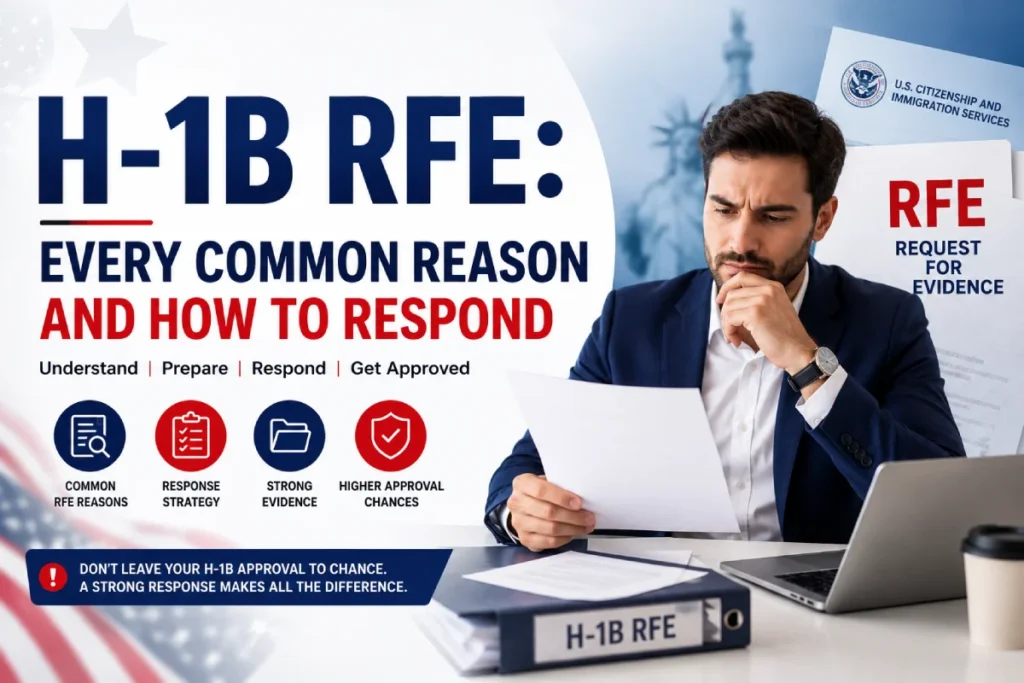
Quick Answer: An H-1B RFE (Request for Evidence) is a formal notice from USCIS asking for additional documentation to support your H-1B petition. The most common triggers are specialty occupation disputes, beneficiary qualification gaps, employer-employee relationship issues, and problems with H-1B extensions. Responding with the right evidence — including credential evaluations and expert opinion letters — is the single most decisive factor in whether your petition gets approved or denied.
If you or your employer just received an H-1B RFE, the first thing to understand is this: it’s not a denial. It’s an opportunity — but only if you respond strategically and completely.
In FY 2025, approximately 9% of H-1B petitions received an RFE, down from the 40%+ rates seen in 2018–2019. The approval rate for petitions that received an RFE and responded was approximately 85.4% — meaning a well-prepared response succeeds the overwhelming majority of the time. The stakes are high, but so is your probability of winning if you know what you’re doing.
This guide covers every major category of H-1B visa RFE, what USCIS is actually questioning in each case, the documents that address each concern, and — critically — the role that credential evaluations and expert opinion letters play in turning an RFE into an approval.

What Is an H-1B RFE?
An H-1B Request for Evidence (RFE) is an official notice issued by U.S. Citizenship and Immigration Services (USCIS) when a submitted H-1B petition does not contain sufficient evidence to approve or deny the case outright. It is not a rejection — it is a request for clarification or additional proof.
USCIS issues RFEs at multiple stages: initial cap petitions, H-1B transfers, H-1B extensions, and amendments. Every time an employer files Form I-129, the petition is open to scrutiny, and an RFE can follow if the adjudicating officer has questions.
⚠️ Critical deadline note: USCIS does not grant extensions on RFE response deadlines. If USCIS does not receive your complete response by the listed date, the agency may consider the petition abandoned or issue a denial based solely on the existing record. Treat the deadline as an absolute.
The RFE notice will specify exactly which issues USCIS needs clarified. Read it carefully with your immigration attorney before preparing any response. A complete, well-organized response that directly addresses every point raised is your only path forward.
The 8 Most Common H-1B RFE Reasons (and How to Respond to Each)
1. Specialty Occupation — The Position Doesn’t Clearly Qualify
This is the most frequent trigger for an H-1B RFE, and it’s the one where the quality of your documentation matters most.
Under U.S. immigration law, an H-1B specialty occupation is defined as a role that requires the theoretical and practical application of highly specialized knowledge, and a minimum of a U.S. bachelor’s degree (or its equivalent) in a directly related specific field. USCIS will issue an RFE when:
- The job title is broad or generic (e.g., “Business Analyst,” “IT Consultant,” “Project Manager”)
- The job description lists duties that don’t clearly require a degree in a specific field
- Industry data suggests the occupation doesn’t uniformly require a bachelor’s degree
- The role description is inconsistent with the Occupational Employment Statistics or O*NET data USCIS uses for reference
What USCIS is really asking: Prove that this specific role — not just the job title — genuinely requires specialized academic knowledge, and that a bachelor’s degree in a defined field is the industry norm for this position.
What to submit in response:
- A detailed, duty-by-duty breakdown of the position, explaining how each responsibility requires specialized theoretical knowledge
- Industry surveys, trade publications, and professional association data showing that a degree in the specific field is standard for comparable roles
- The company’s internal job posting and HR classification policies
- Expert opinion letter from a credentialed industry expert (explained in depth below)
- A manager support letter explaining why the position’s complexity demands degree-level knowledge
A specialty occupation expert opinion letter is particularly powerful here. An independent expert with relevant academic and professional credentials analyzes the position, the company’s industry, and the nature of the duties — and renders a professional opinion that the role meets the H-1B specialty occupation standard. This third-party validation carries significant weight with adjudicators.
💡 Pro tip: Avoid vague language like “performs various IT duties.” Every duty listed in your job description should connect directly to a specific domain of academic knowledge — cybersecurity theory, software architecture principles, financial modeling, etc.
If your H-1B involves a specialty occupation question, AAE Evaluations’ H-1B specialty occupation expert opinion letters are specifically designed to address this category of RFE, written by PhD-qualified professionals who understand how USCIS evaluates position complexity.
2. Beneficiary Qualifications — Your Degree Doesn’t Match the Job
Even when the specialty occupation is clearly established, USCIS may issue a separate RFE challenging whether the beneficiary (the H-1B worker) actually holds the required qualifications. Common triggers include:
- A foreign degree that USCIS cannot independently verify as equivalent to a U.S. bachelor’s degree
- A degree in a field that seems unrelated to the offered position (e.g., mechanical engineering degree for a software developer role)
- A three-year bachelor’s degree from India or the UK, which USCIS may not automatically treat as equivalent to a four-year U.S. bachelor’s
- No degree at all, with the petitioner relying on work experience equivalency under the “three years of specialized experience equals one year of education” standard
What USCIS is really asking: Does this specific person have the academic credentials to perform this specific specialty occupation — and can you prove it?
What to submit in response:
- A foreign credential evaluation report from a qualified evaluator, establishing degree equivalency to a U.S. bachelor’s or higher
- A work experience evaluation if the beneficiary is using professional experience in lieu of a formal degree
- Academic transcripts with certified English translations
- Expert opinion letter that directly addresses how the beneficiary’s educational background qualifies them for this specific role
This is where credential evaluation services and work experience evaluations from AAE Evaluations directly address the RFE. A thorough, well-documented evaluation report provides USCIS with the clear equivalency determination the officer needs to approve the petition.
🔎 Note on three-year degrees: If the beneficiary holds a three-year degree from India, the UK, or another country where three-year programs are standard, USCIS may not automatically treat this as equivalent to a four-year U.S. bachelor’s. An expert evaluation combined with an expert opinion letter explaining the equivalency — through academic content, course structure, and professional standing — is essential in these cases.
AAE Evaluations’ course-by-course evaluation provides the detailed subject-by-subject analysis that USCIS needs when degree equivalency is being contested.
3. Level 1 Wage and Specialty Occupation Contradiction
This is a nuanced but increasingly common RFE trigger. When an employer files an H-1B petition with a Level 1 prevailing wage (the entry-level wage rate on the Labor Condition Application), USCIS may question whether the role is truly a specialty occupation.
The logic USCIS applies: a genuinely complex, specialized role requiring graduate-level knowledge would typically command wages above entry level. If you’re paying an entry-level salary, USCIS may doubt whether the position is actually as specialized as claimed.
What USCIS is really asking: Is the pay scale consistent with the claimed complexity of this specialty occupation?
What to submit in response:
- A detailed explanation from the employer for why the wage is at Level 1 (e.g., candidate is newly graduated, company-specific pay structure, geographic wage variation)
- Industry wage data from the Bureau of Labor Statistics, OFLC wage survey, or equivalent source demonstrating that Level 1 is appropriate for this specific market
- Evidence that the complexity of job duties justifies H-1B status despite the wage level
4. Employer-Employee Relationship Issues (Critical for IT Consulting, Staffing Firms, and Third-Party Placements)
For H-1B petitions where the worker will be placed at a client site, work remotely, or work for a staffing or consulting firm, USCIS scrutinizes whether a genuine employer-employee relationship actually exists.
USCIS requires evidence that the H-1B employer — not the end-client — retains the right to control when, where, and how the beneficiary performs their job duties. This includes control over hiring, supervision, performance reviews, and termination.
What USCIS is really asking: Is the petitioning company actually your employer, or are you effectively working for a third party with no real employment relationship to the petitioner?
What to submit in response:
- Signed employment contracts clearly establishing the employer’s control
- Client Statement of Work (SOW) and master service agreements showing the scope of engagement
- Complete work itinerary for multi-location or multi-client assignments, specifying dates, client names, locations, duties, and supervisory structure
- Organizational charts showing where the H-1B worker falls within the petitioner’s hierarchy
- W-2s, pay stubs, and benefit records (especially critical for H-1B extensions)
- Evidence of employer control: performance reviews, emails assigning work, supervision logs
⚠️ For H-1B extensions at consulting/IT staffing firms: USCIS will closely examine pay stubs showing the H-1B employer as payer, time sheets, and any evidence of supervision. Missing or inconsistent pay documentation is one of the most common reasons extension RFEs escalate to denials.
5. Availability of Work / Speculative Employment
Related to the employer-employee issue, USCIS may issue an RFE if the petition doesn’t demonstrate that real, non-speculative work exists for the entire requested period.
This is especially common for IT consulting firms, project-based work, and situations where the H-1B worker is placed at client sites. USCIS wants to see evidence that there is actual, committed work — not simply a hope that a client will need the worker.
What to submit in response:
- Signed client contracts with start and end dates
- Statements of Work detailing the specific services to be performed
- End-client support letters confirming the engagement and the beneficiary’s role
- Project milestones and work orders if applicable
6. H-1B Extension Issues: The Six-Year Cap and AC21 Eligibility
H-1B status is generally limited to a total of six years (initial three-year period plus one three-year extension). Extensions beyond six years require the beneficiary to qualify under the American Competitiveness in the Twenty-first Century Act (AC21).
USCIS will issue an H-1B extension RFE if:
- The petition doesn’t clearly establish AC21 eligibility
- There is no evidence of an approved I-140 or a pending labor certification that has been filed for 365+ days
- The beneficiary has reached the six-year limit without an approved I-140 or pending PERM
What USCIS is really asking: Does this person legally qualify for an H-1B extension beyond six years?
What to submit in response:
- Copy of approved I-140 immigrant petition, OR
- Evidence that a PERM labor certification was filed with the Department of Labor at least 365 days before the extension period begins, with proof it remains pending
- Entry/exit stamps and trip itineraries to recapture any time spent outside the United States during the H-1B period (time outside the U.S. does not count toward the six-year cap)
- Priority date documentation demonstrating a green card is not yet available
7. LCA (Labor Condition Application) Discrepancies
The Labor Condition Application filed with the Department of Labor must precisely correspond to the I-129 petition in terms of job title, wage level, and work location. When these don’t match — even minor inconsistencies — USCIS may issue an RFE.
Common LCA-related RFE triggers:
- Job title on the LCA differs from the title in the job description
- Work location on the LCA doesn’t match the actual work site
- Wage offered is below the LCA-certified prevailing wage
- The SOC code doesn’t accurately reflect the actual occupation
What to submit in response:
- An approved LCA that accurately matches all petition details
- A clear explanation of any discrepancy with supporting documentation
- If the work location changed, an amended LCA may be required
8. Maintenance of Status and Prior F-1 OPT/CPT Issues
USCIS may issue an RFE if there are questions about whether the beneficiary has maintained lawful status — particularly for individuals who transitioned from F-1 student status to H-1B through Optional Practical Training (OPT) or Curricular Practical Training (CPT).
Triggers include:
- Multiple OPT/CPT authorizations at the same education level
- Gaps in authorized stay
- Questions about whether OPT was properly authorized and used
What to submit in response:
- Complete immigration history documentation
- I-20 forms, EAD cards, and all OPT/CPT authorization records
- Employer letters confirming employment during OPT/CPT periods
- A timeline of status clearly showing maintained lawful presence
The Role of Expert Opinion Letters and Credential Evaluations in H-1B RFE Responses
If you’ve noticed a pattern in the response strategies above, it’s this: for the two most common categories of H-1B RFE — specialty occupation and beneficiary qualifications — expert opinion letters and credential evaluations are not just helpful, they’re often decisive.
What Is an H-1B Expert Opinion Letter?
An H-1B expert opinion letter is a formal document authored by an independent subject matter expert — typically a PhD-qualified professional or senior industry practitioner — that provides a professional analysis supporting one or both of the following:
- The position qualifies as a specialty occupation (analyzing the role, industry standards, and required knowledge)
- The beneficiary holds the requisite qualifications (evaluating educational credentials, work experience, and their applicability to the role)
The letter explains, in technical and regulatory language, why the position meets USCIS’s specialty occupation criteria and/or why the candidate’s background directly qualifies them for the role. It provides the third-party credibility that makes an RFE response persuasive rather than merely assertive.
“A well-written expert opinion letter doesn’t just repeat what’s in the petition — it adds a layer of independent professional analysis that USCIS adjudicators can rely on as objective evidence.”
AAE Evaluations’ H-1B expert opinion letters are authored by PhD professionals who evaluate the specific position, the company’s industry context, and the beneficiary’s academic credentials to build the strongest possible case for specialty occupation qualification.
What Is a Credential Evaluation for H-1B?
A credential evaluation is a formal written assessment, prepared by a qualified credential evaluator, that compares a foreign academic degree to U.S. educational standards. For H-1B purposes, the evaluation establishes that:
- The foreign degree is equivalent to a U.S. bachelor’s degree or higher in a specific field
- The degree field is directly related to the specialty occupation
- If the beneficiary relies on work experience equivalency, the combined education and experience meets the “bachelor’s degree or its equivalent” standard
AAE Evaluations’ academic evaluation services provide the USCIS-recognized credential assessment reports that directly address degree equivalency questions — the kind that arise most often for Indian, UK, and other international beneficiaries whose degree systems differ from the U.S. four-year standard.
For professionals whose formal education doesn’t fully align with the H-1B position but whose work experience fills the gap, AAE Evaluations’ work experience evaluation service documents how professional experience converts to academic equivalency under USCIS standards.
H-1B Extension RFE: What’s Different
Extensions deserve special attention because they carry different evidentiary requirements than initial petitions. By the time an extension is filed, USCIS has an established record — your prior approval — but that prior approval is not binding on future adjudication. Every extension is adjudicated fresh.
For H-1B extension RFEs, USCIS is typically re-examining:
| Issue | Evidence Needed |
|---|---|
| Whether specialty occupation still applies | Updated job description, expert opinion letter |
| Whether employer-employee relationship persists | W-2s, pay stubs, current employment contract |
| AC21 eligibility beyond six years | Approved I-140 or pending PERM documentation |
| Current work availability | Active contracts, SOW, client letters |
| Beneficiary’s maintained status | I-94, entry/exit records, no gaps in status |
The critical mistake many employers make with extensions is assuming prior approval means the extension will sail through. It won’t — especially in periods of heightened USCIS scrutiny. Every extension filing should be treated with the same preparation as an initial petition.
📋 Need a position evaluation for your extension? If USCIS is questioning whether your role still qualifies as a specialty occupation at extension, AAE Evaluations’ position-by-position evaluation can document how the proffered position’s duties compare to industry standards for specialty occupation classification.
How to Respond to an H-1B RFE: Step-by-Step
Responding to an H-1B RFE is a precise, time-sensitive process. Here’s how to approach it:
Step 1: Read the RFE Carefully — All of It
USCIS RFEs can be long and dense. Every issue raised must be addressed. Responding to only part of an RFE — even if every other part of the petition is strong — can result in a denial based on the unaddressed issue.
Step 2: Engage Your Immigration Attorney Immediately
An H-1B RFE response is a legal submission. Your attorney will identify the legal standard USCIS is applying, determine what evidence addresses each concern, and structure the response to address every point in the order USCIS raised it.
Step 3: Identify What Expert Support You Need
Depending on the RFE category, you may need:
- An H-1B specialty occupation expert opinion letter (specialty occupation or beneficiary qualifications)
- A credential evaluation (foreign degree equivalency)
- A work experience evaluation (experience-based qualifications)
Act on this immediately. Credential evaluations and expert opinion letters take time to prepare properly. Order them as soon as you know what the RFE involves — don’t wait until the week before your deadline.
Step 4: Compile All Supporting Documentation
Organize your response to address each RFE issue point by point, with a clear table of contents. USCIS adjudicators review hundreds of petitions. A well-organized, clearly labeled response is more likely to be fully read and properly evaluated.
Step 5: Submit the Complete Response Before the Deadline
Mail or file electronically (depending on your filing method) the complete response — everything in a single packet. Partial responses or follow-up submissions sent after the deadline are generally not accepted.
H-1B RFE Rates by Occupation: What Fields Face the Most Scrutiny?
Not all occupations carry equal risk of an H-1B RFE. USCIS applies heightened scrutiny to roles where:
- The specialty occupation determination is less clear-cut
- Multiple degree fields could potentially qualify for the same role
- The job title is commonly used across both degree-level and non-degree positions
Higher RFE risk occupations include:
- Business analysts and management consultants
- Data analysts (especially without “data scientist” title)
- Marketing and market research roles
- General IT roles with broad or generalist titles
- Finance roles that don’t specify accounting or financial analysis
Lower RFE risk occupations include:
- Software engineers and software developers (well-established specialty occupation precedent)
- Physicians and medical professionals (clear degree requirements)
- Civil, mechanical, and electrical engineers
- Architects
- Accountants (CPA-tracked roles)
If you’re in a higher-scrutiny occupation, front-loading your initial petition with strong supporting evidence — including an expert opinion letter — is far better than waiting to respond to an RFE. An RFE response takes time, adds stress, and delays your start date. A well-built initial petition reduces the chance of receiving one at all.
💼 Working with a sponsoring employer on a new cap petition? Contact AAE Evaluations before filing to have your credentials evaluated and your position analyzed in advance. Proactive documentation dramatically reduces RFE risk.
What Happens If You Don’t Respond to an H-1B RFE?
If USCIS does not receive a response by the deadline specified in the RFE notice, two things typically happen:
- The petition is considered abandoned — treated as if it was never filed, with no refund of filing fees
- USCIS issues a denial based on the record as submitted, without the additional evidence
Either outcome terminates the petition. The employer would need to file a new petition (subject to new fees and, for cap-subject petitions, a new lottery selection). The employee would face a gap in work authorization.
In 2025, USCIS also began issuing RFEs requesting biometrics and home address verification for some H-1B applicants. These must be responded to separately and do not replace the response to any substantive RFE issues.
NOID vs. RFE: Understanding the Difference
While an RFE gives you the opportunity to submit additional evidence, a Notice of Intent to Deny (NOID) is significantly more serious. A NOID means the adjudicating officer has preliminarily concluded that the petition should be denied and is giving the petitioner a final opportunity to respond before that denial is issued.
Key differences:
| RFE | NOID | |
|---|---|---|
| What it means | USCIS needs more information | USCIS plans to deny unless you can change their mind |
| Frequency | More common | Less common, more serious |
| Response strategy | Provide requested evidence | Counter the officer’s specific reasoning with legal argument and evidence |
| Attorney involvement | Strongly recommended | Absolutely essential |
| Expert support value | High | Critical |
If you’ve received a NOID, the response must directly address the officer’s stated reasoning — not just provide general supporting documents. An expert opinion letter written specifically to rebut the officer’s concerns about specialty occupation or beneficiary qualifications is often the pivotal piece of a successful NOID response.
Frequently Asked Questions About H-1B RFEs
What is an H-1B RFE?
An H-1B RFE (Request for Evidence) is a formal notice from USCIS asking for additional documentation to support an H-1B petition. It’s not a denial — it’s an opportunity to provide evidence that resolves the officer’s specific concerns about the petition.
What are the most common reasons for an H-1B RFE?
The most common H-1B RFE reasons are: (1) specialty occupation — the position doesn’t clearly qualify, (2) beneficiary qualifications — the worker’s degree doesn’t match the job, (3) employer-employee relationship issues (particularly for consulting/staffing firms), (4) availability of work concerns, (5) LCA discrepancies, and (6) H-1B extension eligibility beyond six years.
How long do I have to respond to an H-1B RFE?
The response deadline is specified in the RFE notice itself. USCIS does not grant extensions. Failing to respond by the deadline results in abandonment of the petition or denial based on the existing record.
What is a specialty occupation RFE?
A specialty occupation RFE challenges whether the offered position qualifies as an H-1B specialty occupation — meaning whether it genuinely requires at least a bachelor’s degree in a specific field of study. Responding requires detailed documentation of the position’s duties, industry standards, and often an expert opinion letter from a credentialed industry professional.
What is an expert opinion letter for an H-1B RFE?
An H-1B expert opinion letter is a formal document written by an independent expert — typically a PhD or senior industry professional — that provides a professional analysis supporting the specialty occupation status of the position and/or the beneficiary’s qualifications. It provides the third-party credibility that makes an RFE response persuasive.
Do I need a credential evaluation to respond to an H-1B RFE?
If the RFE challenges your foreign degree’s equivalency to a U.S. bachelor’s degree, a credential evaluation from a qualified evaluator is essential. The evaluation formally establishes that your foreign degree meets or exceeds U.S. standards in the relevant field.
What happens to my H-1B if I get an RFE?
Receiving an RFE pauses the adjudication of your petition until you respond. Your current H-1B status (if you’re already in H-1B status) continues while the extension or transfer petition is pending. You have the opportunity to submit a complete response before USCIS makes a final decision.
Can an H-1B extension get an RFE?
Yes. Every H-1B filing — including extensions, transfers, and amendments — can receive an RFE. Extensions are particularly susceptible to scrutiny regarding specialty occupation (is the role the same?), employer-employee relationship (is the employment still real and active?), and AC21 eligibility for extensions beyond six years.
What is an H-1B RFE for an extension beyond six years?
When an H-1B worker has used their initial six-year maximum, an extension beyond that limit requires AC21 eligibility: either an approved I-140 immigrant petition, or a PERM labor certification that has been pending for 365+ days. An RFE in this context typically asks the employer to prove one of these conditions is met.
How do I avoid getting an H-1B RFE?
The best prevention is front-loading the petition with comprehensive supporting documentation: a detailed job description, proof of specialty occupation, credential evaluations for international hires, and — for roles with complex or mixed duties — a proactive expert opinion letter before the petition is even filed.
Get Your H-1B RFE Response Documents from AAE Evaluations
When USCIS issues an H-1B RFE, the quality of your supporting documentation determines the outcome. AAE Evaluations provides the credential evaluations and expert opinion letters that address the most common — and most consequential — categories of H-1B visa RFEs.
Our H-1B services include:
- H-1B Specialty Occupation Expert Opinion Letters — PhD-authored letters addressing specialty occupation requirements and beneficiary qualifications, written specifically to respond to USCIS concerns
- Academic Credential Evaluations — Formal degree equivalency reports for international academic credentials
- Work Experience Evaluations — Professional experience-to-education equivalency assessments for beneficiaries without a directly related degree
- Course-by-Course Evaluations — Subject-level analysis for three-year degree holders or cases requiring detailed academic mapping
- Position Evaluations — Comparison of the proffered H-1B position to industry standards for specialty occupation classification
Time matters when you’re facing an H-1B RFE deadline. Contact AAE Evaluations today to discuss your case and get started on the documentation your response requires. View our evaluation pricing for transparent, upfront costs with no surprises.
Related Resources from AAE Evaluations
Navigating H-1B petitions involves more than just responding to RFEs. These AAE Evaluations resources cover related topics that may be relevant to your case:
- H-1B Expert Opinion Letters — Service Overview
- EB-1 Expert Opinion Letters — For extraordinary ability petitions
- EB-2 NIW Expert Opinion Letters — For national interest waiver petitions
- O-1 Expert and Advisory Letters — For extraordinary ability in arts, business, sciences
- All Evaluation Services — Full service overview
- AAE Evaluations Blog — Immigration insights and updates
This article is for informational purposes only and does not constitute legal advice. For guidance specific to your H-1B petition or RFE situation, consult a qualified immigration attorney.